John Thorn, the official historian for Major League Baseball, explains how America's national pastime has been culturally transformative, even radicalising. He recommends the best books on baseball.
This year the Commissioner of Major League Baseball named you as the official historian of the game, although you started out life far from the centre of America’s national pastime. You were born in a German displaced persons camp to Polish Holocaust survivors. What do the game and the title mean to you?
That baseball is an Americanising mechanism for immigrants is an old story, but for me it was true. When I came here I was only two and a half; I spoke German and Polish. In nursery school I was made fun of for not being able to speak the language. English was not spoken in my household. So I set about trying to learn it by reading the backs of not only cereal boxes but also baseball cards, those magic passports to America.
Now, what does this official historian title mean to me? It’s an honour for sure and it memorialises but I hope does not entomb me. I wrote my first baseball book 37 years ago. So to be an overnight sensation at the age of 63 is somewhat strange. Many people who may not know my work may now pay a little more attention to it. But what’s most meaningful to me about the title of official historian is that I can give back to baseball. I can serve the game in a way that honours the historical profession and be useful to the game that gave me so much, the game that helped me become an American.
It sometimes seems to me that fans make mastering stats and stories about the game a sport in itself. What is so satisfying about become steeped in sports history?
Sports trivia is a diversion. But sports history is different from trivia. There is a man on a bar stool in every taproom in this country that knows something about baseball that I don’t know. However there is no such person in any bar room that knows everything I know. Being able to parrot back how many home runs Duke Snider hit in 1955 does not make you a historian; it makes you a collector of stray statistics. History is an integrative process.
“Sports trivia is a diversion. But sports history is different from trivia.”
There is a competitive aspect to the practice of history. Every historian wants to carve out a little territory in which he is the expert – that’s certainly true of baseball. There are some historians who are great experts on the 1910s. There are others who are experts on the evolution of race and society, as seen through the prism of baseball. My great area of expertise is 19th-century baseball in the era before organised league play.
So how did you break into this world of baseball scholarship?
It was accidental. I came from the world of literature. I started in college as a combined mathematics and English major. But the appeal of statistics, the appeal of history, lore and romance, always held me close to baseball. I thought I was going to be a political editor. I was a magazine editor after graduate school and I wrote a baseball book kind of on the side. It sold well, but my health took a turn for the worse and I thought a wheelchair beckoned. It seemed to me if I had to write and I didn’t have the chops to play in Dicken’s arena, then maybe I could write more baseball books.
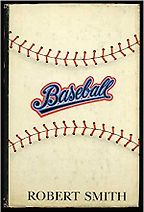
Baseball, the earliest book you name, was published in 1947 by Robert Smith – a novelist and lifelong Red Sox fan. What did Smith accomplish in his single volume that was of such enduring value?
Smith got the stories right. It does not mean that he was a methodical historian. It does not mean that he was a technically gifted historian. But he talked to old ball players. He made friends with baseball players who were – in 1947 – 80 years old. He captured some stories about the game that otherwise would’ve been lost to history; stories that may have strayed from the path of the truth over the years.
But in baseball, legend and apocrypha are important too. When I was working with Ken Burns on the TV documentary Baseball back in the 1990s, we would occasionally come across an anecdote that was entertaining but made me feel obliged, as a historian, to say, ‘Well, that’s something we ought to verify.’ Invariably, the rest of the crew would yell in unison, ‘That fact is too good to be checked.’ I’ve come to feel that although you have to get the stories straight, you also have to respect the enduring legends with a wink.
Robert Smith’s Baseball is a work of history, but you can’t sell history without story and that is Smith’s gift. It has become increasingly rare to tell a story well, rather than simply wield statistics to compare this player to that player, which is the current state of baseball literature to a large extent. Being able to tell a story well was a gift that Smith had in abundance. The 1947 and 1970 editions of the book – which are quite different – are both spellbinding.
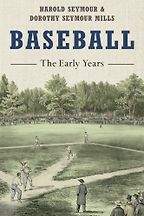
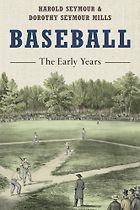
Let’s move on to a mammoth multivolume work: Baseball by Harold Seymour and Dorothy Seymour Mills. By most accounts this is the first scholarly history of baseball ever written. What distinction does it have other than being first on the field?
It is both the first and the best. Seymour wrote a thesis at Cornell – I think it was published in 1956. And the first volume of the Oxford University three-volume series on baseball, The Early Years, which was product of Harold’s collaboration with his wife Dorothy, was based on the thesis. The thesis focused on baseball through 1891 but in his book he went to 1903. The year that the American League and the National League faced each other in a world series for the first time, 1903 is regarded as the launch of baseball’s modern era.
Seymour’s work was brilliant and original in its focus on off-the-field activity. The Seymours showed that baseball was filled with hypocrisy and greed and all of the things that we love about America.
Their work was central in making me a historian of baseball. It helped convince me that having left a doctoral programme in English Literature, in which I was writing a thesis on a 17th-century metaphysical poet named George Herbert, that it might not be such a steep fall into disgrace to go from that to being a baseball writer. That one could write seriously about baseball, not merely tell funny stories. That was the impact of Seymour’s book on me. I think his great contribution was to convince other serious-minded individuals in the years to come that there was a lot left undone.
If someone were to ask me, what should be the first baseball book I should read to understand the history of the game, I would point them to Seymour – and to Lawrence Ritter, another of my choices.
The series was meant to include a fourth volume bringing the history of baseball up to date, but Harold Seymour died of Alzheimer’s before making much headway on it. In fact, his wife Dorothy is believed to be the primary author of the third volume. She worked on the series for 46 years – researching, writing and editing – and yet her husband refused to acknowledge her authorship during his lifetime. Still, Dorothy promotes her husband as ‘the Gibbon of baseball’. On balance, how will both Seymours be remembered?
They were not exactly Ozzie and Harriet. The outdated idea that the wife should be subservient to the husband in all matters, even in professional matters, appears to have had a toxic effect on their collaboration at least. Dorothy has had something of a steep climb to convince scholars such as myself – and I am convinced – that she was a material collaborator and a co-author who deserves full credit.
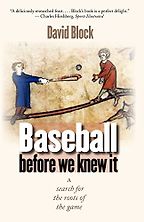
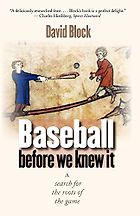
Baseball Before We Knew It also focuses on baseball’s birth. It’s by David Block – a fan and collector who turned his attention to the game’s roots when he retired from his career as a computer systems analyst. What did you learn about baseball’s murky origins from reading Block?
Block picked up where Robert Henderson left off with Ball, Bat and Bishop in 1947. David Block was not a professional writer, this was his first book and it came as a complete surprise – out of left field as we say. He’s a lovely writer, an erudite fellow and a very good friend. But at the time the book came out I didn’t know him at all. He sent me the manuscript and asked me to evaluate it and I was completely stunned. It was a brilliant piece of work. The number of specific finds sprinkled through the work, like diamonds in the dust, is dazzling. For example, it was standard fare for sophisticated baseball folk to say that the game arrived from rounders. David Block demonstrated that the name baseball was far older than rounders – that, if anything, rounders derived from baseball. This may seem a trivial distinction in the wider world and one billion Chinese people don’t care about it, but in our little world this is pretty earthshaking.
Support Five Books
Five Books interviews are expensive to produce. If you're enjoying this interview, please support us by donating a small amount.
David is very systematic and careful in his elucidation of fact. He found a German text by a gymnastic professor named Guts Muths – a 1796 text that had never been translated into English. In it he found the rules and diagrams for baseball. It was a staggering find. Subsequent to publishing the book he discovered a diary in Suffolk from 1755 by a man named William Bray discussing an outing to go to play baseball. Another amazing find. We haven’t heard the last of David.
How does your recent work advance our understanding of baseball’s origins beyond what Block accomplished?
David’s approach was multinational and ancient, first causes. While in my recent book I spend some time in Ancient Egypt and Europe, it is a matter of paragraphs and pages – not whole chapters. I really focus on how the game came to be and rise to prominence in the United States.
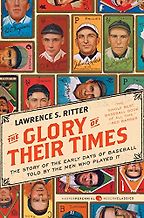
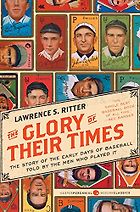
Turning to another fan whose baseball scholarship became a legacy: Lawrence Ritter was a professor of finance who, inspired by the example of blues historian Alan Lomax and galvanised by the death of Ty Cobb, spent five years and travelled 75,000 miles with a 50lb reel-to-reel tape recorder to collect the oral history of baseball’s early greats, in the middle of a successful academic career. Why is The Glory of Their Times regarded as one of the best baseball books of all time?
It is a time machine. You start reading and you are hearing these ballplayers who played in the major leagues between 1890 and 1920. These are men who played alongside Ty Cobb in the outfield, men who were present when Babe Ruth came up to the Red Sox, men who played a key roll in the World Series of 1912. They are speaking to you. You feel as if they were in your living room with you. Hearing from these foundational figures is like listening to an interview with George Washington at Valley Forge.
Larry scoured the country in the age before the internet and ancestry.com to find these players. This was a true labour of love for him. In fact, he gave away the lion’s share of his royalties to the 22 men in the original book and their estates. Larry was an inspiration to me before I knew him. I grew to be his friend, his editor and his collaborator on a number of projects.
His transcriptions of his interviews were more than transcriptions. If he was talking to, say Sam Crawford, and Crawford said something in the third hour of an interview that really belonged in the first hour, Larry stitched it together properly for our enduring reading pleasure. So, while using only the words of the players he interviewed, he transformed sometimes rambling, incoherent audio into brilliant literature.
The tapes that form that basis of the book are now in the Baseball Hall of Fame but the voices of the men that Ritter interviewed can be heard on an audio version of the book. Which do you prefer?
I prefer print, but the audio will blow your hair back. You’ll feel like you are at a seance. These people, long dead, whose moments on the field occurred a century ago, speak to you.
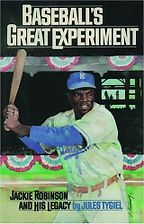
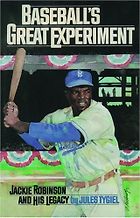
Your final choice, Baseball’s Great Experiment, covers the history of what were called the ‘Negro Leagues’ and how the colour barrier was broken in 1946. It’s part sportsology, part civil rights history. Can you encapsulate what readers learn from Jules Tygiel’s book?
Jules is a PhD. He was a professor. He was every bit as gifted a historian as the Seymours and more formal than Ritter, Block, or Smith. What Jules did was not merely tell the story of Jackie Robinson and that integration: he told the story of prior leagues and prior integrations. He turned baseball so we saw its dark side. We saw the minor leagues, where racism was far more virulent than in the majors. He discussed the shockingly gruesome experiences of integrating each minor league in turn. Many of the heroes of this period never amounted to much as major league players. He gave them their due.
Get the weekly Five Books newsletter
He worked on a broader canvas that portrayed more than just Branch Rickey and Jackie Robinson. Just as it’s convenient for us to just think of baseball’s origins in terms of a single inventor such as Abner Doubleday and Alexander Cartwright, both equally wrong, it’s easy to say Jackie Robinson and Branch Rickey combined to integrate baseball, but there were many other heroes. They were not the only two. Jules tells their story too. It’s his greatest contribution to our understanding of the game.
I understand that Tygiel underscores how the integration of baseball hastened the desegregation of American society. You once blogged that ‘unscripted sport, particularly baseball, is more culturally transformative than staged entertainment’. Can you explain what you mean and why you believe sports fields are such fertile ground for social progress?
We know that Ancient Greek audiences experienced catharsis through attending performances of plays by Aeschylus and Euripides. Sport provides our catharsis. Much of it is ritualised, much of it is repetitive and much of it might be predictable. But because the outcome is unscripted, we are on the edges of our seats. We attach an importance to sport that earlier cultures attributed to tragedies, passion plays and other communal experiences of drama. So when you have something dramatic happen in sport it spills over into real life in a radicalising way.
Five Books aims to keep its book recommendations and interviews up to date. If you are the interviewee and would like to update your choice of books (or even just what you say about them) please email us at editor@fivebooks.com
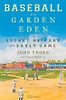
John Thorn, the Official Historian for Major League Baseball, has written dozens of books about the game, including the Total Baseball encyclopedia series. Thorn was the historical consultant for Ken Burn’s Emmy Award-winning documentary Baseball and frequently comments on the game for ESPN. His most recent book is Baseball in the Garden of Eden: The Secret History of the Early Game.
John Thorn, the Official Historian for Major League Baseball, has written dozens of books about the game, including the Total Baseball encyclopedia series. Thorn was the historical consultant for Ken Burn’s Emmy Award-winning documentary Baseball and frequently comments on the game for ESPN. His most recent book is Baseball in the Garden of Eden: The Secret History of the Early Game.