The architectural teacher and writer explores the origins and consequences of urban partition along ethnic lines and selects five books that focus on divided cities such as Jerusalem, Belfast and Beirut
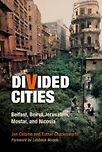
Divided Cities by Esther Charlesworth & Jon Calame
Jon, we’re going to talk about divided cities – a subject you know quite a bit about having written a book by that title yourself. A book which took you several years to research and in which you look at five cities – Belfast, Beirut, Jerusalem, Mostar and Nicosia – where physical barriers have been implemented to keep hostile ethnic communities apart. Could you describe briefly what you were attempting to do in that book?
Ever since World War Two, any observer can see that the nature of warfare in general has changed very quickly from conflict between nations over territory in a ‘winner takes all’ fashion to intra-state conflict and civil war. Conflict of a kind where you have different ethnic groups, different identities, duking it out perhaps over territory but perhaps not; for political control or just to wipe one another out. So what you have is a shift from the piled up corpses being guys in uniforms to something else. If you look at the statistics now for those who have died in war since 1945 you see that a growing majority, a shocking majority of those corpses are civilian non-combatants.
We looked into divided cities not because we had a morbid fascination with these traumatised cities, but because they seemed to be a keyhole through which you could glimpse this larger phenomenon relatively clearly. Of course there’s a whole parallel conversation about cities as their own subject, about urban development and urban decay – which is why I’ve also put Lewis Mumford’s classic book on my list. But I’m talking about actual residents of divided cities. Talking about them as the victims and actors of a broader conflict.
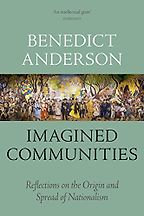
In the bibliography you prepared for me you’ve chosen books which illuminate your subject from several points of view and you’ve characterized them as different voices, starting with Imagined Communities by Benedict Anderson. You call this ‘the expansive voice of the scholar of systems’.
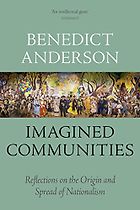
I’d say of all the books the list I gave you, if one of your readers were thinking about just picking up one, this would be it. Anderson created a whole new genre of historiography with this book. He’s just a wonderful guy, still teaching at NYU I guess, who decided in the early eighties to go back and do the archaeology on where nations come from. He didn’t just accept France as France or Britain as Britain. He went back and put dates and names on the origins of these things which we call nations. He talks about how capricious the beginnings often where, how unlikely, and gets under the skin of the whole concept known as nationalism. Now the reason why this book is on my list is that one can’t talk intelligently about the nature of war or civil war unless one grasps how powerful the influence of the nation really is. Everybody thinks love of country is great. It’s great to be patriotic. And to die for your country is of course traditionally considered to be noble. But for your ethnic group or your tribe or, god forbid, for your family – that’s considered to be pretty low brow, a low level affiliation. But here’s Benedict Anderson with his brilliant book and he’s saying essentially that the nation, for which it is noble to die, is a fantasy founded in accident. I called him the ‘expansive voice of the scholar of systems’ because he’s looking at the underlying trestle upon which Britain and France, for example, rest upon.
He’s also saying that the idea of nation and patriotism emerged with the printing press? Simply because even in very small nations one does not meet most of one’s fellow countrymen. One reads about them or watches them on TV.
Exactly. Books are written, newspapers printed, and of course maps drawn. Somebody, at some point, gets out his pencil and the question is always who’s behind that pencil? Which takes us back to the divided city. Who draws the line? In the divided city you always have a line or lines and somebody drew those too. Somebody comes down and fiddles around with the map redistributing identity and territory – and somebody like Anderson is saying, ‘I want to know who was holding that pencil before I get too worked up about what happened after they drew that line.’ So that’s the view that Anderson provides.
Which is, as you say, an expansive, global view. Who would you choose from your list to zoom in on a particular instance of what you’re talking about?
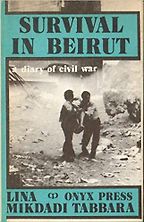
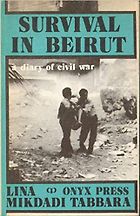
Let’s go to Tabbara’s book, Lina Tabbara, because she’s at the other end of the spectrum – what I call ‘the private voice of the eye-witness’. She’s the woman who consciously decided to stay in Beirut for the entirety of the conflict. Her book is called Survival in Beirut: a Diary of Civil War… It’s expansive in the opposite direction. It gives you the psychological texture of that trauma. And here’s the thing. Anyone in these war-torn cities – anyone with the wherewithal – gets out, if not before the really awful violence starts then very shortly thereafter. Tabbara and her husband were both highly educated professionals; thoughtful, middle class, cosmopolitan Beiruties who ordinarily would have been nowhere near that city by the time the Lebanese army gave up completely on trying to control the warlords that effectively took it over for the best part of fifteen years. But she and her husband stayed. So what you get is this very rare voice telling about daily life in the city during this business, and usually we’re missing these voices, because the kinds of people who would submit their voices to paper in language that people can understand aren’t around. You’d think there’d be lots of them but there are so few I think I can count the number of this kind of book, across all the cities we looked at, on the fingers of one hand.
What was the ethnic configuration of the conflict?
I guess you could say that the more or less Christian Lebanese paramilitaries were pushing back against the PLO. The PLO had set up shop in Beirut after it was kicked out of Jordan by the King of Jordan shortly after 1948. He didn’t want to have to lock horns with Israel despite his sympathies and kinship with the Palestinian cause. So the PLO came to Lebanon and Lebanon gave them a kind of luke-warm welcome as cousins in trouble and then things got a little bit out of hand. So what you had was a well-to-do, essentially aristocratic Christian faction in Lebanon saying ‘we’ve had enough with this PLO stuff. They’re bringing the wrath of Israel into our country. That’s not what we signed up for’. So it was this pan-Arab cause that had their complaint against Israel but no particular squabble with the Lebanese that ended up in a fight with the Lebanese that was much more vicious and bloody than their battle with the Israelis. The Israelis came into the conflict several times taking advantage of moments of weakness or distraction as these others duked it out. Anyhow, it’s terribly complicated.
Of course the reason we were talking about Survival in Beirut was because this was the private voice, the on-the-ground and intimately invested voice of the eye witness – as opposed to the expansive voice of Imagined Communities. Would there be a book balanced between the two?
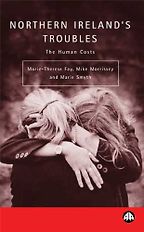
I think so. Imagined Communities, as I’ve already said, is the most enlightening of these books for the general reader, but the book I perhaps admire most is Northern Ireland’s Troubles: the Human Cost. This was written by a team led by Marie Fay and her colleagues in Belfast, and the reason I would go to that one is that these are not super high powered scholars like Anderson. And they also aren’t man-on-the-street voices like Survival in Beirut. They’re practitioners, actually social workers, who spend their whole lives in Northern Ireland watching the city suffer from its partitions – and there are approximately thirty of these so-called ‘peace lines’ – dividing Protestant and Catholic working class neighbourhoods in Belfast.
There are still partitions in spite of the settlement?
They’re still there and they’re growing in number. Belfast has had the greatest progress of all these cities in terms of political progress, and the worst entrenchment of the physical reality of partition. It’s totally weird to me, I can’t explain it. Especially since Belfast, at least on paper, is the most affluent of all these places.
So Marie Fay and her colleagues are speaking with what you call the ‘empathic voice of field-based social workers’.
Yes, so here’s a group of very dedicated professionals who made it their business not simply to lament the ethnic partitions, but decided to walk through every metric they could think of. They made this great decision. They decided not to rant ideologically or at least in ethical terms about what’s wrong with partition. They thought ‘we’re gonna tell you about the incidence of alcohol abuse, drug addiction, domestic violence, unemployment, cardiac arrest, depression etc etc amongst people who live near one of these walls. And sure enough the statistics go through the roof as soon as you get close to one of the lines. So that while all inhabitants of Belfast live from day to day with the weight of this situation what these guys showed was that the cost in terms of health and productivity and all the other economic generators that go with those things go up dramatically as you get closer to these things.
And is it their thesis that the partitions exacerbated existing problems or that these partitions were actually placed along lines of conflict – with all the statistical implications of that – in the first place?
It’s the first. Most definitely the first. And that’s what’s so brilliant about their work. Because they don’t just suggest it they prove it.
You’ve also said that one of the reasons very little statistical work of this kind has been carried out is the reluctance of various governments to thoroughly understand the consequences of their own urban partitions. But what’s your 4th book?
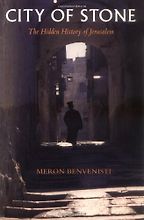
Well now we might go to Meron Benvenisti’s City of Stone: the Hidden History of Jerusalem. Meron is a former deputy mayor of Jerusalem and a scholar of international calibre, but what makes his book so wonderful is that he has not only lived his whole life in Jerusalem, but his father was one of the original extrem socialist kibbutzians – you know in the years before Israel was actually created – with incredibly idealistic notions of what this Israel might be and with visions of how to share power and resources with the Palestinians. Meron came out of this wonderfully intellectual left wing tradition and his whole life, literally, is the history of his country. He was born just a few years before 1948 and in addition he was deputy mayor of Jerusalem through the critical years, the 70’s, when the city was recovering from its partition status. Partition began in 1948 and ended in 1967 with the 6 day war, when Israeli forces surprised everyone and pushed back against the combined Arab forces to take back what they had lost and then some: including Jerusalem which they then departitioned. So here’s Meron with this incredible personal history, this direct insight as a policy maker and politician in Jerusalem, and his specific mandate as deputy mayor was for the Arab population. He was being asked to understand their needs, understand their frustrations, and develop municipal policy accordingly. And he did that brilliantly until he became so jaded by the whole thing that he resumed his career as a scholar without affiliation. He never accepted a permanent university post. His book City of Stone is, in my opinion, the definitive story of modern Jerusalem, not because it takes one side or another side, or even both sides. It’s because of the way it describes how this place which for so many people was so important became such a sink of hatred and violence and ignorance and a refuge for so many hawkish people.
I met an icon painter once in Moscow who told me that Jerusalem was the centre of the world. And I assume that’s why there is so much violence there. Because so many different sorts of people think it’s the centre of their world.
It’s amazing. When you go and you see the squalor inside the walled city of Jerusalem, the most sacred city in the world. When you see the consequences of this incredibly bigoted anti-Arab policy. When you see the filth and the decrepitude of the living conditions of the Arab residents of whom there are fewer and fewer every day, you just can’t believe it. Benvenisti does such an amazing job. He’s the best writer on this list. You couldn’t learn more about this city from a humanistic point of view than by reading Benvenisti’s book.
Benvenisti doesn’t actually think there’s a solution to the problem in Jerusalem or between Israel and the Palestinian state in general. He says what’s needed is a process oriented approach ‘planted firmly in the mud’. What does he mean by that?
Well he rejects the view that there’s any neutral ground in these situations. So anyone who comes in claiming some professional objectivity, saying, ‘I’m a doctor, an engineer, an urban planner’ – fill in the blank – ‘I’m not prejudiced one way or another’. That’s just bullshit. Everybody is assigned a partisan role whether they assign it to themselves or not. So the mud he’s talking about is just the shifting political ground in which any coping strategy must be planted. There’s no soap box that gets you above that. Everybody’s just slogging through the shit. The best you can do is to identify problems as they occur and not let them lead to their worst iterations.
You call Benvenisti the ‘narrative voice of the native scholar’…
Most authors don’t want to be sullied by these problems. They want to talk about them yet remove themselves. That’s why Benvenisti’s book is so amazing and that’s why I say he has this particular voice, as opposed to Donald Horowitz’s Ethnic Groups in Conflict, which is a different sort of book altogether.
‘The mile high voice of the external political scientist’. But his book, like Benvenisti’s, is also published by Berkley University Press.
That’s right, and he also has a lot of important information under his thumb. But just look at the title. I mean Ethnic Groups in Conflict. To look down at so many millions of people, billions, and make them small. The guy’s good. It’s an important book. But I put it on my list because it’s so crucial to remain aware of the problems that arise from the arrogance of that perceived remove. That you can gaze on the situation from a great height. Horowitz is a pretty thoughtful guy but you put him next to Benvenisti and you almost can’t open his book anymore. He’s a top down guy who’s saying that these conflicts, all these conflicts, could have been avoided if somehow, way back, the leadership could have been more honest, or had a broader view, and if the international community had acted more appropriately and energetically to intervene. He talks about the USA and the UN and the Prime Minister of the UK. The problem is that he basically believes that the results are still on the shoulders of these people. I’m the last person to say that irresponsible policy is irrelevant, but there’s so little texture or complexity built into his analysis because he’s so eager to assume that once the sin of omission or commission is committed by the powerful then ethnic conflict was the inevitable bi-product. That’s one way to read it, but it wouldn’t be mine.
What would be your reading?
One of the problems with Horowitz is that, in spite of his subtextual analysis, which is pretty good, he still accepts ethnic conflict as ethnic conflict. I don’t accept ethnic conflict as fundamentally ethnic.
What do you think ethnic conflict is at a more fundamental level?
Well I think it’s usually something much more ordinary, something less exotic. I think if you look carefully, which we tried to do with the five cities we examined, you see unfair allocation of resources. Essentially a Marxist dilemma. You see people of all different ethnicities in the working class who are being mistreated and exploited. And before their grievances can crystallize into a push back against the owners – the owner’s class as I very crudely understand it – they were beaten to the punch by those same owners that were making life disproportionately hard for them. And I think it would be fair to say that the ethnic component was provoked on purpose and by design by the people who stood to lose a lot through a class based confrontation.
So your critique of urban partition is a Marxist critique?
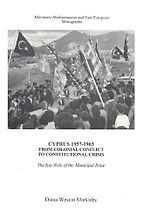
Yes. And it’s not at all original, it’s all borrowed. But what I found most interesting in my research was that [Marxist/economic] reinterpretation of ethnic conflict. And there are people who have spent their whole careers critiquing the ethnic paradigm and doing it very beautifully and thoughtfully. So I’d like to finish up with just two more authors. First Diana Markides, who wrote this wonderful thesis, which landed up becoming a book on the true origins of the Cyprus problem, which are not what they are claimed as being. She’s a Cypriote, born and bred into that world, and a highly trained scholar. Her book is totally obscure. I’m quite positive you couldn’t find it on Amazon, and it’s brilliant. And Morris is something quite different. His book is a survey book of urban form. It would seem to have nothing to do at all with divided cities, except that he shows that cities have always been paranoid, security obsessed places and walls and cities have always gone hand in hand. Not walls within cities of course but walls around cities. That’s the earliest form of city. Morris provides the deep, deep background of how cities have always fundamentally been about a fortress mentality – and there’s just a slight tweak on that to get us to divided cities. And then there’s Markides, the opposite of Morris’s world view, who goes deep, deep, deep into one particular scenario, into one place. Morris’s book is graphically beautiful. It’s just plan after plan of cities from the earliest known archaeological remains of any city anywhere – prehistory – through to the renaissance. When he says urban form that’s exactly what he means. The first city nuclei were castle keeps. As the community was attacked it became tiresome to run inside the keep and so they just decided to just stay inside the walls. So walls and paranoia and security. He doesn’t assess it, he just lets us watch it.
It’s an easy jump, you say, from a wall outside a city to a wall inside a city. So, finally, what has Markides to say about that in the context of modern Cyprus?
Diana Markides is amazing. She chooses to look at something nobody else bothered to look at. It’s right there in the title, Cyprus 1957- 1963: From colonial conflict to constitutional crisis, the key role of the municipal issue. The kind of title that puts you to sleep. But this one’s different. This one’s amazing. Because if you go to the Web or an encyclopaedia and you ask what the ‘Cyprus Problem’ was it’ll probably say, ‘in 1974 the Turkish air force and army invaded Cyprus and ever since then the country has been partitioned along the ‘green line’’. Now anyone worth their salt will say no, it wasn’t in 1974, the beginning was in 1963, because that was when Cyprus failed as a new autonomous constitutional state. The British had to come back in and sort out the pieces. But Markides’ book ends in 1963, and introduces a completely new chapter. She’s placing the beginning of the conflict where it belongs in 1957, because if you really get into the nitty gritty of what went on behind the scenes you will see that it was the manipulation of the British and American governments that created the nucleus of what we call the ‘Cyprus Problem’. The British and Americans wanted their strategic base close to the Middle East, and Markides knows that. That’s the real story and so she goes on to write about the ‘municipal issue’, which is a terribly boring way of referencing the fact that they were going to divide every single city in Cyprus physically between Greek and Turkish Cypriotes, and that they only managed to pull this off in one city, Nicosia. the capital. But they had plans, the British had plans, and they nearly published them but were afraid of rioting. This changes the whole game in terms of Cyprus. Markides found one of these plans in the National Archive in London and what it means is that the British were willing to defend their military bases by full ethnic partition. Because if they had left the Cypriotes alone the Cypriotes would have got on just fine and as soon as they’d had a successful democratic country they would have just politely but firmly evicted the British…
And the British knew in advance that partitioning cities would promote ethnic tension? Is that what Markides is saying? That divide and rule would be the order of the day?
Exactly. It’s the classic strategy and you see it in almost all of the five cities we examine. But here is a Cypriote scholar of enormous talent walking through these steps with the utmost care, and it’s beautiful work. If only people knew more about what her book was actually saying we would perhaps have a very different view of what’s happening in Cyprus today.
May 23, 2009
Five Books aims to keep its book recommendations and interviews up to date. If you are the interviewee and would like to update your choice of books (or even just what you say about them) please email us at [email protected]
Five Books interviews are expensive to produce. If you've enjoyed this interview, please support us by donating a small amount.
Jon Calame
Jon Calame directs "Thermal Efficiency: Eastport”, an affordable heating project in Maine, USA, since 2011. A decade of field-based research is summarized in Divided Cities: Beirut, Belfast, Jerusalem, Mostar and Nicosia (2009). Previously, Mr. Calame was a Rome Prize recipient looking at the legacy of the ghetto system of ethnic segregation, a Fulbright Senior Scholar in Cyprus investigating collaborative urban planning in Nicosia, and a founding member of the Minerva Partners consultancy group.
Jon Calame directs "Thermal Efficiency: Eastport”, an affordable heating project in Maine, USA, since 2011. A decade of field-based research is summarized in Divided Cities: Beirut, Belfast, Jerusalem, Mostar and Nicosia (2009). Previously, Mr. Calame was a Rome Prize recipient looking at the legacy of the ghetto system of ethnic segregation, a Fulbright Senior Scholar in Cyprus investigating collaborative urban planning in Nicosia, and a founding member of the Minerva Partners consultancy group.