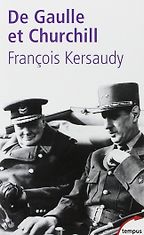
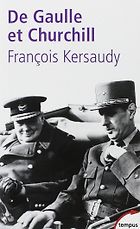
Your first book is about Churchill and de Gaulle, written by François Kersaudy, a professor at the Sorbonne. Do you want to tell me a bit about this relationship and why you chose this book?
The relationship between Churchill and de Gaulle began just before the fall of France, when Churchill went over on two trips to see the French government, trying to get France to stay in the war. Then on 17 June 1940, de Gaulle flew to London and went to see Churchill in the garden at Downing Street. Churchill said: ‘Welcome to London. I will give you the facilities of the BBC.’ And the next day, on 18 June, de Gaulle made his famous call for the French to resist. It was really the first big statement against surrender to the Germans, and one interesting element, which is not often told, is that the British actually tried to veto the speech. They still wanted to try to reach an understanding with the government in France. But eventually de Gaulle got his way and went ahead and did it.
“It was the first big statement against surrender to the Germans, and one interesting element, which is not often told, is that the British actually tried to veto the speech.”
Kersaudy charts the relationship thereafter between Churchill and de Gaulle which was one of the more extraordinary relationships ever between any wartime leaders, then or since. Churchill identified de Gaulle as the man who would represent France – although the British went on for some time trying to find other people.
Why?
Because he was just a little-known Brigadier-General, a junior minister. De Gaulle depended on Churchill’s help because he had nothing when he came to London. So there’s a mutual respect between them. But they were two very strong-willed people, so they kept having the most tumultuous rows all through the war, and Kersaudy charts that. It’s a very well-based book in terms of the documentation and the evidence. I
n a very serious historical way it recounts the often volcanic relationship between the two men. At one point Harold Nicholson says to Churchill: ‘De Gaulle is a great man,’ and Churchill replies: ‘No he’s not, he’s impossible, he’s unbearable,’ and goes on and on denouncing de Gaulle. But then, at the end, he says: ‘Hmm, you’re right – he is a great man.’
“The Resistance in France is this iconic, emblematic moment in French history. But at the same time there’s the uncomfortable fact that most French people did not belong to the Resistance.”
When they had had one of their biggest rows – at the Casablanca conference – Churchill watched de Gaulle leaving his villa and said: ‘There he is, the representative of a defeated nation. But he acts as if he had as many armies as Stalin, the last of a great warrior race.’ So Churchill had this kind of human admiration for de Gaulle. De Gaulle, throughout the war, stood up for French interests, and that often got him on the wrong side of Churchill.
In part it was also because Roosevelt disliked de Gaulle a great deal. He thought de Gaulle was a kind of crypto-fascist dictator. He put pressure on Churchill to drop de Gaulle and Churchill sometimes gave way to this, because he wanted to keep in Roosevelt’s good books. So it was always a testy relationship, but in the end a very important one.
Why did Churchill take so much to de Gaulle in the first place? Why did he decide that this was the man?
Because in June 1940 he made these two trips to France, once to a place near Orléans and once to Tours. The French government had left Paris and was fleeing down to the south of France as the Germans advanced. The Prime Minister Reynaud wanted to go on fighting, but an increasing number of his government didn’t, and he was struggling to hold things together. In the circumstances, it was de Gaulle, who was his defence minister and his deputy, who was the one person who said, ‘We must go on fighting, we must not surrender. If we are defeated in France we must go to North Africa or wherever and keep going.’
There is this line in Churchill’s memoirs about the second of these meetings in Tours. De Gaulle hadn’t been invited but he heard about it, and hurried and got there. As they passed, Churchill said of de Gaulle: ‘Ah, l’homme du destin.’ I’m not sure – that may have been a bit of Churchill rewriting history later on – but he saw de Gaulle as this great man. But then de Gaulle would, of course, stand up to Churchill and that infuriated him.
So they were always having tremendous rows…
Yes. On one occasion de Gaulle had gone over and established the Free French in West Africa, and he made a lot of anti-British statements while he was there. And he came back to London and Churchill was absolutely incandescent with him. He called him around to Downing Street and Churchill rehearsed how he was going to humiliate de Gaulle before the meeting with his private secretary, John Colville, who was going to act as interpreter. And Colville found interpretation absolutely impossible because Churchill corrected him the whole time to be as insulting as possible. So Colville left and a Foreign Office interpreter came in, and he left the room after five minutes saying, ‘Those two men are completely mad.’ So Colville waited outside, wondering, ‘Are they killing each other?’ And after a decent amount of time he pushed the door open and looked in, and they were sitting beside each other in armchairs smoking cigars.
Also, the morning of D-Day at about one in the morning, Churchill gave an order that de Gaulle, who was being very obstreperous as the British saw it – he was standing up for French interests – should be flown out of Britain in chains if necessary. His secretary did not act or pass on that order.
The Kersaudy book is a serious, sober account of that relationship, but it’s got all that material in it.
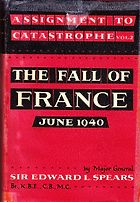
Let’s go on to the Edward Spears book, Assignment to Catastrophe. Could you explain who he was?
Edward Spears was a friend of Churchill’s. He was a British general, and Churchill sent him to France in the summer of 1940 to be his personal representative to the French government. Spears witnessed the whole of the collapse of France, and of the French government, of Reynaud losing power, of Pétain taking over – and his account of that in this book is absolutely wonderful. Some people say it’s a somewhat coloured account, but it’s grand politics, it’s debacle, it’s disaster.
Spears has a tremendous eye for the little details: for instance, this image of Pierre Laval, a politician who became a leading collaborator with Pétain, sitting in a restaurant in Bordeaux tucking into these enormous meals, waiting for his moment to come. He also has this wonderful portrait of the French Prime Minster Reynaud’s mistress – Hélène de Portes – who was a great friend of the German ambassador. She is constantly urging Reynaud to surrender, as they’re going down through France, staying in châteaux. She bustles through the corridors casting poisoned looks at everyone else – she is an extraordinary figure – small and squat and apparently she didn’t wash very much.
The book is almost like a gossip column, but at this great tragic moment. Spears’s account of how he flew de Gaulle out to London on 17 June is that de Gaulle was afraid of being arrested and possibly shot and so begged Spears to be flown out. And they set up a subterfuge at the airport and de Gaulle went to say goodbye to Spears and was pulled on the plane at the last minute. Of course the Gaullist account has a much more dignified exit…
Does the book reveal anything unusual or unexpected about the fall of France?
It’s probably better than any single French account. It’s just an absolute close-up of the Third Republic, the decay, the falling to bits. A lot of it is happening in these châteaux, the foreign ministry in Paris before they leave, the staff burning all the documents in the garden. It’s just a wonderfully vivid account. It’s quite long, and there’s quite a lot of bits of it which someone who is not familiar with the French politics of the time might want to skip over…
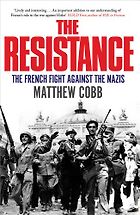
What about your next book, Matthew Cobb on The Resistance?
The Resistance in France is this iconic, emblematic moment in French history – but at the same time there’s the uncomfortable fact that most French people did not belong to the Resistance. They weren’t necessarily active collaborators, but a lot of them were just waiting for the war to be over. So it is still quite a touchy political subject in France. Particularly at the end of the war, there were a lot of unjudicial killings by members of the Resistance of people who had been collaborators or were suspected of being collaborators.
As a result, some right-wing revisionist historians have painted the Resistance as being a violent and Communist-dominated movement – whereas other people, like my wife’s family in France, who were in the Resistance, if you said a word against the Resistance, the whole dinner party ended, as it were. It’s still quite a live thing. Cobb is a very judicious guide to all that – and it’s got tremendous detail and descriptive material in it too.
He’s managed to be fair?
There is so much written about the Resistance, that you can never capture it all, but I think this book is very fair. At the same time, of course, the danger of writing a book that is very fair is that you’re endlessly saying ‘on the one hand, on the other…’ He doesn’t shortchange the shortcomings of the Resistance, but it was a good thing, and there is no doubt it was a good thing. The irony of it all is that, initially, the Resistance set up inside France without much reference to de Gaulle…
Your next choice is a film, Army of Shadows, directed by Jean-Pierre Melville. He was himself in the Resistance, but is it quite a negative portrayal?
It’s not negative – but it captures what a difficult, extremely dangerous and often hand-to-mouth thing the Resistance was, how survival was a matter of chance often. It’s a real-life Resistance film in a sense. He doesn’t glamorise it, he doesn’t downplay heroism, but it’s heroism on a human scale.
It was one of the first movies where you can really feel and empathise with the main characters – it’s brilliantly acted. It also shows up the loyalties and the disloyalties and all the uncertain currents that were around in France, who could you trust, who couldn’t you trust, and so on.
In the film they end up killing each other and not just the Germans?
Yes, they make mistakes, they get things wrong. Towards the end, the different groups don’t know what they’re doing, and so on; it all gets confused. In that sense it’s a very real-life film. One forgets, talking about the Resistance, the extent to which things were often a matter of chance. My wife, for instance, who is Jewish, wouldn’t be here today if, when the police came around to get her and her mother, and the keys were in the door, the neighbour hadn’t said: ‘Oh, they’ve run away.’ And the police said: ‘Why are the keys here then?’ And she said: ‘Oh, you know these Jews, they always run away and forget something.’ And the police went away, and they escaped.
Why were the keys in the door?
I think my mother-in-law had run into the flat when she saw the police and left the keys in the door. My wife was a baby, but she says she remembers her mother stuffing her fist into her mouth, to say to her, don’t cry. The police came and knocked on the door and the neighbour saved them. But, on the other hand, my wife’s aunt was denounced by the concierge who made off with the silver. In the Jewish round-ups it was a question, the whole time, of which road you took. Another cousin of my wife’s who was a big Resistance figure down the Loire said you couldn’t think that much often. You took precautions, as much as you could, but so much was chance. It’s easy now for the British to look down on the French and say, ‘Oh, they collaborated – we would have kicked the Germans back into the sea.’ But life was not very simple.
Melville is also one of the great directors of our time.
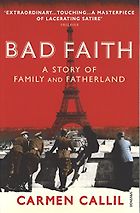
Tell me about Bad Faith.
Carmen Callil is a publisher and writer and she found out that somebody she knew was related to this man who at the time was the Vichy Commissioner for Jewish Affairs, an absolutely awful man in every way – not just in his anti-Semitism, but in his private life and everything else. Actually, there’s a lot in the book about the person Callil knew – the guilt and the family story afterwards. But the elements in it about collaboration and how the collaborators – and a very unpleasant collaborator in particular – lived, that kind of existence, are very vivid and very graphic and very moving.
Get the weekly Five Books newsletter
Because again the whole collaboration side has been swept under the carpet in France. Obviously de Gaulle swept a lot of it under the carpet immediately after the war. It took time to come out, bit by bit. Even Mitterrand, when he was president, from 1981 to 1995, he protected the Vichy police chief, René Bousque. Bousque was a great friend of Mitterrand’s – but he was the man who actually staged the Jewish round-up in Paris in 1942. This man became a deputy after the war, he was the director of a newspaper, he got the Legion d’Honneur. He was assassinated in the end – though not because of the war. But the whole collaboration thing was something people didn’t talk about very much in France.
So has France now come to terms with what happened during those years?
De Gaulle’s line, when he reasserted the state in 1944, was that Vichy, and everything done under Vichy, had been illegitimate, so it didn’t exist. He had had the state with him in London. And when Pétain and Laval were tried after the war, the whole anti-Semitic thing, and the Holocaust, was not mentioned at the trial. It was all about the armistice of 1940, how they’d betrayed France by making peace with the Germans. Through the 1950s and 1960s it was not talked about. The French most certainly hadn’t come to terms with it – Mitterrand keeping up this friendship with Bousque who was absolutely terrible. Jacques Chirac was the first President who said: ‘Yes, look, we have to face the fact that we were part of the Holocaust, and what the collaborators did.’
For all his faults, Chirac was the person who really came forward and said that. For a long time, at the Gare d’Austerlitz – from which a lot of Jews were transported to Auschwitz – there was just one little tiny plaque, where you could see that this had happened. Under Chirac there was much more, there’s a memorial; there’s much more awareness recently. But then, you’ve got a new twist: the relationship between second-generation North African Arab immigrants, who are Muslims and Jews in France and you get flare-ups between them. It’s a very uneasy part of French history, still.
Why?
It was the combination of the collapse and defeat in 1940. People would say: ‘Oh, it’s overdone, Britain would have collapsed too.’ But Britain didn’t actually, there was a difference. Not just the French army was defeated. The amazing thing is the French actually had more planes and tanks than the Germans – and bigger and heavier tanks. They were just hopeless at their tactics and how they used them. It was a complete collapse of morale by the army and by millions and millions of civilians who just fled. The refugee floods along the roads just blocked everything up.
It was like the collapse of a nation, in 1940, of the Third Republic system, which had really given people nothing to fight for at all. There’s this feeling that France imploded and then you have the Jewish persecution on top of that – and the collaboration. There were quite extreme cases of collaboration, particularly towards the end of the war. All this is something that France has found very difficult to get to grips with.
And how does de Gaulle come out of all of this?
At a press conference after the Six Day War, he spoke of Israel and the Jews as a dominating, sure-of-themselves people. That appeared to be anti-Semitic but for de Gaulle that was probably actually praise – he liked dominating people who were sure of themselves. He had a bit of a cloth ear about this kind of thing, so he was genuinely surprised by the reaction that it aroused. It was still a very live issue. Then you had heavy French support for Israel earlier on, and supply of weapons – Mirage planes to Israel. You had a definite link through Algeria, because a lot of the Algerian settlers who were Jewish were very anti-Arab, anti-independence. I just wrote a piece for the Jewish Chronicle here, ‘Was de Gaulle anti-Semitic?’ And the answer is no, but you could make the case…
“There’s this feeling that France imploded and then you have the Jewish persecution on top of that – and the collaboration.”
He never said anything about the Jews in World War II or apologised. There were various attacks on the horrible ideology of Nazism, but for de Gaulle – and this was his world view – this was part of the ongoing struggle between France and Germany. Several times, in conservation with Churchill, he would say: ‘It is Germany, it is the German people who are our enemy – they are always France’s enemy.’ He very rarely said the Nazis and I don’t know of any reference to the Holocaust that I found in de Gaulle.
Five Books aims to keep its book recommendations and interviews up to date. If you are the interviewee and would like to update your choice of books (or even just what you say about them) please email us at [email protected]
Five Books interviews are expensive to produce. If you've enjoyed this interview, please support us by donating a small amount.