We’re discussing your picks for the best happiness books (other than your own book, The Happiness Hypothesis, which has been highly recommended by experts on this site and I also loved reading.) Tell me why you started by recommending the sayings of the Buddha.
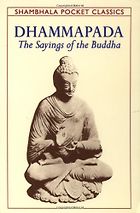
The Dhammapada is one of the greatest psychological works ever written, and certainly one of the greatest before 1900. It is masterful in its understanding of the nature of consciousness, and in particular the way we are always striving and never satisfied. You can turn to it – and people have turned to it throughout the ages – at times of trouble, at times of disappointment, at times of loss, and it takes you out of yourself. It shows you that your problems, your feelings, are just timeless manifestations of the human condition. It also gives specific recommendations for how to deal with those problems, which is to let go, to accept, and to work on yourself. So I think this is a kind of tonic that we ambitious Westerners often need to hear.
Is there a specific saying that you particularly like?
There are two big ideas that I found especially useful when I wrote The Happiness Hypothesis. One is an idea common to most great intellectual traditions. The quote is: ‘All that we are arises with our thoughts, with our thoughts we make the world.’ It’s not unique to Buddha, but it is one of the earliest statements of that idea, that we need to focus on changing our thoughts, rather than making the world conform to our wishes.
The other big idea is that the mind is like a rider on an elephant. Buddha uses this metaphor: ‘My own mind used to wander wherever pleasure or desire or lust led it, but now I have it tamed, I guide it, as the keeper guides the wild elephant.’ That’s the most important idea in The Happiness Hypothesis – I just adapted the metaphor slightly. What modern psychology shows us is that our minds are like a small rider on the back of an elephant: the rider doesn’t have that much control even though he thinks that he does.
And once you accept that you are much closer to understanding happiness?
Exactly, because it helps explain why you can’t just resolve to be happy. You can’t just resolve to quit drinking, you can’t resolve to stop and smell the flowers – because the rider does the resolving but it’s the elephant that does the behaving. Once you understand the limitations of your psychology and how hard it is to change yourself, you become much more tolerant of others, because you realise how difficult it is to change anyone…
Let’s go on to the next of your list of happiness books, which is actually a book about ambition.
Gilbert Brim is possibly the wisest person I’ve ever met face to face. I interviewed him for a report I did for the MacArthur Foundation in 1994. He was running a research network on midlife, on the psychology of people in their 40s, 50s and 60s, and he had written this wonderful book called Ambition – How We Manage Success and Failure Throughout our Lives. In it, he brought together research as well as his own insights that he had collected in his own 75 or so years. It fits very well with Buddha because Brim recognises that our basic psychology is one of striving. When we get what we hoped for, we don’t celebrate for more than a minute – or a day at most. Right away we ratchet up our expectations, and move on to the next goal. Which is why we’re never really satisfied. The book is about how to be a Westerner who is going to strive, who is going to get great pleasure from work. It’s about how to violate the advice of the Buddha, while still respecting the psychology that the Buddha told us about. Brim has this phrase that I’ve never forgotten: he advises us to live life ‘at the level of just manageable difficulty’. So, if you live life at 50 per cent of your capacity, you’ll be bored and disengaged; if you live it at 100 per cent of your capacity, you’re going to be burned out, but if you live at about 85 per cent on average, with some fluctuations, that’s about the best you can do.
So he’s disagreeing with Buddha?
Let’s say that if the Buddha had been born in the Midwest of the US he would have written Brim’s book. Brim has a Midwesterner’s work ethic, and Americans moralise work quite a lot…so Brim says don’t drop out of the game, play it, but play it so you don’t get trapped, play it wisely, so that you get to enjoy the fruits of your labour.
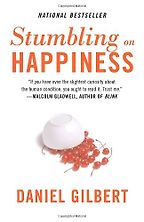
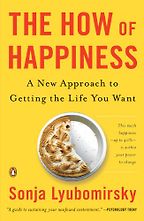
We’re on to book numbers 3 and 4 of your list of happiness books next. You wanted to talk about Daniel Gilbert’s Stumbling on Happiness, and Sonja Lyubomirsky’s The How of Happiness.
These are two books on positive psychology by two of the top researchers. They are very different books and they appeal to very different readers. The Gilbert book is just so much fun to read. He’s one of the funniest people, certainly in psychology – he’s just endlessly witty, and reading it is like strapping yourself into a roller coaster. He’s describing very good research that he’s done along with my colleague here at the University of Virginia, Tim Wilson. It’s a single big idea that is very, very important, which is that we make a lot of errors in our expectations of what will make us happy, and therefore we make a lot of errors in our choices.
What’s a common mistake that people make?
One of the things Gilbert looks at is consumer behaviour – for example, he was involved in a study where they asked people if they would want to be able to return a product or not. And of course most people would like the option of being able to return a television that they had bought. But those who elected for that option actually then enjoyed their product less – they were less committed to it.
This is the idea that you don’t want too many options?
I think Americans in particular think they want a lot of options – but once you get above a small number, it actually cuts down on our enjoyment. That work was done especially by Barry Schwartz, in his book The Paradox of Choice: Why More is Less. That is just such a good book…if I’d had six books, I would have included that one. But the main point that Gilbert is making is that in so many of our choices – in work, in love and consumer behaviour – the things we think we want before we make the choice, lead us to choices that make us worse off…
And The How of Happiness is more of a self-help book?
The How of Happiness I would describe as the state of the art in evidence-based positive psychology. Sonja Lyubomirsky has done the best studies on how simple interventions, simple things you can do, on a daily or weekly basis, have measurable effects on your happiness. So if your goal is to actually raise your happiness level, then this is the best book to read – it has very concrete suggestions of what you can do.
Can you give an example?
One example is that doing good deeds for others does raise your happiness – but not if you try to do it every day. If you do it every day, it can get kind of tedious, it can make you resent people. So she found that assigning people to do one or two good deeds a week is more effective than doing it every day.
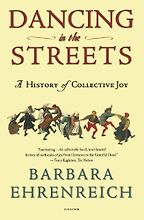
On to the last of your list of books on happiness, Dancing in The Streets. Tell me how this book fits in.
This is one of the most original and interesting books I’ve read in the last five years. Barbara Ehrenreich had written a book on war and got intrigued by the rituals and the group cohesion that results from war. So she wrote her next book on this human capacity and even need for group cohesion. What she found is that just about every society, at the time of Western contact, had some way of altering their bodies, and dancing around a fire or totemic object to some sort of rhythmic beat, music or a drum. Almost every traditional society had ways of using motion and music to bind themselves together and to achieve states of collective ecstasy. Europeans were generally disgusted by this, and tried to stamp it out as best they could. She shows how Christianity used to be a danced religion, but in the middle ages that got stamped out too. And what we’re left with is this rather dry and puritanical fear of ecstasy and loss of control.
Get the weekly Five Books newsletter
The reason I have found this book so wise is that I am interested in the possibility that human beings are products of group level selection. That’s the idea that we evolved in part by groups competing with other groups. I’ve come to believe that we have a variety of mechanisms in our minds that allow us to temporarily become like bees in a hive, and these experiences of collective merger are among our most prized and important experiences. Ehrenreich’s book gives a full account, looking at the history, the anthropology and the psychology, of why this is true.
When you read this book, you feel as though you have discovered additional rooms in your mind, or in your heart, that are almost never used. It helps explain things like the rave phenomenon, and it can help explain silly things like line dances – why we like to move in synchrony so much.
But aren’t we moving further away from this, just sitting behind our computers all day long?
Yes – but most likely we will soon find ways to move in synchrony through our computers. One of Ehrenreich’s points is that there is an eternal battle between Apollo and Dionysus – as Nietzsche put it – the Apollonian spirit of order and the Dionysian spirit of revelry and collective ecstasy. Even though Apollo has gotten the upper hand in the West, you can’t stamp Dionysus out completely.
Five Books aims to keep its book recommendations and interviews up to date. If you are the interviewee and would like to update your choice of books (or even just what you say about them) please email us at [email protected]
Five Books interviews are expensive to produce. If you've enjoyed this interview, please support us by donating a small amount.