It’s dirty, grubby and doubting. And us at our most real. The lexicographer takes us inside the world of “rough, truthful language” from rhyming slang and cant to the streets of Baltimore and an etymology of the f-word
Before we look at your book selection, could you tell us what slang is?
Slang is difficult because everything about it defies simple classification. Nobody knows the etymology of the word slang. If you take slang to a linguist they try to define it within the boundaries of what they know as linguists, and very soon they discover they can’t find a specific register into which it falls.
I see slang as the counter-language. At its heart it’s down, it’s dirty, it’s grubby, it’s tart, it’s essentially subversive. It questions and deals with themes like sex, drugs, violence, rudeness, abuse, racism and so on and so forth. Slang is primarily concrete, but the one abstract that underpins it is that of doubt. It seems to me that slang is always doubting. It’s always questioning, it’s always cynical, it’s always undermining and it’s always been negative. It’s very thematic, which means it’s basically a lexicon of synonyms. There are 1,500 synonyms for having sex, 1,000 penises, 1,000 vaginas and 2,000 drunkards and drink-related words… and so on.
I see slang as Freud would see the Id. In other words, the unrestrained side of ourselves. Slang is the pleasure principle. It evokes it in language, lets us get it out there. It has no morals, it has no party, it has no religion, it’s just in it for the kicks. What I love most about it is that it is ourselves at our most human – not at our best, but at our most real. There’s a nice line in Trollope’s The Eustace Diamonds about someone moving from conventional speech to rough, truthful language. That’s what I think slang is – rough, truthful language.
You started your professional life writing for the underground press, and then books on the counterculture in the 1960s. How did you end up specialising in slang?
I had always enjoyed looking at slang dictionaries and books that had slang in them. In 1981, when my first slang dictionary was commissioned, I saw that not only did this subject interest me but that there was also a gap in the market. The great slang lexicographer Eric Partridge had died a couple of years earlier. In 1937 he had written the hugely influential DictionaryofSlangandUnconventionalEnglish and that had gone through a number of editions. But when Partridge talked about English, he meant English English and not American. By the late 1970s, when it was still being published, it was absurd that it did not include any American slang. Partridge also just didn’t get the 20th century. He certainly didn’t get teenagers, drugs and the counterculture. I thought: I know about that stuff, I’m younger, I shall have a try.
What is your working life like as a slang lexicographer? What are the tools of your trade?
The tools of my trade are the books that sit on my shelves and those that I research elsewhere. There are the many works of my predecessors, who started off in 1530. I have books on slang from Britain, I have shelves of Australia-related slang as well as American stuff and black American slang. It is impossible to be a lexicographer without a degree of plagiarism. However, to steal from one book is plagiarism; to steal from many – and I steal from many – is research. But I don’t see it as stealing. The point is that language is not fresh and new, and this is as true for the Oxford English Dictionary or for Dr Johnson as it is for me. Language does not pop up all shiny and new each time a lexicographer signs a contract to write a dictionary. You have to make sure you include everything that has come before you.
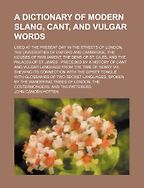
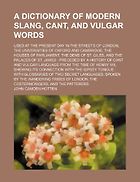
Let’s turn to your first book, Jon Camden Hotten’s A Dictionary of Modern Slang, Cant and Vulgar Words. This was first published in 1859 – why is it still relevant today?
Hotten is the first slang lexicographer to come up with a considered treatment of the history of slang and indeed of cant, or criminal slang. He also offers a history of back slang and rhyming slang. His is a substantial bibliography, which no one had done before him. No-one had ever written about slang in the way that Hotten did. His definition of slang is one of the best there is:
“Slang represents that evanescent, vulgar language, ever changing with fashion and taste, … spoken by persons in every grade of life, rich and poor, honest and dishonest … Slang is indulged in from a desire to appear familiar with life, gaiety, town-humour and with the transient nick names and street jokes of the day … Slang is the language of street humour, of fast, high and low life … Slang is as old as speech and the congregating together of people in cities. It is the result of crowding, and excitement, and artificial life. It is often full of the most pungent satire, and is always to the point. Without point Slang has no raison d’etre.”
If you want to find the starting point at which to look at slang, rhyming slang, back slang and a variety of other sub-sets, plus a very good assessment of what was available in terms of slang lexicography in 1859, then Hotten’s your man.
Hotten was a colourful character. What more can you tell us about him?
He had a shop on Piccadilly where the Ritz Hotel now stands. He was a publisher. He was a bit of a plagiarist, or more of a pirate really. He published authors like Mark Twain. Of course, there was no copyright then. There was also his “flower garden”, which was pornography. Some say the pornography kept his business going. Others disagree. We don’t really know the answer. In all he produced about a million and a half physical books in the last 10 years of his publishing life, which ended in 1873. His firm was bought by his assistant Andrew Chatto and eventually became the firm Chatto & Windus, which exists today.
There is some mystery surrounding his cause of death. Some said brain fever, others claimed a surfeit of pork chops.
One person came up with the line, after it was suggested that he died from a surfeit of pork chops, that this was proof that cannibalism was not a good idea. The joke being that he was pig and ended up eating himself. Others were more generous, saying he was a workaholic, helped authors and never made much money.
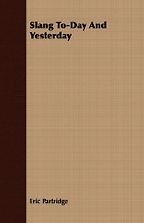
Moving on to your second book, Eric Partridge’s Slang To-day and Yesterday which was published in 1933.
Eric Partridge was the leading English language slang lexicographer of the 20th century. His DictionaryofSlangandUnconventionalEnglish appeared in 1937 and editions continued to appear until the posthumous edition of 1984.
Partridge cut his lexicographical teeth in 1933, when he published this history of slang, Slang To-Day and Yesterday. This book is not just his own first essay into the subject, but also the first attempt at slang lexicology since John Camden Hotten’s comprehensive history and explanation of slang appeared in 1859.
Support Five Books
Five Books interviews are expensive to produce. If you're enjoying this interview, please support us by donating a small amount.
Partridge begins by offering a discussion of the linguistic phenomenon that is slang. Then he puts forward his own opinion on the etymology of the word “slang”, and suggests what constitutes a slang word – he gives 17 qualifications – as opposed to a colloquial or standard English one. He follows these theoretical chapters by a succession of chronological ones, in which he lays out both the major slang lexicographers from the 16th century onwards and the authors who up until the date of his writing had made the greatest contribution to the recording of slang vocabulary.
For me, of course, Partridge is the great mentor. I may not agree with everything he did, and as his successor I have naturally tried to improve on his foundations. But without his example I would have never even considered that slang was something to which I could enthusiastically devote my professional life.
His work was very much informed by his World War One experiences, and there is a lot of military slang in his book.
Yes, there is a lot of military slang. Partridge was a young man in New Zealand on a sheep farm, went to university there, and came to Europe like a lot of other Antipodeans to fight in World War One. He said he was absolutely fascinated by the working class, particularly cockney Englishmen and their language, which he had never encountered before. I think this is the great formative moment for him. He certainly claimed so.
He has been described as an eccentric, and occupied the same desk at the British Library every day for 50 years. Slang does seem to attract some interesting characters.
Yes. I do look in the mirror and wonder. You get up, open up yet another book, read it, look for the slang. Then you do it again. There is a degree of eccentricity. Let’s be kind and call it an odd job. It is slightly strange.
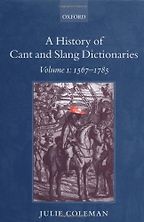
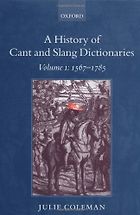
Next up is Julie Coleman’s A History of Cant and Slang Dictionaries. This is a substantial academic work published in four volumes by the Oxford University Press.
I’ve put Julie Coleman in because she does stand out in the relatively small circle of slang experts. I will be the first to acknowledge that they are not easy books. There is a great deal of statistical material but she has covered pretty much everything. I would be very surprised if there is something she hasn’t covered. It is very useful. The important thing about her is that she gives an unrivalled coverage of the dictionaries in the field of slang from the very first in 1531 through to the most recent. And it’s not just mainstream dictionaries. She offers information on enormous amounts of supporting slang – truckers’ slang, college slang and all that kind of thing. It’s a superb collection. If you want to see what has been done in the way of writing of slang lexicography for 500 years, then this is the place to go.
She touches on the general fascination that existed in the 18th and 19th centuries with criminals, and writes at length about the language they used. Why is that?
The very first collections of slang were criminal cant. Criminal cant is the spine of all slang. If the environment of slang is always the city, then its central preoccupation is invariably crime. So obviously there are a lot of crime-related books which she covers.
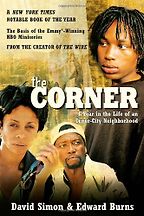
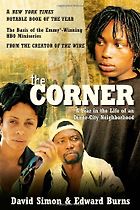
Your next book is something quite different. Set in the 1990s, it’s a true account of a West Baltimore family destroyed by drugs, co-authored by David Simon who went on to create the critically acclaimed HBO drama The Wire. Why did you choose this book?
I wanted to choose a book that showed slang on stage or, as one might say, “live”. The Corner is a view that you could only get through a great deal of patience and supreme reportorial skills. The authors spend a year with a family who use crack cocaine, and you watch the whole world of selling the drug. On one level it’s a soap opera – you could say it’s a crack soap opera. You become fond of the characters in it. You follow them. But it’s also a great tragedy, because no-one comes out happy.
What can you tell us about the slang they use?
It’s full of slang. There are 350 different uses of slang in it, which is a lot for a single book and that makes it exciting to me. It’s also slang that I haven’t come across before in many cases, and it’s slang of a certain culture. As a slang lexicographer one is an appalling voyeur. And there’s no doubt that if you’re white, middle class and live in England, then reading The Corner is a very voyeuristic experience. I have varied opinions at different moments about how I feel towards the voyeuristic side of what I do, but The Corner is a fascinating book because of the language that is used. There is no artificiality, there is no putting slang in for its own sake. This is how the characters are speaking.
The book is set in Baltimore. If you went to another American city where there are people selling drugs on corners, would the slang be radically different?
Radically different no, different yes. Even within a city like London there are differences in slang words used in Tottenham and Brixton, so there are definitely going to be differences between Baltimore and, say, New York. I don’t like to say this in a way as a lexicographer, but there are limits and you chase slang as far and as fast as you can. But there’s a level of fine-tuning that you have to miss. There just isn’t the space, nor the time.
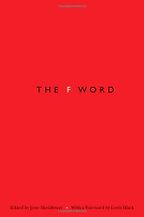
Your final book is not as crude and vulgar as the title might suggest. There can’t be many words that have whole books written about them.
Everybody should look at this and see how lexicography should be done, because it is a superb piece of work. It’s not a grubby book, or a meretricious book, it’s an amazing piece of scholarship.
Get the weekly Five Books newsletter
There is a substantial introduction which covers the etymology of “fuck”, the censorship it has received, and the way in which the word has emerged into wider usage from having been absolutely taboo. Then there are a couple of hundred pages dealing with every instance of the word, be it a derivation like “fuckster”, a compound like “fuckwit” or a phrase such as “get fucked”. There are hundreds of them and, just like the Oxford English Dictionary, it has a body of supporting citations. So you’ve got depth of scholarship, depth of knowledge, depth of information and a formidably large number of f-words.
I was surprised that the f-word has been around for so long.
The first usages are from around 1500. There was a form of ritual poetic insults called “flytings” and that’s where it starts being used. It’s found quite consistently after that, slipped in by many people. Whether we like it or not – and I have no problem with it – it’s a fascinating word. I don’t think there is a single one like it. It certainly has the most pages devoted to it in the slang dictionaries.
The f-word once had real shock value. Is it as offensive as it was 50 years ago, or is it being absorbed into everyday speech?
For some people it is, and for many more it is not. Think of the hoo-ha raised following the use by a politician in public of the word “fuck”. It may be fanned by TV, newspapers and the Internet, but the hoo-ha is there every time. I know, because I get rung up to comment on it. Perhaps it doesn’t have the kind of shock value it once did, but there is a hoo-ha every time and I can’t see that going away anytime soon.
October 5, 2012
Five Books aims to keep its book recommendations and interviews up to date. If you are the interviewee and would like to update your choice of books (or even just what you say about them) please email us at editor@fivebooks.com
Jonathon Green is a lexicographer, or dictionary maker, specialising in slang. His 6,200-page, three-volume Green’s Dictionary of Slang was published in 2010 and contains some 110,000 words and phrases, backed up by 410,000 citations or usage examples. He lives in London and Paris
Jonathon Green is a lexicographer, or dictionary maker, specialising in slang. His 6,200-page, three-volume Green’s Dictionary of Slang was published in 2010 and contains some 110,000 words and phrases, backed up by 410,000 citations or usage examples. He lives in London and Paris