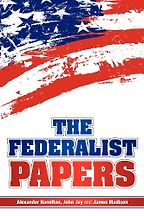
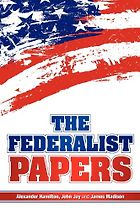
Let’s start with The Federalist Papers. This in its day was a very political piece of work and it’s not a small government book – it was trying to persuade people to have a bigger government. Why did you choose it?
It is a work of great philosophical theory about the nature of the American government, the nature of the American experience. At the same time it was really a series of essays written under anonymous names and published in various American newspapers in an attempt to garner support for the proposed constitution.
I like it because there’s a unity to it, in that it is in favour of that proposed constitution and explains that document in light of the American experience and the American philosophy – and yet at the same time it shows some of the strains that would later become more visible in the party politics of America. They’re muted in the book, but they’re there nonetheless. I think this is the greatest explanation, in one place, of the American constitution, of the essential underpinnings and structures that make American democracy possible.
It’s not so much about small government, as about balanced government, balancing faction against faction. When you’re actually serving in government in the White House, is that relevant? What do you learn from that?
It’s about the essential framework and structure of our government that makes it possible. I am not certain it’s an advocate for big government. It is an advocate for more than the anarchy of the articles of confederation. But it is for, I think, a view of a limited government. There is, throughout its pages, varying degrees of scepticism about America’s ability to exist without a stronger government than it has, but there is clearly a dislike of concentrated power that runs throughout its pages. I think it’s a mistake to read it, and especially to read Hamilton, as an advocate for an all-encompassing, all-stifling, all-directing central state. It is merely, instead, a call for stronger ties, that would allow these 13 tenuous colonies perched on the eastern edge of a vast continent to become a great nation.
Big enough, but not too big, in effect.
Slightly larger, but not overwhelming…
What today can a practitioner learn from The Federalist Papers?
What is necessary to maintain the American democracy. This is how to view the constitution in its proper perspective, as a document of limited government, and enormous personal freedom – as an attempt to understand human nature and draw on both its strengths and its weaknesses to achieve a community and nation.
A user’s manual, in a sense…
Absolutely. That’s a good way to put it.
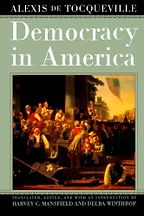
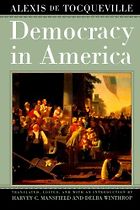
Your second book is a real classic: De Tocqueville’s Democracy in America, written in 1831, Andrew Jackson’s America. Why Tocqueville? Obviously it’s a great book, but how does it resonate for you?
There are many, many important things. You can’t take it, exactly, as a description of either Jacksonian America alone or as the American experience today. But it does show up things that are vital to America as we know it, and which are important to nurture and to support. For me it’s the recognition that the American habit of association, our tendency to gather together in groups to solve immediate needs without waiting for direction from government, is vital to the American experience. De Tocqueville came from an environment where the centralisation of government was so powerful that local officials spent their entire lives writing documents to be shared with their overlords in Paris. Tocqueville was seized by the sharp contrast with America where people did not wait for the central government, but went ahead on their own, and I think that’s a vital part of what it is to be both an American and a vital part of what is America. The other thing that gets me about it, is that he recognised we were a commercial nation. He was at once repulsed by it, because he came from a mercantilist economy, with an aristocracy that didn’t really need to labour hard, and here in America it was the go-ahead man who was going to find a way to rise by his bootstraps. I think that’s what makes America – we take people who are really the wretched refuse, the rejects of the rest of the world, and by giving them opportunity, and by giving them a chance to seek reward and receive reward, in compensation of hard labour and ingenuity and innovation, we became something different.
Support Five Books
Five Books interviews are expensive to produce. If you're enjoying this interview, please support us by donating a small amount.
He puts a lot of emphasis on Americans’ volunteerism, on our sometimes prickly nationalism and patriotism and national pride, on our civic-mindedness, our egalitarian culture. Is that still America today?
I think it’s a large amount of what America is, and I worry about maintaining it. That’s why these mediating structures are so important, and why the vitality of state and local governments is so important and why the sphere of private activity and private action is so vital to protect and nurture and strengthen.
Tocqueville has mixed feelings about America; he worries about the tyranny of the majority. How does that figure in your view of this book and this country?
Well, going back to the book that I first recommended, The Federalist Papers, there is a concern there about the tyranny of the majority. How do you build structures that restrain the tyranny of the majority and make it difficult to make radical changes in the structure of American society? It’s interesting, because Tocqueville’s fear of the tyranny of the majority is in a way slightly anti-democratic, but it’s also anti-revolutionary, because his memories of what had happened to his family in Revolutionary France are too fresh and real for him to have complete trust in allowing the majority to have unbridled control.
Temperamentally, he’s not a true American-style small-d democrat.
I’d never consider him an American small-d democrat. I see him as a keen observer, sort of the man from Mars. Here’s a man who came to study American penitentiaries and, instead, obtained keen insights into the nature of what America was at that time, which I do think has relevance for America today.
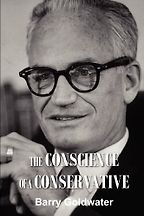
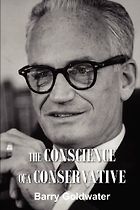
Your third book takes us right into the modern era, and the time when you were probably beginning to come of age politically – Barry Goldwater, The Conscience of a Conservative.
I think I was 12 or 13 when it came out, in the run-up to the 1964 elections. I remember someone giving it to me and, I hate to say it, but I think it was someone who was associated with the John Birch Society, in Sparks, Nevada. I read it and I wasn’t a Bircher, in fact I was with William Buckley on the issue of the Birchers. I remember reading it and just being blown away. I was a westerner – he spoke in a western vernacular and he spoke about things that as westerner I felt familiar with – and it was a rip-roaring good read.
Did it convince you? Was it formative for you?
I was a conservative and a Republican before. I was stealing down to the Sparks library to read the National Review and I was a complete nerd. Do you remember the first time you had civics class in fourth or fifth grade and you had to write an essay? I wrote mine on the Theory of Dialectical Materialism.
Wow.
I was a complete nerd. But it to me was highly energetic and highly motivating.
Is it still relevant? It was out of print for a while, but it’s back in print now. Is it something people should still read?
I think it is worth reading. It doesn’t have the relevance today that it had then, because a lot of it is of a topical nature, the things that were of the time. In many ways it’s incomplete, but it really strikes a defined note of individualism. There are more balanced books that talk about the moral side of conservatism, or there are books that talk about the economic side of conservatism, there are books that talk about the scepticism towards centralised authority better than this. There are books, one of them is Witness, that talk about totalitarian and utopian philosophies better than this one does. But for an impressionable young kid, for a teenager, this was heady stuff, really powerful.
When you finally found out as a grown-up that Goldwater didn’t actually write this book, that it was written by his speechwriter Brent Bozell, was that a comedown at all?
I have to admit I was a little disappointed. It’s one of the reasons I liked Buckley so much, because he clearly wrote everything. I had a first edition copy – long lost unfortunately – of Profiles in Courage [by John F Kennedy] and of course that turned out not to have been written by the author, and then Goldwater… But it is Goldwater’s voice, and I do feel Bozell listened carefully to what he said and how he said it.
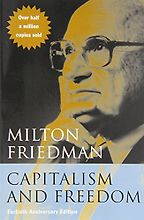
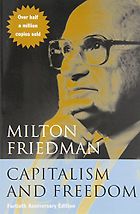
Milton Friedman. He has three books on our list, but no one else chose Capitalism and Freedom. He argues that free markets are a precondition for political freedom and that government intervention tends to be counterproductive. Do you recall when you first came across that book?
As soon as it became paperback. In fact I still have my paperback.
Friedman wrote a lot – why this book?
You put your finger exactly right on it. It was the first book that I read – shortly after this I read Wealth of Nations, because he refers to it in there – [with] the idea that in order to have political freedom you have to have market freedom, economic freedom. That economic freedom drives people towards political freedom. That if you have economic freedom you can have political freedom. If you have political freedom you don’t necessarily need, or have to have, economic freedom, but eventually without the two, political freedom will wither away.
If you have the form of political freedom, but not the substance of market freedom, eventually it will undermine the form of political freedom.
At the time this book came out that was quite a fresh idea, it was even controversial?
Oh yes, very controversial. In fact this is where he lays the predicate for the volunteer army and the negative income tax and so forth – they spring from this. I wasn’t in the most political of environments – I was living in a small town in the west – so this was like opening a window on a wider world. I did not live in a political household, so this is not the kind of book that I would read and be able to talk with my parents about. So it’s almost like samizdat literature. It was read in quiet, it was exhilarating, but very private.
You grew up in Sparks, Nevada?
I was born in Colorado and lived in Kokomo, Golden and Arvada and then when I was nine years old we moved to Sparks, Nevada, and I lived there till I was 16, and then we moved to Holladay, Utah.
So for a kid out there in Nevada – Friedman and Goldwater, they’re a real wake-up call.
Exactly. And a couple of years after I read Goldwater, there was a lot of Goldwater enthusiasm in Nevada. I even had a soft drink can of AuH2O.
Goldwater!
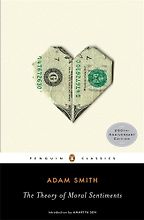
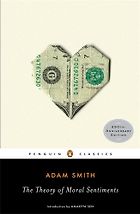
Your last choice was a bit of a surprise for me. I expected to see Adam Smith chosen by one of our panellists, but The Wealth of Nations, not his 1759 book, The Theory of Moral Sentiments, and possibly the least read thing he ever wrote. It was written 17 years before The Wealth of Nations – but Adam Smith considered it his own greatest book.
For me it was a close call. I felt my list probably accentuated the economic side of conservatism more than it should, but I love The Theory of Moral Sentiments and I read it every couple of years, because I know I don’t fully understand it and if I read it again I will get some new insight on it. For me the essential part of it is his description of human nature, that there really is inherent in every human being, a striving to win the favour of others by doing right things. I think it’s a complement to Wealth of Nations – I don’t think you can have a society as he describes in The Wealth of Nations, without also having understood the nature of human striving. Look, a young man who dropped out from Harvard, didn’t go to Albuquerque New Mexico in order to build a personal computer operating system in order to make ten gazillion dollars. He did it because he wanted to win the favour of others by doing something that he enjoyed, that he found stimulating and saw value and worth in, and the fact was he then made a gazillion dollars.
Are we talking about Bill Gates?
Exactly. This is also why the impulse towards charity and service and love your neighbour as you’d like to be loved yourself is so important, because those moral strivings to win favour of those with whom we live, in the communities in which we exist, is a vital part of what it is to live in a free society.
A lot of people are surprised by The Theory of Moral Sentiments, because Adam Smith’s reputation is as the high priest of individualism and self-interest. What he says in this book is that the real foundation of society is sympathy – the ability to imagine what others feel and to see ourselves as they see us. Are these insights as important as the insights about individualism/self-interest/entrepreneurship that we hear so much about?
Absolutely. In fact, they have to go hand in hand. He is caricatured as the high priest of soulless, money-grubbing, uninterested, individualistic enterprise. Instead he says that that is truly soulless without the sympathy that we naturally feel towards those with whom we live. These two works, The Wealth of Nations and The Theory of Moral Sentiments, are distilled quite well in Michael Novak’s The Spirit of Democratic Capitalism. I picked my five in terms of what they did in forming my political and philosophical beliefs but, as an adult, one of the most powerful books that I’ve read is Michael Novak’s – in part because I was sensitised by having read these two previous volumes by Adam Smith.
Today’s conservative movement has taken on board The Wealth of Nations. Do you think it’s adequately taken on board and come to grips with The Theory of Moral Sentiments, the other side of Smith?
As a political expression, no. But as a living expression, yes. Arthur Brooks, for example, made that interesting observation in one of his books, that conservatives of all income levels give more generously to philanthropic activity and implicitly give more of their personal time to charitable activity than do liberals of the same income level. Poor conservatives give more than poor liberals; rich conservatives give more than rich liberals. I think that says something about the accuracy of Smith’s observation. I think there is a natural tendency for conservatives to have a deeper sympathy for their neighbour, and to feel an obligation to take some of the fruits with which they’ve been blessed and provide them in support, and this is where it all fits together, through the associations that Tocqueville described.
Get the weekly Five Books newsletter
Yuval Levin, one of our other panellists, gave a lecture recently. He said American conservatives are very good at walking the walk of sympathy, but they need to get better at talking the talk of moral sympathy. Do you agree with that?
I do. Look, compassionate conservatism was an attempt, in a political vein, to use the natural strength of conservatism and draw attention to this very attractive feature of conservatism. Being a conservative is fundamentally a compassionate philosophy. What is better to say to someone than, we want to construct a society in which you have every opportunity to achieve the best that you can possibly be in life and to be exactly what it is you want to be in life…
American conservatives tend to appear more self-serving and more self-interested than they need to?
Five Books aims to keep its book recommendations and interviews up to date. If you are the interviewee and would like to update your choice of books (or even just what you say about them) please email us at [email protected]
Karl Rove was George W Bush’s most influential White House adviser, and served as his deputy chief of staff between 2004 and 2007. He is now a columnist for The Wall Street Journal and a contributor to Fox News. He is also the author of Courage and Consequence: My Life as a Conservative in the Fight.
Karl Rove was George W Bush’s most influential White House adviser, and served as his deputy chief of staff between 2004 and 2007. He is now a columnist for The Wall Street Journal and a contributor to Fox News. He is also the author of Courage and Consequence: My Life as a Conservative in the Fight.