Many people find it difficult to find their voice when they are writing poetry. What advice would you give them?
Most artists learn by imitation. This is certainly how I learned to write poetry, and this is how I encourage my students to learn. At some point as an apprentice, you realise that you might finally possess enough skills to fashion a reasonably passable imitation of the artist whose work has inspired you, but something other than ability prevents you from achieving the perfect fake. The thing that will keep getting in your way will be your own voice. Ironically, then, in trying to write like the poets whose work I loved, I learned to write like myself. There are so many kinds of poems. Perhaps at the start, a student cannot say why she loves the work of another poet, but contained in that attraction are the seeds of her own aesthetics. Eventually a poet can say, ‘Of all the kinds of poems that I might have chosen to write, I write this kind. And I write this kind because I value this kind.’ While all poets ought to have a wide palette and read other poets of all sorts, their own writing testifies to what they themselves think poems ought to do. We choose.
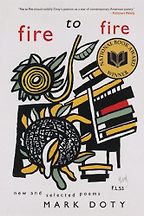
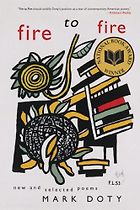
Let’s start with Fire to Fire: New and Selected Poems by Mark Doty.
For the first decade of my working life, I taught in schools. A friend asked me to chaperone a group of her students who were going to a poetry festival. I reluctantly agreed. At the festival, Mark Doty read two or three poems. When he was finished, I thought, ‘I want to learn to do that!’ Doty is an exquisite image-maker. His language is so precise and lush. He allows himself to linger over his descriptions, and his poems emerge out of that careful attention. I have never written a poem as beautiful as any one of his poems. But his work is not all shine (or sequins, as he says in one poem addressed to his critics). I love even more than the rendered image, the engaged, inquisitive mind that animates his vision. The poems are not just conscious but self-conscious; they are inhabited by a soul that is not simply talking to some specific other or many others but also talking to itself. The body of Doty’s work is profoundly moving – many of the early poems having been written in the midst of the Aids epidemic – but the poems are also funny and self-deprecating. There is nothing Mark Doty does not do well!
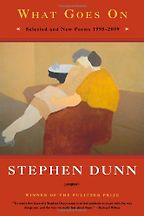
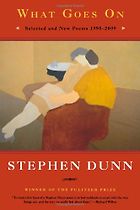
Your next choice, What Goes On: Selected and New Poems, 1995-2009, is by an old teacher of yours, Stephen Dunn.
Stephen Dunn was my first teacher. What Goes On is his second book of new and selected poems, but his influence on the way I think about poems extends beyond the reach of any one collection and also beyond the reach of the poems themselves. I was already in my mid-30s when I enrolled as a continuing education student in Dunn’s undergraduate class. I had a lot of big ideas that I wanted to express in poetry, or that’s as close as I can come now to whatever it was I thought I wanted to do. For a year I wrote very bad poems, consistently among the worst in the room on any given evening. Dunn’s advice, which I understood but couldn’t manage to follow, was to set aside ideas in favour of things. William Carlos Williams is so often quoted in this regard: ‘No ideas but in things.’ I think Stephen wanted me to try, ‘No ideas at all!’
Dunn is himself a very philosophical poet, and this was odd, somewhat dictatorial advice coming from someone who always mixes image with intellect, but he knew that I could think. He also knew that I couldn’t render an image. He wanted the horse before the cart, or, at least no carts without horses, as those things aren’t going to go anywhere! Every thought in Dunn’s work emerges as a direct response to experience. Hence, his ruminations, which tend to undermine our daily assumptions and comfortable moral values, feel as though they have emerged from life rather than from scholarship.
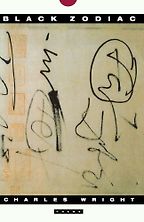
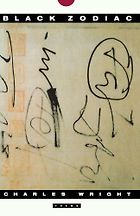
Let’s move on to another influence – Black Zodiac by Charles Wright.
The first imitation that I wrote that felt in any way like a successful poem on its own was an imitation of Charles Wright. While Dunn had rightly tried to steer me away from too much intellectualisation in my writing, Wright is a poet who moves between a generally profoundly understated moment in his life (most often he’s just sitting in his yard watching birds or lightening bugs as twilight comes on) and metaphysical pondering. One gets a sense that the mundane and the overarching are always merged, approaching together on the wind. He gave me permission to quote from other texts directly the way an essay might. There is a difference between Wright’s appropriation of a text and Eliot’s. Wright generally gives you all the contextual information you need right there in the body of the poem. He isn’t interested in opacity at all.
I didn’t know poems could do that! It was shocking to me. I love the wonderful texture that these other voices introduced into his poems, and I love the way Wright moves from the quotidian to the elevated, from the humidity of an August night to snippets from Roberto Calasso or Augustine or Wallace Stevens or one of the Chinese poets he loves so much. The domain of the poem is not bounded by the exterior landscape of the American South but the interior landscape. When you read Wright, you enter into a sensibility. This is how this mind experiences a typical evening. Always rooted in his Appalachian upbringing, it is not, to my mind, pompous or presumptuous, even when it suddenly speaks in Latin: it is, instead, the authentic voice of a soul that thinks and feels in conversation with other souls who have thought and felt. I also realised that Wright was orchestrating the stream of his thoughts through the use of line breaks and the dropped line. These were signals that allowed him to wander around the spaciousness of his own head without losing his reader.
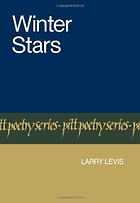
What about Larry Levis’s Winter Stars?
Larry Levis’s poems taught me to do the thing Dunn had wanted me to do. They taught how to bring an experience into a poem in a way that felt intimate but not creepily confessional. At least that’s my goal and that’s how his poems seem to me. Levis died at a relatively young age, 50, and his legacy is still on the rise in American poetry.
What has he bequeathed? His poems have the dynamic shifts that one also finds in a poem by Charles Wright, for instance, but the places his mind goes with each turn are darker, psychologically deeper, and less sensibly linked to one another than the places Wright’s mind tends to go. The connections between the elements in a Levis poem are ‘intuitive’. The poems are very thrilling as a result of their wildness or associative leaping. It is not always possible to say simply why the assembled moments feel ‘right’ together. Levis reaches back into his own personal autobiography (or some imaginative version of it) more often than Wright. There is also something nearly surreal is some of Levis’s poems: an extended image will often be a rabbit hole the reader and poet tumble down. When we emerge, we find we have been changed in some strange way that logic alone could not have achieved.
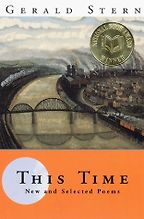
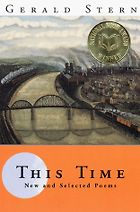
One poet you very much admire is Gerald Stern and his book This Time: New and Selected Poems.
No one else writes poems like Gerald Stern’s poems. Their wildness is different from the wildness of a Levis poem, though it can have some of the same surreal image-making qualities. The wildness, for me, in a Stern poem is one of emotion. If Doty sees more deeply than most, and Dunn and Wright seem to think more deeply, then Stern ‘feels’ more fully or more extravagantly. Of these three broad poetic features – seeing, thinking, feeling – feeling came last for me. It isn’t that I’m a cold person: it is that I am exceedingly suspicious of poems that make me, as a reader, feel like a voyeur. This would be the knock against many ‘confessional’ poets. Hence, for a long time, I tended to write poems that were too understated with regard to their emotions.
Stern’s poems, on the other hand, explode off the page with expressive gestures (weeping and hollering are common activities, for example). Yet I trust Stern’s feelings, meaning I believe he feels them. I don’t think, even in their extremity, that they are inauthentic. I needed to see how far a poet could go with something like raw feeling. A poem without an authentic emotional engagement on the part of its maker will be a boring poem. It may be fabulously wrought, but no one will care. I go to poems to be moved; Stern’s poems move me very, very much. I often weep and howl when I read them. And I like that.
How did you go about choosing the poems for Eternal City – you have many varied voices in there including Johnny Depp?
I wanted to write a book that was in some way different from Correspondence, and I only half-achieved that, which feels fine to me. I had a general idea, after writing the series of poems in response to Marcus Aurelius, that I wanted to think in very broad terms about imperialism and its relationship to technology and also the basic idea of possession. But, of course, everything human falls into those categories so that wasn’t a very limiting vision. But the Jim Jarmusch film Dead Man – which stars Johnny Depp and which is how he ends up with a cameo in one of the poems – seems very much about the American Dream and the nation’s westward expansion. Herzog’s Fitzcarraldo is also a film about people in places they don’t belong doing truly insane things they ought not to be doing. These characters are every bit as tragic and ridiculous and emblematic as they are likable and heroic, though I’m not sure that there is much of a hero in Depp’s character. He seems largely a victim of circumstance, which I suppose makes it a work of realism in some way, despite its strangeness.
The Eternal City is meant to be a metaphor for the mind, a timeless landscape in which the past and present, the fictional and actual, the elevated and the quotidian live side by side. Johnny Depp lives in my mental landscape as does Marcus Aurelius and Walter Benjamin. Benjamin lives in the best house in town, in fact. I never get tired of visiting him!
I’m not very prolific: there weren’t many poems that were excluded from the collection. If I begin a poem, I tend to work on it quite diligently. I’m not someone who abandons a lot of drafts. Most of the poems that I managed to write between 2005 and now are in The Eternal City.
Why do you think in such a busy world people should still make time to read poetry?
I think that precisely because it is a busy world people ought to make time for poetry. Poetry demands that readers and thinkers slow down. Just as a poem emerges out of careful attention, it demands and re-creates that kind of attention within the reader. Poems are the antithesis of the sound bite; they are antidotes to polarisation. A good poem does not seek an easy answer or a single way of looking at the world. A good poem attempts to reopen within us our understanding of how varied and multivalent our experiences are, how complicated the world is. It also often asks us to consider perspectives other than our own and to locate our humanity within a larger context. I am not a person of conventional faith, but there is much that feels sacred to me. Our moral obligations to each other and to the planet are sacred responsibilities. I don’t want a poem to speak in a preachy way directly to those obligations, and there are certainly no quick fixes on the horizon, but poems encourage and cultivate an interior life in which our awareness of those obligations is less easily avoided. The attention of the poem reconsecrates not only its immediate subject but also the act of attention itself. And poetry reconsecrates language, which, as we know, is always under siege from those who would like to empty it of both its meanings and its beauty.
Five Books aims to keep its book recommendations and interviews up to date. If you are the interviewee and would like to update your choice of books (or even just what you say about them) please email us at [email protected]
Five Books interviews are expensive to produce. If you've enjoyed this interview, please support us by donating a small amount.