The Princeton philosophy professor tells us about the meaning of honour, how it's won and lost, and what role it has played in the history of moral change
Your first choice is In the Name of Honor by Mukhtar Mai.
It’s by this amazing woman, though it’s an ‘as told to’ book written by a French journalist working through an interpreter. She talked to her about how she became known around the world because of this episode where she was raped, essentially at the order of a village council in Pakistan because one of the local big families said her brother, who I don’t think was even a teenager, had allegedly assaulted one of their daughters. In fact, he had only been talking to her. But it escalated and at the end of the day, because that was an assault on the honour of this family, they insisted on getting their own back.
This was an official punishment?
Well, it’s difficult, because there are these village councils which are not empowered to do this, but they do…
They do it anyway?
They sort of grow out of a tradition where they were the government, though they’re not any more. Anyway, what’s amazing is that it was horrible, obviously, and she spent a week locked away in her house, but then, instead of what normally happens in these circumstances, which is that the woman just retreats in shame, the village mullah, rather than letting them get away with it, said in Friday mosque that this was a wrong. So then the police felt they had to do something about it and they actually interviewed her.
While they tried to get her to cover it up, it very swiftly snowballed and she was at the centre of this international incident and the people who did it were prosecuted, which doesn’t happen very often. Then it was appealed, and now it’s a mess and still hasn’t been decided by the supreme court of Pakistan, but the key thing is that in doing this she drew attention to the possibility that instead of retreating in shame you should shame the people who did it. Because it drew international attention she got support from around the world and she got money and won prizes and started a centre which has two schools, a girls school and a boys school, though she herself is not literate.
She is an amazing woman, who, instead of doing what she was expected to do, resisted, and as a result women contacted her from all over Pakistan and she tries to support them. She argues against these honour killings and assaults but also for the human rights and the dignity of women in Pakistan.
Why have you chosen it particularly now?
She is one of my heroes and this is a book about how someone who grasps dignity, which is a form of honour based in our humanity, can resist the world of the negative side of honour, where women are punished because they are pawns in a game of honour between men.
Tell me about Frank Henderson Stewart’s book, Honor.
This is a very different kind of book. Frank Henderson Stewart is a very distinguished scholar, now retired, an expert on the ancient Near East, but he thought deeply about honour. He read ancient texts and legal documents because, as you know, honour is a legal concept in German law and you can seek to have your honour protected in various ways – it’s sort of what they have instead of libel. Analysing and thinking deeply about it, he tries to understand how honour developed, and it was he who led me to see the core thought, which is that honour is an entitlement to respect, and that what honour codes do is say how you get to be entitled to respect. I disagree with a lot of what he says – in particular that he wants to give up on honour because it has such negative connotations: I think it needs reform as a concept – but I think it’s a very lovely piece of scholarly analysis.
How would you reform honour?
Well, reform of honour… Because honour involves entitlement to respect created by codes, what reform you need depends on the code with which it’s associated. So, in terms of the honour-killing code, I think the obvious immediate reform is to get people to see that the honourable thing is to protect women in these circumstances and not to assault them and kill them, but to attach honour to protecting these women rather than to attach it to harming them.
That’s assuming a lot of human nature though, isn’t it?
The reason why I think this can happen is because of the historical fact that over and over again it has happened. Nobody would have predicted in England in 1839 when the Duke of Wellington fought his duel that by 1850 that kind of thing would seem ridiculous. At the time, while the particular duel he engaged in was thought to be troublesome in various ways, it wasn’t ridiculous.
Why did he fight a duel?
He was fighting because someone else in the House of Lords had accused him of giving money to King’s College London in order to conceal the fact that he was sympathetic to Catholics. It was a scandalously irresponsible allegation but he felt his honour was at stake. But within a generation, if you challenged someone to a duel people mocked you and thought it was funny. Honour killings occurred in Italy well into the 20th century and they don’t occur there any more, so I do think it’s possible to reform these things because we have reformed them, and the honour-killing codes are in need of reform as fast as we can do it.
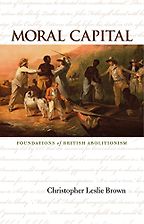
Moral Capital.
This is another beautiful piece of scholarship by an eminent historian, but you don’t have to be an academic to read it. It’s about a really interesting subject that I think would interest anybody. It’s about the abolitionist movement in England in the late 18th century and at the turn of the 19th century, with people like Wilberforce, and it tries to explain why so many Englishmen got involved in anti-slavery. There were no slaves in England so contact with slavery wasn’t something most people would have had. So, how, starting with the Quakers in the 1880s, did huge numbers, in the end millions, of Englishmen end up signing petitions against slavery in the colonies?
He argues that part of the reason was that in the debates about American independence, British politicians kept pointing to the great tension in the American case, which was that they were the ones talking about freedom but they were the ones who had slaves, and this was a stain on the beginning of the national honour of the Americans. The reply from the Americans was: ‘Well, we do have slaves, true, but you are the ones who do the nastiest part of the work. You are the ones packing people into boats like sardines.’ So there was a sort of trade-off, with the Americas saying: ‘Shame on you, British, for the slave trade.’ And the British said to them: ‘Shame on you for having slaves.’ The question of British honour then got tied up with the slave trade and people like Wilberforce could appeal to national honour when they said we have to stop the trade. So it’s a book about those debates.
Support Five Books
Five Books interviews are expensive to produce. If you're enjoying this interview, please support us by donating a small amount.
The great question in the historiography of the abolition and the end of the slave trade is why Britain gave up the slave trade at the point at which it was the most profitable. Nations and businesses don’t normally give up profitable trade for moral reasons.
No.
What this book shows is that it was indeed clear to people that what they were going to do would cost, but that it was more important to do the right thing. The reason they thought it was important to do the right thing was that British honour demanded it. There were other things going on, of course. Wilberforce was an evangelical Christian and part of the rise of evangelical Christianity with its moral seriousness. So, like all historical stories, it’s complicated but at the heart of it is the concern for British honour. My own discussion of abolitionism is concerned with why working-class people got involved in anti-slavery.
Why did they?
The short answer is that the form of slavery that developed in the New World equated manual labour with dishonour and if you’re developing a working-class consciousness of a positive kind, which was happening in England in the first half of the 19th century, you cannot accept a system that equates manual labour with dishonour. So they didn’t do it because they cared about the slaves, because they didn’t know any slaves. The paradox was that some of these workers were in the cotton industry and it was in their interest for slavery to survive in the Americas because the cotton that they were processing was made by slaves, but even they refused to ally themselves with the American South. It’s arguable that if there hadn’t been a strong working-class sentiment against slavery the British government would have sided with the South against the North in the Civil War. If they had, then slavery might well not have ended in America until much later. They got involved, in fact, before most working-class people in England had the vote. So here’s a place where honour and dishonour are very important in the history of moral change.
I’m very excited that you’ve got Chekhov. Tell me why he’s here.
Well, like much of Chekhov, it’s powerful in part because, although there is a moral undertone, no moral arguments are made, he’s not a moraliser. It’s about this guy who gets drawn into a duel so ridiculous that it’s impossible, even if you’ve just read the story, to remember exactly what it was they were duelling about. It’s often true of duels that people are prickly and they think their honour is being abused and they end up fighting. What happens is this man who is leading a rather meaningless life, fights a duel and doesn’t get killed and that turns him around and he pulls himself together. It’s just so marvellous, the description of these professional-class Russians, far, far away from Moscow in the provinces, and their preoccupation with status and all that, and these two guys in a completely pointless duel. It’s not just Chekhov creating an interesting narrative moment; it really was so common with these duels that it was extremely difficult to say in a short paragraph exactly what they were about.
Isn’t it always, given that we are mammals, isn’t it always a silverback thing, a male power play to see who is the dominant male in the situation? Isn’t that the fundamental reason?
I think that’s certainly one of the things involved in historical honour. That’s what’s involved when Achilles is worried about his honour or Prince Hal is worried about his honour, and that’s the part of honour that’s rather unattractive. If you think about what’s unattractive about historical honour codes there are three things: one is that they are hierarchical, including subordinating women to men and subordinating ordinary people to upper-class people; two, they tend to involve an awful lot of violence; three, they often lead people to do exactly the opposite of what morality suggests you should do. They are anti-moral, hierarchical, undemocratic and violent. So, if you’re going to say there’s a place for honour, you have to face up to that and wonder whether reform is possible that deals with those problems. I don’t think we’re ever going to be able to stop testosterone-fuelled fights and so on, but we can, I think, make them seem ridiculous and shameful rather than being a source of respect.
That strikes me as being slightly dangerous. Doesn’t a lot of violence come out of feeling ridiculous and shameful in the first place?
That can be a response and this relates to how one should use national honour and the honour of groups, Muslim groups and so on, carefully, in terms of how to push people ahead on the moral front. If you shame people too much they just get angry so you have to be careful with that. But I think it’s one thing to say, ‘Shame on you’, to somebody who is already pissed off and in a high state of adrenalin, but at least we are not going to say, ‘Three cheers for you’, so we can stop cheering people on when people do this. Cardinal Newman said that the essence of being a gentleman is that you don’t do anybody harm. That meant that by the mid-19th century gentlemanliness, which was very much associated with violence and feudal knights and all that, at least for a significant part of the educated population, had come to be seen as the opposite of that.
It would be interesting to see the figures for violent crime and see if that really did have an impact.
We don’t have good numbers on that but we do have good numbers on the role of this kind of thing explaining the murder rate in the United States. It turns out that one of the biggest things that explain the different murder rates in different parts of the American South is whether you’re in a region that was significantly settled by Scots-Irish. If you are from a region that was significantly settled by Scots-Irish who brought with them the kind of honour code that comes from a rural society that kept cattle, in those regions the rate of honour-related reasons (you flirted with my wife and such) are much higher than in other parts of the United States.
Is that now?
These data would be from the 60s, 70s, 80s.
That’s bizarre.
In fact, attitudes to honour in the South are very different from attitudes to honour in the North. Someone did a nice survey recently where they sent imaginary CVs applying for jobs, and in these CVs there were people who had been in prison. If the CV showed that the reason they were in prison was that they had reacted violently to a threat to their honour, then in the South they could get a job but in the North they couldn’t. The point is that there is plenty of evidence of the pervasiveness of these issues of honour today, including in such things as the murder rates and the rates of assault. You have to face up to that and look for the possibilities for reform – unless you think you can get rid of it, and I don’t think you can. So, as I say, it can be and has been reformed and been moralised. It has changed from motivating people to do what’s bad to motivating them to do what’s good. Hard as it is to imagine when you’re stuck in the middle, we have historical evidence to show that it can be changed.
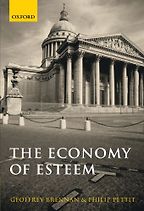
Tell me about The Economy of Esteem.
This is a book by a philosopher and an economist about a topic that was neglected for a very long time in social analysis. So there’s lots about it in the 18th century – Adam Smith and people like that – and it’s about how esteem, which is their word for the respect that you give to people who have achieved things against a certain standard, can be used to motivate people to do good things. How people can be mobilised. What they do is build models about how they actually work and there are graphs of the kind you see in economists’ books, and it’s about how, if you set the rules out right, you can use esteem, the economy of esteem, the system of assigning esteem to people, to do things much more efficiently than money. It’s better than the real economy, that of money, and it’s better than using the fear of punishment.
Do they give examples?
Examples are things like: if you have an up-and-running economy of esteem, then when people do the right thing they get the respect of their friends and neighbours and if they do the wrong thing they get their contempt and disrespect. The great virtue of this is that if people have these attitudes, then the thing is cheap to run because people spontaneously respond in these ways. You don’t have to have courts, which is what you have to have in order to use punishment. You don’t have to have chequebooks and credit cards in order to pay people to do things. Because the thing that they want, the respect of their neighbours, is the natural response of people who are in a social system together. That means we can use esteem to sustain things like philanthropy. It would be self-contradictory to pay someone to give money away and it would be weird to punish someone for not giving their own money away. So, you get the esteem of your neighbours if it is known that that’s what you’ve done. Nobody has to run the system.
So this is a whole new world?
No, it’s just New York City. In New York City a lot of rich people give away a lot of money and, if you ask why, the natural explanation is that they get the reward of being esteemed. People think better of them, and it’s a striking fact that in New York where the richest people are a thousand times richer than the poorest people there is not a lot of resentment. That is because there is a tradition of the rich supporting the public good.
Get the weekly Five Books newsletter
I suppose, though, that in America there is less resentment because there is always the hope that you can become one of them and live the dream. It’s not stratified as rigidly as it is in England.
That is the hope, but the best social science studies show that America is much more stratified than everyone thinks and especially now because the gateways to success tend to pass through education, and well-off people can give their kids huge advantages of the sort that are familiar in England but have historically been underplayed here. There is very good evidence that we are much more stratified than we like to think. Nevertheless, because people don’t recognise that, there is a huge amount of optimism among people who in fact have almost no chance of making it.
Optimism, which we are now crushing.
Well, we’ll see.
November 21, 2012
Five Books aims to keep its book recommendations and interviews up to date. If you are the interviewee and would like to update your choice of books (or even just what you say about them) please email us at editor@fivebooks.com