Religion » Magic & Witchcraft
The best books on Premonitions
recommended by Larry Dossey
The former Chief of Staff of Medical City Hospital, Dallas discusses the weird and wonderful world of Premonitions. Semi-scientific and light hearted


The former Chief of Staff of Medical City Hospital, Dallas discusses the weird and wonderful world of Premonitions. Semi-scientific and light hearted
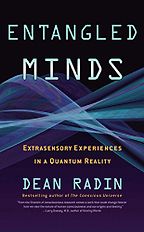
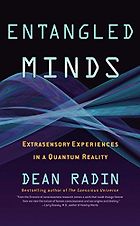
Tell me about the first Dean Radin book, Entangled Minds.
It expresses a view of consciousness which I find extremely accurate from a scientific as well as a personal point of view. Radin’s idea, basically, is that consciousness is not confined to individuals, which is the traditional view, but rather that consciousness extends beyond the individual brain and body to envelop people at a distance, and even outside the present moment. It sounds like a crazy idea to many people who stumble upon it for the first time, but it’s important to recognise that there is a good deal of science that supports this view of extended consciousness. I’ve written widely in the past about this view of consciousness – I call it ‘non-local mind’. It’s a very ancient idea. We’re not making this stuff up. It has been around for ever and it has been affirmed, as I say, by careful scientific study.
How did he come upon this idea?
Dean Radin is a highly trained scientist. His field is mathematics, physics and engineering. There is simply a huge database going back decades looking at the human ability to convey information to other people at a distance, and also to acquire information from people at a distance and outside the present moment. Dean is a pioneer, and a group of studies have now been replicated by researchers around the world that are called ‘pre-sentiment’ studies.
So you’re sitting in front of a computer and that computer is going to show you one of two images. Either a lovely scene from nature or a gruesome war scene, an autopsy, a car accident with bodies strewn around. You don’t know which it is going to be and the computer doesn’t yet know either as they are chosen at random. Here’s what happens. You’re wired up to get a physical measurement of a stress reaction – and here’s where it gets strange. If the image that will be shown to you in the future is one of the horrible images, your body starts to generate a stress response – even before the computer selects the image that will be shown. Your unconscious mind and body know what is going to happen in the future. This is profound evidence that we need to expand our views of consciousness. We say that consciousness is confined to the present and everybody believes that, but these experiments say something else. If we do good science we are going to have to come to terms with this.
Do these studies suggest that consciousness is separate from the physical body, so that you can be conscious after you’re dead or before you’re alive?
Consciousness, obviously, operates through the brain and through the body, but it is not limited to the brain and body. I suppose we’ll all find out whether we can still be conscious after we’re dead. Nobody has come back and staged a press conference yet.
But people often say they have spoken to people who are dead.
They certainly do, all the time, but those are stories and this is a science. However, my own opinion is that we should give these stories some serious consideration. It seems to me that consciousness can exist outside the body and, though we cannot say for sure, this gives a lot of hope for the survival of consciousness after bodily death. My personal view is that consciousness does survive death and is present before the birth of the physical body. That is what I mean when I say that consciousness is ‘non-local’.
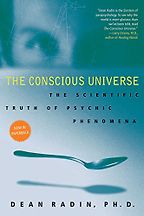
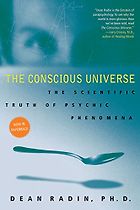
Is the second book you’ve chosen by Dean Radin, The Conscious Universe, different, or is it an expansion of the same theme?
It’s an expansion of the same theme. Dr Radin’s books all go into the scientific evidence for his view that consciousness is not restricted to brain, body or the present moment.
It sounds very religious.
It can be religious. Many people would relate this to the idea of the soul, but it would be a mistake to put Radin’s books in the religious category as he certainly doesn’t intend them in that way. Although, if people find religious meaning in the books, I’m sure he would have no objection to that.
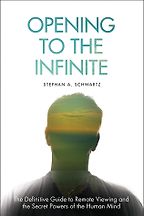
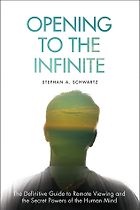
Tell me about the Stephan A Schwartz book, Opening to the Infinite.
He is one of the inventors of the field called ‘remote viewing’, in which people undergo procedures to visualise things that are a long way off – on the other side of the world, for example. This might sound quite strange to someone bumping into it for the first time, but in his book he describes how he has put these experiments to the test and how people have found sunken shipwrecks that have never been seen before, and buried cities in the desert which had resisted archaeological detection in the past.
Why is this not better known? Why wasn’t he in Iraq looking for WMD?
I think many people are aware of it and it is a hot topic in, for example, archaeology. There is a whole history of this kind of work in archaeology, and in other fields. As I’m sure you can imagine though, this goes against the grain in the academic world and a lot of scholars simply don’t take the time to inform themselves of the fact that this evidence simply does exist. It’s like that all the time in science – you have people on the boundaries, pushing the edges, being adventuresome. It takes time for this information to seep into the mainstream.
What I wonder is, why it doesn’t work when you want it to? If I’m trying to imagine where my lost earring is, or am desperately trying to communicate silently with somebody on the other side of the world – as we all do, I think – it doesn’t work.
If you explore Schwartz’s book you will see that there are certain techniques that can be developed that take this out of randomness and put it into a reliable category. Schwartz would disagree with you that this never works when you want it to. He maintains to the contrary that it is ridiculously easy for people to develop this skill. So, who knows, you might become an expert remote viewer if you apply yourself to the discipline.
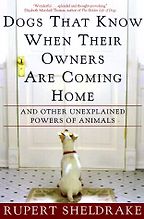
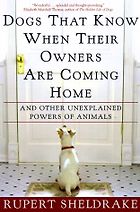
I’ll give it a go. OK, your next book is Dogs That Know When Their Owners Are Coming Home. I love that title!
Yes, it is very playful. What Rupert has tapped into is a belief that is very common among pet owners, which is this idea that their pets, particularly dogs, have some sense of what their owners are doing at the end of the day, returning home from work. They always meet the puppy who is at the door or window greeting them. What he did was he took this piece of folk belief and put it on a scientific basis by actually videoing the dogs when their owners were absent, to show that you can’t fool them. Even though you come home at different times of day in different kinds of conveyances – walking, driving, driving different cars – you can’t fake them out! The video camera shows that they have some uncanny sense of knowing when the owner is returning.
So, what we’re looking at with all these books is a different view of consciousness and the fact that people and animals can be conscious outside their particular locale and time. They can apprehend information in the world that can be useful. I have written a book on premonitions which explains that people can sense things outside the present – that’s what a premonition is – and this serves a purpose. I call this a survival value: in our long history it would be very handy if you knew ahead of time where danger lay. You would be more likely to survive and you would then pass on this quality to your offspring.
So you are saying that maybe we will find out what it is one day, and it will lose the mystical, spiritual suggestion and will be understood as one of the things that helps us survive, like our other senses?
Exactly. Sometimes new ideas are so strange and surprising that we want to put them in some kind of transcendental or spiritual category, only later to find that there is a physiological explanation for these things. This is Radin’s point. He relies on quantum physics with its concept of quantum entanglement to explain some of these things.
Is that where an atom is in two places at once if you’re not looking at it?
Precisely. Then if you have quantum particles separated at a distance and you change one of those quantum particles, the other one changes instantly too, to the same degree, as if they were a single particle even though they are widely separated. This is the notion of entanglement.
Like twins who think the same thing at enormous distance?
Well, I happen to be a twin and my brother and I have this kind of thing happen all the time. My wife is also a twin and has the same experience. My brother and I seem to be able to know when the other is going to call and I can anticipate the topic of conversation before it happens. My wife gets actual physical symptoms in her body that correspond to physical pains and discomforts in her twin.
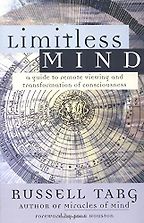
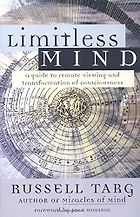
So, Russell Targ’s Limitless Mind?
He is one of the premier examples of a person in the domain of physics who has devoted his life outside physics to exploring parapsychological stuff – the sorts of things we have been discussing. He is one of the great experimentalists in this field and his claim to fame early on was something that touches on Schwartz’s field of remote viewing. He has published his research in journals around the world and shares our common theme – extending the bounds of consciousness outside the brain, body and present moment.
What kind of experiments has he done?
He will take two people and one of them will be focused on an image of a faraway location and this person will try to convey the content of the image to a distant individual who will register it in his or her consciousness and draw a picture of it or describe it. Then a computer will analyse whether there is a hit or miss. I think the evidence is overwhelming that people can convey information like this at huge distances in a scientifically controlled setting. There have been hundreds of these experiments, not just by Targ but by Professor Robert Jahn at Princeton University, and elsewhere around the world.
Give me an example of the premonitions you talk about in your latest book.
Well, I’m interested in those which have some sort of health relevance. I’m a physician so these things interest me. I use the example of Amanda, a young woman who had a terrible nightmare that a chandelier above her baby’s crib fell on the baby and the baby died. She couldn’t go back to sleep and she told her husband about it and he told her that it was just a dream. She got up and brought the baby into bed with them. Two or three hours later the chandelier in the baby’s room fell on the crib and totally destroyed it, but the baby was safe because she had acted on her premonition. This is a very common theme in premonitions – the mother-infant bond and the mother who simply knows that her child is in danger and intervenes to protect it.
What do you make of it?
Survival. This baby survives because of the mother’s premonition. We see this over and over.
But we also see it not happening over and over. Children die in all kinds of terrible ways.
Oh, of course. No human sense is 100 per cent accurate, even though we’d like it to be. Our visual sense is not as good as other creatures’, nor is our hearing. My personal belief is that if we made a place for this in our view of how we function as humans it could probably be developed and become much more reliable, but we are taught to dishonour it. People put down this sort of thing as crazy California woo-woo stuff and don’t want to have anything to do with it. But it is part of who we are and it won’t go away. We can demonstrate premonitions and we know this exists. Our task is to look at the evidence and make a place for it in our account of how human beings function.
June 18, 2010
Five Books aims to keep its book recommendations and interviews up to date. If you are the interviewee and would like to update your choice of books (or even just what you say about them) please email us at [email protected]
Support Five Books
Five Books interviews are expensive to produce. If you've enjoyed this interview, please support us by donating a small amount.

Larry Dossey
A graduate of the University of Texas at Austin, Dr Dossey worked as a pharmacist while earning his MD from Southwestern Medical School in Dallas. Before completing his residency, he served as a battalion surgeon in Vietnam, where he was decorated for valour. Dr Dossey helped establish the Dallas Diagnostic Association, the largest group of internal medicine practitioners in that city, and was Chief of Staff of Medical City Dallas Hospital in 1982. An education steeped in traditional Western medicine did not prepare Dr Dossey for patients who were blessed with ‘miracle cures’, remissions that clinical medicine could not explain. He has written a large number of books on ‘non-local’ consciousness and the power of the mind.
Larry Dossey
A graduate of the University of Texas at Austin, Dr Dossey worked as a pharmacist while earning his MD from Southwestern Medical School in Dallas. Before completing his residency, he served as a battalion surgeon in Vietnam, where he was decorated for valour. Dr Dossey helped establish the Dallas Diagnostic Association, the largest group of internal medicine practitioners in that city, and was Chief of Staff of Medical City Dallas Hospital in 1982. An education steeped in traditional Western medicine did not prepare Dr Dossey for patients who were blessed with ‘miracle cures’, remissions that clinical medicine could not explain. He has written a large number of books on ‘non-local’ consciousness and the power of the mind.
© Five Books 2024