Before we start talking about the five books can you define what you mean by terrorism because for some people this is such a loaded term?
Yes, I guess the definition of terrorism has been a big problem for some, but for me it is clear. For me it isn’t a moral term. In other words, I am not using terrorism to say that this is very bad violence. I see it as a technique of asymmetric warfare where, in order to press your attack against a powerful force that you are too weak to engage directly, you attack a victim who is dependent on your enemy.
The victim that you attack is not really a target of your terrorism; the target is the responsible government or organisation, so what you are doing is not just intentionally committing a crime but you are trying to create enormous fear by showing that the major power with which you have the disagreement is unable to protect the victim that you are choosing to attack, and you are also not restrained by ordinary societal compunctions. In this way you are trying to undermine the standing of your powerful enemy.
You are also hoping that they are going to respond with profound anger and aggression against you so that they lose their moral authority. The tactic of terrorism is a very specific technique of asymmetric warfare which can be used by all sorts of people, they don’t have to be religiously inclined.
“you are trying to create enormous fear by showing that the major power with which you have the disagreement is unable to protect the victim that you are choosing to attack.”
One of the things that I found in my work is that when you examine groups of people who use these tactics you find that they have themselves gone through a period as a group, of humiliation and profound disrespect and they have not found any other way of attacking back or righting what they regard as the terrible wrong done against them.
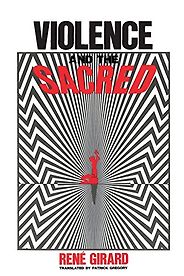
Thank you. Let’s start with your first choice, Violence and the Sacred by René Girard.
This is a book by a French professor of literature, which I came to many years ago when I was trying to understand the violence that we were experiencing in Northern Ireland. Girard had been analysing the novel – that was his particular literary discipline and background. What he discovered was very interesting. In the novels he analysed, people who appear to want to have someone or something did not do so because of something in the person or thing they desired but rather they were imitating someone else’s desire – the person who already had the desired object or person.
When my little boy was playing with Lego and his brother saw him playing with Lego, although he was never interested in the Lego before, now he wants it because his brother has it and then of course they get into a tussle because they both want it. Girard pointed out that this triangular relationship of desire as he called it was a very powerful thing because we are such imitative creatures. So, he said, if you don’t have any boundaries set down you will get violence, people will fight over these things because they imitate each other, including each other’s desires..
That led him to write this book and its central theme is that, because we are imitative beings, there will be violence and destruction unless we find ways of setting down boundaries such as law and culture and religion. That is why the book is called Violence and the Sacred. The boundaries that we put down are in some ways arbitrary. In addition they often create a situation where our group identifies one person who is then set outside the group and made a scapegoat. Everybody can happily turn their aggression against that person instead of against each other and, because that relieves the society of its internal violence, the scapegoated person becomes both a criminal and at the same time a saviour because they bring peace to that society. In the Christian faith Christ is so bad that he has to be crucified but by being crucified he brings salvation.
But you could argue that one of the boundaries being religion is a problem, considering the violence religion often causes.
Well, you see, that is exactly where he differs. What he is saying is that it’s not religion that causes the violence; it is when the religion no longer fulfils its function that violence occurs. It’s a little bit like football which many see as the way in which our society avoids having gang or even national warfare. The aggression of young men is put into the symbolic violence of a football match. People complain of violence at football matches but it is not the football that causes the aggression; rather the violence occurs when football’s symbolic function begins to break down. I think this is true more widely. When such things no longer fulfil their function then you have the violence, not fundamentally because they cause violence; after all, one can point to so many situations where religions works for the good of the community.
The important question is why does religion have the opposite effect at different times and places? I found his explanations interesting and stimulating and they were extremely helpful to me in Northern Ireland, trying to find a way forward. Some people from a liberal, tolerant background like mine said: ‘The only way to stop the problems in Northern Ireland is to get rid of all the churches and faiths.’ Well you can’t do that and, in any case, I discovered that the solution arose when people who did have religious faith and commitment were prepared to come together across the divisions and work with each other to bring peace, rather than when you try to put these important aspects of the human condition to the side. Girard’s work was quite influential on me in seeing that this was the wise way to work.
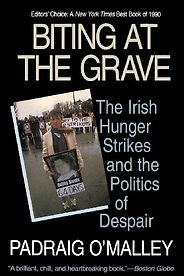
Let’s move on to your next book, Biting at the Grave by Padraig O’Malley.
This is an interesting book. You can imagine from the author’s name that he has an Irish background but he has lived and worked for many years in the United States. He started to write about the Irish hunger strikes in the early 1980s when there was deep frustration in the Irish Republican community that they weren’t getting what they wanted through the IRA terrorist campaign. A number of their volunteers who were in prison because of their involvement in terrorist crimes went on a hunger strike and some of them starved to death.
I remember this extremely well because I was just beginning to get into politics at the time. The first election I ever stood in was during the hunger strike and it was an incredibly polarising time. Some people became powerfully sympathetic to the Republican movement and indeed the current strength of Sinn Fein grew out of that period of struggle. Others, especially in the Protestant community, went the other way and they backed the British Prime Minister at the time, Margaret Thatcher. In Ireland it was really impossible for many people to understand how this woman, this mother who was also the mother of the nation, could fail to understand that these men were trying in their particular way to get something across. It wasn’t the fact that she didn’t agree with them or accept what they said. Rather it was something about the way that she reacted that worsened this awful time. Much of the politics of the next 20 or 30 years was determined by that.
Get the weekly Five Books newsletter
I came to know a few of the people involved when I was elected to Belfast City Council. One of the Councillors, Patsy McGeown, had been a hunger striker. When he had fallen unconscious his mother took him off the hunger strike but he never fully recovered and eventually he died as a result of the physical damage which had been done to his body during the hunger strike. What O’Malley did in working at this book was that every year for about ten years he tried to make contact with the families of each of the hunger strikers who died even though initially they wouldn’t speak to him.
Eventually, after about ten years, they started to speak to him and recount what had happened. What became apparent was the profound damage that was done to the families of the hunger strikers. Within the Republican community they were respected because of what their sons had done, and their sons would be part of the great pantheon of Republican volunteer martyrs, but actually the families were completely destroyed.
So it wasn’t just the people who went on hunger strike who were affected; it was their families as well. For me one of the things that was really important was this understanding that the people who engaged in terrorism (and in a sense this was terrorism against themselves, not that dissimilar to suicide bombing) were creating a very potent symbol which is part of a history and mythology of Ireland. If you could not get justice you could sit on your landlord’s doorstep and starve yourself and every time he passed by he would be confronted with you getting thinner and dying because of his injustice.
“…the people who engaged in terrorism…were creating a very potent symbol which is part of a history and mythology of Ireland”
What I came to understand through this book was the terrible damage done to the person and the community that engages in terrorist violence. From outside you may observe the terrible things they do to other people, but what you come to understand from this book is that there is something profoundly self-destructive as well, which is not being done because it is in their best rational interests; it is something much more regressive than that. O’Malley shows extraordinary patience in going back again and again – not looking at just the surface but trying to get underneath what was going on.
He then went on to similar kinds of work in South Africa and Iraq – trying to understand what was and is going on there.
Your next choice is Violence: Our Deadly Epidemic and Its Causes by James Gilligan.
As I was working in Northern Ireland, trying to understand why people from both sides felt their community had been disrespected and humiliated, I met a forensic psychotherapist called Estela Welldon, herself a distinguished author, who told me that my ideas were just like those of her American friend James Gilligan. He is a professor of psychiatry who had been responsible for institutions for the criminally insane on the east coast of the United States and he discovered that these men, when they did some terrible thing in a psychotic state, didn’t believe that they were doing something wrong. They believed they were righting a terrible wrong that had been done to them, but doing so in a psychotic way. They believed that what they were doing was actually exacting justice albeit in a terrible and horrible way.
Estela arranged for me to meet with James Gilligan and when we talked it became clear to me that what he saw in the case of individuals was similar to what I saw with whole communities. We have kept in touch and exchanged papers, but this book was profoundly important to me because its message is: ‘Don’t try to deal with such violence as a moral question of good and evil. It is like a public health matter which is hugely damaging to our society locally and globally.’ We don’t deal with cancer as a moral problem and when we begin to see violence in this new way it opens up all sorts of new channels to deal more successfully with violence, as he has demonstrated.
What about Blind Trust by Vamik Volkan?
This is another book by a retired professor of psychiatry, this time from the University of Virginia in Charlottesville. Like me, Vamik Volkan came originally from a divided island. He was born in northern Cyprus and he experienced the partition of the island and the violence of the time. He is Turkish and a Muslim by background. As a young man he went to the United States and became a psychiatrist and psychoanalyst working with individual people, particularly people who were psychotic. Because of his background he began to think to himself: ‘Haven’t I seen at a group level something similar to what I observe in these individual patients?’ It is the disturbed individual that you deal with in psychiatry, but where a whole community is disturbed by violence as in Cyprus or Northern Ireland the problem may be a group problem.
He started by looking at this in Cyprus but moved on to look at it in other parts of the world. He went to Kuwait after the first Gulf War to try to help with post-traumatic stress disorder and how to deal with the widespread incidence there. He began to look at how groups are influenced in a profound way often by distant historic events. Whereas you and I would regard something that happened in the 16th century as interesting but distant, for the community caught up in historic violence it is as though it happened last weekend. Time collapses between the distant past and the here-and-now. Such communities, he says, have ‘chosen traumas’ and more positively what he calls ‘chosen victories’ which have symbolic significance beyond the historical facts. The community leaders also become symbolically important and invested with enormous power in violent communities – which is why he calls the book Blind Trust.
Five Books aims to keep its book recommendations and interviews up to date. If you are the interviewee and would like to update your choice of books (or even just what you say about them) please email us at editor@fivebooks.com
Five Books interviews are expensive to produce. If you've enjoyed this interview, please support us by donating a small amount.