Your first choice is about The New York Times.
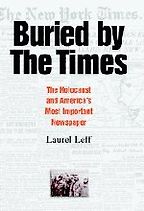
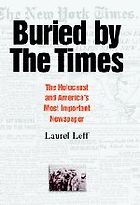
Yes. This is a study that Lauren Leff did, looking at The New York Times and how it handled its coverage of the Holocaust, and what she found is that, by and large, the newspaper did write about it but more often than not they placed the articles inside rather than on the front page and when the piece could have been longer it was shorter, and when it could have been authoritative it was less clear. She shows also that Arthur Hays Sulzberger, who was the publisher then, was himself Jewish but was an anti-Zionist, and had reasons for not wanting to come out for the Jewish cause.
What kind of reasons?
Sulzberger was reluctant to position the paper as supportive of Jews during a time of fairly entrenched anti-Semitism in the US. He valued assimilation, he chose to see his own Judaism as a religious belief and not a cultural identity. The other thing The Times did was to stress that the persecution and slaughter applied to many other groups, missing the slaughter of six to seven million Jews in its attempt to universalise the Holocaust.
Why?
I think news organisations are part of a difficult to grasp paradox: They rarely know how to deal with anything completely new. They’re best equipped to promulgate conventional wisdom. In The New York Times review of this book, Robert Leiter says that while concentration camps were nothing new, death camps were new. And it was ‘beyond the scope of rational thought’ to believe Germany had invented them on the scale they had. In other words, evidence schmevidence. What’s likely? That’s the question the reporter and his editor and his publisher are most amenable to asking. And if it’s not likely that something is happening, then the evidence, no matter how often it comes into the newsroom, will be treated with scepticism. Yet in the build-up to Iraq, because highly placed officials were granted more credence than dissenting lower-placed officials, there wasn’t enough scepticism. So, clearly, the degree of scepticism isn’t the heart of the problem.
“News organisations rarely know how to deal with anything completely new.”
Do people know about The Times’ role in this? Has there been an outcry?
Leff’s book came out in 2005 and built on the work of historians Deborah Lipstadt, who looked at all the news media who buried the Holocaust, and David Wyman, who started an institute to study the abandonment of Jews during the Nazi era not just in the news but by other institutions. So it’s a significant subject of scholarship, but it’s not a permanent feature of popular discussion about the media’s failings. It’s usually talked about in terms of what the Germans knew. There’s a wonderful speech by one of the Nazi judges in the 1961 film Judgment at Nuremburg, after almost every German in the film has contended they didn’t know about the death camps, and this character Ernst Janning says, ‘Where were we when our neighbours were being dragged out … in the middle of the night to Dachau? Where were we when every village in Germany has a railroad terminal … where cattle cars were filled with children … being carried off to their extermination? Where were we when they cried out in the night to us? Were we deaf? Dumb? Blind? Maybe we didn’t know the details. But if we didn’t know, it was because we didn’t want to know.’ I think his words apply to American reporters, editors and publishers during the Nazi era.
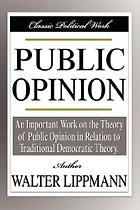
Tell me about Public Opinion by Walter Lippmann.
I can’t tell you how deeply I love this book. Some people get excited by Sex and the City but I get excited by Public Opinion. I could read you chapters on end and say: ‘This is brilliant and true!’ It was written in 1922 and is an insider’s view of how news is made. That is, news is a made thing. News is not facts. News is what is easiest for a reporter to recognise, not necessarily most important for the public to know – a kidnapping, a bombing, a court filing, anything that pokes up from the irregular and massive tissue of reality and events. For example, you could say: ‘Today there is a British Airways strike.’ But underneath that is a morass of barely detectable instances and feelings, a cavalcade of greed and human longing and anger. News is good at recording the overt act everyone can see but it’s less equipped to determine the how and the why of the event. One example Lippman uses is the Russian Revolution. He was fascinated by what he saw in the newspapers and how there was no reporting of the Revolution’s successes, partly because of censorship, propaganda, and the difficulty of the Russian language, but ‘the hardest thing to report is chaos’. I find this so familiar from my own reporting.
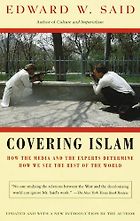
Edward Said, Covering Islam.
Edward Said is a despised figure to some of my friends and a hero to other friends. I pick and choose from his work. He’s most famous for Orientalism, a book which argued that colonial era European intellectuals streamlined their thinking and writing to fit various received and derogatory ideas about a place they called the East. There are exceptions to this, notably the Germans, but I’ll leave that be for now. A much smaller book of his is Covering Islam. There he talks about the ways in which journalists cover the Muslim experience. It came out in 1981 and he talks about the oil crisis, terrorism and the Iranian revolution. He was really the only voice at that time saying that some of ‘the pictures in our minds’ that Walter Lippmann wrote about as being media creations were, when it came to Muslims, either ‘oil suppliers or potential terrorists’. He also echoes Lippmann in his insistence that news is partial and dependent on official interpretation that may serve a private interest rather than a national interest.
It’s interesting that he also talked about The New York Times’ Judith Miller’s lack of training, how she didn’t speak Arabic and was ill-equipped to cover the Islamic world, but was probably among the most powerful journalists in the US covering the Middle East. Her methods and approaches were clear. She talked to high-level officials who used her as a mouthpiece. She lacked a street reporter’s scepticism and discernment. Edward Said was right – 20 years later Judith Miller’s scare-mongering reports on weapons of mass destruction were instrumental in preparing US public opinion for the invasion of Iraq.
Get the weekly Five Books newsletter
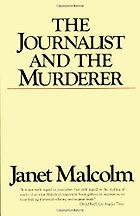
The Journalist and the Murderer.
This is Janet Malcolm’s account of the writing of Joe McGinniss’s non-fiction book, Fatal Vision. Basically, Fatal Vision was written using the immersion technique of spending a great deal of time with the subject to get to the ‘truth’ of the subject. There is a bias in our culture towards the non-fiction dramatic narrative, as we think it is closer to the truth than fiction because the books overtly make those claims. But we know, of course, to make non-fiction ‘read like a novel’ that certain realities have to be massaged and Malcolm picks apart the choices that McGinniss made to do this in his book about an accused murderer. His subject, Jeffrey MacDonald, was accused of murdering his pregnant young wife and daughter and he co-operated with McGinniss because he was going to be portrayed as the wrongly-accused innocent. But, in the course of writing the book, McGinniss came to believe that he had committed the murders and also discovered that he wasn’t interesting enough as a subject to describe his own inner life. This is a huge problem with non-fiction. I’ve done immersion reporting, only to find out at the end that the subject I’ve chosen is a lot less sympathetic than I had realised. Once, I discovered a woman I was following may have murdered her child in a case that couldn’t be prosecuted because of physical evidence that was difficult to definitively evaluate. So I had to start all over with another woman. At the time what Malcolm found was vexing and disputed, though now we probably admit to it, even though it is ignored by people choosing which book to read. That famous line – ‘Every journalist who is not too stupid or too full of himself to notice what is going on knows that what he does is morally indefensible’ – is an overstatement. Yet it stands for a deeper problem.
The premise that journalists must be morally pure seems to me bizarre.
But the truth is hard to get out unless you are a journalist who is willing to be a turncoat, like Janet Malcolm. I think Malcolm’s approach is a model for the future of how journalism might work on the Internet, where space is not at a premium, and hyperlinking can divulge the process of reporting. I think Malcolm’s book, as it says on its jacket, ‘both exemplifies and dissects its subject’. That’s why it is more fully ‘truthful’.
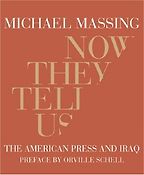
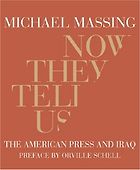
Now you’ve got Michael Massing’s book, Now They Tell Us. This is Judith Miller again, isn’t it?
Not entirely. The book is about how not only Judith Miller, but the whole American press, The Washington Post and The New York Times were complicit in promulgating the ideas of those policy makers who were making very undereducated guesses about WMDs in Iraq. The book champions the work of Knight Ridder, the media organisation whose reports about the dubiousness of the Bush administration’s claims were effectively buried and ignored, much in the same way as the Holocaust had been years before. At The Washington Post people like Walter Pincus and Joby Warrick were valiantly writing about the questionable aspects of the administration’s viewpoint on WMDs but their articles were buried inside and the front page was reserved for administration reporters who will go unnamed here, but who lost their way. It is not my job to name people but they are named in the book. In a democracy you can’t make a decision to go to war if the populus is informed by leading news outlets in such a shabby way.
Why, when we know we were deceived once, do we let it happen again?
It continues because so far there has been no workable alternative proposed to the way journalism has worked for the last 100 or so years. Though I hope the Internet may be able to change that. News organisations are still run by a group of men who have been penalised in circulation drops but who so far have resisted innovation.
In Britain our press is in a tradition of being read for entertainment. We don’t particularly expect it to be true. But in America the press is an arm of democracy and is assumed to be infallible. We are just reading for fun and edification, but our expectations of truthfulness are pretty low.
I read the British press online sometimes, and that explains some of your news organisations. You also have papers whose ideology is official and proclaimed. This is a left-wing or a right-wing paper and you know who owns which paper and what their views are. In the US we have a cult of objectivity but it would probably be more helpful to say: here’s the liberal view, here’s the conservative view. I’m not sure ideology, however, is the core of the problem. I think the press has been unwilling to lay bare its methods as it writes and reports. The speed of the Internet may force that. Instead of making definitive statements, reporters would be able to make provisional statements and identify them clearly as such. That way news organisations wouldn’t get dug into defending any one particular news account.
This interview was first published in 2010.
Five Books aims to keep its book recommendations and interviews up to date. If you are the interviewee and would like to update your choice of books (or even just what you say about them) please email us at [email protected]
Five Books interviews are expensive to produce. If you've enjoyed this interview, please support us by donating a small amount.