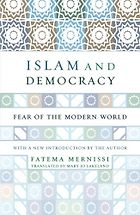
You’ve started with Fatima Mernissi’s book, Islam and Democracy: Fear of the Modern World
Islam and Democracy was published in 1992, following the first Gulf War, and the second edition came out in 2001, just after 9/11. So each time it was after a cataclysmic event of some sort. Mernissi is focusing on women’s claim to be citizens and how this sets off all sorts of fears among states and elites in countries like her own, Morocco, and also other Muslim majority countries, about what democracy will hold.
Mernissi is clearly extremely significant for our topic – do you want to tell me who she is?
Fatima Mernissi is a Moroccan feminist. She is a sociologist who studied at Brandeis in the US, and took her degree in the mid 1970s. And she produced one of the first books on feminism within an Arab Middle East and in a Muslim context – Beyond the Veil, which came out in 1975. This was a book in a secular voice, in parts even a secularist voice or one that takes an anti-Islamic stance. I think the distinction Moroccan cultural critic Raja Rhouni (whose book on Mernissi we shall discuss next) makes between ‘secular’ and ‘secularist’ is helpful. Mernissi was of the same generation as the Egyptian feminist writer Nawal El Saadwai, and the two of them really put second-wave feminism on the map in the Middle East. But in 1978 Mernissi published a book, which in one English edition is called The Veil and the Male Elite: A Feminist Interpretation of Women’s Rights in Islam. This was widely regarded as the first, or a pioneering book-length text of Islamic feminism, that is, using Islamic sources, the Qur’an and hadith (sayings and deeds of the Prophet Muhammad), and revisiting fiqh or Islamic jurisprudence in articulating understandings of gender equality and social justice.
Rhouni calls Islam and Democracy the third in what she identifies as a trilogy of Mernissi’s books engaging with Islamic feminism. And I can see why Rhouni wishes to classify it in that way, because here Mernissi is taking up Islamic arguments for claiming full citizenship, democracy, equality and justice. She is bringing together secular and religious arguments, and among the things she gives importance to is the need to reform Muslim personal status law as part of achieving democracy, because gender inequality was embedded in the Islamic-backed personal status laws and she sees equality in the family as part of equality in society. I find it very important that she makes the link between family and society, and equality in the family as a necessary part of democracy, very explicit.
So women’s rights and democracy in the Middle East are linked?
Yes, and Mernissi makes the point in clear, declarative sentences that democracy requires women’s active engagement across the entire spectrum of life issues – that is, in family and society, which she sees as a continuum. In other words, if women, as citizens, are not equal in all spheres and don’t enjoy their rights, then the whole project of democracy simply doesn’t work. And equally, democracy itself is a force that pushes women to engage in activism, in order to be able to practice their rights. Women have been catapulted into reading religious texts, to fight the regressive Muslim personal laws built upon readings of Islamic jurisprudence and also to make wider claims of the convergence between women’s rights, equal rights of citizens, democracy and Islam. Actually, when Islam and Democracy came out in 1992, the move to demand reform of the Moroccan personal status laws, the Mudawana, had already begun – starting in the mid 1980s – so that is also part of the bigger context in which the book emerges.
What I hadn’t appreciated before speaking to you is that in terms of women’s rights, on paper at least, as guaranteed in the 2004 revision of the personal status law, Morocco is actually the most advanced country in the Muslim world, partly thanks to Mernissi’s work.
Yes. The Mudawana is the most advanced fiqh-based family law in the Muslim world. It is built on an egalitarian model of the family, which replaces the patriarchal model. In the new law the wife and husband are declared equal heads of family. Also, while it doesn’t outlaw polygamy, the law makes it procedurally virtually impossible. The revised law gives women nearly equal rights to end a marriage, but not precisely in the same manner. However the model now is an egalitarian one, and not a patriarchal one.
Mernissi has been publishing books for about 35 years, and her books and writings have been widely circulated not only globally but also in Morocco, where they appear in both French and Arabic. And she has worked very collaboratively with other women, with a wide range of activists. She certainly has played a major role in influencing public thinking – for which, of course, she has also played a price. But when the political circumstances were right and there was political will from on high – and with all the important public work done by feminists in Morocco – the old patriarchal family law was turned on its head, with re-readings of Islam brought to bear.
Can you tell me a bit more about Islamic feminism, how it differs from the secular feminisms Muslims have created, and about using Islamic religious sources to further women’s rights? Does this mean Mernissi was analysing the Qur’an and the hadith closely?
Muslim women’s secular feminisms, which first emerged in the early decades of the 20th century – and I speak now of the Middle East: the countries around the eastern end of the Mediterranean and also Iraq – were called secular because they drew upon multiple discourses, including secular nationalism, humanitarianism, and Islamic modernism and were created by Muslims together with Christian compatriots. Two points are important to remember: one is that these secular feminisms built upon and extended these discourses – they were not trapped within them, as expounded by men, as sometimes has been alleged – and two, that secular feminisms included a religious dimension. Actually, even here in the United States, with our tradition of secular feminism, religion has been present. We can recall, for example, Elizabeth Cady Stanton and the Women’s Bible in the 19th century or later, during the second wave of feminism, when Jewish and Christian women elaborated what became called liberation theology. The idea that secular feminism is ipso facto non-religious or anti-religious in Muslim societies needs to be relinquished – repeating the allegations of detractors only plays into their hands.
Mernissi is hugely fascinating because she moved from using a secular feminist discourse and even in part a secularist or anti-religious discourse – explicated in her first book, Beyond the Veil – to finding in religion support for the feminist cause. Her book The Veil and the Male Elite played a huge role in putting Islamic feminism on the map. When I was in South Africa in the 90s I saw how enthusiastically Islamic activists – progressive Muslims, as they called themselves – had taken up Mernissi’s book. I also observed how ecstatic secular feminists in the West – Muslims and non-Muslims – were when Mernissi delivered a blow to misogyny draped in the clothes of religion; more specifically, the hadith, or sayings and deeds of the Prophet Muhammad. Well, Mernissi took up the tools of hadith analysis and unmasked various misogynist hadith as spurious. She used classical Islamic methodology to expose the misogyny fraud. She hit the mark, as such hadith have been used virtually on a daily basis to belittle, intimidate, and control women, all women – from the grassroots to elite enclaves.
A decade and a half later, Islam and Democracy pulled strands of her secular feminist and Islamic feminist discourse together, making different levels of argumentation in advancing the call for democracy. If she exposed the hurlers of misogynist hadith as bullies she unmasked the democracy obstructionists as fear-ridden. Democracy, Mernissi writes, ignites modern-day fears of individualism, fears of women, fears of the stranger (as the unknown) and the West. Mernissi, who along with ijtihad, critical independent investigation, and analysis of religious texts, also uses the tools of history and memory, reminds people that in the past there was lively intellectual debate and argumentation, spirited exchange among individuals, including women, and brings back to the fore the rationalist thought of the Mutazila in the 8th to 10th centuries. Fear was not the carte du jour. And regimes then were not more amused by independent democratic thinking then than they are now. Central to modern-day fears is fear of women – who are said to unleash fitna (violence and chaos) – a displacement operation if ever there was one. When women want democracy and announce it and are willing to fight for it, this strikes fear in the hearts of tyrants who discredit, and abuse the project and its protagonists, playing all the cards they can get their hands on, including the religious card.
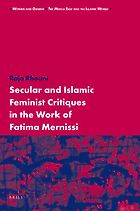
Let’s go on to your next choice – Raja Rhouni’s book Secular and Islamic Feminist Critiques in the Work of Fatima Mernissi.
Raja Rhouni, also a Moroccan, first learned about Fatima Mernissi around the time Islam and Democracy came out while she was a PhD student at Mohammed V University in Rabat – the same university where Fatima Mernissi did her undergraduate work. So Rhouni first came to know Mernissi during the moment of her Islamic feminist production. A cultural studies theorist, Rhouni undertakes the first study of the full corpus of Mernissi, who holds a special place as an articulator of both secular and Islamic feminism. Rhouni’s examination and deft analyses allows us to see in Mernissi – that is, in one individual – the movement from one register to the other and the palimpsest of feminisms. Rhouni’s book comes out at the moment we are trying to make sense of ‘the secular’ and ‘the religious’ in their changing meanings, porosity, and imbrications and, more specifically, in the context of Islam and gender. We are trying to understand more about how secularism and Islam reinforce each other, and how they are not necessarily in contestation, but also the tensions, complexities, and even apparent or real contradictions. In the process of providing her critique of Mernissi’s Islamic feminist production, and in visiting the work of other scholars, Rhouni advances what she calls ‘post-foundationalist islamic feminism’ (she uses the lower case in speaking of Islam to underscore that there is not one understanding of Islam but multiple constructions). In undertaking her analysis of Mernissi, Rhouni introduces us to what I argue is the second stage of Islamic feminism.
Tell me what you mean by a second stage of Islamic feminism.
Rhouni lays it out very nicely, moving from the first stage, which she characterises as foundationalism, to what she calls post-foundational islamic feminism. Foundationalism, she explains, is working within the classical Islamic tradition, using its tools – say, for example, in approaching the hadith to demonstrate that certain misogynist hadith are in fact spurious. Rhouni asks what if, using those traditional tools, you find out that some of the misogynist hadith are in fact accurate? Where do you go from there?
So Rhouni argues we have to get beyond the foundational approach and adopt a post-foundational approach. We have to develop new methodologies. We have to place the Qur’an in its historical context, and interpretations also in their historical context, as we ask our questions, make our observations and conduct our own readings of the scripture – which of course are done in our own contexts.
Now Mernissi does look at the specific conditions in which various ayas or Qur’anic verses were revealed, and in so doing she is following a classical methodology. But we need to take it further and look at the entire Qur’an and hadith corpus, and the body of Islamic jurisprudence or fiqh and figure out the broader historical circumstances – the cultural, economic, and political conditions in which meanings were extracted and elaborated. We need to remember that the society into which the revelation was introduced and the later societies in which Islamic jurisprudence was elaborated were patriarchal societies. Some of what is said in the Qur’an is spoken in a patriarchal language, to a patriarchal audience, and we must recognise this for what it is. At the time the Qur’an was introduced there was no concept of an egalitarian order, of gender, and in fact jins, the word for sex, is not found in the Qur’an or in classical fiqh. When we approach the Qur’an we need to distinguish between description – of historical conditions – and prescription.
This was understood by creators of first-stage Islamic feminist theory, but with the move to the second stage it is more fully explicit and distinct. There are principles that can be extracted from the Qur’an, such as gender equality, social justice, human dignity, but these are not norms embedded in the scripture, as foundationalists are prone to argue, but rather these principles or maqasid or objectives of the Qur’an, as they are called, serve as goals and inspiration along the path – the sharia that the faithful are enjoined to follow – what we can also call the trajectory toward higher levels of living. Quite simply, it is important to recognise that by now there are certain things that are permissible in the Qur’an that are no longer acceptable today. We need to just face this straightforwardly.
For example?
The big example is slavery. No one is going to go back to that, even though it is permissible according to the Qur’an. At the time of revelation, slavery was a widespread institution and the scripture provided a description of what was going on. The Qur’an recommends how to control it and ameliorate the practice of slavery. But in the latter part of the 19th century the idea of human bondage was not acceptable and laws were put in place to eradicate it. Post-foundationalism encourages dialogic relations with the Qur’an.
Which means?
Revelation was oral. The Prophet Muhammad was commanded to recite. People listened and they asked questions of the Prophet Muhammad. Then there was discussion and there were other revelations and more discussion. It was an ongoing conversation; people were trying to figure out: What does it mean? What does it mean for our lives? In short, how was it relevant? If it wasn’t relevant why would people opt to follow what they heard? If you adhere to underlying notion of foundationalism you buy into the idea that it has been understood what the Qur’an means for all times, the discussion is basically closed and you try to manoeuvre within this constricted space and heed its gate-keepers. In post-foundationalism, and more specifically post-foundationalist islamic feminism, the dialogue with the Qur’an is resumed. Of course it’s already all written down, it’s no longer in the process of being transmitted and there’s no Muhammed to interpret it. But this notion of reading and engaging and asking questions and bringing your own experiences to bear is part of engaging with the religion.
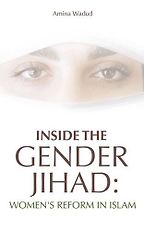
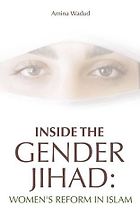
Your next book is Inside the Gender Jihad: Women’s Reform in Islam by Amina Wadud.
Wadud is a theologian with a PhD from the University of Michigan and a long-time professor of Islamic studies. The book of hers that I am eager to talk about is her second book, which came out in 2006. Her first book, Qur’an and Woman, is a pioneering text of Islamic feminism. She brings together new methodologies from the humanities and social sciences, especially linguistics, and she stays quite close to the text. She skilfully deconstructs the Arabic vocabulary and syntax in the Arabic, and, in that way, is able to open up complex meanings found in the texts. So when the scripture says, for example, it is possible for a husband to strike a disobedient wife, she can deconstruct that so that the literal meaning is dissolved. Or the idea that a husband has authority or qawwama over his wife. Such things can be explained away. It was quite revealing for many because she showed how, through careful reading, you could come up with multiple understandings and certainly to move away from facile literalism. And she took us quite far, but there are, of course, limitations to that approach.
But by 2006 she had got to a new spot and with the book Inside the Gender Jihad has moved from foundationalism into a post-foundationalist phase. She emphasises even more than before the need to contextualise, the need to engage in dialogue with the text and she doesn’t talk about equality as a norm in the text, but equality as a principle and justice as a principle – and how you can’t have justice without equality. She says we need to elaborate this more. The Qur’an exists, but meaning is extracted by us. She emphasises that gender equality is an unfinished project – it needs human intervention, strenuous human intervention. We need to struggle, we need to engage, to understand what is going on and not maroon ourselves in tired old literalist understandings of the Qur’an.
If we need to, we just have to reject what seem to be evident or literal meanings. If something seems to be against a notion of, say, justice – one of the maqasid or goals of the Qur’an – we just have to declare it and move on. So when the Qur’an says that if a wife is disobedient her husband can hit her, however lightly (as it might be interpreted), her answer is no. This is not acceptable; it is not acceptable according to the standards of our day and our context and we just have to say it isn’t – the same way as we did with slavery. She has this very nice phrase, ‘We are the makers of textual meaning.’ So we go beyond the foundationalist approach and re-make the textual meaning. The Qur’an is supposed to furnish guidance, it’s suppose to elevate us wherever we are, and we are now in the 21st century and we have understandings of equality that patriarchal ideas, institutions, and practices are subverting. We have to make meaning – or make sense – and we don’t have to get bogged down if there are spots in the scripture where it’s difficult to get our heads around. She stresses this idea that we have to look at the descriptive dimension of the Qur’an, the scripture’s description of a patriarchy and how to deal with it, and not to mistake description for prescription. Wadud is very inspirational to this rising generation of younger women and also gives non-Muslims a whole different way of grasping Islam.
Your next choice puts the spotlight on Indonesia, the Counter Legal Draft of the Compilation of Islamic Law, foreword by Siti Musdah Mulia, which came out in 2004.
Siti Musdah Mulia was the chair of the gender mainstreaming committee in the Ministry of Religious Affairs in Indonesia that was charged with coming up with what is called the Counter Legal Draft. She was part of a gender-mixed committee comprising legal experts and various teachers of religious studies, including some who are teachers at the religious boarding schools that exist at the grassroots level. The impetus for establishing the committee was mounting pressure to establish wider-reaching sharia, by which is meant an extended codified sharia, so as to move things along in a more conservative direction. Indonesia boasts the largest Muslim population in the world, but it also has a significant number of minorities – it’s a highly pluralistic society. So Indonesian Islam has had to develop ways of respecting those of other religions and diverse cultural groups and this really comes out, in my view, in the way they approach the Muslim personal status law and jurisprudence.
One of the things that the introduction to the draft law emphasises is the idea of basic equal rights of human beings and the maqasid or objectives of the sharia, sharia being literally ‘the way’ or path to understanding and living an elevated existence, in terms of practising such principles as justice, equality and dignity. So the framers of the Counter Legal Draft looked to the maqasid for overarching inspiration in proposing the legal reform of the family. Like the Moroccan revised family law, promulgated the same year that the Indonesian Counter Draft was published, it called for husband and wife to be declared equal heads of family. But the Counter Legal Draft has elements that are not found in the new Moroccan family law, such as mandating mutual obedience of spouses and adherence to the ideas of mutual obligations, duties and respect. And not simply the obedience of a wife to a husband. In classical jurisprudence, the male can extract obedience from a wife for all sorts of things, and if she doesn’t obey him she is declared disobedient and can be reprimanded, including being physically admonished.
Another important feature of the Indonesian document is that both women and men may marry non-Muslims. Nowhere in the world where Islamic law is codified, and certainly not in classic jurisprudence, is this allowed, though men may marry women of the book – in other words, Jews and Christians. The Counter Legal Draft calls for the ability of both genders to marry non-Muslims, and they don’t just confine it to people of the book, because there are lots of people in Indonesia – Buddhists, Confucians, etc – who are not people of the book.
Why shouldn’t a Muslim woman be allowed to marry a non-Muslim?
The argument for a Muslim woman not being allowed to marry a non-Muslim, is that in a patriarchal society, the man is head of the family. He can extract obedience at several levels and as head of family might pressure her to act in ways that might be against her religion. But of course when you have an egalitarian model of marriage, spousal equality, that problem disappears, because each individual will be an autonomous individual deciding his or her own religion.
The last point not dealt with elsewhere is equal inheritance. Gender equal inheritance is another important step forward that made it into the Counter Legal Draft. And it will probably take quite some time for all these things to find their way into law. But it is a vision, it’s a template for an egalitarian model of the family within an Islamic framework.
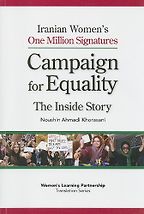
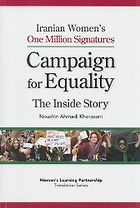
Lastly, you’ve selected Noushin Khorasani’s book, Iranian Women’s One Million Signatures: Campaign for Equality.
Noushin Khorasani is an Iranian activist and one of the founders of the One Million Signatures campaign to get signatures for a petitions to revise all sorts of laws, particularly the family law, to make them gender-equal. Khorasani, like Mernissi, emphasises the question of citizenship; she talks about the new citizen and how citizenship has to be gender-equal in law as well as in practice.
Her book is a splendid set of articles, almost a case study, of how to build a social movement in the 21st century in order to effect legal change. So if the Indonesian document is the vision, this book is about how to achieve results through a broad social movement. And it’s especially compelling because the million signatures campaign is very much a grassroots movement. Volunteers fan out over the countryside, in urban areas they go across class divisions. All kinds of people come on board. As Khorasani emphasised, simply by circulating a petition there’s a lot of spreading the word about the basic ideas and demands, and it’s also about engaging with the folks who are signing and finding out from them what they think, what they want. And so it’s a constant putting together of people’s demands and questions. It’s very organic – not top down in the usual sense, even though, of course, there are steering committees, organisers, etc. So that’s pretty exciting and inspiring.
So much criticism is levelled against all kinds of feminist and equality movements for being elitist and to some extent these criticisms are well founded, and also to some extent it’s very difficult for these movements not to be elitist. But this movement in Iran is very much connected with the broader population. As Wadud does in interpreting the Qur’an, Khorasani stresses the necessity of connecting with people’s lived experiences in order to achieve social justice. Khorasani points out that the demands for legal reform come from what people need in their daily lives, what they suffer in their daily lives. So the legal reform movement is very pragmatic, demand-based, and non-ideological – and informed by the needs and desires of the broad population.
Khorasani relates how just before the presidential elections of last year there was a convergence of women’s movements, voicing their demands. They contacted the two major opposition candidates, Mousavi and Karroubi, and asked them to take a stand on their positions on legal reform and equality for women. The convergence between the million signatures campaign and the election campaign was impressive. She stresses: ‘We’re not interesting in testing who is religious or non-religious; we’re pragmatic and non-ideological, and we can focus on achieving results.’ Khorasani says quite simply that there’s a choice to be made between democracy and dictatorship.
So they did they get a million signatures?
They were steaming ahead but then they were stopped. The problem is that last spring repression was getting beefed up even before the elections and then afterwards the campaign was muted – it was silenced by the government. It seems only to be dormant and, like so much else, the word has spread and hopes that have been raised cannot be erased just like that. Repression, as terrible as it is, is not eradication. Khorasani’s book of this vast movement helps us see that.
On the back of your own book Feminism in Islam it says that many in the West regard feminism and Islam as a contradiction in terms. Is this notion being expelled? To what extent are the people we talked about today widely known among Muslims as well as non-Muslims? Do you think Islamic feminism is gathering momentum? What can we say about gender equality and social justice in Muslim societies?
The Muslim world, as we know, spans the globe today way beyond the older Muslim societies in Africa and Asia, so Muslims and Islam are present in the West as well. I think more and more of what we’ve talked about – these new egalitarian ideas about Islam – are getting into the Muslim mainstream as well as into other worlds. But there is still more ignorance than knowledge or exposure to new ways of thinking about Islam and gender out there. Even when introduced to the new ideas about Islam, many Muslims and non-Muslims, for their different reasons, are often resistant to this new thinking. Many initiatives have stalled, conservatism is even more rampant than before and many governments in Muslim majority countries are clamping down, claiming security concerns. There’s state repression – as Mernissi says in her book, fear of democracy big-time – and a vast gender-reactionary sea is sweeping through these societies.
So in the short term, things are very, very difficult. But I am at heart an optimist, and there is another sea swelling – other currents moving in a different direction. In spite of all the repression and reactionary intransigence there are also very strong insistent movements for democracy – as we see in the case of Iran – and people are using religious and secular arguments to open up space for democracy. So I do think repressive regimes and patriarchalists of all stripes, wherever they are, and whether secular or religious, feel and fear the death knell. They know their hoodwinking is laid bare and that their power and privilege is highly endangered – because no genie, especially the genie of justice, can be put back in the bottle.
Five Books aims to keep its book recommendations and interviews up to date. If you are the interviewee and would like to update your choice of books (or even just what you say about them) please email us at [email protected]
Five Books interviews are expensive to produce. If you've enjoyed this interview, please support us by donating a small amount.