The bestselling author of Cod and Salt tells us about five science books he loves—from whales and snails to evolution and string theory—all of which make difficult subjects accessible
As someone who teaches writing to other people, what skills do you need to write elegantly?
First of all, you have to have an elegant mind. You have to be able to reason things in an elegant way. You really just need to be honest and straightforward, and then try not to write.
Try not to write?
Yes, I always tell students to try not to write. Very bad things happen when you try to write. It becomes too forced. You need to say what you have to say, and tell the story. It is the literary equivalent of what some people do in the plastic arts. They advise people not to think. You can’t write without thinking, but don’t think about writing.
It doesn’t. I write fiction and non-fiction, and to me it is almost the same process. I even do research for my fiction. The only difference is that with fiction you can control the story. Life doesn’t always write a story as well as it could be written. On the other hand, sometimes it writes it better than you could ever imagine.
How do you come up with the topics for your books, from cod to salt?
I get asked this a lot. I guess the implication is that I write about odd things. What makes my books eclectic is that I write about what interests me, and I’m interested in a lot of things, fields and kinds of writing. I have to think that it’s a great story, and a meaningful story. Contrary to what people imagine, I don’t try to come out with odd things. But I always enjoy the challenge of doing something different. And I always like to think that my next book will be nothing like my last book.
What is your next book?
I have a book coming out in the spring which is a biography of Clarence Birdseye, the inventor of industrial frozen food. You could argue that he was odd! He was an adventurer in very physical ways. He harpooned whales. He travelled out west on horseback for his biological survey in 1910, when it was still really the wild west. He went fur trapping in Labrador [Canada]. And he was attracted to ideas. He would look at a problem, at the way something worked, and try to come up with a better way.
How did he come to invent modern frozen food? His name is best associated now with the “Captain Birdseye” brand of frozen fish.
Initially, he had a job with a fishing association. He became concerned with the fact that fish was not arriving in urban markets in very good shape. That was his original thought. Then he remembered that in Labrador – where he had brought his wife and son along – the diet was very limited because there wasn’t much fresh food in winter, nothing grew, and there wasn’t even much of a fishery because it was iced in.
What he did to provide fresh food year round for his family was freeze everything – which was very easy to do in winter time in Labrador, when the air was well below zero. He would hang food up in the air, freeze it solid and pack it in barrels with snow. He never really thought much about it when he left Labrador, but then when he was confronted with this problem of the quality of commercial fish, he remembered it and started applying it to fish.
So was he a fisherman or a businessman?
There was definitely a commercial aspect to him. He was born in 1886, and 19th century American inventors – as opposed to 19th century European inventors – were very much entrepreneurs. The idea was to get a patent and build a company out of it. That’s what Bell did, that’s what Edison did. Theoretical inventing was a European thing. Einstein even complained about that. He said that Americans don’t care about theory, they just want to make money out of it. Which is why so many things that Europeans invented made Americans rich.
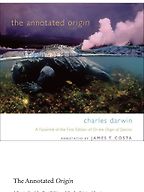
You have chosen five science books which you describe as having an elegance of thought which is science writing at its best. Let’s start with Charles Darwin’s On the Origin of Species, which sold out on the first day of its publication in 1859.
Yes, and it keeps selling. It is one of the most important books written, and I always urge people to read it. The book is more than just the theory of evolution. It’s an exploration of how the entire natural order works. And without understanding how the natural order works, you can’t understand environmental issues or how to solve them.
It is disturbing to me how many environmentalists have never read it. It explains the natural order better than anyone else ever has. It addresses biodiversity long before the word was invented, and climate change, and has some fundamental messages that we need to understand, such as the fact that everything that happens changes everything else. It is a starting point for understanding how everything works. Towards the end of the book Darwin says, “There is a grandeur in this view of life.” And there is. It is so magnificent the way it works.
Is Darwin readable?
Oh, Origin of Species is very readable. It muses on a lot of things, and progresses in the way that a good mind thinks. He will take on a very complicated idea by talking about a very simple observation in a neighbour’s farm. It’s always making the point that things are observable. And Darwin was a wonderful writer. He wrote in a very simple, honest way, talking about the heath in Staffordshire and running across an area where there were fir trees. He very clearly lays things out, and he lets the elegance of the natural order he is talking about shine through. It is the wholeness of his ideas and the completeness of his vision that make it readable.
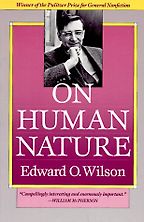
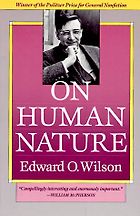
Your next choice, On Human Nature by Edward O Wilson, has been described as one of the most important nonfiction books ever written.
I wouldn’t argue with that description. When I was selecting this book it was a bit of a struggle, because I am a big Ed Wilson fan. I have met him and had a fascinating two-hour conversation with him. I have read about 10 books of his, so I had to struggle to choose because there were a number of great candidates.
On Human Nature is an absolutely fascinating book, in which a biologist applies the laws of nature to understanding things like the urge for religion and the impulse for altruism. He writes fundamental things about how we work and tries to explore the biology of these things, which are so central to our understanding of human beings but which seldom come up in the field of biology. Wilson has such an interesting mind, and also is a wonderful writer. Actually he is the only writer to have won two general nonfiction Pulitzer prizes. His style is almost poetic. There is a real beauty to the way he writes, and a love of his subject that comes through.
What specific aspects of human nature is Wilson interested in?
I personally have had interesting conversations with him about the impulse to violence. He’s a pacifist – opposed to violence – but he is very misunderstood on this because he also holds the belief that humans are hard-wired for violence. He talks about what he calls the natural fallacy. The natural fallacy is that because something is imprinted in nature, it necessarily means that that’s the way things ought to be. Like Wilson, I couldn’t disagree more. If you followed the natural fallacy logically, we shouldn’t even wear clothes because that’s not in nature.
Wilson says that we have to evolve our thinking about violence, that we can’t afford it – especially with the weapons we have. He’s an ant expert, and he says that if ants had nuclear weapons, the world would last two seconds. So because humans do have nuclear weapons, we can’t be thinking like ants.
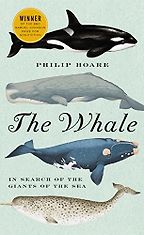
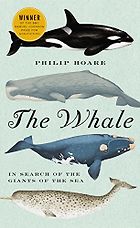
Your third selection is Philip Hoare’s book The Whale.
This is a wonderful book. It is about the whale, and everything about the whale – its history, its myth and its science. Whales are huge and compelling, and Philip Hoare’s excitement about them comes through. It is also a very handsome book and very nicely illustrated. Everyone talks about what the future of books will be because of electronics, and I have this theory that the future of books is beautiful books. Books that you would want to look at and touch and own. This is that sort of book.
What are some titbits that we learn about whales from it?
We learn a lot about their lives but we also learn about the lore of whales – why they have always been important to us, and what throughout history has been thought about them. The crowning example is Moby Dick, which inspired Hoare to write his book. Moby Dick was in many ways about a mythological version of whales. As Melville intended, it tells us more about us than it does about the whale. It’s about hysteria really – concepts of evil and our hysterical reactions to them.
Whales are the largest animal, as far as we know, to have ever been on earth, which is itself fascinating. They’re just so huge. They communicate, I shouldn’t say verbally but auditorily, through sound. We don’t really know what these sounds are. Maybe they are words. But it’s clear that they make sounds and the sounds are communications, telling other whales information.
Hoare isn’t a scientist, he is a biographer who has written about people like Noel Coward and Oscar Wilde. Is that biographer’s style reflected in this book?
Yes. I think in many ways his style is similar to mine, because he comes at things in so many different ways. I may have influenced him, I don’t know! I get sent books all the time that I am supposed to like because they are sort of like my books. But this one I actually did like. He covers so many different fields. It has a sense of science, but also of literature.
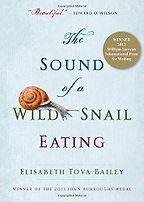
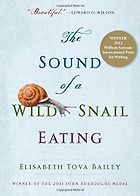
Next up is Elisabeth Bailey’s The Sound of a Wild Snail Eating, which is actually autobiographical.
This is the autobiographical story of a woman who gets ill with a mysterious virus that totally incapacitates her for years. Somebody brings her a violet in a pot which has a snail on it, and she becomes fascinated with this snail. And she starts to learn everything about snails, which are not what you would have as the usual household pet. It is an engaging story of snails, which is surprising. This is also an example of a book that you would want to have in your library, because it is such a handsome book and nicely illustrated. It is a beautiful little book which is written with a real gentleness and is very enjoyable to read.
It is almost like a meditation on life.
By starting with something so small and seemingly so simple, it gives you this great understanding. Darwin made the point that the beauty of evolution is that so much springs from things that are so simple.
She ends up looking after these snails and studying them. At one stage the snail lays eggs, and she thinks she may be the only person to have ever recorded observations of a snail tending to its eggs.
Yes, and then at the end she releases them into the wild. Most of us certainly don’t watch snails that closely. However there was a big storm this summer, and after the storm my 11-year-old daughter discovered all these snails on her door stoop, and she became fascinated with them. I haven’t told her anything about this book but perhaps she should read it.
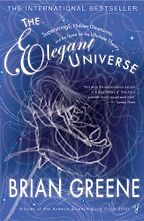
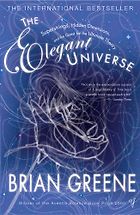
The only contact I seem to have with snails is trying to avoid standing on them the morning after it has rained. Your last choice is a much-lauded physics book by Brian Greene, The Elegant Universe.
I love this book. In more years than I want to add up of journalism, I have talked to people in every walk of life imaginable – movie stars and athletes and politicians. I find that the most interesting people to talk to are scientists, but the problem is that they are often not that articulate, and difficult to understand. So when you get a scientist who can explain things clearly it is a real opportunity. Brian Greene writes well, and he explains things clearly in plain English.
The book is about string theory, but not exclusively. It’s really about what’s been going on in physics since Einstein, and also does a great job of explaining Einstein. He makes quantum physics and Einstein’s theory of relativity really make sense, so you can understand something which nobody seems to understand (the big discovery was that the speed of light never changes). Quantum physics is almost 100 years old and we still talk about it as something new and incomprehensible.
He talks about such complex subjects. How does he manage to make them accessible?
By writing in accessible language, and explaining things in a very clear step-by-step way. It is kind of what I did in WorldWithoutFish, where I was writing for children and I covered fishery issues which nobody understands, because they speak in a weird language. So I used normal language, I explained things step-by-step, and what I found is that adults have been reading my book too, because they also need that explanation. That is what Greene did with physics. We all know that people like Einstein and Niels Bohr were geniuses, but he explains why. He also manages to capture the excitement of re-thinking the universe. Fundamentally, what you need to do clearly in both fiction and non-fiction is convey a passion and tell a story.
Why don’t we just leave science writing to the scientists?
I would love to leave science writing to the scientists. When scientists can write – like Brian Greene – it’s wonderful. There’s nothing better. But the truth is that most scientists can’t write. So somebody else had better do it.
January 24, 2012
Five Books aims to keep its book recommendations and interviews up to date. If you are the interviewee and would like to update your choice of books (or even just what you say about them) please email us at [email protected]