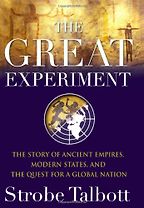
Your first choice takes us back to the past with Strobe Talbott’s The Great Experiment: The Story of Ancient Empires, Modern States, and the Quest for a Global Nation.
This is a curious book because its author, Strobe Talbott, is a very old friend of mine and in some ways a similar sort of practitioner and theoretician of globalisation, in that after a long career writing for Time magazine he went to work for his old Oxford roommate Bill Clinton, and ended up the Deputy Secretary of State. As such he really understood the hidden back-story of modern politics, which always gets shoved out of view by the more familiar story of nation-states.
So Strobe went back to the beginning, to the Greeks and the Romans, to show that there is a whole kind of alternative narrative of world history, which is of abortive efforts to form political organisations that operate above country level. He has done, at a much more academic rigorous level, what I sought to do at a kind of anecdotal personal level in my book, which is to say that this prism of looking at politics through the nation-state misses out a lot.
So what do you think people should be focusing on?
It is not that you should ignore the nation-state, but going back a very long way people have realised that one should also be trying to look for forms of organisation which transcend the state. So whether it is trading arrangements or other treaty arrangements over many centuries, people have always been struggling for cooperative ways of working together which aren’t just limiting themselves to nations.
But, in practice, it is difficult to make that work. We are seeing this played out with the situation in Libya, where France, Great Britain and the U.S. are all trying to work out what role the UN should be taking and not necessarily agreeing.
But you can also look at it through the other end of the telescope, because, in fact, Britain, France and the U.S. for different reasons – the first two because they didn’t have the capabilities in a sustained way, and the U.S. because it has other commitments – actually weren’t willing to do this alone as countries. They were determined to do it through a global arrangement, the UN Security Council, and Obama spent much of the week leading up to the action insisting that the U.S. would only be part of it if the rest of the world was on board.
Do you see that as a turning point for the UN?
It has had a reasonable start, but it is a resolution which, like so many UN resolutions, has found forms of words and phrases that people can agree on but it doesn’t necessarily reflect a coherent political strategy or even an operational military one. It is good as far as it goes and it serves its immediate objective, which was stopping Benghazi being turned into a Srebrenica. But what it didn’t offer was a strategy for the international community to give Libyans the right to choose their own government, so I expect they will have to circle round and come back to this again.
Let’s move on to your next book,
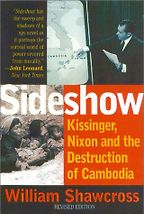
Sideshow: Kissinger, Nixon, and the Destruction of Cambodia,
by
William Shawcross.
This is the book that my generation, interested in Indo-China, grew up on. It is an astonishing story of one small country’s attempt to move itself from an absolute kingship system of government to a more democratic constitutional monarchy. It was aborted because it got sucked into the Indo-Chinese war because the North Vietnamese military were using it as a means to infiltrate South Vietnam. It was subjected to a brutal bombing campaign by the U.S., which caused many casualties. One of which was a more pluralistic future for Cambodia. This essentially got bombed out of the political culture and the country became highly radicalised under the Khmer Rouge, so to me it was a book which pointed the way to the vital importance of democracy as a way of building some kind of middle road between Maoism and an absolute monarchy or military dictatorship, which seemed the two extreme choices.
And how does this move towards democracy help with globalisation as a whole?
I see globalisation as having come from two interlinked phenomena: one the rise of national democracy, and on the heels of that market liberalism became the preferred economic doctrine. These two together have had unintended consequences, which were that they facilitated the rise of globalisation. Liberal market economics particularly was a vehicle for global integration. Protectionism was reduced and the state share of the economy brought down as well. Having helped father globalisation, national democracy has been threatened by its own offspring. Because so many issues have migrated from a national level to a global level, you need a global democracy not a national democracy to provide some kind of accountability.
So what about the U.S.’s role in globalisation – what do you see that as and what do you think it should be?
U.S. policy has always been a mixture of altruism and self-interest. The altruism goes back to a Roosevelt, Woodrow Wilson strain of emerging international engagement, which is around a value-based view of these things, where democracy and capitalism are seen by Americans as their two most important exports. Democracy because it provides freedom, and capitalism because it is seen by Americans as the best way to create prosperity and economic opportunity. But behind that altruism is a much more self-interested opportunistic commercial strain, which is American companies enjoying access to global markets through globalisation and often on terms and conditions that America as the dominant power has set.
That mixture of altruism and self-interest is very similar to what fuelled the British Empire and pretty much every other system of economic global relations that we have seen over the centuries.
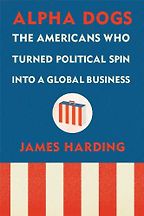
Let’s look at America a bit further with your next book, Alpha Dogs: The Americans Who Turned Political Spin into a Global Business. by James Harding. This is really looking at the rise and fall of the Sawyer Miller Group. Who were they, and why were they so important?
The Sawyer Miller Group was a political consultancy firm and I was one of the partners in it and as a result I feature heavily in the book. After Cambodia I came to believe that countries needed to have this democratic middle way choice and I came to realise that the way to help build competitive democratic politics was through working as a hired adviser to leaders struggling to prevail in a democratic context. Democracy was going to succeed if strong leaders embraced it as a means of coming to power and accepted its value and its disciplines. So I had almost ten years working with different candidates and parties in various countries to help to bring this about.
Five Books interviews are expensive to produce. If you're enjoying this interview, please support us by donating a small amount.
I think I could have actually made it into the Guinness Book of Record as someone who had worked on more elections in more different countries than anyone had ever done in the history of humankind at that time!
What were some of the more memorable ones?
Corazon Aquino in the Philippines, Yeltsin in Russia, Mario Vargas Llosa in Peru, presidential candidates in countries like Colombia, Bolivia, Argentina and Eastern Europe. My first was the Philippines and Cory’s success gave me the consultant’s moniker as a winner. I was a hot ticket. The first one I did after Aquino was the ‘No’ campaign in Chile.
So you chose the people you worked with carefully to fit in with your political beliefs?
Yes, and they chose me equally carefully because they liked the idea of someone who had a clearly progressive commitment to like-minded, democratic leaders, who were often fighting authoritarian regimes.
Presumably you must have had your critics who felt that you were brains for hire meddling with internal foreign matters?
That is right. But I think I left the business just ahead of the critics. When I was doing it, it was rather glamorous and exotic and these were the first elections in countries moving from authoritarian governments to democracy. I was a little bit of a Robin Hood figure. I myself started to grow sceptical as more and more of these big American political consulting firms started to pour into this space and the fees became a real burden on the cost of politics.
And they might not have had so many scruples about who they worked for.
Yes, and I therefore hung up my sword and moved on to work for the World Bank. I did that because I felt I had taken this democracy thing as far as an outsider could and secondly I thought that economic reform was critical as well.
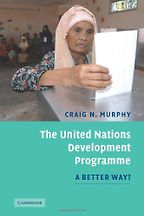
Your next book looks at another big organisation you have worked for – this is Craig N Murphy’s United Nations Development Programme: A Better Way.
This was a book written about UNDP, an organisation which, when I was its head, was 40-something years old, and he wrote about its history from the beginning. I encouraged him to write it because I felt it was an extraordinarily important but unknown development agency.
It is the central network that coordinates the work of the UN in various developing countries around the world.
Yes, and it is a significant organisation in its own right, now with an annual budget of over five billion dollars and offices in more than 160 countries. They are very much the core of the UN in terms of development. It was considered a friend to developing countries whereas the World Bank was viewed as much more a donor-driven organisation. It gave me a chance to apply my thinking about democracy and development through the extremely sympathetic vehicle of this organisation because developing country leaders listen to it. And this book is a history of how UNDP had always tried to find a more subtle, gentle, pro-developing-country view of development versus the more Western institutions like the World Bank.
But there is a big backlash in that lots of people are critical of the way the money is managed and many think that developing countries should be allowed to help themselves with more grassroot initiatives.
There is. It is partly a backlash that periodically comes at time of economic hardship at home. Suddenly the grumbles of an anti-development assistance community gets a lot more resonance when public spending is under general pressure and cuts. Nevertheless, developing countries should have much more control in their own decision-making about how resources are used. And the idea they should set their own development priorities has always been the UNDP way.
So would you prefer for countries like Afghanistan and Haiti to have more control over their aid?
Yes, and there is a second advantage to UNDP when we talk about countries like the two you have just mentioned, in that it is much more able to get on the ground and work directly with them and provide the capacity they lack to implement decisions when, like these two, they have weak institutional capacity in the government.
Your final book is Jeffery Sachs’s The End of Poverty: Economic Possibilities for Our Time.
All these books are drawn from people that I have worked with over the years. Jeff came to me when I was head of the UNDP and we were talking about how we could get this real injection of political energy into achieving the so-called Millennium Development Goals. These goals promoted the basic global safety net of halving poverty, getting every boy and girl at least into a minimum of primary education and so on by 2015. He said, ‘What about if I assemble the world’s best experts and we cost out what it would take.’
Get the weekly Five Books newsletter
So he did this exercise for the UN and it gave a huge plausibility to achieving the MDGs because it brought them from being just some empty, unrealistic ambition to something doable and practical. That work later became a big part of this book. It is a wonderfully powerful manifesto of how providing a basic global social safety net is an affordable and achievable objective.
That fills out my vision of an accountable global society because it needs this kind of social safety net. My whole thesis is that it needs to be accountable and have something in it for everybody – even the poor. Jeff’s book shows it is doable in an economic sense, and that is a very important building block in all of this.
Five Books aims to keep its book recommendations and interviews up to date. If you are the interviewee and would like to update your choice of books (or even just what you say about them) please email us at [email protected]