The best books on Religion versus Secularism in History
recommended by Martin Marty
The professor of religious history says that though the world may seem to be increasingly secular, the growth of Christianity and Islam in some places disproves it. He chooses five books that fuel the debate
Before we start on the five books I think it would be helpful to find out what you personally think about religion versus secularism and how it defines our lives?
Dietrich Bonhoeffer, the Lutheran pastor and theologian, makes a good case for dealing with this contrast. The world seems to be increasingly secular or ‘this-worldly’ and yet if you look at the growth of Christianity in the poor world or of Islam, there appear to be many signs of more religiosity than ever.
Why do you think that is?
People in many cultures – including in the United States – turn in their search for meaning to religious symbols and communities, unsatisfied as they are by science-only explanations.
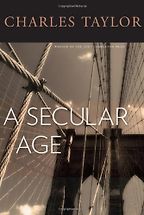
Very interesting. Let’s turn to your first choice, A Secular Age by Charles Taylor, which traces the processes of secularisation in the modern age.
Charles Taylor, a Canadian Catholic philosopher, is among the most notable thinkers on these themes in North America these days. This is a massive, almost 800-page book that really attracted attention and debate. He argues that most can’t really make sense of the modern world or life today without some version or other of religion. He defines religion very broadly. He is not pointing to Christianity or Judaism or any other faith to carry all the meanings, but instead speaks in the broadest sense of how the human relates to the transcendent order, to that which is ‘beyond us’ etc. This is not what you normally expect from a philosopher. Taylor is running against the grain of much modern philosophy, since it has dispensed with such matters. He gave me a lot of reason to rethink some themes in the book I was writing about Dietrich Bonhoeffer’s Letters and Papers from Prison.
What kind of things did he make you rethink?
The notion that the 18th-century Enlightenment and its heritage had pretty well finished things off. In other words, if you reach back to the Middle Ages of Catholicism and the Anglo and Continental reformations of the 16th century, religion dominates. For instance, when the Protestant reformations were over the church was still established in England and most of Europe for centuries. The Protestants were doing the same thing that the Catholics had done before them. They couldn’t conceive of a society in which God didn’t rule through the rulers. But then came the Enlightenment – the great burst of scepticism and criticism in a time when philosophers and scientists took over and offered a new kind of accounting of the world. Most stressed the empirical, which meant that you had nothing to say unless it was based on something you could see or touch or smell. Such an outlook was predominant from the 18th century onwards, in the 19th century taking more radical forms and in the 20th century even more so. Moderns take that for granted. Bonhoeffer looked out on that world and dealt boldly with it.
I am Christian and yet I know that if I want to communicate many kinds of things I do them without reference to a transcendent order. Taylor, without naming him, challenges Bonhoeffer’s description of this ‘world come of age’. He finds that to be a very unsettling settlement because it is hard to provide a basis for our decisions. What is good and what is true and what is beautiful when all is only a matter of our own emotions? Somehow or other we have to pay attention to deeper stirrings. I think Taylor’s thoughts have presented a challenge to this ‘secular’ side of Bonhoeffer.
So this book has really stirred up your community?
Oh, yes. Many universities are having conferences on it and elaborating on its theme. Sometimes he repeats himself but the second time around you learn something you didn’t the first time. You are never going to be quite as ready as before to lean back into a simple scientific agnosticism. Taylor is not preaching a sermon or setting out to convert you but he does want to raise deep questions as to whether we have mastered the world the way we thought we did two centuries ago.
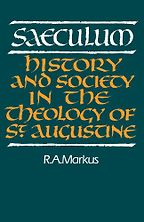
Your next book looks at one of Christianity’s great thinkers, St Augustine. R A Markus’s book, Saeculum: History and Society in the Theology of St Augustine, explores how his ideas relate to the world he was living in.
Almost everyone who confronts this slim 47-year-old book testifies that it brought a fresh understanding of the monumental ancient Christian thinker, St Augustine. Why, you may ask, should he show up when we are trying to make sense of the world around us, and, in the present case, of Bonhoeffer’s letters? Well, what Augustine argued was quite radical. We think of him as one of the four or five greatest Western Christian thinkers, one who is not shelved in the ancient world but who still frames much thought of people who have never heard of him. This book’s title deals with the saeculum, the Latin word for ‘this age’.
Augustine took up his theme with an effort to secularise Roman history. His world, 400 years or so after Christ, was a world where many still evoked the old gods of Rome by citizens who saw Rome as sacred. But Augustine said, no, the state may be a wonderful human invention, which needs criticism. So he dealt in undercutting ways with the old political order and ‘civil religious’ order. He in effect wrote a ‘charter for Christendom’, a view of civil and churchly power which lasted for centuries. But if Bonhoeffer was critical at the end of Christendom, Augustine also had concerns for ‘the city of God’ at the beginning of Christendom. The Christians who now ruled did what the Romans had done: they persecuted the dissenters. They tried to coerce people to become Christians. The legacy lived on for centuries.
Augustine trained his eye on his important distinction between what he called the eternal city and the other, the human city. The eternal city was the one in which God ruled through the Christian message, to save people and make them moral and all the rest, but he did not think it should be used to rule over the human city. So in a sense he gives autonomy to the human city.
Augustine remains a very controversial figure. A lot of people think because Augustine was not a modern feminist or a republican or something like that he isn’t relevant. But actually he is part of all the reading we do in these realms. In the United States, for example, we talk a great deal about the separation of Church and State. The notion that you can have a republic without forcing religion on people was really quite radical. Very few of the people who founded America had been ready for this separation. Then came the Bill of Rights, which says that ‘Congress shall make no law respecting an establishment of religion or prohibiting the exercise there of.’ The people who wrote it may not have known that these ideas went back to Augustine’s concept of the secular. The same God who ruled the church is the God who is also among people who don’t know about God. It is a very radical notion.
So the concept of a secular world has been around for a lot longer than many of us thought and someone like St Augustine still has an impact on us today.
That’s right.
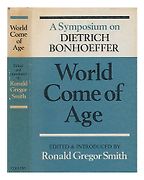
In your next choice, Ronald Gregor Smith’s World Come of Age: A Symposium on Dietrich Bonhoeffer, you want to concentrate on one chapter in particular, by Hanfried Mueller. Why?
Readers today may be surprised to find out that a substantial interpretation of Bonhoeffer came from the Marxist author Mueller, in a book never translated but condensed in Smith’s book. Its author intended to shock people who knew Bonhoeffer as a Lutheran Christian theologian and participant in church life. Mueller helped make Bonhoeffer, for a time, the favoured theologian in Communist East Germany.
The ‘world come of age’ was one of the main terms Bonhoeffer used to describe his time. The German word was Muendigkeit, which means adulthood. Bonhoeffer thought the world had become adult, which meant it could strip away so many things that people thought were important for faith and life. Using this version of Christian themes, he argued that one could follow the concept of the ‘world come of age’ and get rid of the trappings of the church and live happily ever after.
But if he was a Christian, why did he reach that conclusion?
Bonhoeffer was killed before the war ended. He remained faithful to the moment of death to his faith and advocated a trimmed-down church and world-friendly Gospel.
Do you have some sympathy for Bonhoeffer’s theories?
I have very much sympathy for very much of Bonhoeffer’s thought, but consider his view of the adulthood of the world to be, shall we say, naive, and it is hard to picture the theologian throwing Christian means all overboard.
After studying Bonhoeffer and writing about him, what is the one thing about him that stands out for you?
What stands out first is his courage, for he came to know that Hitler’s people would not tolerate what he stood for, and, second, that he was picturing and working for a way of being Christian without all the trappings.
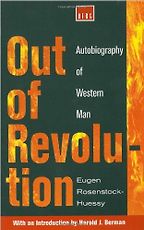
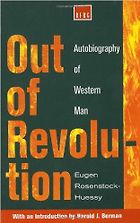
Your next book is all about the theory of history – Out of Revolution: Autobiography of Western Man by Eugen Rosenstock-Huessy.
Many people might think of this as a strange choice, but it strongly influenced my interpretation of Bonhoeffer.
Once again there is a particular chapter you have gone for in it: ‘Farewell to Descartes’.
Yes. Let me provide the background. Eugen Rosenstock-Huessy was a Jew turned Christian who appreciated both Judaism and Christianity. He wrote a great number of influential books. The poet W H Auden, for instanced, penned a preface for him. Eugen Rosenstock-Huessysays that the very things that Hanfried Mueller isolated and favoured about the world’s secularity bring their own problems.
For Rosenstock-Huessy, Western Enlightenment thought since the great philosopher Descartes brought mixed blessings, and he believed that Descartes should not have the world to himself. He looked at learning as it developed in the West in three successive frameworks. The first is ‘Credo ut intelligam’, ‘I believe in order that I might understand’, saying that squares with Augustine. The second saying moves from theology to science and scepticism. Descartes discovered or proposed ‘Cogito ergo sum’, ‘I think, therefore I am.’ Rosenstock-Huessy says, if the first phrase in isolation led to ignorance, the second one leaves you alone in the world. Writing in World War I, he said that the instruments of science can lead to great problems. For example, the same thing that gives you a cancer cure can also give you murderous mustard gas. He offered a third view, which I think matches Bonhoeffer’s communal impulses – this imprisoned letter-writer needed company! This phrase was ‘Respondeo etsi mutabor’, ‘I respond, though I will be changed’.
When he spoke about the wrong turn with Descartes, what does he see as the best way of getting back on track?
You get back on track by interaction. His own writing is very much getting away from pure academic thought. He doesn’t think people can learn by just sitting in a library and reading. He was very eloquent about this. There are a couple of lines that are very moving. He says:
‘Historians and economists and psychologists cannot stand the idea of not being “pure” thinkers, real scientists. What a frustration! I am an impure thinker. I am hurt, swayed, shaken, elated, disillusioned, shocked, comforted, and I have to transmit my mental experiences lest I die. And although I may die. To write a book is no luxury. It is a means of survival. By writing a book, a man frees his mind from an overwhelming impression. The test for a book is its lack of arbitrariness, the fact that it had to be done in order to clear the road for further life and work, and to encounter each other.’
So it was with Bonhoeffer’s letters, as edited by his friend Eberhard Bethge. And that life of dialogue and interaction is so exciting today when the religions have to interact with each other, and not always militantly but so that they learn from each other. So there is a great openness in this tradition about learning from each other. And this is part of Bonhoeffer’s tradition as well.
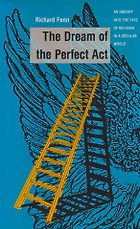
Your final book is Richard Fenn’s The Dream of the Perfect Act: An Inquiry into the Fate of Religion in a Secular World.
I think the subtitle of this book gives you a clue as to why I included it. Fenn believed that humans and society are always dreaming of what he calls the perfect act. That would mean the ‘total thing’, where humans will have all the answers. Fenn thought that this impulse usually showed up in worship when people are addressing or bowing or somehow interacting with someone they cannot see. This could be Yahweh or Jesus or Allah or any other form of religion. Your dream is always to get to that total package of understanding everything. Fenn believes there were certain times when that nearly happened. He sees people being nostalgic about what never was ‘real’.
He thought that we were nearly in the range of that in times like that of Augustine. Fenn says that the theory, really only a dream, will be approached through ritual. Thus in the United Kingdom, once upon a time everyone was supposed to be ruled by one rule. But he now knows that in a free world you can’t go back to that. It’s a book about what people show they think is needed, but in the end can’t be gotten. The only way to approach it is through fragments. You can find meaning in your own soccer team or club or your own nation. But that sort of thing frightens us, or should, because nations are often a big part of the problem of taking over and giving us meaning along the way. Bonhoeffer knew the problems of this very well because he was in a plot to kill Hitler. For him the Nazi realm needed to be resisted.
Bonhoeffer, through his life and letters, passed judgment on all ‘total’ concepts of human endeavour, such as worship of the state. I think one reason he made less of ritual – even though he respected arts and common life – was his fear of ‘totalism’ – as in totalitarianism and fanaticism.
April 19, 2011
Five Books aims to keep its book recommendations and interviews up to date. If you are the interviewee and would like to update your choice of books (or even just what you say about them) please email us at [email protected]
Five Books interviews are expensive to produce. If you've enjoyed this interview, please support us by donating a small amount.
Martin Marty
Martin E Marty is Professor Emeritus of Religious History at the University of Chicago. He is the winner of the National Book Award and the author of more than 50 books. He has recently written a book about the work of the German theologian Dietrich Bonhoeffer.
Martin E Marty is Professor Emeritus of Religious History at the University of Chicago. He is the winner of the National Book Award and the author of more than 50 books. He has recently written a book about the work of the German theologian Dietrich Bonhoeffer.