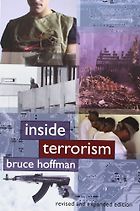
Let’s start with the Bruce Hoffman book.
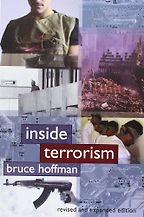
The Hoffman is a terrific introduction to the issue of terrorism. It is a foundational book for anyone who wants to understand terrorism and the War on Terror.
How does he define terrorism?
Well, this is a problem. The UN cannot decide on a definition for terrorism and there are probably ten definitions, of which Hoffman discusses a variety. He brings together all the theories in a coherent narrative. I want to encourage people to read this book for themselves, but, for example, he describes the difference between an insurgency during a conventional war and a terror attack. He is writing on a fairly theoretical plane, but he does give examples. He looks at al Qaeda especially, and he sets the stage for thinking about terrorism with new definitions and ways of thinking about it.
He talks about the difference between religious and political terrorism and says that religious terrorism is far more dangerous and the terrorists are more likely to use extreme violence because there are not as many curbs on what they can do if God has commanded it.
Hoffman represents one side in a continuous debate about al Qaeda. He argues that al Qaeda is a coherent terrorist group, a group with politics and an ideology, willing to commit acts of terror to achieve its goals. Hoffman would say that it is al Qaeda and groups like it that present the most serious threat to the United States today.
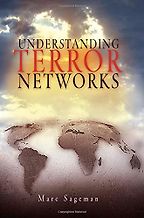
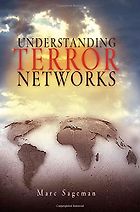
Marc Sageman, on the other hand, says al Qaeda is a loose network, small groups of guys hanging out, not in the pursuit of an objective or a political goal but just satisfying the demands of their small social network even if that includes carrying out acts of terror.
That sounds more like it to me. What do you think?
I think this is a problem you get when you are looking at an organisation from above and below. Both are true. If you look at any phenomenon that involves leaders… Take Communism, for example. You had small groups of revolutionaries who called themselves Bolsheviks and had a coherent political philosophy for which they were willing to fight. That doesn’t explain, however, why Joe Smith in America decided to join the Communist Party. He could have had all sorts of social and economic reasons for joining which, again, do nothing to describe where the Bolsheviks come from or what they’re up to. So the two theories are not contradictory. They only seem contradictory if you say: mine is the only theory and yours is wrong.
Do people say that?
Well, I’m not going to name anyone individually, but academics can be that way sometimes.
Have we covered Sageman?
No. I would like to add that Sageman offers an explanation for individual motivations for terrorism. He looked at 400 European members of terrorist organisations and asked them the questions you’d expect – about poverty, lack of opportunities, lack of education. The responses showed that the terrorists had more education than was average, belonged to a higher socio-economic class and had more opportunities, not less. That is the revolutionary thing about Sageman’s work.
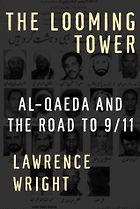
Tell me about The Looming Tower.
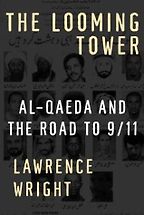
This is a fantastic account of the origins of al Qaeda, the individuals who laid the foundations of the organisation and why they carried out 9/11. It is the best work on the origins and development of al Qaeda in the 1990s. He uses interviews conducted in the 1990s and he also uses captured documents and materials that he integrated after 9/11. The government started releasing documents after 2002 and I’m going to use a lot of them for my next book.
The other thing about Lawrence Wright is that he has a very compelling writing style. He shows in a very comprehensive way that the al Qaeda groups had a very coherent concept of what they hoped to achieve and that they were doing all this completely under the radar – only a handful of Americans knew what was going on. The fervour on the one hand and the ignorance on the other is startling.
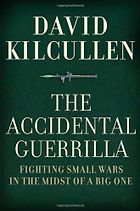
And now you’ve chosen David Kilcullen’s Accidental Guerrilla.
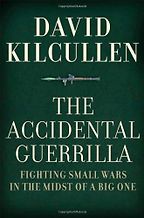
Kilcullen writes from both a theoretical and an experiential point of view. His background is in anthropology and he’s interested in ‘full spectrum strategies’, that is, taking everything into account from social situation and tribal dynamics up to what the US calls kinetic operations. He is interested in why we’ve had guerrilla warfare and insurgencies in the middle of what seemed to be a regular fight, a conventional war. Why did it happen in Afghanistan after the Taliban seemed to be defeated? He writes about the War on Terror writ large, looking specifically at Iraq, Afghanistan and Indonesia on which he is an expert. Kilcullen also has a continuing relationship with the military, which allows him access to the battlefield.
So why do we get guerrilla war in the middle of conventional war?
One argument is that the US continually misidentifies the insurgents with legitimate and local aims with the wider network of al Qaeda – we treat them all the same instead of trying to peel off those with local issues and grievances. So we can blame the US. If we had dealt with the local grievances we wouldn’t have this insurgency problem. The US had a ‘one size fits all’ attitude to jihadist groups for a while. Many groups had no intention of carrying out attacks on us.
Kilcullen provides a good look at counter-insurgency tactics too – he was one of a group who advised General Petraeus in Iraq and helped developed the current counter-insurgency theory. So what’s going on now are attempts to peel off insurgents from the Taliban and al Qaeda in Afghanistan, following their ability to peel off some insurgents from the al Qaeda guys in Iraq.
And it works, doesn’t it?
The trouble is that in Afghanistan the people who are willing to have conversations with the US and are willing to do deals are those who have lost influence and power. So if you make an agreement with them they may only have 200 in their tribe rather than thousands handing over their arms. It was the same thing in Iraq, where the US was having conversations with leaders who were only willing to talk because they had already lost out to al Qaeda. The al Qaeda people seem to have made a more successful appeal to the younger generation than the US did. I’m not saying that offering amnesty doesn’t work, but in Iraq it was more that al Qaeda was so awful, committed so many terrible atrocities, that people turned against them because of that – not because of US efforts.
Kilcullen talks about the need to Clear, Hold and Build. You provide security first and you have to be there persistently. You can’t clear out the bad guys and then leave, because they will be back. This is something that can take years. You also train the locals to hold, to take over when you do leave. Kilcullen is big on population-centric warfare rather than enemy-centric warfare. So you secure and protect the population rather than going after the enemy. After you have held, then reconstruction and development, the build, can begin. This gives people a reason to support you and to support local governance that will take your place when you leave.
That sounds good.
But where insurgency is succeeding it is very difficult to make an appeal over that success. You have to make the argument that you are going to win and that you will win and stay around and not just leave soon, like in 2011 for example!
So, more troops for longer?
Yes. The average time for a counter-insurgency to take effect is eight to ten years. You might get the wrong idea in Iraq because you might count from 2003, but, in fact, the counter-insurgency didn’t start until 2006-7, so the US should have a full presence until 2013 or so. Let alone Afghanistan, where they’ve only just started.
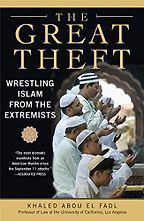
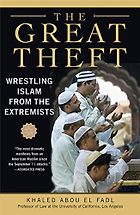
Tell me about The Great Theft.
I can recommend everything that Khaled Abou El Fadl has ever written. He has written great books on tolerance in Islam. His view is that extremists have hi-jacked his religion, and he presents an alternative, tolerant version of Islam. There is an argument going on in Muslim communities about whether or not a reformation, a revival of Islam is needed. He is the person to discuss this – he is educated in Islamic law, theology and jurisprudence and it would be great for people to read this book and to see that there is a push-back within the Islamic community against extremism. He has the background to give him authenticity and authority within Islam.
The extremists used to have a fringe, cult-like thing about them, but they have spread very successfully because al Qaeda and other groups like that have made arguments to people who don’t have the education to counter them. Surveys in Europe have shown that the people most likely to be radicalised are those with no religious training or background, because they have no inoculation against the arguments.
Five Books aims to keep its book recommendations and interviews up to date. If you are the interviewee and would like to update your choice of books (or even just what you say about them) please email us at editor@fivebooks.com
Five Books interviews are expensive to produce. If you've enjoyed this interview, please support us by donating a small amount.