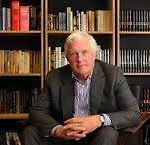
Before we get to your recommendations, Agatha Christie’s books are probably still the bestselling novels of all time but, by all accounts, she was a very humble person. As her grandson, could you tell us what she was like?
She was a lovely grandmother because she didn’t stand out at all. She never tried to be famous or act a part. When she was with the family, she was just normal and loving. She was a wonderful listener and always more interested in hearing what other people were doing than telling them about her success. I often think we could do with more of the former and less of the latter today. She was just marvellous. I’ve been involved in her business—books, television and film—for quite some time now. I frequently ask myself how she might respond to a particular issue today. I think she would have accepted the challenges of computers, modern communications and all the different visual representations of her work.
Tell me how you chose the Agatha Christie books for this list.
Choosing five was virtually impossible. The only thing I give you credit for is that it’s easier than choosing one. I’ve always been a huge fan of the early Miss Marples, so I’ve chosen one of those. And one Poirot. I’ve also picked my favourite book that doesn’t feature those characters. After that we have a short story, which gives me an opportunity to talk about her plays. Finally, I’ve chosen a biography. I think the sum of those gives a fair representation of what she achieved during her long career.
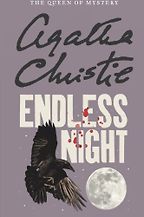
Your first recommendation is Endless Night, first published in 1967. It’s not that well-known, but it’s a real page-turner.
The book is about three young people; my grandmother was well into her 70s when she wrote it. As a young person myself in the early 1960s, I saw more of my grandmother than at any other time because I was studying at Oxford, not far from where she lived and worked at the time. I used to take my friends to see her, often for Sunday lunch, and I think I even took my first girlfriend. She didn’t seem like an old person at all. She was always interested in what we were doing and fascinated by our relationships with each other. She never judged us. There are, fortunately, no characters in Endless Night that she ‘copied’. But she does say somewhere in the book that it’s all about relationships. To me, it’s an astonishingly modern and human book. To write about people 50 years younger than herself was a tour de force. And that’s quite apart from the plot. It also illustrates her belief in evil as a force in the world.
The plot is great, very twisty.
Yes, though you could say that about many of her books. I would have chosen more than five if you wanted all the ones with wonderful plots.
It’s true. I’ve read a lot of mysteries and thrillers in my time and, plot-wise, I really don’t think anyone has ever managed it better than Agatha Christie in her books. People do try, but…
It’s one of the reasons her books have stood the test of time. My wife died five or six years ago and I’m now married to someone much younger, with nephews in their early teens. They love Agatha Christie books, and it’s not just because I’ve entered their lives vicariously.
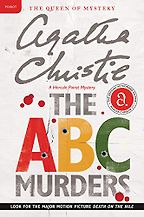
Your next choice is The ABC Murders. You’ve chosen the unabridged audiobook, read by the actor who often plays Captain Hastings, Hugh Fraser. I really enjoyed listening to it in the car with my kids. Why’s it on your list?
I thought it would be nice to have an audiobook. Agatha Christie is one of the very few people to have sold more unabridged audiobooks than abridged ones. That says something about the quality of her writing and the difficulty of abridging detective stories. You can’t leave out the red herrings. Hugh Fraser reads it wonderfully. In many ways, it’s the most complicated challenge Poirot faced. When you come to the end, you really do put down the book and say to yourself: ‘Why on earth didn’t I think of that?’
There was always a copy of the ABC railway guide beside my grandmother’s telephone. I’m sure that’s where the story originated. I can see her sitting there, talking to one of her friends and staring at the book, the plot forming in her mind. It’s always been one of my favourite Poirots. It had a very good TV representation by David Suchet.
Is it true that Agatha Christie got rather fed up with Poirot?
Yes. It’s common knowledge she wrote her last Poirot in the 1940s, in which he comes to a sticky end. Her agent and publisher persuaded her to put it in a drawer and it wasn’t published for 30 years. Part of Poirot’s attraction is that he is irritating and pedantic. He likes his boiled eggs the same size and he’s dandily dressed. If you’re writing about someone like that, he’s probably going to get to you. The other reason she found him tiresome was nothing to do with him at all. Her mind was so fertile. She was constantly thinking of plots and stories, most of which weren’t suitable for Poirot. She was dying to get those written down. She would ring up her agent or publisher in the 1940s, the era in which the Poirot books were at their most popular, and one or the other would say: ‘It’s wonderful, Mrs Christie, but couldn’t you write another Poirot instead?’ I think that annoyed her too.
She wrote many wonderful books without Poirot or Miss Marple in them. Not only Endless Night, but also the book she was most proud of, Crooked House. She was desperate to write more stories like that. Life was a constant struggle, throughout the 50s, to write the books she really wanted to write.
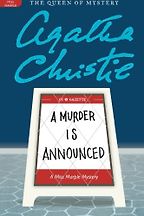
Let’s move on to your next Agatha Christie book, A Murder is Announced.
I’ve chosen this because it’s a great Miss Marple. It features my favourite murderer. He or she—I’m not going to reveal the plot—behaves predictably one moment and unpredictably the next. The setting is an English country house in a village: classic Miss Marple territory. It’s got what all good books have: a wonderful ending and a wonderful beginning. Film producers have rung up and said: ‘We’d like to buy the rights to A Murder is Announced.’ But when it comes down to it, all they really want is the beginning and to go away and write their own stories. Of course, we don’t allow that.
Remind me how it starts.
An advertisement appears in the local newspaper: ‘A murder is announced and will take place at 6.30pm at Little Paddocks’. She must have seen a quirky little notice like that and thought: ‘If I just changed it a little, it would make a wonderful beginning to a story.’
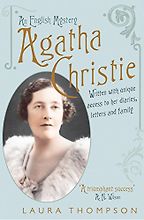
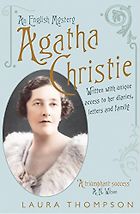
On to Laura Thompson’s biography, Agatha Christie: An English Mystery. You chose this rather than one of her two autobiographical books.
I’ve partly chosen it because it was being hatched around the time my mother died. I acted as her confidante, though I can assure you I didn’t influence the biography in any way. It’s such an intelligent book. Better than anyone else, it understands the way her mind worked and how she saw her work. In particular, Laura gives a telling analysis of the books my grandmother wrote under the pseudonym of Mary Westmacott and how they related to her life. No one else has done that.
The greatest compliment came from my eldest daughter. I’d inadvertently left a pre-publication copy at her house. She rang me up three days later and said: ‘I’ve read Laura’s book. I couldn’t put it down. It told me so much about my family that I didn’t really know or understand.’ The book convincingly explains my grandmother’s famous disappearance. It fits that into her life in a quiet and unassuming way, without making it terribly dramatic or taking up too many pages. I think Laura understands unhappiness. It’s a very honest and successful analysis of the various phases, some difficult, of my grandmother’s life.
Would you say that, on balance, and despite these difficult periods, she was a happy person?
Yes, I think she was. And if there was one place that encapsulated that happiness it was Greenway in Devon, the house she bought in the late 1930s. That was where we spent our family summers. From late July to early September, we all congregated there: family, close friends and her second husband Max Mallowan’s archaeological friends. It’s a lovely part of the world and we recently gave Greenway to the National Trust. If you find yourself in south Devon, you can go and visit. It’s one of the most beautiful places in England. She loved relaxing there and she loved her food. She didn’t drink alcohol. By that stage of the year, she had done her archaeological dig and had usually finished her current book, though she occasionally corrected proofs. But this was family time.
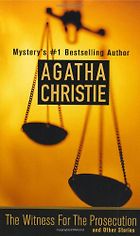
Tell me about Witness for the Prosecution.
It’s unquestionably the best short story she wrote. It’s better known as a play, written after the book in the 1950s and performed in the West End just after The Mousetrap. I think Witness for the Prosecution is one of the truly great theatrical murder mysteries. It has an ingenious twist, it’s daring and adventurous. If you ever see the play, put yourself in the position of the writer and ask yourself how anyone could bring it off.
My grandmother found the business of constructing mysteries for the stage fascinating. It was the one time she almost lost her shyness because she was completely absorbed in what she was doing. I remember how involved she was with rehearsals. She stuck to her guns and kept the plot the way she had written it. She wouldn’t listen to anyone who told her it was impossible. On the first night at the Winter Garden Theatre, there was a huge ovation from the audience. She was sitting in a box overlooking the stage. It was the only time anyone saw her take a bow.
I really enjoyed listening to it as a dramatised audiobook, it’s just so clever, but I’ve never seen it. Is it on anywhere now?
We did a tour of it in the United Kingdom last year. And we’ve just put on another play, Verdict. Particularly in the provinces, her plays are hugely popular because they are about entertainment and puzzles. Whatever your age, they are great fun. Witness for the Prosecution was also a successful film, directed by Billy Wilder.
So she was very shy.
Unbelievably so. I think it all stemmed from the unhappy time in her life when she lost her first husband and mother in quick succession. It was the time of her notorious disappearance. She also felt rather hounded by the press. She hated being recognised in restaurants, much preferring the company of family and close friends. The idea of doing a book-signing tour would have been a complete anathema to her.
Why do you think Agatha Christie’s books have been so incredibly popular?
It’s a question I’m often asked. She wanted to write things that people enjoyed. Perhaps she provided people with a means of escape from things in their own lives. I think she sometimes had hospital patients in mind – she used to be a nurse – and people on long journeys, which she often took herself. She didn’t talk as much as most people. She spent a lot of time listening and observing, which comes out in the books. Although they may appear ordinary when you first meet them, her characters are very shrewdly drawn; they feel real. The other thing that makes her books hugely attractive is that they are much shorter than many written today. Your concentration doesn’t have to be endless. I’m constantly gratified that the magic still works. The final thing I want to say is that, however much you try to analyse the success of Agatha Christie’s books, there is something in them that no one fully understands. That, I think, is what genius is all about.
Five Books aims to keep its book recommendations and interviews up to date. If you are the interviewee and would like to update your choice of books (or even just what you say about them) please email us at editor@fivebooks.com
Five Books interviews are expensive to produce. If you've enjoyed this interview, please support us by donating a small amount.