Insects outnumber us, outweigh us, and without them ecosystems would collapse. In short, we live on their planet. The entomologist explains why we should value bugs more – even, or especially, the carrion beetles and dung feeders
It was quite unexpected. I spent much of my childhood terrified of insects. I was a real entomophobe but I was interested in every other aspect of biology. As an undergrad at Yale I placed out of introductory biology in my first semester, so in the second semester I was ready to take an upper-level course. Literally the only one that could fit my schedule was called “Terrestrial Arthropods”. I figured: All right, fear stems from ignorance, I’ll take this course. I ended up completely enamoured of insects.
What would you say to people who reflexively swat or step on insects?
I teach a general education course for non-scientists here called “Insects and People”. Proper pedagogy requires that goals be stated at the start of the course. My goal is for students to stop and think before they swat, squash or dismember any arthropod.
Life on this planet, if it were possible, would be miserable without insects. Insects are the premier partners of flowering plants. Plants are rooted in the ground so when the time comes to find mates and reproduce sexually, they’re stuck. About three quarters of the 240,000-plus species of flowering plants rely on an animal partner. The vast majority of those animal partners are insects. So the majority of flowering plants would not be able to reproduce without insect assistance – which means the majority of terrestrial communities essentially wouldn’t exist without insects.
Insects outnumber us and they outweigh us. It’s basically their planet. They probably have the greatest adverse economic impact of any particular class of organism, but they also contribute benefit disproportionate to their number. Insects are really more instrumental to the day-to-day functioning of the earth than we are.
I look forward to learning more as we talk about your five books. Let’s begin with a memoir by entomophile Thomas Eisner.
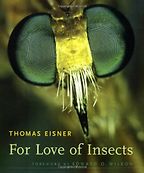
Tom Eisner was a member of my thesis committee and a major inspiration to me. He really lived the life of a “curious naturalist”. This is a phrase that Nobel laureate Niko Tinbergen introduced for those of us who derive research questions from what we observe in nature. Tom was uncanny at seeing things that other people missed. I think of him as a superhero. His superpower was what I call “nature vision” – he saw things in nature that most of us miss.
Tom’s interest was chemical communication. You can’t see chemicals but you can see their mark in the morphology of organisms. One example is his revelatory work with the rather ordinary and unloved European cabbageworm – one of the most dirt common insects in North America. It’s an invasive species, on wing from early spring until fall. They feed on crops so they’re not particularly welcome in anybody’s garden. These caterpillars were familiar to every entomologist and thoroughly studied, but nobody ever bothered to ask why they were covered with little hairs that have glistening globules at the end. Tom asked, and found that what made the hairs glisten on this otherwise unimpressive caterpillar was an undiscovered class of chemical defence compound.
Please tell me more about what For Love of Insects is about. If a reader were to pick it up what would they find inside?
They would find an abundantly illustrated autobiographical account of Tom’s life and his scientific explorations. It’s a compelling read for many reasons. He led a very interesting life and he had an amazing eye – not just for odd bits and pieces of insect morphology but also for the beauty that is easily overlooked in the arthropod world. He was a superb photographer and even developed methods to capture images that people would otherwise miss.
The examples he uses are familiar to biologists because they are in introductory biology textbooks. They are brilliant examples of what evolution can do given time and opportunity. He writes in this book: “I spend a fair amount of time looking around, I already knew as a boy that if I wanted to see things happen, if I wanted to win the revelatory lottery in nature, I had to buy a lot of tickets.” That really captures the position of a curious naturalist – if you want to understand natural history, you need to be out in the field.
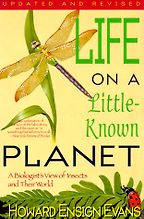
Let’s move onto Life on a Little Known Planet. Written in 1966 by Harvard entomologist Howard Ensign Edwards but updated in the 1990s, this seems like an accessible introduction to the insect world.
The organism Howard Ensign Edwards mainly studied was the wasp, but in Life on a Little Known Planet there are essays on cockroaches and crickets and fireflies. Some of the stories I tell my class today I first learned about in this book, which was given to me by a classmate when I was an undergraduate at Yale. The same copy still sits on my shelf.
Howard Ensign Evans was absolutely masterful at describing the majesty of the insect realm, the ways entomologists study insects and the ways insects have been incorporated into human culture since ancient times. The book is a killer combination. It has elaborate descriptions of scientific experimental design as well as poetry. It’s a wonderful overview of how insects are important ecologically, scientifically and culturally.
You said to me earlier that this book is “guaranteed to captivate and win over even the entomophobic”. How so?
People don’t realise the key role insects play in ecosystem dynamics. Entire communities are built around figs in the tropics. But figs don’t flourish without pollinating fig wasps, which are almost microscopic. The whole system can collapse without a keystone organism. A keystone holds an archway together – it doesn’t look any more important than the other stones but if you take it out everything collapses. That’s the analogy to keystone species.
You also wrote an accessible guide to the insect world, BugsintheSystem.
Bugs in the System is where I try to reach people who don’t think they care about insects and don’t think they need to know about them.
You argue that insects have a greater impact on human affairs than almost any other group of organism.
There are few human activities, no matter how simple or complex, that don’t relate to insects. Even the invention of the computer owes its origins to Bombyx mori, the domestic silkworm. Silk is of course a product of salivary secretions of Bombyx mori. Herman Hollerith devised a punch card system for coding data to conduct a census in the late 19th century based on the punch cards used to work silk looms in US factories. [His innovations then became the foundation of the information processing industry.] So silkworms gave life to computers.
Another important service that insects provide is waste disposal. Our planet would be almost uninhabitable if there weren’t dung beetles busy clearing out excrement and carrion insects busy clearing out dead bodies. These insects have become incredibly useful to us. Carrion insects help solve crimes – they are used as indicators of forensic investigations. And dung feeders are indispensable in keeping pastures clear and usable.
When Australia was colonised Europeans bought their livestock with them. Australia raised massive numbers of cattle and sheep, which are placental mammals while native Australian mammals are marsupials. Dung beetles in Australia were equipped to deal with marsupial dung but did not have the capacity to cope with huge quantities of cow and sheep dung. As a consequence dung piled up and another insect called the dung or bush fly proliferated, to the extent that there were places in Australia where you couldn’t walk without getting flies in your face. It was incredibly unpleasant. In the 1960s [the entomologist] George Bornemissza suggested importing dung beetles adapted to feeding on placental mammal dung to Australia. Over 40 species were ultimately imported, with different life cycles and different temporal patterns for the different regions of Australia. They’re doing a good job handling dung. It’s a dirty job but some organism has gotta do it.
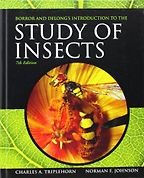
Why is your next choice, the Introduction to The Study of Insects by Triplehorn and Johnson, indispensable to entomologists?
It’s essentially a parts list and operating manual for classification. There are over 900,000 species of insects described. Insects are the most abundant animals on the planet, in terms of numbers of species. As an entomologist, one of the minimal expectations is that you can tell them apart. That’s not easy to do without an introduction to basic anatomy, physiology and ecology. This provides an order-by-order description of most of the 900,000 and step-by-step guides for sifting through all kinds of anatomical features so that you can discern who belongs to which order. That is not an easy thing because of the mind-numbing diversity within the class insecta. The book is amply illustrated and amazingly comprehensive. The authors somehow managed to say a word or two about even the most obscure families, such as Enicocephalidae or unique-headed bugs.
I refer to it all the time, and find it enormously entertaining to read about what insects have come up with. If you’re an entomologist, at some point in your career someone will bring something to you in a pill box or a ziplock bag and ask, “What is this?” That’s always a moment of high tension, but this is the book that can help you find the answer. No entomologist can identify everything. The reason there are entomology departments is that insects are abundant, very species-rich and have enormous economic impacts. So every entomologist has an obligation to be useful. Even if it’s just putting a name to something annoying.
The way in which entomologists are often useful, to be blunt, is as a resource for pest control.
The politically correct term is insect pest management, not control.
I wonder what it’s like for those who populate entomology departments to know that their research might be subsidised by an industry intent on killing the bugs that they love.
A significant proportion of entomologists have no interest in destroying insects. Even the ones whose careers are dedicated to management often are advocates of tolerance. It’s the public that doesn’t appreciate insects not the entomologists. I try to advocate tolerance as often as possible because the vast majority of insects really aren’t bad actors.
First published in the 1950s, the Introduction to The Study of Insects is now in its seventh edition and it seems that new molecular science has lead to significant revisions. How is molecular biology affecting entomology?
It’s essentially a revolution. The traditional means for reconstructing evolutionary relationships and classifying insects is to rely on morphology, but morphology can be misleading and difficult. As I was saying, it’s very hard to sort out 900,000 insects. There can be convergence – structures that look similar because they perform similar functions but don’t reflect any close relationship. But molecular analyses that really get down to the DNA level have illuminated relationships that we never could see just by relying on morphology. That’s what made me keep buying the new editions, because people who look at the evolutionary classification of insects keep incorporating new attributes and traits to deepen the understanding of the relationships among organisms.
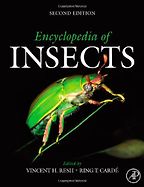
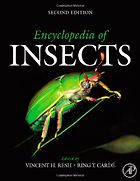
Next, the Encyclopedia of Insects. Some 260 experts selected by the editors wrote the encyclopedia’s 300 entries. What makes this reference work exceptionally useful?
This is like Wikipedia on steroids – it has all kinds of topics and it’s easily accessible, but the difference between it and Wikipedia is that the Encyclopedia’s editors did a superb job of seeking out go-to guys who are the absolute experts on the subject. It’s not completely comprehensive, you won’t find every insect-related topic in here. But each topic is covered by an entomologist who arguably knows more about it than anyone else, so it’s a delight.
If I were stranded on a desert island, I would like to have this book with me because it’s endlessly entertaining. It’s not just about arcane technical topics like Mantophasmatodea, a new order of carnivorous insects that was recently discovered in Africa. I don’t think the average person on the street has burning questions about Mantophasmatodea. There are accessible topics too. I was invited to contribute a chapter on “Movies, Insects in.”
I had the idea as a graduate student at Cornell. I noticed a sign on campus that said the Asian-American Society was showing Godzilla, and I thought if Asian-Americans can have a sense of humour about their identity, why can’t entomologists? I thought: We could prey on people’s fears and misperceptions to draw them in and then we could explain to them why insects are useful. I pitched the idea to the department head at Cornell. He thought it was undignified. When I got to Illinois, once I established my credentials as a legitimate scientist I suggested it to my department head here. The festival is entering its 29th year and I’m happy to say we are in no danger of running out of insect films.
The description of the Encyclopedia says it covers all aspects of “exploitation, conservation and management”. Which leads me to wonder how insects can be exploited?
We exploit insects in all kinds of ways. Silkworms produce silk, bees produce honey and wax. Of course there’s the pollinators. We also employ parasitic insects – in many cases an insect’s worst enemy is another insect, so we mass-rear parasitic wasps and release them to manage crop pests without causing the collateral damage that’s associated with synthetic insecticides. We even exploit dung feeders and the consumers of dead bodies. We clean museum specimens by throwing a dead body into a colony of so-called museum beetles. Carrion beetles strip every last bit of flesh off a bone more efficiently than any chemical processing. So we use insects in all kinds of ways. They contribute services, they just don’t get the credit for it.
And which insects are the focus of conservation?
It’s an interesting question because it’s difficult to make the case to the public that protecting insects is important. Not many insects are as charismatic as the endangered mega fauna – the noble bald eagle and other poster creatures for conservation, such as leopards. It’s not quite the same when you’re worried about saving the Haematopinus oliveri, otherwise known as the pygmy hog sucking louse. It feeds exclusively on pygmy hogs, which like it are endangered. It’s a struggle to get insects listed under the Endangered Species Act provisions. The preponderance are butterflies. People care about butterflies. But other insects – those that may not be so pretty to look at – are also marvels of evolution.
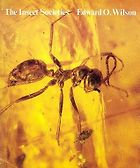
Let’s finish with the social insects who make up so much of our biomass. You chose The Insect Societies by two-time Pulitzer prize winner EO Wilson.
The Insect Societies is a book by the most famous entomologist in 50 years. Edward O Wilson is a myrmecologist – that means he’s enamoured of ants, and it’s not difficult to understand why. Most insects are solitary. Ants are one of the few species among the 900,000 who are social.
The elaborate social systems of some insects are amazing. Termites can build nests that tower over people. Honeybees live in communes of 30,000 to 50,000 individuals. The brilliant thing about The Insect Societies is that EO Wilson distills down the essence of social behaviour across all of these organisms. He finds the commonalities and the unique attributes of insect societies. And he writes about them in absolutely captivating prose. He is such a superb writer. Many might argue that he has written other books with a greater scientific impact – he basically created the field of sociobiology – but I think it all started with this book. It is crystal clear and so fascinating. He rooted out every interesting example that existed at the time and integrated them into a seamless story about how organisms learn to cooperate.
What makes social insects – ants, bees, wasps and termites – so interesting to study?
Social insects have a disproportionate influence on the planet relative to other species. They outweigh most other organisms, including humans. They change the physical features of the environment through their social activities and their collective ability to do amazing things such as build enormous structures. And, as EO Wilson showed, social insects help us understand how organisms can get along and work collectively.
All these books seem to celebrate the evolutionary accomplishments of bugs. What is their greatest achievement?
Flying is pretty impressive. They are the only organisms on the planet that have managed to fly without giving up a pair of appendages. Birds and bats had to give up a pair of limbs to fly, but insects didn’t. Being able to fly took insects everywhere. They’re tiny creatures, not as big as most other vertebrates. But this ability to fly means they can exploit resources that are unpredictable in time and space. They can find food in far-flung places and escape from their enemies. They can fly thousands of miles. Monarch butterflies are capable of migrating at least a thousand miles. Can you imagine walking that far, especially if you have six little tiny legs?
You wrote a humour column for The American Entomologist and many of those pieces are collected in your book Buzzwords. What’s the funniest thing about bugs?
I find them endlessly entertaining. That’s one reason I’m an entomologist. I’m supposed to be a serious scientist and there are serious aspects to the research that I’m involved in, but I’m not a serious scientist because insects are just hilarious and inspiring. Superlative questions, though, are tough.
Well then, what’s the best conference joke you’ve ever told?
I’ll tell you two:
A termite walks into a bar and asks: “Is the bartender here? Is the bar tender here?”
A man walks into a doctor’s office and says, “Doctor, you gotta help me. I think I’m a moth.” The doctor says, “It’s clear you have a problem, but I’m a pediatrician not a psychiatrist. Why did you come here?” The man says, “The light was on.”
August 29, 2012
Five Books aims to keep its book recommendations and interviews up to date. If you are the interviewee and would like to update your choice of books (or even just what you say about them) please email us at [email protected]
Five Books interviews are expensive to produce. If you've enjoyed this interview, please support us by donating a small amount.
May Berenbaum
May Berenbaum is an entomologist and the author of six books about bugs. A summa cum laude graduate of Yale with a PhD in biology from Cornell, she has taught at the University of Illinois since 1980, where she founded the Insect Fear Film Festival. She has received awards for environmental achievement and the public understanding of science, and wrote a humour column for the journal American Entomologist. Berenbaum also inspired a recurring X Files character in her image, Dr Bambi Berenbaum
May Berenbaum is an entomologist and the author of six books about bugs. A summa cum laude graduate of Yale with a PhD in biology from Cornell, she has taught at the University of Illinois since 1980, where she founded the Insect Fear Film Festival. She has received awards for environmental achievement and the public understanding of science, and wrote a humour column for the journal American Entomologist. Berenbaum also inspired a recurring X Files character in her image, Dr Bambi Berenbaum