Can you tell me about A Separate Peace?
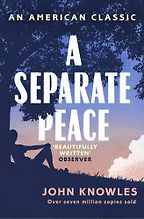
It’s not very well known in England. It takes place in a boys’ boarding school in America just before World War II. It has a little bit of that Brideshead feeling about it – a boy of privilege and a boy who just happens to be there – and it’s about this extraordinary friendship between a risk-taker – a confident, beautiful boy called Phineas – and his poorer, much more awkward, intellectual roommate, Gene.
They create an initiation rite that involves jumping out of a very high tree, and it’s all about physical excellence. But Gene begins to be jealous of Phineas; a jealousy that grows angrier and angrier, as he thinks Phineas is trying to undermine his academic career, which is, of course, all he has. During one of the initiation rites, Gene joggles the branch of the tree. Phineas falls and shatters his leg and never realises that his best friend has done it. In the end Gene goes to see Phineas and tries to tell him that he did it, but Phineas won’t believe him or accept that he would ever have tried to hurt him.
What I really love about it is that it’s one of the very few novels that I read as a kid that deal with that really intense kind of friendship between boys, a kind of presexual love story that grows up at boarding schools when there are no women around. I became very affected by it because of the subtlety of the psychological portrait of the two. It became a sort of required text in a lot of American schools – if you talk to most Americans my age they will all cite it. It was just an amazing turning point kind of book. It was not only a bestseller, but one for all ages.
“I love Elizabeth Bennet, she’s acting like a teenager by not considering her future in a serious way, by believing in love.”
Basically the story is that kind of self-realisation that happens when someone begins to understand himself through someone else. It got something that no one had really talked about very much – that period in self-realisation where some people just seem to have the confidence and the rest of the world doesn’t, and there’s a huge attraction between those two poles but also a huge resentment
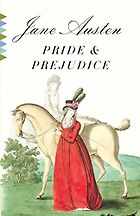
Pride and Prejudice?
It’s about Elizabeth Bennet, who’s 20, and she’s in a situation where there’s a huge necessity for her to marry and marry well. She goes out on a huge limb in deciding or being convinced that she wants to marry for love. In my mind what makes it a teen novel is that Elizabeth is a romantic – and because she’s still young she’s allowed to be a romantic, whereas her father is a very weak man who believes in romance. He says: don’t marry a man you don’t love, which is a slightly ridiculous thing to say to his daughter given her social position. If he were to die of a stroke the next day it couldn’t have been worse advice – they will be out on the street – so in a sense he’s still behaving like a teenager. Elizabeth gets very lucky because passion does win out in the end. I love Elizabeth as a character because she’s acting like a teenager by not considering her future in a serious way, by believing in love – which is a wonderful indulgence. She’s the great true rebel character.
I like to read it from a class point of view. I’m always interested in that bit when Jane asks Elizabeth when she first knew she was in love with Darcy, and she says, ‘When I first saw his house’. It’s a coming-of-age story, because she throws aside her prejudices but also sees the house and realises that she could be quite comfortable and maybe realises how important that is.
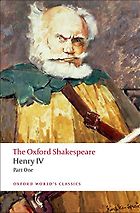
Shakespeare’s Henry IV Part I?
It takes place around 1400, with the usual battle in the background, and the basic story is that King Henry IV is beleaguered and besieged, and is waiting for his son, Prince Hal, to give him a hand. It keeps cutting off to Hal in taverns wasting his life, and in the meantime his rival Hotspur is making his own bid for the crown, assuming Prince Hal will never amount to anything. I just love Shakespeare’s version of a coming-of-age story. For me the wonderful turning point is where Prince Hal, who’s had a fantastic time playing around and joking and drinking, throws off his friendship with his ne’er-do-well companions (particularly Falstaff) and gives that absolutely wonderful speech: ‘I know you all, and will awhile uphold the unyoked humour of your idleness.’ It’s just such an absolutely brilliant and cold-hearted declaration of what it is to be a king.
Reaching adulthood is part of the job for a king.
Well exactly – it suggests a kind of recognition of his own destiny. One’s not sure how much he’s recognised it all along and has just been biding his time. There’s a lot of time spent talking about the betrayal of Falstaff, but I think that’s terribly sentimental: Falstaff was born to be betrayed. The wonderful thing about teenage years, and coming of age and so on, is that shift that happens: that moment when everything is refined and everything suddenly leaps into focus. Maybe it happens from middle age to old age as well, when you suddenly see people and you realise they’re old, but that’s what I absolutely love about Prince Hal: the fact that it is a moment – because it’s a play – that’s completely condensed into that one speech.
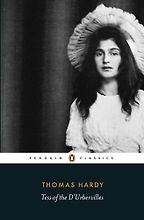
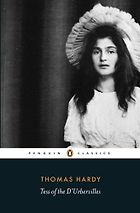
Tell me about Tess.
It’s about an older teenage girl, Tess Durbeyfield, whose father overhears a conversation which makes him think that they are actually not peasants, but are related to the noble family of D’Urberville. So he sends Tess off to declare herself as a cousin to the D’Urbervilles, not knowing of course that they bought the title and the name. Tess ends up getting lost with Alec, the D’Urbervilles’ son, in a foggy glade.
“Falstaff was born to be betrayed.”
It’s clear what happens there, but it’s unclear whether it’s consensual or not. I think it’s interesting if you think of it as being marginally consensual. If it turns into rape then Tess is a completely innocent victim of a terrible decline of her fortunes based on a crime. To me it’s much more interesting if it’s a seduction and she’s tempted by him and collaborates a bit in her own downfall. Tess has a baby by Alec who dies after a couple of days. Later, she meets Angel Clare, who falls in love with her purity and perfection. When she finally tells Angel she had sex with Alec, he betrays her and then goes to Brazil, and because there’s really nothing left for her she becomes Alec’s mistress again. Then she murders Alec.
Get the weekly Five Books newsletter
It’s one of my favourite coming-of-age stories. It’s very much about trying to find a place of happiness for yourself in a world full of obstacles, in a terrible maze of social change and convention at the end of the industrial revolution.
Why do you like it?
I quite like the fact that she murders Alec. I like her as a heroine. She isn’t entirely a victim. She murders him because he’s told her Angel’s never coming back, and she finds out he’s lied and ruined her life once again.
But she’s a very resigned heroine.
Yes – once Angel turns her down that’s a great disillusionment. But that’s her coming of age: it’s that combination between wisdom and a giving up of innocence and illusion. Unfortunately her gaining of wisdom is all tragic. I love her as a character though, and for her emotional ambition. I admire her passion, even though it’s her downfall: she not only has sex with Alec, she murders him. But she’s an incredibly passionate character for whom absolutely everything goes wrong. I’m just not wild about Hardy’s ending, really.
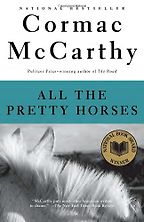
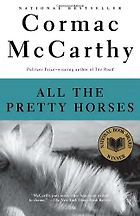
And what is All the Pretty Horses about?
It’s about John Grady, who leaves home, gets a job on a ranch, and falls in love with the daughter of the rancher. It looks like his life is really going full speed ahead: a good job, love, everything fine. And then it all goes horribly wrong: he gets arrested for conspiring in the murder of a man, who in fact he had nothing to do with, and thrown into jail. He loses everything.
Does he come of age in jail?
In this book it’s an ongoing gaining of wisdom. I’m quite interested in that whole subject of finding out where you belong in the world, which is not a search that starts and ends between 18 and 21. It’s a process of optimism and again maybe the passion of youth: the expectation that things will go well, that the world is not against you, is not evil. The wisdom John Grady gains is very chastening and tragic; he’s lost the woman he loves. You sense he’s starting again, but with something harder than he did last time.
“Tess is an incredibly passionate character for whom absolutely everything goes wrong.”
I know I’m not alone, but I absolutely love McCarthy’s expressionless, very flat prose that doesn’t lead the reader in any way. All the Pretty Horses is one of my five or ten favourite books in the whole world. There’s something absolutely thrilling about his lack of inflection because it allows the words to do all the work and therefore anything horrific that happens happens without any sentimentality or manipulation or emphasis. It all happens in your head. The book really mixes up loss and gain and wisdom and sorrow, and it ends with a sense of potential for John Grady, which is based on the wisdom he’s gained on the way.
Five Books aims to keep its book recommendations and interviews up to date. If you are the interviewee and would like to update your choice of books (or even just what you say about them) please email us at [email protected]
Five Books interviews are expensive to produce. If you've enjoyed this interview, please support us by donating a small amount.