"I was looking for books that offer good, practical ideas on how to make the world a better place." Pulitzer Prize-winning New York Times columnist, Nicholas Kristof, recommends books to read if you'd like to save the world.
Is one theme behind these books new approaches to helping people out of poverty?
Yes. I was looking for books that offer good, practical ideas on how to make the world a better place.
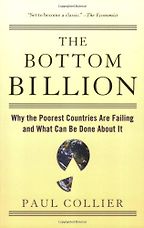
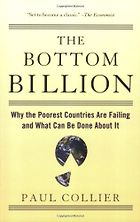
Let’s start with The Bottom Billion by Paul Collier.
There’s been a tendency for people looking at global poverty to either emphasise the extraordinary difficulty in making a difference or to make it seem almost too easy. What I really liked about The Bottom Billion is that he acknowledges how difficult it can be to end poverty, but also offers some important ideas about how one can actually make a difference.
Is he critical of aid and NGOs?
No. Collier acknowledges that it’s often harder than it looks. He does cite, for example, a figure of money that was intended for rural health programmes in Chad: it turned out that 99 per cent of the money was lost along the way. But he also has a lot of admiration for groups that pay attention to local needs and have local ownership. He looks at what, realistically, the world can do – for example, by promoting trade, by reducing conflicts and wars in the developing world. It’s a very clear-minded, non-ideological look at what one can actually do to chip away at global poverty.
You say he has important ideas – is there one you’d particularly like to highlight?
I think one of the issues that the humanitarian world maybe hasn’t paid adequate attention to is the problem of conflict – in Africa in particular. This is something I’ve seen in my travels. You just can’t address poverty by building schools or building clinics in a country where warlords are running around burning schools and killing teachers. Also, conflict in poor countries tends to be incredibly contagious – it is devastating not only to that country but to surrounding countries. Collier argues, I think correctly, that this is a crucial issue, and that there are some things we can begin to do about it. Not in every case – but the West should try much harder to prevent conflicts before they happen, rather than just try to address them after they’ve already erupted, at which point it can be very difficult.
Collier really believes there is something we can do to reduce these conflicts?
Yes. For example, peacekeepers aren’t a magical solution by any means. But they’re pretty cheap compared to the $100 billion that is the cost of the average war in Africa. If one can spend $100 million on peacekeepers and it reduces the chance of a $100 billion war, that’s a pretty good investment.
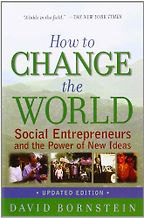
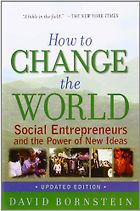
Let’s go on to your next book, David Bornstein’s How to Change the World.
One of the revolutions of the last ten or 20 years has been the rise of social entrepreneurship. This is beginning to bring the same kind of vision and efficiency into the social sector and to do-gooders as has traditionally existed in the world of business. I think David Bornstein has chronicled that rise of social entrepreneurship better than anyone. He also has a follow-up book, with Susan Davis, from Oxford University Press, called Social Entrepreneurship. It’s a much shorter book that’s also good. But How to Change the World really is the Bible for do-gooders and it’s just a terrific book.
What is a social entrepreneur?
A social entrepreneur is somebody who, like a business entrepreneur, has a new idea to solve a problem out there. But instead of trying to maximise profit, this person is trying to maximise improvement in the social condition. So, for example, one social entrepreneur that I know of was trying to address the number of women dying in childbirth in Africa. This person is an ob-gyn, so you would think she would immediately look at medical intervention. But she noticed that one of the big problems is that hospitals don’t have reliable electricity and you can’t do a C-section in the dark. So she ended up providing solar-powered surgery lights to a bunch of hospitals in Africa. It was very cheap and because it’s solar powered it also tends to be reasonably sustainable. The result has been that it saves lives, very cost effectively, in those hospitals.
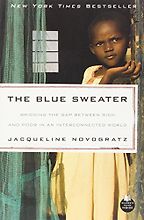
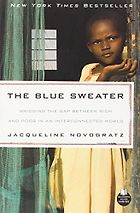
What about The Blue Sweater?
The Blue Sweater is a book by somebody who has really pioneered the use of business solutions to address poverty, Jacqueline Novogratz. Jacqueline emphasises not just charity, but how to start businesses that employ people and generate profits while also generating some kind of an improvement in the countries they operate in. For example, she is supporting a factory in East Africa that makes bed nets against malaria.
“I was looking for books that offer good, practical ideas on how to make the world a better place”
It’s an account of her own life in the world of development, mostly in Africa, and it’s also got some lovely anecdotes. The title of the book comes from the fact that, as a child, Jacqueline had a blue sweater that she was very, very fond of, with her name written in the back of it. At some point a boy criticised it, and off it went to the pile of giveaways. And years later she was walking through Rwanda and she sees this sweater that looks just like her old one, the one she used to love so much. And she goes over and asks the person if she can look in the back and – sure enough – there’s her name. It was the very same sweater. It’s a lovely look at how one can actually use business approaches to try to address poverty.
So when she’s making mosquito nets she is selling them rather than giving them away?
Yes, that’s correct – and the advantage of that is that it tends to be more sustainable. If businesses are generating some kind of profit, they can then spread their model and scale it up more easily than something that is based on giving things away. Clearly you need both. If you just charge for bed nets, for example, you’re going to be really limited, and the poorest people may not be able pay for them. But where they are feasible, business models can be really powerful.
But if you’re selling mosquito nets, and someone else is giving them away…how do you make a profit?
You can’t do it side by side, of course. But, for example, in India, there’s a hospital company that tries to provide very low cost childbirth for women in rural India. It’s a for-profit company, and it uses other parts of the hospital to subsidise the maternity wards. Because it’s a for-profit company, and actually makes some money, it can afford to build new hospitals in new areas. That’s the kind of model that’s she’s thinking of. You need to pay for your free maternity wards and with that model, by making money, you have part of the solution.
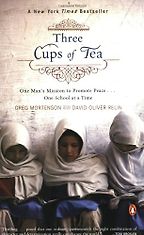
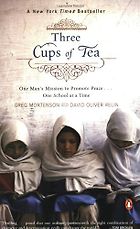
Your next book is Three Cups of Tea – about the man who failed to climb K2 but ended up setting up more than 50 schools in Pakistan and Afghanistan instead…
Probably everyone at this point has read Greg Mortenson’s book. I admire it for a couple of reasons. One is that there is a lot of real antipathy and hostility toward Islam these days and I think Greg does a very good job of providing a more nuanced portrait of the Islamic world and what is possible in it. Also, there has been a tendency to try to address violence in places like Afghanistan and Pakistan with more violence – and I’m a big believer that education is the most transformative way we can intervene. And that is exactly what Greg has done. I wish we would learn from some of his experiences in Pakistan and Afghanistan.
If someone does want to make a difference… For example, here in New York I’m surrounded by people working in finance. One or two are getting a bit older – perhaps they’ve already made a bit of money and want to give something back. If they wanted to save the world by going to, say, Afghanistan or Africa, what would you recommend they do?
If they’re in finance, one of the huge needs for the developing world is building up microsaving capacity, ie, figuring out systems to let people save money in areas that banks don’t reach. One mechanism, for example, is to let people save money on their cellphone, to use cellphones as a kind of alternative banking system. There are a lot of creative ways being worked out now on how to promote microsavings, and, to some degree, microfinance. So that would be a case where someone from Wall Street could bring their background and apply it. The Gates Foundation is pumping money into microsavings – as are a lot of people. So that’s what I would do, I would look into that sphere.
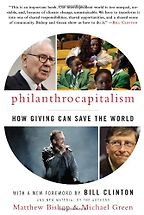
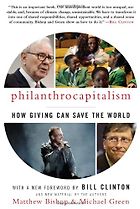
Speaking of Bill Gates, tell me about your last book, on Philanthrocapitalism.
Philanthrocapitalism is by the New York bureau chief for The Economist, Matt Bishop. It looks at the way so many hard-headed businessmen have gone into the humanitarian sphere in recent years. Traditionally, a lot of moguls did their philanthropy by giving money to the opera or to art museums. More recently, partly because of Bill Gates, there’s been a tendency to try to go into issues of global poverty. I think this has had a hugely positive effect, partly because businessmen are very results-focused. They are used to looking at metrics, and being very tough minded about what the most cost-effective way of achieving something is. So in malaria research, for example, a lot of these very wealthy people have not only focused a lot more attention on malaria globally but have also figured out creative ways of distributing nets and targeting malaria in other ways. To me, it’s hugely important – not only because of the money they’ve brought to the field, but also because of the rigorous mindset they’ve brought as well. This is something that Philanthrocapitalism documents very well.
But hasn’t there been a bit of a backlash against all this philanthrocapitalism? I noticed, for example, a book by Michael Edwards of Demos, Small Change: Why Business Won’t Save the World…
In Europe in particular there has been something of a backlash against it – on two bases. First of all, the idea that these are robber barons who stole this money and now you give them credit for doing some good with a small fraction of that money? The second critique is that these are problems that can really only be resolved through government and multilateral action – so why make a fuss over some modest interventions by companies here and there? I don’t buy either critique. If people can give back some money and make a difference then I welcome that. And while I don’t think that the Gates Foundation or any other wealthy philanthropic organisation is going to save the world, I do think it can make a real difference. I’ve seen what the Gates Foundation has done in Mozambique, for example. For those people who are now getting help it’s transformative – and the reality is that governments and the UN aren’t doing the job. If the philanthrocapitalists can fill in some of the gaps, that’s great.
September 22, 2010
Five Books aims to keep its book recommendations and interviews up to date. If you are the interviewee and would like to update your choice of books (or even just what you say about them) please email us at editor@fivebooks.com
Five Books interviews are expensive to produce. If you've enjoyed this interview, please support us by donating a small amount.
Nicholas Kristof
Nicholas Kristof is a columnist for the New York Times. He won one Pulitzer Prize in 1990 for his coverage of the massacre at Tiananmen Square and another in 2006 for his coverage of the genocide in Darfur. His most recent book, co-written with his wife, Sheryl WuDunn, is Half the Sky: Turning Oppression into Opportunity for Women Worldwide.
Nicholas Kristof is a columnist for the New York Times. He won one Pulitzer Prize in 1990 for his coverage of the massacre at Tiananmen Square and another in 2006 for his coverage of the genocide in Darfur. His most recent book, co-written with his wife, Sheryl WuDunn, is Half the Sky: Turning Oppression into Opportunity for Women Worldwide.