Before we get to the books you’ve recommended, how did you first become interested in philosophy?
I can remember as a very young child asking the question, “How does a baby learn to speak?” I wasn’t really satisfied with the answer my mother gave me – that you just point to things and say their names. I’m not sure I could answer the question now, but it was certainly of philosophical interest. As a teenager, I also picked out Bertrand Russell’s History of Western Philosophy from the local public library, which was one of the great inspirations for me. The library, that is, rather than the book. I think it’s the route out of suburbia for a lot of people. It opened up different sorts of reading for me. I would walk several miles to the local library and take out as many books as I could. Inevitably, sooner or later I got some philosophy books, along with all sorts of weird and wonderful ones.
What did you make of the Russell book?
It wasn’t the book I needed at that age. I’ve since tried to write that book a couple of times, but I don’t know if I’ve succeeded. It was a bit slow-moving for me and I didn’t get beyond the pre-Socratics, who didn’t really stimulate me.
So did you really get into the subject at university?
I actually went to Bristol University to study psychology, but I became a bit disillusioned with it and dropped out. After a year out from university, that I mostly spent working as a car park attendant, the decisive factor for me about going back to university to study philosophy rather than psychology was that there was a clash between the two courses. I was very interested in reading Sartre and I wouldn’t have been able to study Sartre’s Being and Nothingness in psychology. That clash made me realise how much I wanted to understand that book, or at least parts of it. That was my one opportunity, I felt, because it isn’t the kind of book you can make sense of on your own. So I switched to philosophy.
It seems a lot of Anglo-American philosophers are drawn into the subject as teenagers by their encounters with existentialism, and especially Sartre. But often, after a certain number of years of study, they come to strongly disagree with Sartre’s philosophy. Did that happen to you?
I don’t think you have to agree with the philosophers you read. It’s almost better if you disagree with them because then you have some kind of dialogue – you don’t read them in a passive way. I find Sartre stimulating, difficult and frustrating. His later writings are unreadable, driven by his use of the drug speed and written with no concessions to the reader. So the fact that I disagree with huge amounts of what Sartre said doesn’t mean that he wasn’t an amazing and important thinker to me.
Sartre was also a novelist, and his novels are often described as philosophical. Do you think novels and novelists can really engage in philosophy, or is that only possible if you’re a professional academic philosopher?
I think professional philosophers often like to make their subject smaller than it really is by setting arbitrary limits. As far as I’m concerned, philosophy is any human enterprise that involves critical thought about basic questions, like how we should live, what is the nature of reality and so on. Those questions can be asked seriously in all kinds of forms. So I don’t see the subject as restricted to nerdy philosophical papers in refereed journals. Some of the most important contributions have been literary. If you think of classical philosophy, you have Plato’s very literary dialogues, and Lucretius’s On The Nature of Things is a poem! Some parts of TS Eliot’s poems are very philosophical. Kierkegaard is a poetic writer who uses fictions, and Nietzsche uses aphorisms and poetry. They’re all philosophers.
Do you think, given the success of your podcast series Philosophy Bites—which as of 2021 has had more than 40 million downloads—that there has been increased interest in philosophy over the past 30 years?
There may have been the same appetite for philosophy back then, but it wasn’t necessarily filled in a palatable way. When I began writing introductory philosophy books in the late 1980s, the only introductions that were readily available were The Problems of Philosophy by Bertrand Russell, which was published in 1912, and a book called Philosophy Made Simple – which was actually a good book, but people found the title off-putting because it sounded like it was dumbing the subject down. If you go into a bookshop now there would be a whole bookcase of introductory books, but 20 years ago there were surprisingly few philosophy books designed for the general reader.
When I was first teaching, I was aware that there were no books to help people make the transition from an interest in philosophy to being able to read some of the classics. Most university teachers would say you don’t really need an introduction, you can just go and read Hume or Descartes or Mill. But many readers can’t get through that sort of writing and gain an overview of the key points without a bit of help.
Let’s talk about your first choice, What Does It All Mean? by Thomas Nagel.
I just dug through my bookshelves looking for this but I couldn’t find it. I’ve had a number of copies of this book but I always seem to end up giving it away, which I think is a good sign.
Why is it such a good gateway into the subject?
It’s perfect for someone who wants to find out what philosophy is all about. First of all, it’s very, very short. Secondly, it’s written in prose that is completely unpretentious, unpatronising and clear. It’s the kind of book you could read in an evening, but at the same time you’d really have a flavour of what philosophy is. It’s got the authority of him being a significant philosopher in his own right, but if you had no idea who he was it wouldn’t matter. The writing is almost Orwellian in its simplicity and directness. As somebody who has tried to write clear introductory books, I know how difficult that is to pull off.
Nagel begins with the observation – which mirrors my experience as a teacher and as a father – that philosophy arises naturally out of the human condition. People start asking philosophical questions from an early age. And there is a history of over 2,000 years of people discussing these questions – thinking critically about how we should live, what the nature of reality is, what consciousness is. Nagel goes through all these major areas of philosophy with a very light touch.
“What does it all mean?” is a question that people who haven’t studied philosophy often think the subject is about. They might be a little disappointed, if they study it formally, to discover that there is little talk about the meaning of life and so on. Do you think the title might give readers false expectations?
In the introduction to the book, Nagel writes, “There isn’t much you can assume or take for granted. So philosophy is a somewhat dizzying activity, and few of its results go unchallenged for long.” He’s not pretending philosophy is going to tell you what it all means. It’s going to introduce you to the questions and help you think critically about them. If somebody comes to philosophy thinking they are going to come out after a few years understanding exactly how we should live and what reality is like, then they’re naive. That’s one of the things you learn from studying philosophy. As Socrates pointed out, true wisdom lies in knowing how little you know.
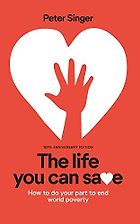
The next book is The Life You Can Save by Peter Singer, who is perhaps the most famous living philosopher.
I was thinking, “How would you introduce philosophy to someone who didn’t know anything about it?” I think the central question in philosophy is, “How should we live?” And that’s a question about which Peter Singer has a lot to say.
What is the central message of the book?
The book focuses on the terrible poverty and disease found around the world, and how we in the West are living in a luxury that we could adjust just a little bit in order to alleviate that misery. He suggests that we give maybe 5% of our wages to charity. He’s not saying you have to live in a sackcloth and give away all your possessions. Even a small gift of 5% would make a tremendous difference to other people’s lives. It’s not just him preaching, he gives arguments for his positions. And even if you disagree with him, the process of reading his work makes you think, “Why do I disagree?” He is in the tradition of Socrates – somebody who challenges your preconceptions and asks you to respond.
How does the book begin?
Singer starts with a compelling thought experiment. Imagine you’re passing a pond. There’s a young child drowning in the pond and his head’s just about to go underwater. You’re on your way to work, you’re nicely dressed. But you’d surely jump in the pond and try to save the child, wouldn’t you? Almost anyone would do that unthinkingly, even though it would ruin their expensive clothes and make them late for work. Yet in our everyday lives, we know that through inaction we are allowing children to die of poverty who could otherwise be saved by a minimal contribution – less than the price of an expensive pair of shoes.
What’s the difference between the situation described in the thought experiment and our inaction in everyday life? Singer thinks that there isn’t an important moral difference. He says there are ways in which we could act that would be the equivalent of saving the drowning child’s life – giving to charities that tackle poverty, disease and so on. He believes most of us could be much more generous at very little cost to our own lives, and that the result of this would be of huge measurable benefit to mankind.
That sounds like a persuasive argument in theory. What are the objections?
Singer is brilliant because you don’t have to agree with him, but he goes through all the standard objections to his view and presents counterarguments. Someone might say, “The difference is that if I save the child myself I know the child is going to be saved, but if I give my money to a charity it might be wasted.” Well, there’s a website that has been set up which analyses the comparative effects of money sent to different charities. It comes up with charities where the effect of your donation is most likely to save lives. So Singer has second-guessed you, and come up with a counterargument and a practical way of implementing the conclusion he’d like you to embrace.
What do you think of Singer’s work more generally?
Singer is incredibly consistent in his positions. He used to be a chess player, but he believes that the point of philosophy is not to solve chess-like problems but actually to make a difference. If you really believe, as he does, in a form of utilitarianism – the view that the consequences of our actions determine their rightness or wrongness – then that’s not just an intellectual position, it should affect how you live. Singer is a counter-example to the stereotype of the philosopher in an ivory tower, whose life makes no difference, who leaves everything as it is.
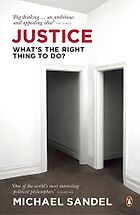
Your third book, Justice by Michael Sandel, discusses political philosophy rather than ethics.
The reason I picked this book is because I think Michael Sandel is an outstanding speaker and writer in his ability to bring philosophy alive. He can take a thinker like Aristotle and make him completely relevant to the present day, to show how his ideas have applications in our everyday lives.
Can you give an example?
There was a golfer named Casey Martin. He was an excellent golfer, but he had a problem with his leg. There was a whole dispute about whether he should be allowed a golf cart to get around the course. There were even court cases about it. Sandel shows how the debates that arose about this issue were extremely Aristotelian in nature. They come down to questions like “what is golf?”, “what is the essence of golf?” and “what is the purpose of playing golf?” Is it a sport where the emphasis is all on the hitting of the ball into the hole, or is there – as some golfers argued – a physical endurance element as well? Is it unfair if one person is whizzing around on a golf cart whilst others are tiring themselves out walking around the course? Does that mean they’re going to be at a disadvantage in relation to this guy on the golf cart? And so on.
To resolve these questions, we need to think about the ultimate purpose – what Aristotle would call the telos – of golf. But these questions also turn on questions of honour and prestige attached to the notion of physical endurance. Sandel adds a really nice observation here. He discusses how some golfers are touchy about how their sport is not a physical sport, so they have a vested interest in it seeming physically demanding. Sandel has also been extremely good at using the Internet to encourage people across the world to engage with his ideas. His justice course at Harvard is available on YouTube.
Sandel is primarily a political philosopher. Obviously, philosophy is very rigorous and helps train one to think critically. But do you think knowledge of philosophical ideas themselves is helpful to politicians?
Many politicians have studied philosophy, and that undoubtedly influences their thinking to some degree. There are very few examples of contemporary philosophers who have dramatically changed the course of politics. But there are some: Karl Popper, John Rawls and, in the modern era, Sandel to some degree. But possibly more important has been Philip Pettit, whose ideas were taken up by the Spanish prime minister, José Luis Rodriguez Zapatero. Pettit was actually invited in to assess Zapatero’s government according to the philosophical principles of republicanism. Pettit famously gave it nine out of 10. The idea that a contemporary philosopher should be involved with that kind of activity is really interesting. But for the most part, the study of abstract ideas with particular attention to reasoning is simply a useful skill for politicians. Of course you could be a Marxist and apply a single philosophical theory to every case, but what I’d prefer in a democracy is politicians who are prepared to think on their feet about changing situations, rather than just apply a ready-made theory and read off the conclusions.
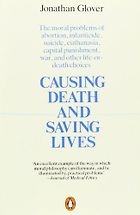
Your next choice, Causing Death and Saving Lives by the English philosopher Jonathan Glover, is another work on moral philosophy.
When I was an undergraduate, this book made me think philosophy was really worth studying. It showed me that philosophy isn’t nitpicking or school debating societies, but rather a subject that gets right to the heart of what matters. Like Peter Singer, Glover believes that your thinking about philosophical issues should make a difference to your life.
Is that view unusual among professional philosophers?
It’s surprisingly unusual among academic philosophers – or it certainly was when he wrote the book in the 1970s. At that time, most moral philosophy was focused on very abstract questions in meta-ethics. Glover was an important part of a movement towards looking at real-life problems. This book looks at questions surrounding abortion, euthanasia, suicide and killing in war. The common thread is the theme of the morality of killing.
How does Glover differ from Peter Singer?
Glover is as likely to quote Dostoevsky, Orwell or other literary writers as he is to quote philosophers. There’s an extremely humane feel to his work. He wants to combine the insights of utilitarianism with those of Kant – the idea that individual human autonomy is important and shouldn’t be overridden. That latter point is sometimes overlooked by utilitarian thinking. Glover is very good on questions about the sanctity of life. A lot of religious people believe that all human life is sacred and that it’s wrong to end a life ever. Glover’s emphasis is on a life worth living. He argues that there must come points where, for some individuals, life simply isn’t worth living.
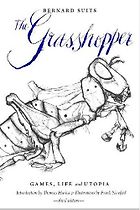
Your last book is a bit of a curveball. I can’t say I’ve ever heard of The Grasshopper by Bernard Suits before.
I hadn’t heard of it myself until GA Cohen recommended it to me a few years ago. And then, independently, Simon Blackburn recommended it. So I thought given these recommendations from eminent philosophers, there must be something to it. It’s a slim book, first published in 1978. It’s all about playing games. Not only is that an interesting subject for a book, but it’s also written in a light-hearted way. It actually exemplifies some of what it’s arguing for.
What does it argue?
One way of reading the book is as a critique of Wittgenstein’s “family resemblance argument” about games. Wittgenstein says that there is no one thing in common that is shared by all games. Instead, there’s just a pattern of overlapping resemblances between the things we happen to call games. There’s no single, essential aspect of all games. Well, Bernard Suits thinks you can actually give a definition of games according to necessary and sufficient conditions. That makes it sound dry but it’s not a book about definition.
Why is the book called The Grasshopper?
It’s called The Grasshopper because the central character is, in fact, a grasshopper! It’s inspired by Aesop’s fable about the grasshopper and the ant. The industrious ant works all summer and survives the winter, whereas the grasshopper spends his time dancing and singing, so he has nothing to eat and starves to death. But at the same time, it’s a parody of a Socratic dialogue with the grasshopper in the role of Socrates, dying of starvation but choosing to die rather than give up his belief that the thing which has intrinsic value in life is play. He’d rather die of starvation than give that up.
Is the book for children as well as adults?
Oh no, it’s a book written for philosophers primarily. That’s what makes it so clever. It actually puts forward a whole theory about the nature of game playing. Suits argues that playing a game is “the voluntary attempt to overcome unnecessary obstacles”. Basically there are three features to all games, and for something to be a game it has to meet all these features. Games must have the “pre-lusory goal”, constitutive rules and the “lusory attitude”.
The pre-lusory goal is the purpose of a game. Take mountaineering. The pre-lusory goal is getting to the top of the mountain. Now you could get to the top of the mountain by parachuting in from a helicopter. But for something to be a game it needs to have rules, which might exclude certain ways of achieving the pre-lusory goal. And then there is the third part, the lusory attitude – namely that you accept the rules not just because you have to. It’s all about participating in the spirit of the game. You’re following those rules because you want to.
This book is written in dialogue form, which is very unusual in modern philosophy. How does it work?
A few of the classic works of philosophy have been written as dialogues – Plato’s works of course, and also one of my favourite books, David Hume’s Dialogues Concerning Natural Religion. But it’s amazing how few successful dialogues there are in philosophy, given those great exemplars. The Grasshopper is Suits’s serious attempt to do it in a lighthearted way. Without being po-faced, Suits has found a way to make serious philosophical points.
And why is Suits so interested in games in the first place?
He believes that game-playing is the highest good, because in a utopian world where all our other needs are met, he believes human beings would just play games. They’d set themselves obstacles and willingly try to achieve these pre-lusory goals. They wouldn’t need to worry about anything else. If heaven were real, that’s how we would survive in eternity. Suits thinks games are the highest intrinsic good. That might be going a bit far, but he’s found a light-hearted way of getting to that conclusion – by using arguments and considering counter-examples.
Get the weekly Five Books newsletter
He builds in lots of jokes and he’s a skillful writer. Unlike the other writers on my list, he draws attention to his style. You can’t read this without noticing he’s playing with form. It’s a nice short book that deserves to be better known. It’s mysterious that it’s been so neglected, particularly given all the interest in Wittgenstein’s theories about games.
_____________________________
2021 update:
Since we first spoke, there have been a number of introductory philosophy books published. I was wondering, Nigel, if there are any books you’d like to add to the list?
There are certainly a couple. All the authors of the introductory books that I recommended when you last interviewed me were men. That’s probably quite representative of how dominated philosophy has been by men for all kinds of social reasons. But there are many women philosophers, academic philosophers around, some of whom have written some very interesting introductory books which are suitable for beginners, a few of which have been published since we did that interview.
I’d like to recommend a Ladybird book, by Angie Hobbs (whom I interviewed about the pre-Socratic philosophers for Five Books). It’s a book about Plato’s Republic. Don’t be put off by the fact that it’s a Ladybird book, this is a new type of Ladybird book which is designed for, I guess, teenagers and adults, rather than for children. But it’s got the same format. It’s a short book of 50 pages, and around 24 of those are illustrations.
Angie is a serious Classics scholar and yet she has a very light touch as a public philosopher. She explains ideas very, very clearly. And what she’s done in this book is pick out the key arguments that Plato—through the mouthpiece of Socrates—uses in the great philosophical work the Republic and summarizes them.
Now, some philosophers, when asked about introductory books, say, ‘Well, of course, you don’t really need an introductory book, you can start with the great classics: you can read Plato’s dialogues, you can read Descartes’s Meditations, you can read Hobbes’s Leviathan – or at least parts of it. Why bother with an introduction?’ But I don’t think most people can actually get a huge amount out of those sorts of books by just picking them up. Somebody who’s a very competent reader could, but it might take them quite a long time. What a book like Angie’s does is point you to the arguments which philosophers have considered the most important in the history of reading this book. She gives you a map of what’s there, an overview, and a way of grasping something which you might lose in the detail on a slow, first reading of the Republic.
I’m not recommending you read Angie’s book instead of the Republic. I think it’d be a great book to read alongside the Republic. The Republic isn’t a particularly difficult philosophical work, but some of the ideas about the theory of forms, which is at the heart of the book, can be quite easily misunderstood. And the importance of the simile of the cave, just what Plato was saying about how society should be structured, it’s very easy to slightly misread that. This book is a great way to teach yourself to read Plato’s Republic, as it were. If you’re going further, you’re going to read other commentaries on the Republic too. There are many excellent ones, but this is the shortest, clearest one I’ve seen and it’s written for an introductory reader. It’s also got pictures, which helps. I love books with pictures. I find they help me identify and remember particular arguments.
And that’s also true of the second book that I’d like to recommend.
Which is?
The Philosopher Queens by Rebecca Buxton and Lisa Whiting, who have also been interviewed for Five Books. This is a brilliant book edited by two postgraduate students. It’s an anthology of introductions to key women philosophers, philosophers conceived in quite a broad sense—some of the people in the book aren’t conventionally within philosophy departments. It goes through the history of philosophy, it’s not just about contemporary, living philosophers. It’s women writing about women philosophers, with a bias towards the political end of philosophy, politics and ethics.
These are great short essays, again, written for a general reader. They’re a wonderful way into reading works by these thinkers and a counterbalance to the male-dominated histories of philosophy that you will typically be given as introductory texts. And the pictures are great. We discussed them in a Five Books interview with Helen de Cruz, about illustrated philosophy books. They’re like pop art caricatures, but they also have a dignity about them. It’s a very nice way to punctuate the book and for you to remember which thinker is which.
Is it aimed at young adults?
I think their ideal reader is somebody like they were when they were about 15 or 16, trying to find out about philosophy, picking the book up in a bookshop and getting a sense that it is possible to be a woman philosopher and to make a significant contribution to the field despite the historical dominance of men. It also links with the previous book, because the idea of a philosopher king or a philosopher queen comes from Plato’s Republic and it’s something Angie Hobbs discusses. Even though he is quite authoritarian and conservative in lots of other ways, Plato would have allowed women to rule society as philosopher queens – the important point was that they be philosophers, not that they were men or women.
The great virtue of The Philosopher Queens is that you can dip into it, it’s got these discrete essays, which you can sit down and read in fifteen or twenty minutes. You don’t need to have read the other chapters to make sense of them. It’s a book to have by your bedside, I think, and a good way to come in gently to philosophy, without committing to a patriarchal history of Western philosophy.
I know you don’t want to talk about your own books, but the reason we interviewed you on Five Books in the first place, all those years ago, was because you’ve written some excellent philosophy books for beginners. For somebody who’s just starting out and knows very little about philosophy, which of your books would you recommend?
Bizarrely, when I first started writing philosophy books, in the late 1980s, there were hardly any philosophy books targeted at the general reader, and hardly any introductory ones. I was teaching undergraduates and 16-18 year olds philosophy at the time and I had lots of notes. The first book I wrote was partly based on my teaching — it’s called Philosophy: The Basics. It’s a general, topic-driven introduction to philosophy. It’s the kind of book that I hoped I would find, when I was 15 or 16, to help me understand what philosophy is. The publishers liked the format and title so much that they created a whole series of ‘Basics’ books with well over 50 titles now (unfortunately they forgot to credit me for initiating that!).
Get the weekly Five Books newsletter
Argument is central to the kind of philosophy that I’m interested in—making a case for a position without being dogmatic about what that position is. It’s a book that doesn’t presume any prior knowledge of philosophy, but I’ve also tried to write it as clearly as possible. The structure of it is that I present an argument that’s been important in the history of philosophy and give some criticisms of it in each case. There’s an engagement with the ideas, not just simply a summary of them, it’s meant to encourage the reader to decide how good they think the criticisms are, and to carry on with further reading if they want to.
The second book that I wrote was called Thinking from A to Z. This is about critical thinking, the kinds of informal logic that are central to the philosophical method: reasoning tools, that complement the first book. The third one, Philosophy: The Classics, is slightly different. It’s approaching philosophy historically, looking at some key books in the history of philosophy, from the Republic to the present day. The book summarizes very briefly some of the key arguments from each book, and some possible criticisms of the approaches within the book. Again, it’s a book that’s meant to take you to the original books—not to be an excuse not to read them. Again, it’s written for a very general audience. I also edited an anthology of readings, called Philosophy: Basic Readings. That is meant to complement these three books. So that has short readings from a range of different places, on various topics and philosophers.
More recently I wrote A Little History of Philosophy, which is in the Little Histories series that was spawned from a book that Ernst Gombrich wrote called A Little History of the World. So it’s in that format, written for a general readership. It covers some of the same areas as Philosophy: The Classics, and Philosophy: The Basics, but in a more story-driven way. I think it’s more accessible for a general reader. I’ve tried to bring in some aspects of the philosophers’ lives and context, briefly. The idea was that an intelligent 14 or 15 year old could get a lot out of the book and there’d be nothing threatening in terms of language or presupposed ideas. That’s a book that has surprised me greatly in the way it’s been taken up. It’s been translated into over 20 languages and has sales all around the world. I’m delighted to have been part of that movement to popularize philosophy through this dispersal of ideas. It’s very encouraging that so many people are interested in philosophy today.
Lastly, I also wrote two slim books for people studying philosophy at university. One is called Philosophy: The Essential Study Guide, which is to help philosophy students understand how to approach being a student of philosophy (my original title for this was ‘The Seven Habits of Highly Effective Philosophy Students’, but the publisher didn’t like that). The other one is more general and is called The Basics of Essay Writing. It’s again a short book and applies particularly to writing philosophy essays, but to other subjects as well.
Five Books aims to keep its book recommendations and interviews up to date. If you are the interviewee and would like to update your choice of books (or even just what you say about them) please email us at editor@fivebooks.com
Five Books interviews are expensive to produce. If you've enjoyed this interview, please support us by donating a small amount.