The sci-fi author tells us how the genre evolved from “gosh-wow” novels of the 1920s into some of the most inventive fiction being written today. He recommends five books sure to get new readers hooked
What would you say to a book lover who has never read science fiction, to persuade them to try the genre?
Written science fiction has as much variety inside it as all of literature has outside it. If you haven’t been reading sci-fi, chances are you know of it only through science fiction movies. Unfortunately, with rare exceptions, sci-fi films resemble written science fiction of the 1920s and 30s – full of adventure, a gosh-wow attitude toward technology and characters who are paper-thin, there to have terrible things happen to them and somehow find a way to survive. Mostly they’re pretty empty.
Written science fiction, on the other hand, has gone through many generations since the 1920s, few of which show up in film. When they do, nobody thinks of them as sci-fi, but they are. The Time-Traveler’s Wife, Slaughterhouse-Five and Jurassic Park are all science fiction – they just weren’t marketed that way. Somewhere in Time is well within the time-travel sub-genre. The Eternal Sunshine of the Spotless Mind and Being John Malkovich are absolutely science fiction, with the reality-bending inventiveness of the 1960s new wave sci-fi.
“If you’re looking to try out science fiction, the best idea is to ask somebody who reads within the genre. Don’t ask them what they read, ask them what they reread”
That doesn’t mean you should pop into the sci-fi or fantasy section of Barnes & Noble and grab something off the shelves at random. What you’ll find there is an awful lot of vampire novels – Twilight is making its influence felt – and heroic fantasy. I don’t read vampire novels, so I can’t tell you much about that. In fantasy, there are good and bad works depending on your tastes.
What are the good ones?
It happens that fantasy is where the best work in speculative fiction is being done right now. Long before Harry Potter reared his bespectacled head, sci-fi writers had started to migrate into fantasy, taking their science fictional techniques with them. That is, instead of mere handwavium, they devised magic systems that worked like science and created fully-realised worlds. Perhaps the most substantial example of this is George RR Martin’s A Song of Ice and Fire series, a work in progress that is already excellent, beginning with AGameofThrones. But other fantasy writers, like Lynn Flewelling, Patrick Rothfuss, Robin Hobb, Brandon Sanderson and KJ Parker, are doing some of the best work ever done in science fiction – only they’re doing it in the fantasy genre.
How much of what science fiction has imagined do you think will become science fact in the future?
The point of a futuristic novel isn’t to predict the future. The point is to show how humans adapt and change to deal with whatever the future brings. The skills that sci-fi readers practice are adaptability, resourcefulness, calmness in the face of change and stress. When we read, we practice extrapolation – if this changed, then these other things would have to change as well, but this and that might remain the same. What is at the core of human nature, and what can change according to the winds of fashion or culture? So the question of sci-fi ideas becoming fact is merely a matter of coincidence.
What separates the wheat from the chaff?
Sci-fi and fantasy are author-driven genres. That is, fans do not read indiscriminately but rather look for writers who tell the kind of story they want to read. Then they become loyal to those selected writers, continuing to follow them through many books. So if you’re looking to try out science fiction, the best idea is to ask somebody who reads within the genre. Don’t ask them what they read, ask them what they reread. That’s how you’re likely to find the favourites, the classics and the best entry points.
In fact, that’s what you’re doing by looking at my five books. For me, there are three writers who brought science fiction to a place where it can endure: Asimov, Bradbury and Robert A Heinlein.
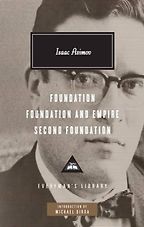
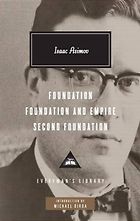
Let’s begin with Isaac Asimov and The Foundation Trilogy.
Isaac Asimov wrote many good books, but the one that stands as his finest, and the one that most rewards periodic rereading, is The Foundation Trilogy – Foundation, FoundationandEmpire and SecondFoundation. (Yes, Second Foundation is the third volume of the trilogy.) Following Edward Gibbon’s DeclineandFalloftheRomanEmpire in tracing the predictable collapse of a galaxy-wide interstellar empire, Asimov wrote with an episodic structure because each section was to be published separately in John W Campbell’s magazine Astounding.
The stories never feel fragmentary, though, because they are all woven together by the Seldon plan. Hari Seldon, at the beginning of the book, is a psychohistorian who predicts the fall of the empire – not a politically safe move to make – but instead of being executed for treason he is given safe passage to Terminus, a world at the edge of the galaxy. There, he and a team of scientists can work on the Encyclopedia Galactica, a compendium of all human knowledge, so that the dark ages following the collapse of the empire won’t take so long or sink so deeply into ignorance.
But it soon emerges that this is all a blind. Terminus is really a place for the successor empire to be seeded and grow in isolation, with Seldon’s plan marking great psychohistorical thresholds that the new empire will pass through. At each important juncture, Seldon himself reappears as a holographic image. But midway through the second book we run into something that even psychohistory couldn’t predict – a charismatic leader who throws a wrench into the works, derailing the Seldon plan and leaving the secret guardians of his future empire to scramble in order to put things back on track.
Foundation and its sequels show you the scope of first-rate extrapolative science fiction, and there is no better writer of the American plain style than Isaac Asimov. He never calls attention to himself as writer, but invisible as he is, he writes with such lucidity that everything is always clear and you slip through the story effortlessly. I loved it when I first read it at 16, and I loved it still when I reread it recently in my late 50s.
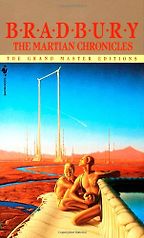
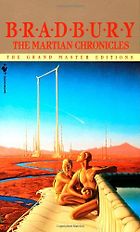
Moving onto Ray Bradbury and The Martian Chronicles.
Ray Bradbury also fits naturally into the early magazine days. The short story was and remains his natural length. It’s a shame that Fahrenheit 451 is his most-read book (schoolteachers love its tale of rescuing books from the flames) as it is far from Bradbury’s best work. In fact, the stories I love best are those collected in DandelionWine.
Bradbury’s love was science fiction, but not because of technology. When he went to space in The Martian Chronicles, it was already well-known that Mars was nearly or completely lifeless. It didn’t matter. He was writing about the Mars of the dreams of children growing up in the 1930s, the Mars that Edgar Rice Burroughs had written about. Bradbury’s martian stories are infused with tragedy, lost dreams, ancient glories and hope resurgent.
And the way he writes! This is language that is meant, like ancient Anglo-Saxon alliterative verse, to be read aloud. It contains its own music. It is music. When my future wife had a procedure done that required her to have her eyes covered for a time, I came over and read to her a couple of stories from ISingtheBodyElectric – a marvellous collection – and that was when I realised that Bradbury’s work is crippled when you read it silently. Your lips have to form the language, you have to let his words flow out of you.
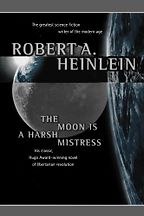
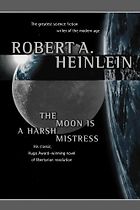
Next up is The Moon Is a Harsh Mistress.
Robert A Heinlein is, quite seriously, the creator of modern science fiction, in the way that Jane Austen is sometimes said to be the creator of the modern novel. Where Austen gave us the third-person viewpoint with deep penetration into the mind of a single character – which is now the overwhelming standard for all English-language fiction – Heinlein taught us how to handle the expository burden that is inherent in speculative fiction. Sci-fi and fantasy take place in a world other than our own, and it is essential to explain exactly how things differ from our familiar reality. It used to be done with expository lumps: “As you know, Dr Smith, the ergonuclear flux in the argyle drive requires a steady flow of harmonized eta rays.” But these explanations stopped things cold.
Heinlein pioneered and demonstrated the method we all use today, of effortlessly dropping in details and clues that help the alert reader learn just how the world of the story differs from their own. For example: “Marcus stepped onto the slidewalk and manoeuvred up to the fast lanes – he wasn’t getting off for a long time, and he needed the 60-mile-per-hour speeds if he was going to get there in time.” No explanation of moving sidewalks. The word “slidewalk” is self-explanatory. The idea that there are lanes sliding along at 60 miles an hour does the rest. The character doesn’t notice or comment on this unusual thing, because it’s not unusual to him. He simply uses it.
I first encountered Heinlein with his juveniles, and one at least rewards rereading: CitizenoftheGalaxy. But the book I’m going to point you towards, which I think of as his best, is The Moon Is a Harsh Mistress. This account of a revolutionary struggle between lunar colonists – many of whom came there (or their parents did) as exiles and prisoners – and the exploitative government agency that controls their lives is, like Foundation, a working out of historical forces. But Heinlein sticks with a cast of a few main characters and, with a charmingly colloquial writing style, makes us care about them all.
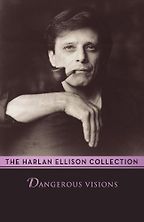
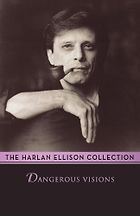
Your fourth choice is an anthology of stories edited by Harlan Ellison, Dangerous Visions.
So in my last two books I’m cheating a little, by giving you collections that provide you with the best possible entry into science fiction. These are, in fact, the books that gave me my doorway into the field – they are books that I loved.
Harlan Ellison is one of the giants of the sci-fi field. Like Bradbury, his work is mostly short stories, and from masterpieces like “‘Repent, Harlequin!’ Said the Ticktockman” and “I Have No Mouth But I Must Scream” Ellison became the heart of the new wave. But it is in his role as the creator of anthologies that I recommend him here. He came up with the idea of a collection of stories that could not be published in the somewhat rule-bound magazines of the day. He found a publisher and the writers responded to his call.
Get the weekly Five Books newsletter
The result was Dangerous Visions and Again, DangerousVisions, two of the greatest original anthologies ever created in any genre. Almost all the giants in the field responded, giving if not their best work then credible, delightful samples of what they brought to sci-fi. The only fly in the ointment is that the anthology was so successful, influential and widely read that today, any magazine would be proud to publish any of these stories. This collection remade the field.
One of the best things about a Harlan Ellison anthology or collection is reading his introductory essays. Ellison puts on no disguises, and he shuns the notion of anonymity or even aesthetic distance. His essays are personal, entertaining, smart. As much as the stories, they will shape your thinking about science fiction, then and now.
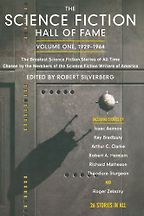
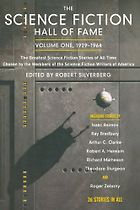
Finally, The Science Fiction Hall of Fame.
Where Dangerous Visions is a brilliant snapshot of a moment in sci-fi, The Science Fiction Hall of Fame is the whole background of the field. After the Science Fiction Writers of America began giving out the Nebula Awards and publishing annual anthologies of the winners and runners-up, many felt that it was a shame that they couldn’t retroactively give awards to the stories that had come before – the ones that shaped their reading, the ones that taught them what science fiction could and ought to be. So the SFWA members at the time nominated and voted on memorable stories that had stood the test of time. The result was The Science Fiction Hall of Fame. There is simply no better introduction to the whole history of science fiction than this book.
One problem with science fiction, however, is length. Not only do you have to tell the story, but also you have to create and reveal a new world. As a result, science fiction tales tend to be markedly longer to tell the same number of events. So in singling out shorter works for The Science Fiction Hall of Fame, SFWA would have to ignore novellas – a length that thrives in sci-fi precisely because it allows room for world development. That’s why there’s a second volume of the Hall of Fame, divided into parts 2a and 2b in some editions.
I love all five of these works I have chosen. I have reread all of them, and they hold up well. They were my education in the field, but more importantly they helped shape my vision of what storytelling is, and what it needs to be in order to matter in the lives of readers. Few of these writers wrote primarily to be admired or studied. They wrote to carry the reader into vicarious lives that were worth living. The characters and the worlds they lived in were the stars, not the writer. Having read these works, I’m afraid I became impatient with most – though not all – contemporary literary writing. So be warned. They might have the same effect on you.
Five Books aims to keep its book recommendations and interviews up to date. If you are the interviewee and would like to update your choice of books (or even just what you say about them) please email us at editor@fivebooks.com
Five Books interviews are expensive to produce. If you've enjoyed this interview, please support us by donating a small amount.
Orson Scott Card
Orson Scott Card is an American author. He writes in several genres, but is best known for his science fiction. His 1985 novel Ender's Game and its sequel Speaker for the Dead both won Hugo and Nebula Awards, and he has also edited numerous anthologies of science fiction
Orson Scott Card is an American author. He writes in several genres, but is best known for his science fiction. His 1985 novel Ender's Game and its sequel Speaker for the Dead both won Hugo and Nebula Awards, and he has also edited numerous anthologies of science fiction