Palaeontologist and dinosaur specialist Paul Barrett says many of the 1,200 known species of dinosaur were far more complex than we once thought. Some were brightly feathered, many were at least partly warm-blooded
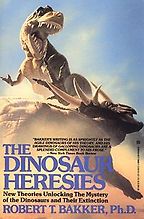
Your first choice is The Dinosaur Heresies by Robert Bakker.
This is a book that came out in the mid-80s but in many ways it’s a seminal work because, although it has a number of idiosyncrasies, it is actually a work that kick-started some of the modern views we hold about dinosaurs today. In particular, in this work he made clear that dinosaurs were not sluggish lizard-like animals but were very active, very dynamic and actually behaved a lot more like modern birds and mammals with very complex behaviours and social lives that hadn’t been thought about previously. So, this is a book that really got me interested in dinosaurs when I was a teenager and it has some very interesting ideas in it that a lot of people have tried to run with. Some of them have fallen by the wayside but others have subsequently become almost dogma.
Like what?
For example, some of the ideas were to do with body temperature in dinosaurs which have been very heavily debated. Nowadays it is thought that dinosaurs had some kind of metabolic regime intermediate between a very warm-blooded mammal or bird and that of a crocodile. So, in part Bakker seems to have been right in thinking that dinosaurs have a physiology more advanced than that which we usually associate with reptiles. He also came up with lots of behavioural ideas about how these animals would interact in terms of parenting, how they would interact in their fighting behaviour, their display behaviour when looking for mates. Again, generally he was looking at them as much more sophisticated, complex creatures than had previously been thought.
This book represents the culmination of ideas that he’d been throwing around for about ten years. It’s really only from the 70s onwards that we start to get this change in view and only from the 80s that we had a crystallisation of this view that dinosaurs were very exciting animals. For most of the 20th century dinosaurs were viewed as a dead end – an evolutionary dead end that was kind of interesting because they were big and odd-looking, but that never really went anywhere. It was the recognition in the 70s that dinosaurs and birds were closely related, and that dinosaurs were more like birds than like other reptiles, that suddenly led to a new burst of interest in them and new research programmes. If you spoke to a student in the 1940s or 50s they would just view dinosaurs as curiosities, but these days they’re viewed as an integral part of a greater knowledge of how animals are related to each other and how animal behaviour has changed through time, not just as a side-show oddity.
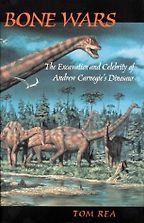
Next up is Bone Wars: The Excavation and Celebrity of Andrew Carnegie’s Dinosaur by Tom Rea.
This one has a more historical flavour. He goes back to the late 19th century, looking at the early discoveries of some really spectacular dinosaur specimens in the American West. So, in particular, up until this point all we knew about dinosaurs were a few pieces from Europe and some other far-flung parts of the world, but we hadn’t found any complete skeletons of dinosaurs. Then suddenly, in the 1870s and 1880s, they were recovered in large numbers, in Colorado, Wyoming and around there.
Until then people had been looking in places where it is quite hard to find them, because, although they’re there in western Europe, it’s built over, farmed, urbanised, such that there were relatively few chances to look for dinosaur fossils. As pioneers started heading out to the American West, following the railroads and trying to make their way to the gold fields in California, they are going to very desolate country where it’s much easier to find fossils because the rocks are at the surface and exposed. The rocks were the right age and type to have lots of dinosaur fossils in. So, as people were heading for gold, a lot of those people were actually involved in some of these very early dinosaur discoveries.
Which dinosaurs were discovered in the American West?
A lot of the iconic dinosaurs that we see in exhibitions and museums today. Some very good examples of the gigantic plant-eating dinosaurs, like Diplodocus, those things with very long giraffe-like necks, big fat barrel-shaped bodies and very long tails. Lots of examples of these were found complete – so, Diplodocus, Brachiosaurus, Camarasaurus, and some of the really big carnivorous dinosaurs too like Allosaurus who would have been preying on these things.
Are there periods of time where different dinosaurs were dominant? Were some extinct while others were alive, or is it kind of one long period of dinosaurs?
Dinosaurs were around from about 225 million years ago to 65 million years ago, at which point they all became extinct apart from their direct descendants – birds.
A pretty good run.
They were around for a very long time and during that time we get lots of different sorts of dinosaurs appearing and disappearing, so the sorts of dinosaurs we see early on are very different to those we see 50 million and 100 million years later. To start with, dinosaurs were pretty small animals, then through time they get much bigger, their body shapes change, some go back down on to all fours and you get a very wide variety of shapes and sizes and all sorts of different diets and behaviours. We start off from very simple beginnings and get much more complicated through time. So, in fact, Tyrannosaurus rex would have been around much, much later than the earliest dinosaurs. In fact, the distance in time between us and T. rex is smaller than that between T. rex and the earliest dinosaur, so they were around a really long time and underwent a huge amount of evolution.
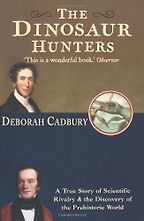
Your third choice is The Dinosaur Hunters by Deborah Cadbury.
This was a huge bestseller. It is another historical book dealing with the very earliest discovery of dinosaurs, pre-dating the spectacular finds in the US, which most people don’t realise were actually found in southern England – Sussex, Surrey, Kent and the Isle of Wight. These were the first fossils ever to be described scientifically, back in the early part of the 19th century. She deals with the circumstances of the discoveries, how they were initially interpreted, because nothing like this had ever been seen before, and also the personal rivalries between the scientists who were working on this very rare material.
Excellent. Tell me about the rivalries.
The two main protagonists are Gideon Mantell, a Sussex-based country doctor who was actually someone who went out looking for these remains as a kind of obsessive hobby, and did a lot of work in finding and describing these animals. His nemesis, if you like, was Richard Owen who went on to become the first director of the Natural History Museum. Owen was a career academic and a brilliant man but didn’t have all the scruples that you may have wanted. They competed very strongly and there were some very nasty incidents on both sides. Owen would rip off Mantell’s ideas, try and poach specimens from collections that Mantell was working with and try to suppress publication of some of Mantell’s work. In return, although Mantell was definitely on the receiving end, he was a vain character and was so obsessive about these animals that his doctor’s practice went to seed, his wife left him (which was very unusual at that time, but he was so obsessed with these things) and his eldest son emigrated to New Zealand to get away from him. So you have these two very irascible characters competing.
I notice in the Natural History Museum dino-directory that there are only two types of dinosaur in Japan.
They are not very common in Japan, though there are more now in the updated directory, I think.
I thought that when dinosaurs were around the land-mass was in one block?
It depends when. When they first appeared the continents were all joined in a single land-mass called Pangaea. Through the time the dinosaurs were around that land-mass breaks up, so when T. rex was around, close to the end of the age of dinosaurs, it’s starting to look a lot more like the world we’re familiar with today, with the Atlantic opening up and the continents approaching their present-day positions.
There’s a stunning number of dinosaur species here.
There are about 1,200 main species of which 800 to 850 are currently considered to be valid, depending on who you ask.
What do you mean? How can it be invalid? Either it’s a dinosaur or not, surely?
There is sometimes doubt over whether a particular fossil skeleton is distinctive enough to deserve a new name.
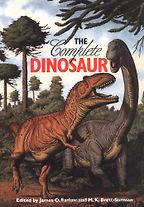
The Complete Dinosaur, James O Farlow and Michael Brett-Surman.
This is a slightly more technical book. This is a desktop summary of the state of dinosaur science. I think a new edition is currently in preparation and this is a hybrid between an encyclopedia and a series of longer articles dealing with all the topics of biology and evolution. It’s an opportunity to read short essays on a particular subject that’s written for a non-specialist audience. So, for example, there are lots of individual chapters, some of them dealing with the history of dinosaur discoveries, a large number of chapters on how dinosaurs ate, how they moved around, their colouring, how we use them as museum exhibits, an introduction to all the different groups of dinosaurs, how they’re related to each other and a discussion about how they became extinct, their biology, what did they eat, how fast did they grow.
Are we sure about how they became extinct? Was it a meteorite?
There are three main hypotheses about how they became extinct, for all of which there’s good evidence and all of which probably happened. It’s a question of trying to work out which was the most important. We know that a meteorite hit at the right time and it would have had a huge impact on the atmosphere and on global temperature, so we know that. We also know there were more gradual changes to the earth’s climate happening, due to the continents splitting apart, changes in ocean currents, changes in the amount of land and sea and a general cooling. We also know that there were two massive volcanic eruptions in India towards the end of the age of dinosaurs and millions of cubic kilometres of lava that released a lot of gas. So, there were all sorts of things going on and it looks as though dinosaurs may have been declining for other reasons too before they finally became extinct, and these things all acting together performed the final coup de grace that killed off these large dinosaurs.
Do we know what they looked like? I once read that they might have been covered with feathers and might have been pink and red and yellow.
We used to reconstruct dinosaurs in very dull colours, based on comparisons with large living animals like crocodiles, hippos and rhinos. Now we have beautiful fossils of some small meat-eating dinosaurs from China that show very clearly that at least a number of small meat-eating dinosaurs and possibly some of the bigger ones were definitely covered with feathers. So, these things are looking much more like birds and it’s possible that they were brightly coloured and using their feathers not only to keep warm but also for display.
Also, I suppose, even if they were big lizards, lizards can be amazing colours.
Yes. Unfortunately it’s only in a very, very small number of cases that we have direct evidence of colouring. Just within the last year they’ve found examples of ways that we can extract direct evidence of colours of feathers, so we now know that one or two particular dinosaurs were stripy white and black, and stripy ginger and black. But these are two specific dinosaurs where there’s microscopic preservation of parts of the feathers that allowed us to work out what colour they were.
Enough for a Jurassic Park scenario?
Unfortunately not. Although we can work out colour there’s no DNA. Sadly, it doesn’t survive in fossils beyond a few tens of thousands of years, possibly a hundred thousand years. So, although technically it may one day be possible to resurrect the mammoth, we are never going to be able to resurrect the dinosaurs. DNA just doesn’t survive that long.
Finally, you have picked The Dinosauria by David B Weishampel, Peter Dodson, and Halszka Osmólska.
This is the most technical book in my five. It is, if you like, the current bible of dinosaur studies. It’s a massive compilation and a technical review of everything we know about dinosaurs. It’s the most comprehensive single resource you can go to for information on dinosaurs.
What surprising things has it got in it that a lay-person wouldn’t know?
Well, it has summaries of all the recent research so it deals with the evolution of feathers and how dinosaurs actually got feathers and other bird-related characteristics before we actually get to birds themselves. It also presents summaries of the biology of dinosaurs, how they’re feeding and behaving, things like nocturnal behaviour, growth rate and a comprehensive review of all the different types of dinosaur and how they’re related to each other.
With the warm-blooded thing, are you saying that some of them were warm-blooded?
It’s very likely that they were warm-blooded, though not necessarily in the same way as a modern mammal, but more advanced than what we might see in something like a lizard. As far as we know, all dinosaurs laid eggs though. We have very good evidence of dinosaur eggs – some of the fossils have embryos inside. We have no evidence of any dinosaur giving birth to live young. In that sense they are very reptile or birdlike.
Which is your favourite dinosaur in the museum?
The Triceratops. It was always my favourite from when I was a kid. I love the massive Diplodocus in our central hall and have done some work on it in my professional career. My actual favourite we don’t have in the museum now. It’s one from South Africa called Heterodontosaurus, a very cute early plant-eating dinosaur about the size of a Labrador. As it was vegetarian as well, it would probably have been quite a good household pet.
I like those huge claws that are just exhibited on their own and nothing else has ever been found of that dinosaur.
Oh yes! Deinocheirus from the Late Cretaceous of Mongolia. That’s still a mysterious animal. No one really knows what it is. That’s all that’s ever been found, those two very large arms.
They’re terrifying.
It’s probably a type of dinosaur called a therizinosaur which is a very weird group of dinosaurs that’s not very well-known, which are actually close relatives of a lot of meat-eating dinosaurs but that became secondarily vegetarian, so they’re very odd, but the arms are all that’s ever been discovered of that particular species of dinosaur.
November 17, 2010
Also recommended on Five Books:
Five Books aims to keep its book recommendations and interviews up to date. If you are the interviewee and would like to update your choice of books (or even just what you say about them) please email us at editor@fivebooks.com