Before we talk about your five books, tell us about what first got you interested in the Spanish Civil War.
I think it is down to the fact that I was born in Liverpool in 1946 and Liverpool had been really badly hit with the Blitz. So when I was a kid the conversation was always about the Blitz and all the kids’ games were British versus Germans. I grew up with this kind of obsession with World War II and why it had happened. When I went to university that’s what I really wanted to study. I got into Oxford but in those days there was little opportunity to study very much modern history.
After Oxford, I got an opportunity to do an MA at Reading, which was just on interwar Europe. I was absolutely in my element and one of the courses was the Spanish Civil War. Initially, it seemed a dream come true. It was like this Pandora’s box that had everything. You have got Hitler, Stalin, Trotsky, Mussolini, Franco, Baldwin, Chamberlain, Leon Blum, fascism, communism, socialism, anarchism and liberalism – you name it, it was all there.
So you had all these different things to explore.
Yes, and decades on I am still studying it, even though I didn’t realise at the time I was going to end up devoting my life to it. Once I started reading about the Spanish Civil War, I just devoured everything I could find in English and that made me want to learn Spanish. So I started hanging around with Spanish and Latin American students in the university and picked up enough Spanish, and then I went to Spain in the late 1960s and fell in love with the place.
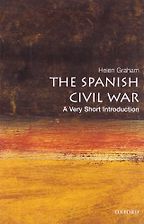
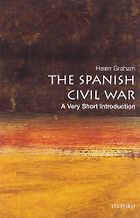
I know that you think some of the best books are the ones that are written in Spanish, but for the purposes of this interview we are looking at English books on the subject. Helen Graham’s The Spanish Civil War: A Very Short Introduction seems like a good place to start.
I think Helen Graham is probably the most profound historian writing about the Spanish Civil War in the English language. This little book, an Oxford University Press paperback, which is a short introduction, is a remarkable work in that in a very short space she manages to deal with everything. Despite spending 40 years researching this subject myself, I found that it just glitters with insights. It gave me angles on things that I hadn’t necessarily thought about before and yet is still a very good book to read if you are an absolute beginner on the subject.
What particular insights did you find most interesting?
She is very good on the ramifications of how particular politicians dealt with particular issues. She’s very perceptive, especially on the whole issue of what was going on in Spain in relation to a much wider European experience – the dark continent where dreadful things were happening everywhere. She links them up in an extremely perceptive way. She is very keen on photography and the way visual elements can be symbolic or emblematic of what is going on in politics, and that is something that also filters through in the book. This is more apparent in her next book The War and its Shadow, which I have also read. Both books show how good she is at examining the meaning of certain images.
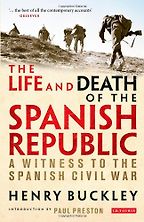
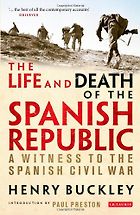
Next up is Life and Death of the Spanish Republic by Henry Buckley. I know that it took you eight years to find a copy of this book. Why was it so difficult to track down?
The book was published in 1940 and a few copies were distributed to reviewers but the bulk of the copies were in a warehouse that was hit during the Blitz. Maybe a few copies made it into bookshops but most of them were actually blown up. And because of wartime restrictions on paper, it wasn’t reprinted. It is one of the great rarities of Spanish Civil War literature. Although recently I have managed to get a Spanish translation printed in Spain and a Catalan translation printed in Catalonia but there is still nothing apart from the original copies available in English.
Henry Buckley was a very significant figure in the civil war – what did he do?
He was a correspondent who was in Spain during the war. But he actually first went over in 1930 as a very young man. He was one of the few correspondents during the Spanish Civil War who really knew Spain backwards. He was there throughout the experience of the Second Republic and got to know quite a few politicians. There were many great correspondents in Spain during the civil war but only Henry Buckley and the American Jay Allen were in Spain from before the foundation of the republic. They had been there since around 1930, so they knew the country very well.
Many of the articles that Buckley wrote during the war are difficult to track down because he was an agency reporter. A lot came out in The Daily Telegraph but they are almost all without a by-line. During the war he tended to move around a lot. He became very friendly with Hemingway, when he arrived in April 1937. Herbert Matthew, another great correspondent, and Robert Capa, the great photographer, were also part of his group. And actually Buckley himself was quite a significant photographer and his photos of the civil war are very important.
Towards the end of the war he met and married María Planas, a Catalan woman from Sitges near Barcelona. After Spain, Buckley was posted to Berlin where he worked until two days before the outbreak of World War II, when he was expelled by the Nazis. He was briefly in Holland during the German invasion, then in Lisbon, before becoming a correspondent for the Daily Express with the British forces. He was very badly wounded at Anzio and then he ended up going back to Spain after the war and was a correspondent there more or less until he died.
What is it about his book that you like so much?
It is really one of the great books about the Spanish Civil War, which is beautifully written, and written by someone who knew all the major protagonists and does wonderful pen portraits of them. But he also felt very deeply about the big issues. It is a book that is ultimately very sympathetic to the republic, and rightly so, in my view.
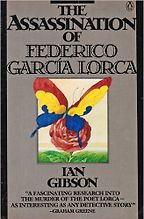
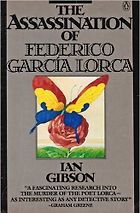
Your next choice focuses on Federico García Lorca who is seen to embody the poetic spirit of Spain during the civil war. What does Ian Gibson’s book, The Assassination of Federico García Lorca tell us about the poet?
Ian Gibson later wrote the great biography of Lorca, which is another wonderful book. This book on the death of Lorca was his first and was published by a Spanish exiled publishing house in Paris in 1971 and won a lot of international prizes. As a literature student Ian had gone to Granada to do a thesis about Lorca’s poetry. And he got hooked on the whole mystery of his death and what had happened and so produced this beautifully written book. It was such an international success that it then came out in English.
He really does write like an angel. The book is effectively a detective story and, although over the years odd bits and pieces have come out, it remains to this day the definitive study. There is a lot written about Lorca’s death in Spanish as well. I have got a couple of yards of books about the death of Lorca.
For those who don’t know – what was the mystery surrounding his death?
What wasn’t known was exactly who had pulled the trigger and, of course, the bigger mystery was why. Here was this man who wasn’t dangerous to the military rebels. But he was somebody who was very much associated with the republic and in 1934 had declared: “I will always be on the side of those who have nothing.” His travelling theatre group La Barraca, inspired by a social missionary zeal, took culture to the villages, not just in Andalucia but all over Spain. He had upset the local establishment by suggesting that the Catholic conquest of Moorish Granada in 1492 had been a disaster.
In many respects he was an innocent. When the war broke out he decided to go to Granada because he thought he would be safest at home, but actually when he got there it became apparent that he wasn’t safe. He took refuge in the home of a friend, Luis Rosales, who was also a poet, albeit a Falangist. Federico assumed that if he stayed with him he would be safe. But one day, when Rosales was out, civil guards came to get him. He had been denounced by Ramón Ruiz Alonso, a right-wing politician. With the OK of José Valdés, the local commander of the civil guard, a real fascist and also a rather twisted individual who had been badly wounded in the stomach, was in extreme agony and eaten up with hatred, Lorca was shot and, until Gibson’s book, nobody really knew why.
Ian unravels all of this and does it wonderfully. He gives the background of what Lorca was like and why he was hated. He gives a fantastic picture of the social tension in Granada in the spring of 1936 and then writes this great detective story, following what exactly happened to Federico. He managed to track down the people who were boasting in bars that they had shot Lorca because he was gay! The story of the guys who did it is just disgusting but it is a fascinating read.
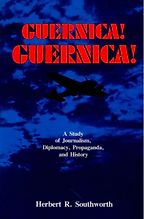
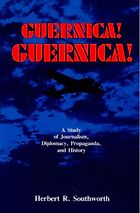
Your next book, Guernica! Guernica! A Study of Journalism, Propaganda and History by Herbert Southworth, explores another of the key moments of the Spanish Civil War.
Yes. The author Herbert Southworth was always my inspiration. I think he probably knew more about the Spanish Civil War than any man who has ever lived. He was an absolutely extraordinary man who was born in Canton, a tiny Oklahoma town, in 1908. He worked in copper mines in Arizona in the 1920s. I think he was one of the few Anglo-Saxons to do so because most of the workers were Mexicans and that is how he learnt his Spanish. Initially he was self-educated but he managed to work his way through university in Arizona. Always fascinated by books, he went to Washington and got a job in the Library of Congress. When the Spanish Civil War broke out he became fascinated by the Spanish Republic and he started to review books that were coming out. And lots of books did come out almost immediately, as instant think-pieces from both sides. His reviews were noticed by the Spanish Republican ambassador in Washington, who invited him, with Jay Allen, to form a kind of unofficial office of information. And through that he was reading everything they could lay their hands on about what was going on in Spain.
After the civil war he and Jay Allen continued trying to help Spanish refugees and when American finally entered World War II, Herbert volunteered and ended up in North Africa. After the war he bought a pile of army surplus radio equipment and created Radio Tangier and stayed on waiting for the day when Franco would fall. During that time he befriended lots of Spanish Republicans. He also became a great expert on the Falangists as well and through endless communication with them came to be recognised as an expert by them as well.
To cut a long story short, he became a great collector of books about the Spanish Civil War, which he housed in the old French château where he went to live after Morocco gained its independence and he was forced to hand over his radio station. When he ran out of money he was forced to sell his collection to the University of California, where you can still find it today. But he couldn’t live without his books, so he started his collection again.
I first met him in 1973 and he almost adopted me. My father was dead and we ended up with a very strong personal relationship and I used to go and visit him a lot. I also have a huge collection on the Spanish Civil War and some of the jewels in my collection were given to me by him.
But to go back to his writing, Herbert had this mind-boggling recall which enabled him to collate almost everything that he read. His first book, which unfortunately never came out in English, was published by the same Spanish publishing company who published Gibson’s book on Lorca and was called El mito de la cruzada de Franco – the myth of Franco’s crusade.
And that book went on to inspire his book, Guernica! Guernica!
Yes. His first book written in Spanish dissected various myths put out by Francoist propagandists and their impact. After the bombing of Guernica there was a massive and quite successful propaganda effort claiming that Guernica had not been bombed, but had actually been blown up by Basques as part of a scorched earth policy in order to create a false atrocity. Herbert had always hoped that his book El mito de la cruzada would come out in English. Although it never did, he spent years revising it and particularly the part about Guernica. He chose it as the subject of the doctorate that he did at the Sorbonne, and worked on it as a visiting researcher at the University of California.
The thesis became Guernica! Guernica! – a book not just about what happened but also about the myth. The full title of the book is, Guernica! Guernica! A Study of Journalism, Propaganda and History and it is about all of those things. It is just an astonishing treasure trove about many aspects of the civil war. It is all seen through the prism of Guernica, but there is so much in it about the propaganda services of the nationalists, how lies are disseminated. Obviously, he was interested in journalists, having been one and knowing most of the main journalists who worked on the Republican side.
There is so much about the press which inspired my lifelong interest in the journalists. I wrote a book about war correspondents during the civil war which I wrote for Herbert. It came out after he had died but the book was dedicated to him. So Herbert’s book on Guernica is one that I would always include in the five most important books on the Spanish Civil War in any language. And he certainly had a lot of influence on other historians, particularly in Spain. Indeed, Helen Graham’s book The Spanish Republic at War is dedicated to him.
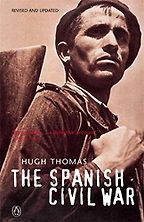
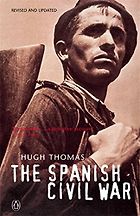
One of those historians was Hugh Thomas, the author of your final choice, The Spanish Civil War
In my five choices I have included Helen Graham’s short, very precise and up-to-date scholarly essay on the war. So I thought that, given that these will be five books aimed at people starting to be interested in the Spanish Civil War or indeed people who we might want to get interested in the subject, it would be a good idea to have a big colourful account of the war. I was torn between Thomas’s book and Antony Beevor’s. Both books are very similar, both very lively and well written. But even though Thomas’s is a much older book I think it wins by a short head.
It has been revised several times. I was his research assistant at one point for the third edition, which was the biggest revision. It is immensely colourful. I wouldn’t say I agree with all his views on aspects of the civil war by any means. But when I am working on the war, there is not a week that goes by when I don’t take it off the shelf to look at what he says about a particular incident. It really is a remarkable achievement that when I go back and look at this book, which is now 50 years old, I find his take on things is still fresh. I always find I can get some inspiration from picking it up. And for anyone who has never read anything on the Spanish Civil War it is an immediately gripping book that shows just how much the subject has to offer. There is that sense of the rich cornucopia of characters and topics which, as I mentioned before, is what got me interested in the subject all those years ago.
Five Books aims to keep its book recommendations and interviews up to date. If you are the interviewee and would like to update your choice of books (or even just what you say about them) please email us at editor@fivebooks.com
Five Books interviews are expensive to produce. If you've enjoyed this interview, please support us by donating a small amount.