Our topic today is the meaning of life, and the first book you’ve chosen is Antonio Damasio’s Descartes’ Error. Why is that top of your list?
The book isn’t actually about the meaning of life, but it’s incredibly important for pursuing the topic in a useful way. It came out in 1994 and it had a huge impact. There are probably two main advances in the book that I hadn’t seen in previous work in philosophy or psychology or other fields.
The first is that he puts a big stress on the importance of emotions to rationality. People often think that rationality and emotions are in conflict with each other. You hear people say ‘Stop being emotional, be rational.’ What I learned from Damasio is that that is just not a good way of looking at it. By drawing on famous examples, such as Phineas Gage, and by drawing on his really deep knowledge of neuroscience, he shows ways in which rationality, especially the kind of rationality that is involved in decision-making, really does require having your emotions working well.
The second respect in which this was a breakthrough book is the way in which it understood emotion in terms of what the brain does – not as a kind of abstract computational process (the way a lot of ideas at the time about thinking worked) but very much tied in with the particular brain processes.
So the insights are: firstly, emotions matter to thinking about how you should live your life, and, secondly, the brain matters to thinking about emotions. So if you put those two things together, you get a different approach to thinking about the meaning of life: one which takes emotion seriously, and the other which takes the nature of the brain seriously.
Do you want to give an example?
A starting point for a lot of Damasio’s research was the 19th century case of Phineas Gage. He was a railroad worker who took a rod through his head, and it should have killed him, but he survived, despite the fact he clearly had a hole in his head. What’s really interesting is that his personality changed. He retained his ability to use words articulately, and he was certainly OK doing mathematics. But, basically, he became a jerk. He went from being a responsible employee and a good family person to being someone who was very difficult to get along with. So the brain damage he got didn’t affect his reasoning ability, but it really affected his behaviour in negative ways. What Damasio discovered, using the old pictures of where Phineas Gage had gotten the rod through his head, is that it had damaged a part of his brain that was very important for connecting high-level reasoning with the emotions. Then Damasio, who is a neurologist, was able to find similar kinds of damage in a bunch of patients that he was treating in Iowa at the time. So this was a way of getting at how crucial the interconnections between verbal and mathematical reasoning on the one hand, and emotional processes on the other, are to enabling people to function well as human beings. And that becomes really crucial for assessing what it is to find a meaningful life. It isn’t just a matter of being able to reason about how you should live your life; it’s a question of getting your emotions engaged in a way that makes your brain work, to enable you to find meaning in life.
Before we get to that, tell me about your next book, The Really Hard Problem. What is the really hard problem?
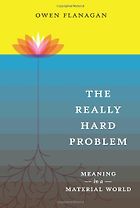
This book is by Owen Flanagan who is one of the best people currently working in the philosophy of mind. He’s starting off with an idea from the philosophy of mind called the hard problem. The hard problem is the problem of figuring out how a physical system like the brain can have consciousness. And it certainly is a difficult problem. It’s one on which lots of progress is being made right now, though it’s still not at all solved. Flanagan has written a bunch of books that are very well informed by current work in psychology and neuroscience, and he’s also written about the hard problem. But in this book he is dealing with what he calls ‘the really hard problem’, which is the problem of the meaning of life. If, as he thinks, the human being is not anything that’s supernatural, if there’s no such thing as a soul, there’s no such thing as immortality, if, as Damasio assumed, we’re just a biological system, how is it possible that we could have meaningful lives? That’s what he takes to be the really hard problem. And many people have reacted the same way. Lots of people have thought that if there isn’t a God, and if there isn’t religious truth, then life is inherently meaningless. How, if you take a more secular, naturalistic, scientific approach, can you find meaning in life? And he’s got some very interesting things to say about that.
It’s certainly a big question.
It’s the question I try to tackle in my book. But his approach…
Yes, what’s his solution?
He doesn’t actually have a solution, but it’s a very good book. There’s a lot of discussion of Buddhism in it. He’s very interested in Buddhism, not as a religion, but as a way of life. He takes a lot of practical ideas from the Dalai Lama – such as having positive emotions and avoiding conflicts as recipes for finding meaning in your life. He pursues various avenues for thinking about how there can be meaningful lives in a physical world. But he doesn’t have a crisp answer. Nevertheless, it’s an extremely intelligent exploration of the question.
Tell me more.
What he does in a fair amount of detail is to consider the relation between Buddhism and the philosophical questions. He proposes to do what he calls naturalising spirituality. Naturalising means to give a scientific account of something. So he wants to take the notion of spirituality away from its traditional religious notion of involving souls and immortality and Gods and angels and things like that, and talk about ways in which people can find meaning in their lives through social practices and through rituals, including the kinds of rituals that are practised in Buddhism. I’m not sure that’s very successful. Although the Dalai Lama expresses a lot of interest in modern science, if you read his works, he’s got a traditional view of reality as something that’s based on the mind, rather than the scientific view that I know Flanagan shares with me, that the mind is something that results from biological and physical processes. Nevertheless, Flanagan does an interesting job of exploring the possibilities of coming up with a naturalistic notion of spirituality.
You’re not necessarily convinced by this? It does sound a bit like Buddhism with the main point of Buddhism taken out.
Buddhism is a flexible school of thought, so you could argue about what the main point is. But, yes, for anything that is spiritual in the traditional sense, for example if you believe in ideas about reincarnation, obviously the soul is not something material, because it has to be able to survive into the next life. When people asked me about spirituality I used to say: ‘Oh I don’t believe in spirits.’ My preferred way to deal with the question of spirituality is simply to eliminate it. But I think he does a very interesting job of trying to retain a notion of spirituality that fits with science. The aspects of spirituality that he’s really interested in, which are the aspects of the meaning of life that interest me, are questions of ethics and values. I think both of those things, and the package that goes with them, except for the metaphysical part, can survive from a scientific, naturalistic perspective.
So even if you don’t believe in a Christian God, you could still strive to love your neighbour as yourself and follow some of the precepts of Christianity…
Sure. There are certainly lots of things from those religious traditions that point to things that are valuable in human life, regardless of whether you believe there’s a God and immortality.
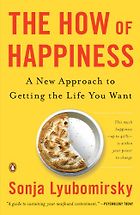
The How of Happiness is more of a self-help book, I think? How you set about getting happy on a day-to-day basis…
It’s much more than a self-help book, though. Most self-help books are just made up. The people who write them don’t know anything – they just put together some cute package that will sell lots of copies. What makes Sonja Lyubomirski’s book different is that it’s actually based on scientific research on what makes people happy. She’s part of a research programme that’s been very active in psychology in the last ten years, called positive psychology. Traditionally psychologists were more likely to study people’s unhappiness – problems like depression and anxiety. In the last decade there’s been a very strong movement to turn that around and use the methods of scientific psychology to try to look at the more positive side. Lyubomirski has been one of the leaders in that movement, along with people like Martin Seligman. But the key thing is you don’t get to make things up – you’ve got to do studies and experiments to try to figure out what actually does make people happy. And I think her findings are maybe not shocking, but they’re very interesting and very useful.
Tell me about them.
She talks about a dozen or so happiness activities that are known to make people happier. Things like expressing gratitude, cultivating optimism, not thinking too much about things you shouldn’t be worrying about. Being kind, having social relationships. These things are all common sense, but you don’t know they’re actually true. She talks about strategies for coping, learning to forgive, savouring life’s joys, practising religion and spirituality, taking care of your body. I think these are all good pieces of advice, but at a level over and above what you usually find in self-help books – because she’s doing it from a scientific perspective, where there’s actually evidence that supports her claims that these are ways people can be happy.
Also, she shows that a lot of the views that people have about happiness are just wrong. Thinking, for example, that the best way to be happy is to be rich. The data on that are really quite interesting. It certainly makes you unhappy to be poor, but over a certain threshold, people don’t get much happier by having more money. That’s a really important thing, I think, for people to know. Especially if, as she tends to assume, the goal of life is happiness. That’s where I disagree with her. I don’t actually think happiness is a meaning of life, though lots of people assume that. Still, happiness is something folks care about, and she gives the best discussion I know, of the nature of happiness and the ways that one can practically accomplish it.
We’ve all grown up being told to help other people, but here’s an added incentive to do so – it makes you happier. Ultimately, it’s also selfish.
It can be both. Actually, after reading her book, I tried an experiment. I started tipping more. I always gave reasonable tips – 15 per cent in a restaurant or a taxi. But, as an experiment, I tried tripping more than is expected – 20 per cent. It’s really quite interesting the effect you get, because people really appreciate it. That was something I tried based on her book and I actually quite enjoyed the experience.
But happiness isn’t the key, in your view?
I think happiness is certainly important to people, but I see it as an effect, rather than as a prime goal. The arguments that I make in my own book, The Brain and The Meaning of Life, are based partly on ways in which happiness is independent of meaning. There are people whose lives are extremely meaningful, even though they may be short on happiness. Consider, for example, people who are really struggling with a difficult situation – an example I use is a single parent with a disabled child. This is someone whose life is clearly very difficult, and there may be limitations on happiness. Nevertheless, I don’t think that person’s life is lacking in meaning. On the other hand there are ways of getting happiness that are really quite trivial. Someone could be perfectly happy just watching bad television while taking drugs. There are ways of generating happiness that don’t seem to contribute to a meaningful life at all. On the other hand, when people are satisfying what are really human needs, then happiness usually comes along with it. So then the question becomes: what are human needs? Here, like Flanagan, I take a naturalistic approach. I think we can look at human biology and human psychology and figure out what are the things without which we can’t lead meaningful lives.
Obviously, you have biological needs like food and water and shelter and healthcare. But on top of that, if you look at the evidence concerning the fundamental needs that seem to matter in people’s psychological lives, for this I draw on a bunch of psychological and neurological evidence to argue that love, work, and play make up the most meaningful pursuits. Love is obviously relationships, work gives accomplishments and confidence which I think are important, but I also threw play in there because I think kinds of entertainment that people enjoy are an important part of people’s lives – from the time they’re kids, when play is the most important thing they do, all the way through to retirement – when people aren’t working so much any more but still can find meaning through various kinds of entertainment pursuits. If you look at people’s psychological needs and the way they meet them through love, work and play, you should see those as the primary goals, rather than happiness.
What about your next book, Education’s End by Anthony Kronman?
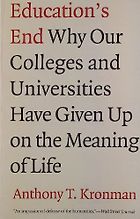
I like this book because it raises the question of why universities no longer spend much time addressing questions like the meaning of life. The author is a professor of law at Yale University and has been involved in educational planning there. He talks about the shift of the way that universities or colleges have viewed their educational function in the last 100-200 years. In both the United States and England, if you go far back enough, colleges were essentially religious institutions. They assumed that a big part of what they did was the ethical and religious training of the students who went there. Now they’re secular, but one result of that is that questions of ‘Why should I live?’ or ‘How should I live?’ are no longer addressed. These used to be taken as central questions. And it’s not just for philosophy but also for literature. Important works of literature can address issues about meaning and not just the most philosophical ones such as Dostoevsky. Lots of different works, from Shakespeare to contemporary novelists, are at least indirectly addressing questions about how people can and do and should lead their lives. But the people who are teaching at universities dodge these questions in favour of questions that are not only more secular, but also more narrow and more technical. Literature departments are more interested in French philosophers than in talking about what novelists, or playwrights or poets were getting at, which was often addressing key issues about life.
Five Books interviews are expensive to produce. If you're enjoying this interview, please support us by donating a small amount.
I think it’s really a good diagnosis of a situation in universities and it’s true even in my own field – philosophy, which I teach – where these questions usually just don’t come up. If you think about why people might take a philosophy class, people coming out of high school, it’s because they’re interested in these questions. But we just don’t address them – because philosophy, the social sciences, the humanities, got more tied up in technical internal questions, rather than looking at the issues that really matter to people.
Do you think this book has or will make a difference?
The book ends with an appendix where he describes the kind of curriculum they put together for a directed studies programme at Yale. I think it’s a good thing for most students to get that, not only read the classics of philosophy and literature, but discuss them in a way that gets at what I think are the main concerns of the great novelists, the great philosophers and the playwrights, which are very much tied in with the meaning of life. I think the humanities and the social sciences can do a much better job of addressing the sorts of questions that most young people naturally have in a very formative part of their lives.
But most young people these days seem to want to study media or marketing and PR and communications, which aren’t much focused on, or possibly irrelevant to, these central questions…
They needn’t be if they were done reflectively. But an awful lot of the theory, if you can call it that, that operates in those areas is really abysmal. It’s not only uninformed by philosophy or literature, but even sound work in the social sciences such as positive psychology. A lot of the theory as far as evidence goes is no better than self-help books: people just make things up.
Lastly you’ve chosen the Terry Eagleton book The Meaning of Life. Does he have a good summary for us?
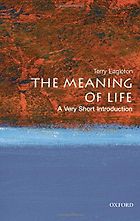
What’s valuable about his book is that he comes at it from a different perspective because he’s actually a professor of English. He’s talking about meaning in the context of literature. Which I think is very important, because I think the issue, the meaning of life, isn’t just a matter for philosophical discussion, though it certainly is that. But it’s also something about which people can learn a lot from the great poets and playwrights and novelists. He’s aware of that connection. He also says, quite sensibly, that the meaning of life isn’t something that’s given to you, it’s not something that’s pre-fabricated. It’s something that you have to construct. So he has a view of meaning that not just develops in your life, it’s something that you develop – by reflecting, by reading and generating ideas about how you want to lead your life. A lot of what he emphasises – like everybody else who is sensible – has to do with social relationships, as an integral part of meaning for all well-adjusted people. It’s a very short book, part of the ‘Very Short Introductions’ series that Oxford does. I think it’s very nice for tying in meaning of life with some literary questions, although he’s also got some good discussion of some of the relevant philosophers. He certainly doesn’t come up with a simple answer at the end, but he says some very interesting things along the way…
Get the weekly Five Books newsletter
Is he arguing that we each have our own meaning of life?
He’s not quite that relativistic – that would allow more latitude than I certainly want to. I don’t think he would say that all meanings that people have are equally good, the relativist view. But he certainly allows for variation.
Five Books aims to keep its book recommendations and interviews up to date. If you are the interviewee and would like to update your choice of books (or even just what you say about them) please email us at editor@fivebooks.com