You’re writing a new book on Rwanda and have gone back twice this year, for the first time in nearly a decade. How have things changed since you wrote We Wish to Inform You…?
When I finished writing We Wish to Inform You… I was very conscious of putting dates at the end of it – May 1995-April 1998. I did that because I felt that was the precise period of my immersion in Rwanda, and because I was aware that future events could massively alter the way that period of history looked. Those dates are there to say: this is how it looked at the time. Who knew what might happen in the six months after I signed off on the manuscript and the book appeared, much less in the next five or ten – or now 15 – years? The leadership could be violently overthrown or abruptly change its direction or there could be more massacres – even, conceivably, worse than the last round. And, of course, it could go the other way. There could be a level of peace and stability and coexistence of the sort we now see but that was unforeseeable at that time. I talk about that in the book; there’s a line where I say: ‘Maybe, if you’re reading this in the future – five, or ten or 50 years from now – you’ll be taking this book with you as you plan your vacation in Rwanda.’ And when I went back in January, tourism was booming. People were actually reading that book as they arrived there on holiday and, yes, the country is one of the safest in Africa.
But don’t get too comfortable about it. Rwanda’s still a terribly complex and problematic place. It’s not an open society. It’s not a place without violence, and obviously the incredible, appalling legacy of the genocide colours everything. And yet, the government’s project of making people live together and insisting that they must make a nation together – not just any people, but killers and survivors – is an extraordinary experiment. There really is no precedent for it in modern human history. To say that it is working far better than I’d have anticipated does not mean that we can yet say it is really a success. For that, generations must pass. And in the meantime, while establishing physical security at home, President Paul Kagame has waged a series of wars in Congo over a long period of time and at great detriment to the national reputation (not to mention to the people of Congo). And he has done this – and he defends the wars and their damage – in the name of a simple nationalist idea that Rwanda has got to bring everybody home, that the country cannot afford to be divided within or without, that those who committed genocide or now threaten to must be integrated into the society: they may give up their fight, or they must be crushed. And to make that idea live, Kagame has integrated into his army and his government a great many former enemies, just as he asks ordinary citizen survivors to forego revenge and live alongside the killers of their families. It is extraordinary to behold and to get one’s mind around it.
So, in short, I think Rwanda has gone from being the most fascinatingly torn apart country on earth to perhaps being the most complex and strangely compelling story of a country putting itself back together. I say ‘strangely’ in the sense that it simply defies all expectation – and to a large degree defies belief. There was a survivor who was talking about living with killers around, and he said to me: ‘It’s our obligation, it’s our duty, it’s our necessity, it’s the only way we can survive and I do it every day. And yet it’s incomprehensible to me.’ That sums up the national condition.
So the first book you recommend is actually three books – all by a French journalist?
One of the things that writing about Rwanda doesn’t offer you – although writing about many other fascinating places does – is a substantial literature by the people you’re writing about. There just aren’t many books by Rwandans that are readily accessible to an outsider. There is a Kinyarwandan (Kinyarwanda is the language) oral tradition, there’s a lot of poetry and in the last century more and more written stuff, but little of it has been translated, and of the writing on the genocide that’s taken place – their own recent history – most of it has taken place in French or English. And most of it has not been done by Rwandans. Under the circumstances, I would say that the most fascinating literary project about Rwanda in the last few years has been by Jean Hatzfeld. He is a French writer and reporter who worked for a long time for the newspaper Libération and covered the Balkan wars. For the last six or seven years, he has been visiting Rwanda on and off, and always going to the same small town in the southeast. The first book he wrote took a kind of a hybrid form – a mixture of oral history and personal reflection – and it was based on the stories of a group of survivors who had spent the 100 days or so of the genocide hiding in these dense papyrus swamps near their home. They were being hunted there by a gang of killers from around their village, people whom they knew. What makes this a great book is not just its subject matter, but its style and its voice. Hatzfeld is obviously someone who spent a huge amount of time just hanging out in the village, in the bars, in the backyards, in the fields, with people who had had this experience – and he relates their stories with unmediated immediacy, and with great soul.
When Hatzfeld finished that book, which was called Dans le Nu de la Vie (or in English translation Life Laid Bare: The Survivors in Rwanda Speak) people asked him, well what about the killers? So he wound up going back to Rwanda and realised that the whole group of killers who had been pursuing the survivors he’d been writing about were all in one prison nearby. And he arranged to meet with them on a regular basis, individually and collectively, to hear their stories. And it’s the most direct (I guess you could say honest) account, by people who took part in the genocide, of the excitement and thrill of the hunt and the kill that motivated a lot of them. Then on New Year’s Day in 2003, President Kagame announced an amnesty, in which a huge number of prisoners – 40,000 from around the country – were to be released. These were prisoners accused of genocide, who had by then spent nearly ten years in prison. Many of them had been through some form of justice, or at least rudimentary justice, but many of them had not yet been fully judged or punished by any tribunal. The government just felt the need to diminish the prison population, which was massive and overcrowded, and to start reintegrating people into the society, however awkward that would be.
Hatzfeld then went back to his village and watched them come home, and suddenly he had these two groups of people, whom he’d studied more closely than you can imagine, re-encountering one another. And in the process he learned a great deal more than he had known in the first place about either of them. And so the third book, which is called The Antelope’s Strategy, really combined these two experiences. And in some ways it becomes a great literary work, because it’s also a commentary on the two earlier works. You see the evolution of his encounter with these two groups and his reflections on what is called ‘reconciliation’ by the government, but is just the problem of living together – a problem that Rwanda most dramatically confronts us with. And it’s a beautiful book, a book that’s incredibly deep. It also tells you something very shocking, which is that ultimately this process of reintegration is really not hard at all on the killers. They go home, they have their freedom, they have their fields, they have their families waiting for them. They give a rather minimal confession and they’re left alone. And obviously the survivors have a much, much harder time reintegrating. So this notion that Rwanda is this society where the victim has gained power and has taken it out on the perpetrators, that’s false. It’s a fiction most often put forward by human rights activists, who aren’t paying close enough attention, frankly. What you find is that both groups feel in many ways disenfranchised.
Five Books interviews are expensive to produce. If you're enjoying this interview, please support us by donating a small amount.
Hatzfeld keeps politics at a distance – which is the distance at which these poor peasants experience it. So when you hear about the government, you hear about it in the sense that a van shows up, three government officials come out, announce there will be a meeting, everyone has to show up, everybody shows up, they get lectured about how they’re supposed to live together, then the guy disappears and then they get on with living together – or not. And there is much more to it than that. The reason that people are living together, without violence to a large degree, the fact that people are in jail or out of jail – all that has to do with policies, which are another story.
Your second book is the work of a human rights agency.
Yes, there’s an organisation called African Rights that I admire, run by a woman called Rakiya Omar. She is Somalian by background and she had worked for Human Rights Watch and had had a falling out with them about their policy on the American operations in Somalia – which of course just preceded the Rwandan genocide. And she started her own organisation with Alex de Waal, who is perhaps better known as a writer about Darfur. And she really made it her mission, in the immediate aftermath of the genocide, to start documenting the experiences of survivors. She recorded the experiences of everybody she could talk to, but typically she focused on survivors. And, while other human rights organisations have largely devoted themselves to holding the post-genocide government to account for its treatment of accused perpetrators of genocide, and for its various shortcomings, African Rights has kept its eye on the injustices suffered by the victims of the genocide – not just at the time, but in the aftermath of the massacres. Rakiya Omar wrote one of the first books that came out after the genocide, and it’s almost entirely an oral history. It’s a huge fat book and everyone just calls it ‘the yellow book’. Death, Despair and Defiance was a tremendous documentation effort.
Your third book is about justice.
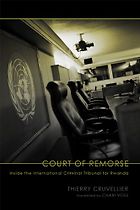
Yes, there’s a terrific book by, again, a French writer, named Thierry Cruvellier, and it’s called Le Tribunal des Vaincus – The Court of the Defeated. And it is the only serious, and by far the best, account of the workings of the International Criminal Tribunal for Rwanda, in Arusha, Tanzania – which followed the model of the International Criminal Tribunal for the former Yugoslavia in The Hague. And, while Rwanda has grappled with hundreds or thousands of genocide cases internally (and been criticised for failing to be up to the highest standards of international justice, when it never even pretended that it could meet those standards – nobody could), this was set up with tremendous international support. Something like a billion dollars was spent – about $150 million per year and it has existed for 15 years. And it has tried fewer than 50 cases and achieved maybe 40 convictions. The court has been important, because in a conflicted international community it established that this was genocide, that rape was a crime of genocide, etc. But it’s been really problematic and the trials themselves have barely been noticed by the outside world. Which is fascinating, because you can’t imagine a Milosevic trial having been ignored, had he lived. But nobody knows the names of the Rwandans. It’s part of the story of Rwanda, that nobody’s ever paid much attention. Ask anybody if they know about the Rwandan genocide and they’ll say yes. But ask them if they know who the Pol Pot figure was, or what was the name of the party, it strangely draws a blank. And Cruvellier wrote a really interesting, thoughtful, analytic, deep book about how tangled, messed up, and compromised this pioneering international court for Rwanda has been. Happily, it is just now being translated into English – and will come out in America next year.
So, who is the big name in the genocide?
Well probably the biggest name has been Bagosora, who was convicted last December by the tribunal. Théoneste Bagosora. But there’s a bunch of them, part of the point is that there are multiple names.
So, on to Speake, your fourth book.
One of the books that I find most interesting – although only partly about Rwanda – is a book by John Hanning Speke, called The Discovery of the Source of the Nile. He was a 19th-century, Royal Geographical Society-sponsored explorer of Central Africa. Largely in direct competition with Richard Burton, he was vying for the big European explorer prize of discovering the source of the Nile. And that source is now understood to be a little trickle somewhere in the hills of Rwanda. Among Rwanda’s many fascinations is that it’s the only country in Africa, with the exception of Burundi perhaps, that exists entirely in its pre-colonial borders. There was this pre-colonial kingdom called Rwanda that had real cohesion as a proto-nation state that didn’t get all carved up in colonialism. And Rwandans are very proud of the fact that they avoided the slave trade, they kept the traders out. The country is surrounded by Swahili but it doesn’t speak Swahili. And it was known as a very insular, impenetrable place. Speke tried to get in and so at some point did Stanley. But Speke basically parked on the border of what would now be Tanzania and he cooked up a Victorian racial theory about the people of the place. That these two groups – the Bantu Hutus and the Nilotic Tutsis were two distinct tribes and the group that became known to us as the Tutsis or the Nilotics were, in fact, descended from the lost tribes of Israel. This was Speke’s terrible contribution. It was known as the Hamitic hypothesis, because it’s named after Ham, Noah’s son, which is something that you also find in the American South – the slave-owning racist theory there also involved all sorts of ideas about Ham as the original black man. Because how are you supposed to account for what was really a human sub-species as far as they were concerned?
It’s just incredible to read Speke’s book because he talks about the flat-nosed, flat-lipped negro, on the one hand, and then waxes euphoric about the kind of superior, Aryan-looking Ethiopic types. It’s almost like a zoology about human beings – and it became incredibly influential. It became, in many ways, the underpinning of all the theories that were used by the Belgians to divide Rwanda, when they ruled it as a colony in the 20th century. And it came to influence these Rwandan peasants in the hills as they killed their neighbours in 1994. Even if they’d never heard of John Hanning Speke, they had internalised a huge amount of what is at the core of it. The book also has the virtue of being a pretty good read.
Your last book is on South Africa?
I’m very wary of the idea that one can read a book about one country in Africa and substitute it for another country. But I do think one of the more powerful books that has come out of the continent as a piece of literature in a long time was Rian Malan’s My Traitor’s Heart. He’s descended from the founders of apartheid. He’s from the Afrikaner family of the Malans who were involved in every stage of it. He is a really extraordinary writer, and he was writing, in late-apartheid South Africa, about killings by blacks of whites and by whites of blacks. A bit like police reporting, but also a memoir. It’s a hybrid form, grappling with what the violence tells us about the politics, and what the culture tells you about the violence. It goes deep, deep, deep into individual lives, which I increasingly have come to believe is the only way that we can understand these large, political shapes, particularly in stories that are foreign to us. It’s beautifully written and it’s extremely complex. It’s also highly personal. You don’t read it to get the information that you would get from the Economist Intelligence Unit. But you come away with this sense that something has been drawn absolutely out of the South African soul, the way you might read a Solzhenitsyn book to understand something about Russia.
Five Books aims to keep its book recommendations and interviews up to date. If you are the interviewee and would like to update your choice of books (or even just what you say about them) please email us at [email protected]