World
The best books on French Attitudes to America
recommended by Richard Kuisel
The historian tells us how French condescension towards America goes back to the 18th century, but more recent antagonisms can be traced to the Second World War


The historian tells us how French condescension towards America goes back to the 18th century, but more recent antagonisms can be traced to the Second World War
You have been studying France’s attitude to America for many years, and have written several books about it – what first got you interested in the subject?
When I came to Washington in 2000, anti-Americanism was on the rise. I was invited by the State Department to give some advice about how one can explain the phenomenon. That got me interested in trying to understand French attitudes. As a result I began to publish studies about French anti-Americanism, and that ultimately led to thinking that I really needed to write a book about it.
The decisive moment came when at the State Department they were discussing French attitudes and one staff member said we needed some historical perspective, explaining that we needed to go back two years. I thought to myself, “We need to go back a little longer than two years to understand how the French perceive us.”
You obviously specialise in France but it wasn’t just France that was perceived as being anti-American.
Yes, of course there were other countries as well – such as Greece, Spain and the Middle East – where this was on the rise.
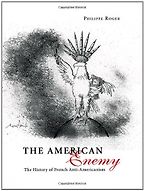
Your five books all offer some perspective on this. Your first choice, Philippe Roger’s The American Enemy, explores the background to that relationship starting in the 18th century, so a lot longer than two years.
Indeed! I chose this book because Philippe Roger contributes an erudite yet witty and scathing account of Gallic anti
–
Americanism. He starts in the 18th century when French naturalists claimed they found the New World inhabited by deformed animals and degenerate natives. And he ends with Cold War intellectuals like Sartre, who complained that America at that point was suffering from rabies – by which he meant virulent anti
–
Communism.
The subject of The American Enemy is French intellectuals rather than public opinion or policy. Roger has composed a kind of genealogy of ideas, and argues that the French developed a veritable discourse about America built on stereotypes, prejudices and fictions. Americans are supposedly materialists, Puritans and racists.
In the book there is a character called Georges-Louis Buffon, an 18th century French scientist who had some of the misguided attitudes you are talking about towards America. Even though he hadn’t been there he was sure it was somehow deficient, with dogs not barking and birds not singing. Where did people like him get these ideas?
If you go back to the 18th century there is an expression of cultural superiority. French intellectuals saw America as a rude country of immigrants lacking any cultural eminence. So there is a Gallic condescension operating here. Even to this day there is a belief that the French are the guardians of culture and we [Americans] are the purveyors of some kind of cultural pap. Roger is trying to ridicule this discourse which he finds biased, hypocritical and uninformed. He is trying to remove a toxin from French intellectual life.
Your next choice,
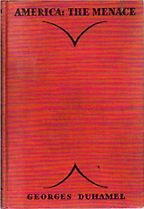
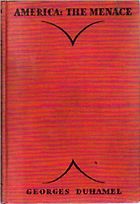
America, the Menace by George Duhamel is seen by many as the classic anti-American text from between the wars. Why was there so much ill feeling towards America at that time?
Part of it has to do with policy. There was a good deal of resentment against how America treated France after the First World War. There were issues like the collection of war debts. But I think that in Duhamel’s case, the source of trouble was dismay and anxiety about American modernity that he observed when he toured America in 1929 and 1930.
The French title of the book is Scenes from the Life of the Future, so what he was writing was a kind of warning to the French that unless they were careful they would likely end up imitating the Americans. In America, he thought, capitalism and mechanisation had run amuck. He likened America to an anthill inhabited by brain-dead workers doing monotonous jobs at machines, convinced by ceaseless advertising that life’s goals were nothing more than acquisition of products like cars and household appliances.
It sounds like an early warning about the perils of consumerism.
Yes, but again the culture theme emerges. Duhamel argued that America lacked culture in a European sense. He claimed that America’s culture centres on entertainment like movies and sports, rather than on art, music or literature. He ends the book asking: Where are the great American artists, writers and composers? The answer he gives is that there are none because this is a mass society of workaholics and conformists. Duhamel’s book is important because it was the most read text about America for two or three generations. French school children were still reading excerpts from it as late as the 1970s.
And in your book you look into whether Duhamel’s predictions came true.
Yes, and to some extent they did come true.
How do you find the French feel about Americanisation?
Ambivalent. On the one hand they condemned us for exporting American products and practices, but in the end they have learnt how to live with it. I think there is a great deal of ambivalence about accepting so much of consumer society like McDonald’s, Hollywood movies and Eurodisney.
Which hasn’t been a great success.
Eurodisney has been something of a disappointment to Disney. It never really lived up to their expectations. They had enormous trouble with the park at the beginning, when it almost went bankrupt twice. And even now it doesn’t attract the audience that Disney expected.
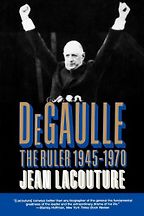
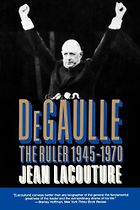
Let’s go back in time a few decades for Jean Lacouture’s biography of one of France’s most famous presidents, Charles De Gaulle.
Lacouture is a journalist and a prolific biographer, and although this study is not new I think it still remains the best biography of De Gaulle in English. It is fair-minded and lively. He treats De Gaulle as a national hero, but at the same time points out the mixed record of his accomplishments and failures.
Support Five Books
Five Books interviews are expensive to produce. If you're enjoying this interview, please support us by donating a small amount.
I picked this book because the Gaullist project has been a potent strain in attitudes towards America among the French right, and it survives to some extent to this day. President Sarkozy in some ways still buys into the Gaullist project, by which I mean that France is a global power with a special role in championing civilisation and an independent Europe – and that America has been the major obstacle to France’s aspirations.
But presumably at that time America’s involvement in
meant there was a change in attitude towards the United States?
I think that change really comes from the American side. The fall of France in 1940 marked a real break in American perceptions of France. That led to difficult relations between Franklin Roosevelt and De Gaulle, culminating in Roosevelt’s refusal to acknowledge De Gaulle’s place in creating a provisional government. Even Winston Churchill was far ahead of Roosevelt on this issue. There was a perception among American leaders that France was no longer a great power and that it should be treated as such, and this behaviour antagonised De Gaulle. There has been a conviction among French leaders ever since World War Two that the United States refuses to treat France as a true partner and expects it to be a follower. Needless to say this has generated a testy transatlantic relationship.
Your next book, Sherrill Brown Wells’s Jean Monnet, is a biography which acts as a foil to this one.
Yes, the idea is that Jean Monnet and Charles De Gaulle represent two opposing strains in French views of America. Monnet, who was the architect of the European Union, was almost as important figure in mid-20th century France as De Gaulle but he was the mirror image of De Gaulle. He was the Frenchman who liked America and wanted to import American ways, especially its economic practices. Among American officials he was their favourite Frenchman during the forties and fifties. De Gaulle and Jean Monnet, as one might expect, were rivals in many ways. Here you have the two opposing strains among the French elites.
Who was Monnet popular with?
He was respected by many political leaders, officials and businessmen. French business, at least among those with international connections, never shared the anti-Americanism expressed by intellectuals.
Lastly you have chosen a book which takes the form of a dialogue between the former French foreign minister, Hubert Védrine, and the international relations expert, Dominique Moisi.
The main theme of the book is a discussion of France’s role in this new globalised world and how France should act towards the United States. What is interesting here is that Védrine is the diplomat who coined the term “hyperpower”, referring to the multiple ways the United States exercises its power. It combines hard and soft power – for example military might with Microsoft and Hollywood. He argues that the Americans use globalisation to advance their model of a free market economy and minimalist government. The question he raises is what should France’s role be in an American-led globalised world. He admits that France is not a “hyperpower”, but it is still an elite nation and one that has an important role.
What does he think they should do?
He thinks they should try to tame or regulate globalisation, develop the European Union, protect the French social model and French culture, and act as an independent adviser to Washington. In his language, the French should be allied but not aligned – meaning that the French should act as an ally to, but not necessarily follow, the United States.
With France taking an increasingly dominant role in Europe, what do you think its relations with the US will be like in the future?
What is surprising is that President Sarkozy, who ran on the most pro-American ticket of any French presidential candidate and rejoined NATO, has not had better relations with Washington. Sarkozy and Obama have never been exactly friendly, and if anything there is a kind of disappointment on the part of Sarkozy’s government with Obama. The French are still trying to get the Americans to recognise them as partners, as independent allies.
Now we have elections coming up in both France and the US – could things change?
I doubt it. François Hollande is a socialist and it is the French left that has historically expressed the most ardent anti-American attitudes, while Sarkozy is likely to continue his independent ways. And in our [US] presidential campaign Europe is being vilified by Republican candidates as the anti-model for America. So I don’t see anything encouraging about either election for French-American relations.
February 8, 2012
Five Books aims to keep its book recommendations and interviews up to date. If you are the interviewee and would like to update your choice of books (or even just what you say about them) please email us at editor@fivebooks.com

Richard Kuisel
Richard F Kuisel holds a joint appointment in the History Department at Georgetown University and at the BMW Centre for German and European Studies. He has a particular interest in Franco-American relations and has written several books on the subject, most recently The French Way
Richard Kuisel
Richard F Kuisel holds a joint appointment in the History Department at Georgetown University and at the BMW Centre for German and European Studies. He has a particular interest in Franco-American relations and has written several books on the subject, most recently The French Way
© Five Books 2025