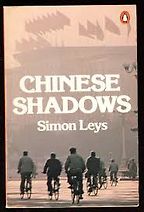
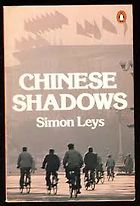
Your first book is Chinese Shadows by Simon Leys, published in 1977. I gather from reviews that at the time people still thought Mao was really great and so the author’s negative approach did not go down well.
Yes, Mao was still the cuddly guy in the Andy Warhol paintings and the visionary statesman who allowed Nixon to visit China. He was the man standing up in Tiananmen Square with 27,000 giggling schoolchildren waving their flags at him. But the truth, as we now know, was much, much worse. At the time, it wasn’t easy to write a polemic of this kind against Mao, but the style of writing is brilliant: it’s a literary work as much as a work about China. It’s sarcastic, it’s witty, it’s deeply learned. And it absolutely takes apart Mao’s defenders limb by limb. It’s the sort of thing that utterly cuts through all sorts of cant, and I still enjoy picking it up and reading it today.
Why? Do the things it says still hold true?
It’s not true in describing day-to-day life in China now. But it’s certainly true about Mao. And you still can’t talk about Mao like that in China these days.
Tell me about the author, what did he base his information on?
Leys is a Belgian-Australian, the ultimate high-minded scholar. I think he may have worked for the Belgian Embassy in Beijing at one point, but ended up at the University of Sydney and the Australian National University in Canberra. He was a great defender of Chinese culture, and the refinements of Chinese culture. He wrote a wonderful essay once on the art of calligraphy. But he made a trip back to China in 1976 and was absolutely horrified at the changes that had taken place. For example, Mao had knocked down the old city walls. There’s one chapter where he goes to find one of the famous old city gates, which he thinks has survived the Maoist purge of the old city, and it’s not there. He goes almost into a delirium – he thinks he’s lost his way, that he must have come to the wrong spot. And then he realises that it’s gone altogether.
There are these quite remarkable scenes that illustrate his horror at the utter destruction of the Mao period. He uses a great word to describe the Maoist policy: he calls it cretinous. It’s so evocative of his bitterness at what has happened and his scorn for the apologists in the West who defended Mao.
So is it more about the culture and not so much about talking to Chinese people he knew?
He has conversations with Chinese people. But he’s not allowed to talk to ordinary Chinese, which is another theme in the book. He is shadowed by people wherever he goes. It’s really an utterly spooky and deeply pessimistic work but also gripping to read. I can’t fathom why it has gone out of print and hasn’t been republished.
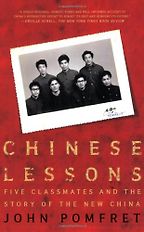
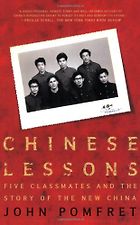
Let’s go on to the book by the Washington Post correspondent, John Pomfret, Chinese Lessons: Five Classmates and the Story of the New China.
I found this book really unputdownable. We’ve all read lots of books about the reforms under Deng Xiaoping since 1979. Pomfret takes it straight down to street level, almost, with the story of five people that he knew, former classmates he had met at university as a foreign student in Nanjing in 1981. He was able to trace their lives intimately from when he left them. The book really has this grand sweep to it – like a great historical novel, part Balzac, part Exodus. The stories are very poignant and moving on their own, but once they’re displayed on the widescreen of China and the policy changes taking place in China at that time, it amplifies them even more. The detail is just amazing.
There’s one guy who becomes an official in Nanjing. He becomes your typical petty official, banging his desk and demanding sentences be handed out to various criminals, and coming up with grand schemes to redo the city. Another guy goes into business. He has lots of failed businesses, but at one stage he manages to corner the market in urine in a district in Beijing. They distil urine to make a particular sort of medicinal product. So Pomfret’s old classmate goes around Beijing at night collecting people’s piss. And there’s a horrible story, about a guy whose parents were killed by some fellow students in the Cultural Revolution – and he has to bicycle past them every day. He’s resigned to the fact. He doesn’t boil with anger; he just shrugs his shoulders as if it was a bad thunderstorm that had passed or something.
The stories themselves are incredibly poignant, even though they’re ordinary stories. In China, ordinary people’s lives have been so dramatic. It works really well, and the book is really well written as well.
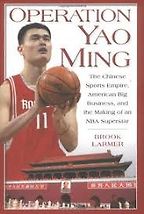
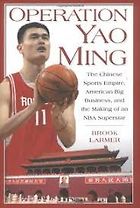
Let’s talk about Operation Yao Ming: The Chinese Sports Empire, American Big Business, and the Making of an NBA Superstar. So the fact that Yao Ming is 7ft 5in didn’t happen by accident, it seems…
I don’t have any interest in basketball, but the great thing about this story is that it becomes another way of telling the story of China. Look at the story of Yao Ming’s mother, for example. By the time Yao Ming was a star for the Houston Rockets, his mother is this sort of innocent, loyal Mommy, in the kitchen in Houston, making her son lovely Chinese food that he can’t get in the States. But when she was growing up, his mother was a rising basketball star, and more to the point, a member of the team of Red Guards that toppled the leadership in the Shanghai Sports Association, who then got put through horrible struggle sessions. Ten years later she was toppled herself, when the Cultural Revolution was over and the Gang of Four went down. Yao Ming had to struggle a bit there, because his parents had had their privileges withdrawn. The book minutely chronicles that – the research is absolutely fantastic, right down to, as you say, the touch of eugenics in his creation. Yao Ming was a product of these two tall people, mated to create a great star.
The other interesting bit is that you often forget that the state controls sport in China. So when it comes to selling Yao Ming and another basketball player, the back and forth between the state trying to both retain its property, and trying to profit from it, makes a great read.
So Yao Ming is still partly owned by the Chinese government?
I think the state allows him to go on contract, but it initially got a lot of the money.
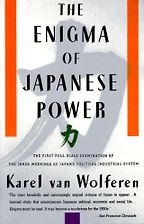
Your next book is about Japan, The Enigma of Japanese Power, by Karol Van Wolferen. Tell me why it’s on your list.
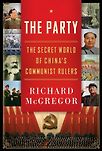
When I was writing my book, about the Chinese Communist Party, I used to read this. It’s a classic book from someone who has an uncompromising point to make, and Van Wolferen backs himself with the most prodigious research. He goes right back into the pre-Meiji period in Japan, and looks at how Japanese power structures were developed. The detail is stupefying in its thoroughness. It’s a great example of somebody refusing to be befuddled, as a lot of people in Asia are, by this idea that, ‘We’re like this because our culture is like this.’ In other words, we can’t vote because our culture doesn’t stand for democracy. He has this great phrase in the book, ‘politics in the guise of culture’, which he uses to describe how a lot of practices can be justified. Supposedly it’s about culture, but actually they’re the product of long-standing political arrangements and an attempt by power holders to hang on to those arrangements because they suit them.
Get the weekly Five Books newsletter
I spent many years in Japan and Japan is very, very different from China. But this book I thought was a classic at describing the power structure as it really is, and not how the power holders would like you to think it is. And that’s a very good lesson for writing about China.
Can you give me an example?
The great example is rice. The Japanese used to say, ‘We can’t have foreign rice because Japanese people don’t like foreign rice. It’s not in our culture to eat foreign rice; it’s not what our society is based on.’ In fact one of the most powerful organisations in Japan is the agricultural cooperative organisation, which is a massive, wealthy political lobby. It wasn’t necessarily anything to do with the taste of foreign rice. It was about the power of the farm lobby.
And you applied this when you were writing about the Chinese Communist Party?
Japan is a sitting target, whereas China is a moving one. But I thought it was a good lesson in not compromising in what you set out to write; not to be taken in by, to use that terrible word, spin.
Let’s go on to your last choice, for readers who are more into fiction.
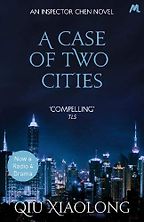
My fifth choice is a novel, a series of detective novels set in Shanghai. Specifically, A Case of Two Cities, by Qiu Xiaolong, who is great. He’s a Chinese guy, but he lives in the States. He’s got a series of detective novels and the key character is a detective who is also a famous poet. This detective is not a revolutionary, but he’s a bit leery of the system and suspicious of promotion, though he’s a diligent and excellent detective. And the theme of the book is how he has to work through the system to get to the bottom of the case. He has a loyal underling who, like a lot of Chinese people, is struggling to get on with his life and family. But the thing that’s great about the book is how the author portrays the system. It’s like that great phrase of Perry Link’s, about ‘the anaconda in the ceiling’. You never quite see the Party operating. You never quite know what the political situation is, because you’re not allowed to know. But you get calls out of the blue every now and then from the Party Secretary. The detective always gets calls from the Party Secretary barking cryptic enquiries and vague instructions at him. It’s typical of the Chinese system – it puts you on alert, on edge: something’s up and you’d better not push too far. On top of that, they’re lovely detective stories, and very well crafted plots, set very evocatively in 1990s Shanghai, during the modernisation period.
The central character is a very captivating and endearing guy. It turns the stereotype upside down because he is a poet, a gentle character, but still a tough-minded policeman. One has an outside view of Chinese police being apparatchiks, and it’s not like that at all. But he works in a system that is corrupted and difficult – it’s a good-man-in-a-bad-system type story. The books often finish off with people being arrested, but the situation in the police station and the police itself, being a bit unresolved. The whole atmosphere is a mixture of vaguely spooky and vaguely hopeful, which is a bit like China itself these days…
Five Books aims to keep its book recommendations and interviews up to date. If you are the interviewee and would like to update your choice of books (or even just what you say about them) please email us at editor@fivebooks.com
Five Books interviews are expensive to produce. If you've enjoyed this interview, please support us by donating a small amount.