Am I right to think, from the books you’ve chosen, that newspapers really are in big trouble now and that there is a fundamental transformation going on?
Yes. That doesn’t mean news organisations are all doomed, but I do feel quite strongly that print distribution is going to fade much more quickly than most people today believe. As we’ve seen, print circulation has been falling for many years. What people sometimes miss is that the print distribution of newspapers is a classic 19th century, economies-of-scale business. What that means is that, as circulation falls, it becomes less and less efficient. There are diseconomies-of-unscale, in effect, and the cost of producing each individual copy starts to go up very quickly. There is no way for the publishers to recoup those costs, so there comes a point, as circulation falls, where publishers will seek to accelerate it. They will need readers to switch to electronic delivery. We’re not there yet, but I think that we’ll be there sooner than people think. At that point the industry will try to drive a process which, for the past 15 years, it’s been trying to retard.
For a traditional newspaper, what percentage of total costs are printing and distribution compared to hiring good journalists?
Very significant. Total newsroom costs are probably around 15% for a really good newspaper. Some of the other costs are for sales and marketing, but the largest single expense is printing and distribution.
It does seem as if we are reaching a point where many people are comfortable with not having a physical newspaper, with just reading it online.
Yes, and clearly there are all sorts of changes going on where publishers are trying to recover more costs from readers, which makes a lot of sense. That’s going on in the UK and now increasingly in the US. We’ll see how it plays out. That is the big question of this year – will people look back on the initiatives taken last year at The Times of London, and this year at the New York Times and judge those to be successful or not? That is a very significant fork in the road.
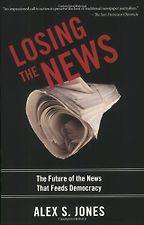
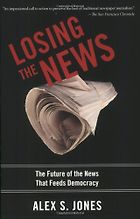
The first book you’ve chosen is Losing the News, by Alex Jones. Is his main concern that the media is being overtaken by opinion and puff pieces, and that the real hard news, the actual reporting – say on the war in Iraq – is going out the window?
That’s right. Everyone sees there has been this enormous proliferation of information and of publishing. What people sometimes miss is that while the number of opinions is exploding, the number of original sources of fact is contracting. In the US, for instance, the number of reporters working for US organisations based outside the country has collapsed. Many, many news organisations that used to base some people outside this country no longer do. The New York Times has, I think, the largest staff covering general news outside the US for an American audience, and they have 40 people. The US broadcast television networks base almost no one outside the US. They tend to just have a very small flying squad that runs to any particular point of crisis.
And is it the same for serious reporting within the US?
Yes. Here is the problem. Editors are not people of bad will, they are not people who are trying to deliver less to readers. They’re trying their very best. But if you force people to cut news budgets, they will pare away. There are certain basic things they feel they have to do, and there are other things they feel they can live without. So international news is one that gets cut, investigative reporting is another one that gets cut (which gives rise to ProPublica where I work). A third one that gets cut, and this is a particular issue in the US, is statehouse coverage. I’ve concluded that a principal reason for that is an accident of 19th century American history. The state capitals of most of the largest states are not population centres. So you have Albany instead of New York City, Sacramento instead of LA or San Francisco, and Springfield instead of Chicago. That’s actually true for eight out of 10 of the largest states in the US — the consequence of which is that when you have to cut back, the state capital is not local and you adjust accordingly. In Britain, it’s as if important government ministries were located in Manchester and if they were, they would be covered less.
Are these the kinds of issues Alex Jones looks at? Tell me a bit more about the book.
To a considerable extent they are, yes. Alex Jones is a distinguished reporter, a Pulitzer Prize winner. He covered the press for The New York Times and, with his late wife, wrote a history of The New York Times. Earlier, he wrote a book about a family that owned a once great newspaper in Kentucky, the Binghams, which is the story for which he won the Pulitzer. My one reservation about the book is that it strikes me as excessively nostalgic for the newspapers of yesteryear, and excessively convinced that the salvation of newspapers is the principal issue. I don’t want to caricature his argument, but I think his view is that the news is going to rise and fall with our leading newspapers. I’m not completely convinced that is the case.
For example at ProPublica, where you are general manager, you’ve been able to specialise in investigative reporting by going down the non-profit route.
If you look at this as an economic matter, all the phenomena we’ve been discussing are a series of market failures in certain areas of high quality news. Everyone is beginning to realise that these market failures are very, very likely to persist. When you have a market failure, the good, assuming its creation is desirable, becomes a public good. And in the case of news, it’s more than desirable, it’s essential to democratic governance. So then certain kinds of news need to be funded in the way that public goods are. Investigative reporting is one of those areas that, particularly in this country, has increasingly been revealed to be a public good — and in the US, the funding of that comes largely through philanthropy. Britain has a different tradition in this respect, and a different culture [BBC news is funded by a licence fee payable by television owners]. But while there is some public support for public radio and public television in the US, it is increasingly under attack. If public television and public radio had not yet been invented in this country, today they could not be.
Could you see ProPublica being able to survive as a for-profit?
No. We’ve begun to accept advertising and you can garner a certain amount of money that way. You may be able to charge partners for a certain amount of content. But ProPublica exists because of a market failure, not because there is a business opportunity. Take, for example, the economics of charging partners. In the US, pretty much the most that anyone will pay for a long and incredibly well done story is about $50,000. That would be an unusually high price, but there are a few times and places when people will pay that much money. The cost of the kinds of stories that we’re talking about producing – and it’s not just us, there are a number of other entrants in this field – is often a very, very significant multiple of that. Which again just points out the problem.
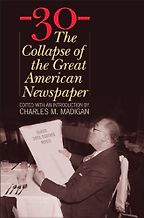
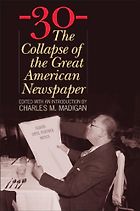
Your next book is -30-: The Collapse of the Great American Newspaper. What is -30-?
-30- is what journalists used to type at the bottom of their stories when the story was over. It was the journalistic equivalent of the cinematic “The End”.
And is it “The End,” according to the book?
Yes, particularly of newspapers. This book is an anthology. But it is an especially well-crafted anthology that reflects the writing of some of the best short-form writers on this subject, including David Carr of The New York Times, Jack Shafer of Slate, Michael Shapiro, who now teaches at Columbia University, and Ken Auletta of The New Yorker. The book surveys the field by doing case studies. Some of them are functional — about readers or circulation — and some of them publication-specific, about The New York Times, The Philadelphia Inquirer, The Los Angeles Times or The Chicago Tribune. It gives a very, very strong portrait of where we have come to in this decade and how we got there in the two or three decades before it.
Is there a story or fact in there that particularly took you aback?
Jack Shafer’s piece on the Newspaper Preservation Act [of 1970, which exempted newspapers from certain antitrust laws], the mergers and disappearance of a whole raft of American newspapers 30 to 40 years ago, was, I thought, very smart. America used to have a substantial multiple of the number of newspapers it has now, and part of what happened was all the afternoon newspapers disappeared. There was a time when the afternoon papers were stronger, then that shifted. Many of them merged with the morning papers. The upshot of all this is that people have been talking about the sky falling for newspapers for 40 years now. One unfortunate consequence is that when it actually starts to fall people miss it, or underestimate the danger, because they feel like they’ve been warned about it too many times. It’s the story of the boy who cried wolf.
And that’s where we’re now at, you think?
I do. I don’t mean this year, or in the next five minutes, but sooner than people would be inclined to believe.
Tell me your thoughts about a specific newspaper. Say The New York Times – what’s your feeling about its prospects?
If the metering works, The New York Times is as well positioned to make the transition as any. The bar is getting higher in terms of quality of content, which plays to the Times’ strengths. It’s the run of average papers that are going to be in the most serious difficulties. Particularly if charging for online content turns out to be the test – and I think it likely will be. It’s already clear that readers will not pay for most content. Whether they will pay for particularly excellent content remains to be seen, but I think there is some reason to hope that they might.
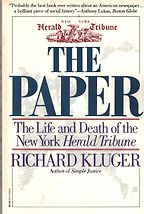
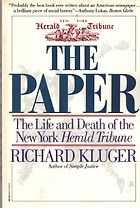
Your next book is by Richard Kluger, The Paper, and is about The New York Herald Tribune. I loved your line about it in an earlier email: “Even the dominant outlet of one day can be literally obliterated”. That’s food for thought isn’t it?
That’s my point. The New York Herald Tribune was a great newspaper with an august tradition. It was actually the product of a merger of the two great mid-19th century New York newspapers, The Herald of James Gordon Bennett (which was the precursor of The Paris Herald) and The Tribune of Horace Greeley. In the 20th century it came to be run by the Reid family and was, for many decades, up there with The New York Times. The Times leaned Democratic, The Herald Tribune leaned Republican. They were the two leading newspapers in the largest city in the country and, to a considerable extent, the country’s leading journalistic voices. That remained true, certainly through World War Two. And then by the late 50s, The Herald Tribune was in desperate trouble, and by the mid-60s it was gone.
What happened?
The Paper is a spectacular, nuanced, beautifully written story of how it happened. As always with any given organisation, the problems were partly particular to that place and the foibles of some of the people involved. But also, as so often with the fall of institutions, it went well beyond that. Particularly with the rise of television, there was no room in New York for two leading, serious, high-end newspapers. Kluger doesn’t entirely agree with this, but others made the point that The Times made an enormous investment in content during WWII, much greater than The Herald Tribune’s, and The Times came out of the war much stronger. I wrote a book myself about the newspaper business, about Barney Kilgore, who was the father of the modern Wall Street Journal and the person who built it into what it was when [Rupert] Murdoch bought it. That book begins with Kilgore being brought in to consult on “is there any way to save The Herald Tribune?” which is also a small episode in Kluger’s book. And the advice he gives them seems to me very relevant, even today. He talks about “distinctiveness” and how The Herald Tribune had lost its. That’s in 1958. So the paper had gone from dominant to existentially troubled in less than 15 years, and less than 10 years after that it was entirely gone.
Is your focus on this comment about “distinctiveness” because you think that really is the key to success?
Yes! It’s basically true of all products. People don’t pay for the same old, same old.
Do you get a lot people applying for jobs at ProPublica? I imagine investigative journalism really does still stir people’s imaginations.
We’ve been very fortunate in that regard. It’s a good time – and it has been for the last three years – to be in the buyer’s market for talent. There’s an enormous amount of journalistic talent available, either people being cast off or, in many cases, at least when it comes to us, not getting the opportunity to do the work they want to do.
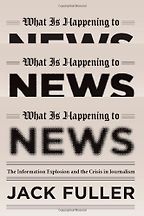
Your next book is by Jack Fuller, What is Happening to News.
Jack Fuller is in many ways the renaissance man of modern American publishing. He’s been a law school graduate, a Supreme Court clerk, he’s an accomplished novelist, an expert on jazz. In the newspaper business he has been, at various points, the editorial page editor, the editor and ultimately the publisher of The Chicago Tribune. He’s a remarkable figure, and this is his second book in the last 10 years or so on journalism. The first one was called News Values and was a very sensible approach to questions like “what is news about?” and “how do we make the choices we need to make ethically?” It was a handbook for the way news used to be practised. This book – the title of which, What is Happening to News, I confess I don’t love – is about emerging research in neuroscience about how people consume news, how they react to news and how that is changing. It directly confronts issues such as shortened attention spans, heightened emotional stimuli and bombardment by multiple media. The book talks very intelligently, and quite creatively, about how news is going to need to be significantly re-conceived if it is to continue to get through to people and break through all of the stimuli that surround people in the modern information world.
How does one do that then?
The book is frankly stronger on description than it is on prescription, and I don’t think anybody has definitive answers on this yet. But Fuller is right to point people to this research and to suggest that a new grammar of news is almost certainly emerging and is going to need to emerge.
Isn’t a fundamental problem, though, that when people have a choice they prefer to read about a celebrity going to the gym than the war in Iraq?
That’s not really his point. His point is more how do you deal with the fact that video is such an emotionally more powerful medium? How do you convey subtlety in a world dominated by people who are shouting at each other, and who are incredibly easily distracted? He also points out that telling stories by talking about human beings, for instance, as opposed to abstract policies, is not cheap but may be essential.
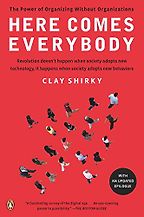
Lastly, you’ve picked Clay Shirky’s book Here Comes Everybody.
I know this is not an original selection, but I do think it’s the smartest thing that I have read so far, of book length, about social media and what it means and will mean. This is obviously an increasingly critical factor for journalism.
Tell me how it ties in with the news model.
In a number of ways. One is that it is increasingly the way people discover the news. It is now widely observed, and I think true, that the atomic unit of news is no longer the issue of the publication but the story. That is obviously critical for the way that news organisations conceive their work. You can convince yourself that people are going to read your product, or look at your service, from some definition of beginning to some definition of end. But in fact many – and increasingly most – people are going to come to a particular story and then go to another story. One of the most important ways they are going to find those stories is from trusted sources of different kinds, and people they know – or virtually know – are an important driver of that. As the ability to produce aggregrations and curations that make use of that increases this will only be more true. For instance, I think [the iPad app] Flipboard is a very, very interesting product that will be attractive to a lot of people. Flipboard itself might get overtaken tomorrow by something that is even better. Something like it, that harnesses the power of social media for story selection for readers. To some extent, your site [The Browser] is such a thing.
I’ve been completely converted to Twitter. I follow lots of people who I think are interesting but don’t know personally. They recommend links and that’s how I choose what I read.
It’s very adaptable and highly customisable, and if people are of a mind to spend time with it, it works pretty well. What I think will happen as we go along is it will become almost equally useful to people who put in less and less effort, and that will broaden out the base of people who consume it. So that’s one way in which the world that Clay Shirky describes has impact for news.
The second big way is that the newsgathering process and the process of reacting to news are fundamentally changed. The phrase that Jay Rosen likes to use – “the group formerly known as the audience” – has a lot of power to it. Readers (to use a simple old-fashioned word) can be involved very significantly in the creation of content. And the creation of content is not a one-time static phenomenon, but more of a process that evolves and can morph and shift. This is, of course, a fast-moving subject. Clay Shirky finished writing his book about three years ago, which seems like an eternity. There are not a lot of books in this area, because it is so fast moving. But of the ones I’ve seen this is the one that, for me, most intriguingly points in the directions that I think we’re headed.
I know at ProPublica you have a team of professional journalists, but does the “group formerly known as the audience” also play a big role? Say, for example, someone calling in to say they’ve just witnessed some shocking bit of corruption?
It does, on two or three different levels. One way is the way you’re suggesting, people who tell you about stories. More meaningfully and more often, we can quite intentionally involve large numbers of people in helping us do things that would otherwise be impossible. The Guardian has had a great deal of early success with this, and so have some others. We’ve spent some time with it as well. We have a reporting network here at ProPublica of close to 7,000 people at this point. We occasionally enlist them actively in helping us do things that we otherwise simply couldn’t do.
What kind of thing?
Last year we were reporting on campaign finance and came to realise that big, high-profile sporting and entertainment events could be a centre of that. So we wrote a story about a Bruce Springsteen concert and all the congressmen that were at the concert, how it was used for fundraising, how many lobbyists were there and so on. Then we were coming up to the Super Bowl, and we asked our readers to help us determine which of the 535 members of Congress were going to be attending the Super Bowl, and to do it quickly. Even with a large newsroom, that would be almost impossible – with a small newsroom it’s out of the question. But with the help of our readers – and a number of other publications that enlisted their readers – we got very quick answers on close to 400 members of Congress. You can then have professional journalists go and probe the nine or 10 yeses that you have more deeply. Now in that particular case, we may also have reduced the attendance of members of Congress at the Super Bowl. That was an unintended consequence, and probably not a bad thing. But we did get to write some interesting pieces on a couple of them who were using the game to raise money.
This interview was published on May 13th, 2011
Five Books aims to keep its book recommendations and interviews up to date. If you are the interviewee and would like to update your choice of books (or even just what you say about them) please email us at editor@fivebooks.com
Five Books interviews are expensive to produce. If you've enjoyed this interview, please support us by donating a small amount.