"You have to understand people first before you can understand how to devise an economic system for them" argues Robert J Shiller, the Yale economics professor and Nobel laureate. He chooses five books that explore who we fundamentally are, as human beings, and how that will determine the shape of a successful capitalism.
You’ve chosen a fascinating topic—‘capitalism and human nature’—but quite a tough one to get one’s head around.
It’s been the subject of discourse for centuries – or even millennia – so it’s very hard to summarise.
If you did try to summarise it, what would you say you’re trying to get at with these book choices?
I think that our economic system reflects our understanding of humankind, and that understanding has been developing, with especial rapidity lately. You have to understand people first before you can understand how to devise an economic system for them. And I think our understanding of people has been accelerating over the last century, or even half-century.
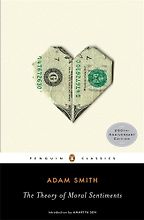
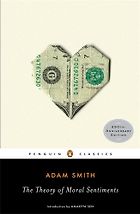
You’ve started off with Adam Smith’s Theory of Moral Sentiments. Tell me why you chose it.
This is a remarkable book because, although in some cases it’s outdated, he has an interest in exposing human traits that are relevant to thinking about our daily lives. He has a surprisingly insightful ability to do that. He doesn’t have any of the research methods of the modern social sciences; it’s all casual observation, and reading, I suppose, of other people and literature. But there are observations and conclusions in there that I never had before. They’re focused on a purpose, which is understanding how our society works and how people get a sense of mission, of purpose, that somehow makes things work as well as they do.
Can you give a particular example of a trait where you thought, ‘Wow! I hadn’t thought of that before, but he’s so right’?
Well, if you put it that way, it’s going to be disappointing – because your readers will say, ‘Yes I had thought of that before!’ It’s a personal thing. But the thing he starts the book off with is sympathy. He uses the word sympathy and he’s really focused on selfishness versus social consciousness. He sees that sometimes people are completely selfish, and that’s the problem for any economic theory: how to make a society work when people are completely, unremittingly selfish.
But he also notes something else. He doesn’t use the word empathy, because empathy hadn’t been defined yet, but he makes a very important observation about human behaviour, which is that we are wired to feel each other’s emotions and to have a theory of other people’s minds (not that he would have used the words wired or theory of mind either). The English word empathy was coined around 1900, in a translation of the German word Einfühlung from a German book by psychologist Theodor Lipps. What it means is that it’s not that I feel bad because I observe that you are suffering, it means I actually feel your feelings. So people may often be selfish, but they also have empathy.
Smith also talks about a selfish passion, which is a desire for praise. He argues that people instinctively desire praise, but that, as they mature, this feeling develops into a desire for praiseworthiness. This is a little bit different, and I haven’t seen it written about anywhere else. He points out that, suppose you were praised for something that you knew you didn’t do: It was a mistake, people thought you did something, so they’re praising you, but in fact you didn’t do it. It wouldn’t be such a good feeling – even if you could keep the lie going, and continue to receive the praise. He uses that to show that what people really want is to be deservedly praised. And that turn of mind, which develops as people mature, is what makes us into people with integrity.
“That’s the problem for any economic theory: how to make a society work when people are completely, unremittingly selfish.”
I think this underlies how the economy works. We start out with selfish feelings, which are intermixed with feelings of empathy for others, and then we develop this mature desire to be praiseworthy. I think it is central to our civilisation that people do that. Adam Smith uses the example of mathematicians. Mathematicians seem to be, in his observation, totally unconcerned with popular praise. That’s because they know they’re doing good work in their mathematics, but also that the public will never appreciate them for what they do. They live in relative poverty, and they don’t seem to care about praise, except from their fellow mathematicians. And yet they’re doing all of this work which benefits humanity.
This is something that happens in our society, and it makes the system work. He doesn’t go on, in this book, to explain how this develops into something that works. But this does mark the beginning of the thought process leading to his later book, The Wealth of Nations, in 1776.
Get the weekly Five Books newsletter
Doesn’t The Wealth of Nations focus more on the negative aspects of human nature – the self-interest as opposed to the sympathy?
I didn’t see a contradiction between the two books. The Wealth of Nations is realistic about human behaviour and argues that a reasonably free enterprise system works well because it combines the different, sometimes conflicting passions of man, into something that is well-directed.
Isn’t Theory of Moral Sentiments also the book where Adam Smith first uses the term ‘invisible hand’?
I once did a search for the “invisible hand”, and it was actually used before Adam Smith, but not in an economic context. I think Adam Smith was just using an expression of his time. I wouldn’t attach a whole lot of importance to it. My book with George Akerlof is Animal Spirits, and we say Keynes used that term. But he used it in a totally offhand manner. Everyone was using it; any literary person knew that expression.
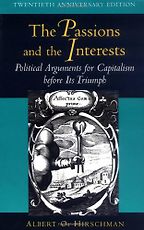
Your next book is The Passions and The Interests: Political Arguments for Capitalism Before its Triumph, by the great Albert O Hirschman.
This is a great book. It traces the history of an idea that is central to our whole civilisation today. The idea is that human nature is basically unruly and destructive, or has the potential to become so, but that we’ve designed a society that sets a space for this kind of impulse, where it’s acted out in a civilised manner – and that’s capitalism. So when we reflect on some of the horrors of capitalism, we have to consider that things could have been much worse if we didn’t have this system. Our fights would have been on real battlefields, rather than economic battlefields. That’s a theory, that’s an idea that really led to the adoption of capitalism, or the free enterprise system, around the world.
Capitalism had quite a tough path toward acceptability, I think. Traditionally, making money was viewed as unseemly, and avarice considered a deadly sin.
In medieval times, the dominant intellectual tradition was one of sin and the avoidance of sinful behaviour. Lust for power or wealth were unambiguously bad things. Even in a feudal society, such passions were acknowledged by society as, in some sense, legitimate, but the view didn’t have any authority. In the Renaissance, the authority of these self-denial concepts began to recede. Hirschman talks about Machiavelli representing a different ideal (of sorts) that was emerging.
“You have to understand people first before you can understand how to devise an economic system for them”
But it wasn’t until the early 1700s that we saw clear thinking about really having a system that becomes stable in a military sense — because you develop a business class that has an interest in the political stability of the system, as they fight it out for their economic interests. He emphasises the philosophy of the French writer Montesquieu and the Scottish writer James Steuart. They both wrote in the mid-1700s about the ideal of a merchant society that would be orderly and looking out for the material interests of people.
Was communism a big setback to this very positive view of capitalism?
Hirschman doesn’t emphasise communism, though he does emphasise that all along, during this course of history, there were critics of capitalism. Montesquieu and Steuart didn’t have the final answer. Marx was obviously among these critics, but the kind of criticism that Hirschman emphasises is a kind of criticism which may be in Marx but is not a major theme. The criticism is that capitalist society is so good at reducing our passions to passions about business, that we become a kind of vulgar, low-brow society – it doesn’t serve the spiritual interests of people.
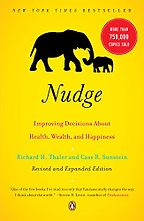
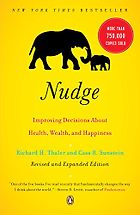
Your last three picks are all comparatively recent books. Tell me about Nudge.
We’re now coming up to 2008, when Richard Thaler and Cass Sunstein published this book. It looks quite a bit different from the first two in that it reflects much more modern psychology. I admired Adam Smith for his personal observations, but there was no experimentation, there was no real modern psychology in it. What Sunstein and Thaler emphasise is a lot of principles of psychology that can only be understood with regard to actual experiments. So they talk about things like anchoring, availability, representativeness, heuristic optimism, overconfidence, asymmetry of appreciation of gains versus losses, status quo bias, framing, self-control mechanisms – all the things that we’ve learned about.
We’re way ahead of Adam Smith now in our understanding of people, and that suggests a different model for our economy. Nudge doesn’t present itself in a grandiose way at all, but it’s a very important book. It really is a different model of our economy, and how government should be involved.
How should we be organising our economy post-crisis?
The book points out that the free enterprise system emphasises choice. The classic theory of capitalism is that information is decentralised – it can’t be centralised – and so the important thing is that people should be, as Milton and Rose Friedman put it in their 1980 book of that name, “free to choose”. If people are free to choose, that will allow the economic system – and this is Adam Smith again – to adjust its activities to take account of all of their diverse information.
But what Thaler and Sunstein point out is that individual people are not experts in making any of these choices. They succumb to these psychological errors. As a result, they say that what our society should be doing is providing what they call “choice architecture”. The government, which in their model is benevolent, sets up rules that encourage people to make the right choices, that nudge people to make the right decisions. But in cases where people have specific information that makes them want to do otherwise, they can.
Can you give an example?
I could give you the first example in their book, which is the Save More Tomorrow scheme. The problem they identify is that most people —at least in the United States, but I’m sure in other countries as well— don’t save enough for their retirement (or whatever) and that that failure to save is acknowledged. A survey of people in the United States asking, “Do you think you are saving enough?” found that most people said, “No, I’m not.” So it’s like dieting, in that most people wish they were slimmer than they are, but they can’t quite do it. Similarly, they wish or think they should be saving more, and they can’t quite do it. That means we ought to offer policies or programmes that nudge them, that help them.
In the case of dieting, you don’t leave bowls of candy out all around the house if you know you’ll be tempted by them. Our society has to try to nudge people towards other virtues, like saving. The Save More Tomorrow plan is thus a very ingenious idea: You offer people the option of signing up for a programme that will withhold from their pay cheque any future pay increases. So you sign up today and you’ll be saving more tomorrow. And experiments with this show that it does indeed raise the saving rate. So this is the kind of thing the government needs to think more about doing. Abject acceptance of Adam Smith’s principles suggests that we should provide people with the most elaborate choices. The naive assumption has been that people can handle those choices, which isn’t right. But, instead, the government has a different role. It’s still a free enterprise system, but it’s one that has nudges in various places.
But it involves politicians being sensible, rather than just trying to get re-elected.
Cass Sunstein, one of the two authors, was in a high position in the Obama administration, and some of their proposals made it into legislation. I’m not a political scientist; government is imperfect, and it reflects special interests, but sometimes it triumphs. Sometimes it does work. You bring in experts and they point out that we need to put chlorine in the water supply, and we do it. It does work. Sunstein and Thaler’s proposals will probably be somewhat adopted.
But in the savings example, isn’t there something cultural going on as well? The more capitalist a country is, the worse it seems to be at saving. I lived in China, where people might be earning RMB 1,000 a month, and yet somehow they managed to have RMB 30,000 in their savings account.
It’s an interesting phenomenon, and it may not be permanent. I think it may reflect the stage that China is going through. It used to be that the Japanese had a higher saving rate. In China, they have a sense of epic transformation right now. It’s a kind of patriotic feeling, as well as a sense of uncertainty, that encourages saving. It’s not the capitalist difference, I don’t think. You’re suggesting that China saves more because of some cultural values that are at odds with capitalism?
I think culture plays a big role in our attitude to money. I’m originally from Holland, where we like being thrifty.
That’s a stereotype of the Dutch, isn’t it? That they’re stingy?
It’s true. You may have a million dollars in the bank, but you’ll still take a bus rather than a taxi.
I bet it’s not true. If the Dutch had been conspicuous savers for centuries, they would be vastly richer than any of us. It would accumulate over centuries. I like to use another example from Holland, which is that home prices in Amsterdam, according to Piet Eichholtz at Maastricht University, haven’t gone up – they’re no higher in real terms today than they were 300 years ago. So, I’m sorry, but you can’t be right.
The amazing thing about saving is that if you really save a lot and you do it for a hundred years, reinvesting interest, you will get awfully rich, and that’s a fact. The best example of that is not Holland, it’s Singapore, which has had a government imposed saving plan. In Singapore, they have a mandatory saving plan that has propelled that nation up rapidly. It’s just arithmetic. If you save and invest, it adds up, because of the power of compound interest.
So in this context, Nudge is advocating a libertarian style of paternalism – a free-choice version of what Singapore is doing.
Yes, that’s right – by nudging people, rather than caning them.
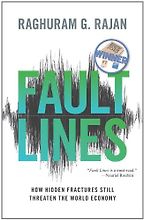
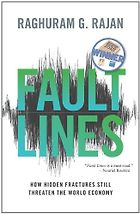
Your next book is Fault Lines, by Raghuram Rajan, a former chief economist at the IMF.
I admire this book because it’s not superficial. It goes for the ultimate causes of the economic crisis we’ve been through. Most people tend to focus in on something approximate. I don’t know that I exactly agree with this emphasis…
What was the ultimate cause of the crisis, in Rajan’s view?
The title of his book is Fault Lines – so it’s plural. He notes that it’s not one cause; he actually has several different classes of causes.
The first of them is political, and the politics that lead to rising inequality. That’s been a trend in recent years in most nations of the world. Inequality has been getting worse, particularly in the US, but also in Europe and Asia and many other places. One thing that this has done is it has encouraged governments, who are aware of the resentment caused by the rising inequality, to try to take some kind of steps to make it more politically acceptable. He gives other examples as well, but historically, that has often taken the form of stimulating credit – instead of fixing the problems of the poor, lending money to them. He has a chapter entitled “Let them eat credit”.
The US in particular has stimulated the housing market — it has subsidised lending to people, which drove up home prices in an unsustainable way. And there wasn’t that much concern about, or understanding of, the sustainability of this. That’s his first fault line.
The second one is trade imbalances. Here he looks in particular at the developing world, notably China, that has an export-led growth policy. The Chinese noted that the export-led growth model was a huge success for other countries like Japan, Korea, Singapore – and so they want to follow that model. But it involves them running a trade surplus – and so, by implication, the rest of the world has a trade deficit. Advanced countries like the US then become dependent on this constant inflow of capital. That’s another imbalance which is also fundamental.
The third set of fault lines comes from a clashing of systems. In the US, and in advanced countries, there is more of a sense of trust, and advanced financial solutions can be achieved better than in a developing world where people are still mistrustful. In the developing world, people prefer to make only short-term loans because they don’t trust tying up their money. It often needs to be denominated in foreign currencies so they won’t be devalued on, and they like to lend to local banks rather than to international ones because they know the local banks will be bailed out if there is ever a crisis. But that means the economies are more fragile. He’s talking about the Asian financial crisis in particular, of course – but there are other examples. Because people can withdraw their money quickly, there’s too much reliance on “too big to fail”, so the economies don’t function right.
Those are the main fault lines that he talks about, and these are deep and difficult problems that don’t have easy solutions.
And to what extent do you agree that these are the causes of the crisis?
They are part of the causes. This is a theme that I stressed in my book Irrational Exuberance (2000) – any big crisis always looks mysterious, because it doesn’t have a single cause. It has multiple causes, and the reason it’s a big crisis is because a number of different events chanced to happen all at the same time and created the extremeness of the event.
In my book, I acknowledge these same causes that Rajan talks about, but not with his eloquence. I also emphasise something that is only secondary in his book, and that is the kind of social epidemic that happened, that produces bubbles in speculative markets. So we had a speculative bubble in the housing market in many advanced countries in the early 2000s – as well as in developing countries. I don’t think those really can be explained entirely in terms of these fault line theories. “Let them eat credit” was a factor, but I think that there was something else. There was a change in thinking that explained both the bubbles and the public policy. It’s something more permanent, more sociological.
“The reason it’s a big crisis is because a number of different events chanced to happen all at the same time and created the extremeness of the event.”
One thing that economists are very poor at is sociology. They don’t read about it and they don’t think about that discipline. But sociology tells us that our culture has its own internal dynamics and drift and we have to appreciate that it can drive things, it can change things. That was the theme in my own book: there were cultural changes that had many dimensions that brought on this crisis. I even brought in some things that might seem peripheral to some people, like the rise of a gambling culture, or a winner’s culture. I didn’t say “winner takes all” – but it’s a culture where we tend to admire the winners, and we have less sympathy with the poor or the unsuccessful. It’s a zeitgeist. I may be getting down even more to ultimate causes here than Raghuram did, but I very much admire his book. It says things that are not in my book, that I hadn’t thought of before.
If you were in Washington now and you could implement whatever you thought was necessary to prevent another crisis from happening, what would you do?
I’ve written several books about this! First of all, I don’t think this crisis is the end of the world. It is serious, but I wouldn’t do anything so radical as to hamper our engine of growth, which is capitalism. In fact, in many ways, I would like to expand it – capitalism has its own solutions to its own problems. Risk management may have failed us recently but the general principles are valid. So a lot of the things I talk about doing involve expanding our markets. For example, I advocated – and we did actually create – a futures market for single family home prices. I think that would actually help stabilise home prices. We have that going on the Chicago Mercantile Exchange, but it’s not a success yet.
“Risk management may have failed us recently but the general principles are valid”
But beyond that, let me talk more in sync with Raghuram’s book. I think inequality is a huge emerging problem, and that our society has to think about dealing with it in a constructive and real way – not through “Let them eat credit”, not through wishful thinking. We have to understand how we get inequality and what we can do about it.
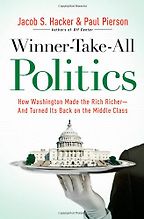
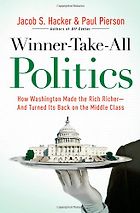
Which brings us to your final book, Winner-Take-All Politics: How Washington Made the Rich Richer and Turned its Back on the Middle Class, by Paul Pierson and Jacob Hacker.
This book is about rising inequality and it traces back to fundamental causes. I like books that get back to ultimate causes and that think like social scientists about these causes. The question is, ‘Why is inequality getting worse in so many different countries?’ This book particularly focuses on the US. There are a number of traditional answers, but the most prominent among them is this idea that in a modern economy there is a skill bias in technical change. Our computers and communications have led to a winner-take-all society, where only the really smart can make money. Everyone else is technologically obsolete, with all these computers that are replacing people. It is, I think, a very important theory.
But Hacker and Pierson point out that it doesn’t really fit the recent data. In the US, we’ve seen a rapid concentration of wealth at the extreme high end. The top tenth of a per cent of the top hundredth of a per cent of the population is getting wealthy very fast. They point out that this is not true in Europe, and yet the economies are very similar and growing at similar rates. If the technology is the same, why would there be a difference at the extreme high end? And they argue that the answer is really political. There have been political changes in the US that allow the extreme high end to garner more wealth. Ultimately, it represents a failure of our society to take account of the fact that the extreme high end can lobby and can organise for its own interests, and we’ve let it happen.
So you feel inequality is central to what has gone on and that we really need to address that?
Yes – and there is very little concrete talk about addressing it. It’s a very difficult problem. You might think that in a system of majority voting, the middle class and the poor would dominate and would prevent this kind of inequality from developing. But it hasn’t been that way. It’s been even less so that way lately, especially in the US. And once again, we have to attribute that to some change in our zeitgeist, in our way of thinking about what people view as important. That’s an underlying theme in all of these works, going back to Adam Smith. I don’t think he uses the word inequality very much, but it is about poverty and the alleviation of poverty. In Adam Smith, of course, the wealthy tend to be the kings and lords…
Rather than hedge fund managers…
They did have some wealthy business people. That’s an interesting question: In the 18th century, who were the super-rich? It doesn’t call to mind any famous, super-wealthy business people.
But looking down your list of books, I was trying to figure out…is greed good?
Isn’t that a line from the movie Wall Street? Gordon Gekko?
Or is it not so good after all?
That’s what Adam Smith is talking about in the Theory of Moral Sentiments. This is the dialogue. You’re right to use that very direct phrase to summarise the question. The idea of medieval Christians was that greed is a positive, unadulterated evil, and you must go to confession every time you have this feeling. But it led to a more advanced knowledge. We are people, and we have certain psychological traits and emotions, some that we call greed, that are programmed into us by forces of evolution. We are greedy in a way. So are all the other animals. I watch birds fighting over food, they’re greedy and they fight each other. But they usually don’t seem to get into too bad a fight. That’s a thing that develops in society and we have to understand it. But greed, in our language, is actually a name for excessive self-centredness. So it is, by definition, bad. But some degree of self-interest is just part of our society. I’m actually writing another book now with George Akerlof, where we want to get into some of these issues, but it won’t be out for years…
Tell me more.
The question that has always bothered people is whether society is really optimising our spiritual life, our sense of community, in the optimal way. There may be some nudges that we need, even if we remain in a capitalist system, and I think this is what Akerlof and I are trying to get at.
What kind of nudges?
We have to understand human psychology; we have to accept an impulse towards selfishness, which is the reality. We cannot change that. It’s through millions of years of evolution that this has come. And yet, we do have an engineered environment. Our economy is an invention, a reaction to past crises and depressions, and we can try to coordinate it. We can’t change people’s emotions, so part of what we do is we tolerate greedy behaviour, within limits. If it follows certain rules, and if there’s a certain integrity that underlies it, we tolerate it.
Attitudes can vary widely, though. In Manhattan, there are plenty of people who can think of nothing better than becoming a billionaire, whereas if I suddenly became phenomenally rich I think members of my family would find it not only unnecessary but also rather unseemly. Why is there that difference? Is it my Dutch Calvinist roots?
These are deep issues that interest me a lot. And what do these people do with the billion dollars? That’s the question. What can anyone do with a billion dollars except give it away? I’m referring to Bill Gates’s Giving Pledge, going to billionaires around the world and telling most of them to give it away.
Are you religious?
My parents raised me as a Methodist, but my Sunday school teacher complained I had a chip on my shoulder. I thought he was a moron, so I wasn’t very good at Sunday school. I didn’t think much of the preachers. But I suppose I have spiritual feelings.
So how did you get interested in all this in the first place?
I think the year was 1958, when I was 11 years old, or maybe a little after that. I read Galbraith’sThe Affluent Society and it had a great impact on me. It talks about deep issues: We have rapidly growing wealth, but what is it doing for us? I don’t know that I agree with him, but there’s some element of truth to what he says, that we end up being manipulated by marketers and corporations, who try to create demand for things we don’t need.
And Galbraith stuck with you and influenced your life’s work?
Five Books aims to keep its book recommendations and interviews up to date. If you are the interviewee and would like to update your choice of books (or even just what you say about them) please email us at editor@fivebooks.com
Five Books interviews are expensive to produce. If you've enjoyed this interview, please support us by donating a small amount.
Robert J Shiller
Robert J Shiller is the Sterling Professor of Economics at Yale University, and a leading authority on speculative bubbles. In 2013, Shiller jointly received the 2013 Nobel Memorial Prize in Economic Sciences. He is the creator, along with Karl Case, of the Standard & Poor’s/Case-Shiller Home Price Indices. Widely credited with correctly predicting the housing bust, Shiller has also written a number of popular books, including Irrational Exuberance and Animal Spirits, co-authored with Nobel economics laureate George A Akerlof.
Robert J Shiller is the Sterling Professor of Economics at Yale University, and a leading authority on speculative bubbles. In 2013, Shiller jointly received the 2013 Nobel Memorial Prize in Economic Sciences. He is the creator, along with Karl Case, of the Standard & Poor’s/Case-Shiller Home Price Indices. Widely credited with correctly predicting the housing bust, Shiller has also written a number of popular books, including Irrational Exuberance and Animal Spirits, co-authored with Nobel economics laureate George A Akerlof.