Countries do have to come to terms with their own history, and it's unhealthy that China has not yet come to terms with the Cultural Revolution, argues the West's leading scholar of the period, Roderick MacFarquhar. He chooses the best five books on the Cultural Revolution.
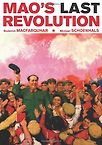
Mao’s Last Revolution by Michael Schoenhals & Roderick MacFarquhar
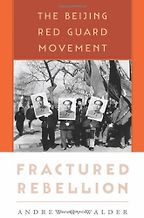
We’re trying to understand the Cultural Revolution, these ten years of madness in China from 1966-1976, and your first choice is a new book, Fractured Rebellion, about the Red Guard movement in Beijing. Do you want to tell me why you chose it?
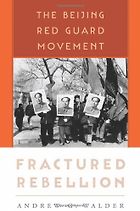
Andrew Walder, a sociologist at Stanford who wrote this book, has provided us with the first really detailed study of the Red Guard movement that we’ve ever had. There have been lots of books about the Red Guard movement; individual Red Guards who got out of China have written them. The most well-known is, of course, Jung Chang, who wrote Wild Swans, which was partly about her experience as a Red Guard. But what Walder has done is to look not just at the oral record – which he feels is often misremembered experiences – but also at the copious written record of the Red Guards, who published their own newspapers from very early on in the movement. And what he does for us is to destroy the hypothesis with which most of us have been working in trying to understand both the Red Guard movement and why it fell into internecine warfare after it had bombarded the headquarters of the universities and ministries and sent teachers and officials away.
“The Cultural Revolution is absolutely relevant to present day China, and absolutely relevant to our understanding of why China abandoned Communist economics and went capitalist.”
The old explanation was that there were two basic groups. One was more conservative, the earliest of the Red Guards. They were normally either members of the Communist Youth League or members of the Communist Party itself. Their Red Guardism was designed, in part at least, to protect what they thought were their natural Mao-given rights. They were going to be the inheritors, because they were often the sons and daughters of so-called ‘red’ families. They usually came from a revolutionary official background, and could trace themselves back to their parents or grandparents as peasants or workers, and they were defending an order that promised to give them power in due course. The more radical faction, on the other hand, was composed of all those people who had not been allowed to get into the Communist Youth League or the Party because of their ‘black’ background. They weren’t red at all because their parents or grandparents were landlords or bourgeois or rich peasants or managers of factories, etc. So this movement was, as social movement theory would suggest, a clash of interest groups. What Walder has discovered, and what Walder has, in my view, proved, is that it’s a much, much more complicated story.
What did actually happen then?
In many cases it depended on what happened in the very early months of the Cultural Revolution, when so-called work teams of officials were sent to the campuses to restore order. If the work team defended the local party system in the university or college, one set of results ensued. If they actually dismantled the party system (which often was the case, despite the fact they were all members of the Party) then another set of results was predictable. It’s a difficult book to work with, because it’s as complex as life itself, and during the Cultural Revolution in China life was extremely complicated. But what Walder does is he follows each major university’s Red Guard movement through from its beginnings in 1966 through to 1968, when the Red Guard movement was, in effect, dismantled. And I think it’s a fascinating book, which only Walder – who has consistently over the years not been bound by pre-existing theories – would have been able to write.
Oh dear. Does that mean we’ll never be able to understand the Cultural Revolution?
Well, the Cultural Revolution is something quite different from the Red Guard movement…
Yes, what was the Red Guard movement?
Mao unleashed the Red Guards, encouraging them to attack authorities in universities and eventually in the government and in the Party because he wished to rear a new generation of revolutionary successors. He was bitterly disappointed when the Red Guards fell into internecine warfare and caused so much trouble that they had to be sent back into the countryside.
Was that the opening salvo of the Cultural Revolution?
No, the opening salvo of the Cultural Revolution was Mao’s attack on the Beijing Party apparatus. He knew it was so powerful that no students could ever attack it by themselves. So he had to do the groundwork of attacking the Beijing Party and propaganda apparatus. That set the stage for lesser people to be attacked by the Red Guards.
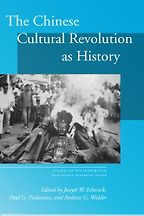
Your second book is The Cultural Revolution as History.
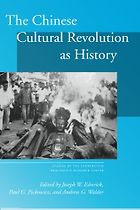
This book is co-edited by two historians at UC San Diego and the same old Andrew Walder. Joseph Esherick and Paul Pickowicz started a year-long seminar for their graduate students, which a number of us spoke at, and these graduate students were then encouraged to go off and do their own research projects. And they really are extraordinarily interesting – and very revealing. There is one, which I have assigned in one of my courses, which tells about the extent of mass violence, based on a number of provinces where this graduate student was able to get really detailed grassroots records. Another, which I’ve also assigned, is about someone who became a hero during the Cultural Revolution, because he had written to Chairman Mao. He was a poor person and he had written to Chairman Mao and got the local situation turned around as a result of his letter. But then he became a villain later on. It’s a complicated story, but it showed how, during the Cultural Revolution and, to be fair, even before in China, it was possible for someone to rise up very quickly and then, when the political wind changed, to be blown down.
For people who maybe don’t know so much about the Cultural Revolution, do you get a sense from this book – or any of the others – of the extent of the devastation during that period, the number of people killed?
I’m afraid I would have to refer you to a book which I co-authored to get that kind of information, and I know that’s not allowed.
Which book is that?
Mao’s Last Revolution, which I wrote with Michael Schoenhals. But, in the dedication to historians of Chinese origin, we say that we dedicate the book to them because one day, when the archives are open, they will write it for themselves. From the information that’s available now, I think we’ve provided a pretty good account of the Cultural Revolution in that book. But the essence of the Esherick, Pickowicz & Walder book is that these are graduate students who are beginning to come to grips with how you use the materials which are all fragmentary and of very different types in order to study the Cultural Revolution. Only the one chapter I mentioned really goes into the mass violence, and I suspect that we may never, even when the archives are open, be able to fully estimate the number of people killed. All I think I would say with reasonable confidence is that far fewer people died during the Cultural Revolution than died as a result of the Great Famine of 1959-61.
So in China there is still a lot you can’t research on this period?
The Chinese authorities have effectively banned any academic work on the Cultural Revolution. In December 2006 I gave a lecture in Shanghai, in what I was told was the first seminar ever given anywhere in China on the Cultural Revolution. People who do research on the Cultural Revolution are forced to publish abroad, usually in Hong Kong or Taiwan – except in the case of a couple of very trusted Party historians, who have given semi-official accounts.
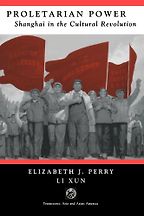
Let’s go on to the book about Shanghai, Proletarian Power.
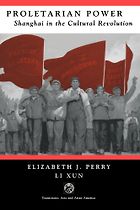
This book by Elizabeth Perry and Li Xun is very important. Elizabeth Perry has worked on Shanghai for many years and has had tremendous access to Shanghai archives – I’m sure not all the Party archives, but enormous access. What her book reveals is that Shanghai was very exceptional during the Cultural Revolution. We are used to the idea that the Red Guards wiped out whole administrations in cities and in provinces, and then, as they were sent away to the countryside because they were being too destructive, the army took over. Shanghai was the one exception. The Red Guards in Shanghai, aided and abetted by the Red Guards from Beijing who came down to help them, failed to overturn the Shanghai Party officials. So they had to turn to the workers, led by a factory security man, Wang Hongwen, who later become number three in the Party [the youngest of the Gang of Four], to help them out. Therefore Shanghai is the only city where the movement that toppled the Party was in fact a workers’ movement, not a Red Guard movement.
Why is that significant?
Because the whole thing is called the Great Proletarian Cultural Revolution – and so in this one city, this one great city of China, the proletariat actually did seize power.
Tell me about the book about Lin Biao, Mao’s heir apparent, and his mysterious death.
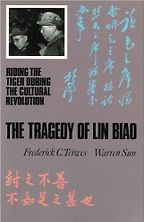
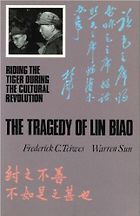
Frederick Teiwes and Warren Sun, both of whom teach in Australia, have produced a series of books looking back at the Maoist period and just after, trying to revisit ideas about what happened on certain major occasions, with access to Party historians and new materials. My own view, frankly, is that it’s probably a little early to write books, articles would have been better. But, nevertheless, they have done extraordinarily valuable work. In the case of Lin Biao, it’s this still very, very, murky episode when the chosen heir apparent, his name written in the Party constitution, allegedly plotted to assassinate Chairman Mao. Then, when fleeing in the direction of the Soviet Union, his plane crashed with his family in Mongolia.
“The Chinese are always talking about the Japanese not coming to terms with what they did in World War II. But the Chinese themselves have not come to terms with the Cultural Revolution.”
The important thing about Teiwes and Sun, is, apart from the fact it’s a very, very judicious and well-researched work on this episode, is that they prove, I think conclusively, that the likelihood of Lin Biao plotting against the Chairman is very small – because it goes against all his previous behaviour in the Cultural Revolution. Lin Biao had always been very careful to wait and see what Mao did, and then to sign his name on the document after him. And not to push ahead. And in my view, the one time he really angered Mao, when he did push ahead, was when he thought he was fulfilling what Mao wanted. Mao was alleging in the summer and early fall of 1969 that the Soviet Union was going to launch a surprise attack on China and the words Pearl Harbor were bandied around. So Lin Biao, who was the executive vice-chairman of the Military Affairs Committee and Minister of Defence, decided, for the first time, to do what he was supposed to do – which is to get the country ready for the attack that Chairman Mao had predicted. And he did some inspections and made sure that the airfields were not going to have the planes in position so they’d be destroyed immediately by an attack, as happened at Pearl Harbor. And he did other things, so that hundreds of thousands of troops and ships and tanks and aircraft were moved around. It was a massive movement which was even detected in the US – and no one in America knew what was happening. And the whole thing was billed as Deputy Commander in Chief Lin Biao’s order number 1 and then there were order numbers 2, 3 and 4. Mao was apparently furious, and I think the reason he was furious was not because Lin Biao was doing what his duty was, to protect the country, but because Mao suddenly realised that his main bulwark of support throughout his career, the military, could be moved by someone else, and that therefore, conceivably, there was a threat to him personally. And I think it was from that time on that Mao started the process of pressuring Lin Biao in order to try to get rid of him.
So Lin Biao wasn’t planning a coup, he was just running away because he was scared?
We don’t even know that, because it is said Lin Biao was asleep, having taken sleeping pills. His son and wife decided that the situation was dangerous, and it was the son who was supposedly entrusted by Lin Biao with an attempt to assassinate the Chairman. And the son and the wife hurried Lin Biao, half asleep, into a car, rushed off to the airport and took off. So we don’t even know what Lin Biao’s role was.
And the plane wasn’t sabotaged? It just crashed over Mongolia?
We don’t know anything. The story is so obscure, even to this day. Some years ago there was an allegation that Lin Biao and his wife had their car rocket-attacked after they had had a pleasant dinner with Chairman Mao and Premier Zhou Enlai in the Western Hills outside Beijing. And if someone, in this case a Chinese with an alias, can write that, then obviously there is much still to be discovered…
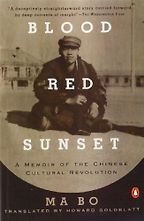
Finally, you’ve selected a memoir, Ma Bo’s Blood Red Sunset. There are lots of memoirs but you’ve chosen this particular one…
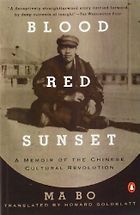
There are lots of memoirs – ‘I was a Red Guard’ and ‘I did this and I did that.’ What is strikingly consistent about most Red Guard memoirs is how un-guilty the authors are of any of the crimes, brutality and destructiveness that we know the Red Guards were guilty of. It seems that the authors were always disapprovingly looking on. There are exceptions, there is some frankness here and there, but on the whole, we’re getting an outsider’s view, rather than an insider’s view, even though the people were Red Guards. Ma Bo is different because when he was sent down to the countryside, like 12 million others, during the years from 1968 onwards, he was still a red-hot enthusiast. He was sent to the north, to Mongolia, to herding areas, and their orders were to plant grain. What is fascinating about the Ma Bo book is that it describes an ecological disaster, and he accepts guilt for it.
Get the weekly Five Books newsletter
I like this book for several reasons. Firstly, because it’s a first-hand account. Secondly, because it’s by a writer who is a writer, and therefore it’s very good reading. Thirdly, because it admits to a disaster. Fourthly, because it shows the kind of policies that are prevalent when orders come from on high and no one has the courage to disobey them, because of the dangers to their career. There was in China, during the Cultural Revolution and just before, a famous brigade in Dazhai, which was a very poor agricultural community in northern China. And peasants, peasant leaders and local Party officials from all over the country and, indeed, foreigners made the pilgrimage to Dazhai. For the foreigners it was just sightseeing, but for the Party officials it was ‘this is the way you have to do it’. And, across China, all sorts of agricultural regimes were destroyed as a result of attempting to copy a totally different agricultural environment and its agricultural policies.
Grain was not the thing to be growing up in Mongolia, I take it?
It destroyed the natural habitats of the herds, which was the income and way of life of the herders. There are other books on the Cultural Revolution that are more widely read than the ones I’ve suggested. I’ve chosen books that ordinary readers are less likely to come across, so I thought it was useful to bring them to people’s attention.
More than three decades have passed since the Cultural Revolution ended. Is it still important to understand it?
The Cultural Revolution is still a very live issue in China today, not just because so many people suffered as a result of it. The official figure is that 100 million people were affected by it one way or another – and I assume that means that at least one member of their family was killed or ill-treated. So there is still a lot of bitterness about what happened. Secondly, the Cultural Revolution is important because without it we wouldn’t have the China that we see today. It was the disasters of the famine and then the Cultural Revolution that made Deng Xiaoping and his colleagues decide “This is ridiculous, we are tearing ourselves apart, we must have a New Deal, or the party will be thrown out because we have not benefited the people at all.” So you have the total transformation of the last 30 years of the reform era.
Most importantly, in a psychological sense, the Cultural Revolution is important because countries do have to come to terms with their own history. The Chinese are always talking about the Japanese not coming to terms with what they did in World War II. There’s some justice in that. But the Chinese themselves have not come to terms with the Cultural Revolution. The Cultural Revolution’s violence is not just to be put at the door of Chairman Mao, though he fired the starter’s gun. It’s to be put at the door of individual Chinese who were incredibly cruel, in many cases, to other individual Chinese.
I have taught a course on the Cultural Revolution on and off since 1988. More recently, Chinese students have been coming out to American universities as undergraduates. Last year, out of 150 students, 15% were Chinese – either directly from the mainland, or who came over to America when they were 3 or 4. On occasion, these Chinese students come up to me and thank me for teaching the course, because their mum and dad, or granny and granddad, never told them anything about the Cultural Revolution. And you can see why. Because they were either humiliated themselves, or they humiliated — or perhaps worse — other people. So there is this great big lack of memory about the Cultural Revolution that’s very unhealthy. So the Cultural Revolution is absolutely relevant to present day China, and absolutely relevant to our understanding of why China abandoned Communist economics and went capitalist.
June 22, 2010
Five Books aims to keep its book recommendations and interviews up to date. If you are the interviewee and would like to update your choice of books (or even just what you say about them) please email us at [email protected]
Five Books interviews are expensive to produce. If you've enjoyed this interview, please support us by donating a small amount.
Roderick MacFarquhar
Roderick MacFarquhar (1930 - 2019) was Harvard University’s Leroy B Williams Professor of History and Political Science. From 1986-1992, he was the director of Harvard University’s Fairbank Centre for China Studies. He was the leading western scholar of the Cultural Revolution, the decade of turmoil that terrorized China beginning in 1966, and his three-volume work, The Origins of the Cultural Revolution, is a classic in the field. Born in Lahore, Pakistan, when it was still a part of British India, MacFarquhar was a British politician in his pre-academic life, first as a member of the Labour Party and then for the newly-formed SDP.
Roderick MacFarquhar (1930 - 2019) was Harvard University’s Leroy B Williams Professor of History and Political Science. From 1986-1992, he was the director of Harvard University’s Fairbank Centre for China Studies. He was the leading western scholar of the Cultural Revolution, the decade of turmoil that terrorized China beginning in 1966, and his three-volume work, The Origins of the Cultural Revolution, is a classic in the field. Born in Lahore, Pakistan, when it was still a part of British India, MacFarquhar was a British politician in his pre-academic life, first as a member of the Labour Party and then for the newly-formed SDP.