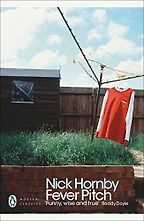
You’ve selected the best football books in English, and top of your list is Fever Pitch by Nick Hornby. It’s about an obsessive Arsenal fan…isn’t it a bit depressing?
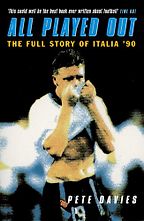
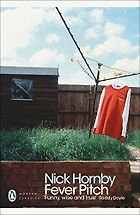
It’s not depressing! It’s very funny and was also almost the book that started this all off. Actually, the book that started it all off was Pete Davies’s All Played Out. That came out in 1990, and has been called the John the Baptist to Nick Hornby’s Jesus. Because when Pete Davies’s book did well, publishers realised there was a literate football fan audience out there, and then Nick Hornby came and proved it with a vengeance in 1992. It was just when memoirs were coming into fashion, about the same time as Blake Morrison’s And When Did You Last See Your Father? And you could say that Fever Pitch really launched the genre of serious football books.
Nick Hornby doesn’t revel in, ‘Oh I’m such a football geek, isn’t that funny?’ He treats it as something suspect. And he describes how he uses supporting Arsenal to escape his parents’ divorce, problems with women, the question of what to do with his life, and lots of things like that. It’s also a bit of a social history of England from the 1960s through to the 1980s. And nobody had written a book like it – it was completely original. Nick Hornby was a not very successful, lower-middle-class bohemian, and when he was telling friends at the time, ‘Oh I’m writing a book about being an Arsenal fan,’ his friends all thought, ‘Oh God! Poor Nick.’ Nobody expected this book. It’s completely honest and it’s very funny. The only problem with it is that it’s a little bit formless: It’s a book to dip into, rather than to read through. It doesn’t quite have a narrative, but every little bit is brilliant.
And is it on your list partly because it captures what it’s like to be a fan? Is it true for a lot of people?
There are definitely moments of recognition. I’m not an obsessive fan of one club, and I hope I haven’t used football to escape life. But there are definitely strong moments of recognition, of football as this place of safety. Life is complicated but when you’re a football fan you’re gathered with others who are like you, and nobody judges you. It’s like being a member of a family, where there are no standards, where the only criterion is, ‘Are you an Arsenal fan?’ and then you’re accepted. Outside the Arsenal stadium life is scary, you have to be adequate, but as a football fan you don’t have to be adequate and that’s a great joy. What I’ve discovered more and more is that when you watch football and support your team, it is all a game. And that’s a terrific release, because as adults we have children and responsibilities and pressures, but when you’re just a supporter, you don’t.
Tell me more about Pete Davies’s All Played Out. It’s about the English team going to the Italia 90 World Cup…
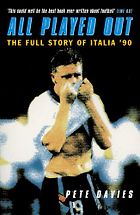
This book has just been rereleased now, 20 years on, as One Night in Turin and it’s also been turned into a film. Pete Davies really started off English football literature, and when I was going around London publishers in 1991, trying to sell them my first football book, people said to me, ‘Oh yes, we know football books sell, because Pete Davies wrote this very good book called All Played Out.’ Before Davies, ‘football book’ was sort of an oxymoron, and then Davies made it happen.
Davies was a little-known novelist, and the then English manager Bobby Robson said, ‘Why don’t you spend the 1990 World Cup, as a sort of writer-in-residence for the England team? And you can live in the hotel, and have complete access to the players, and we’ll shut out the nasty journalists.’ Davies got the players to trust him, and he interviewed them seriously and sensitively, as if they were sentient human beings – which at the time nobody suspected footballers were. He also ventured out into the World Cup, he got out of the hotel, he met hooligans and other fans, and tabloid journalists – there are all these wonderful character portraits in the book. It’s an account of the hysterical football industry at its most hysterical moment during a World Cup. And even 20 years on, you feel some of the tension and the excitement of the World Cup: Will England do it, won’t they? And it’s a book that has lived on and survived. And interestingly, like Nick Hornby, Pete Davies never wrote about football again. This was the book he wanted to write, and then he moved on.
It’s quite gripping, I gather from the reviews.
It’s gripping and it’s written in a very sort of populist, laddish style, but it works. The characters make it work, and the setting of Italy during the World Cup. It doesn’t matter that that World Cup is now history.
Let’s go on to Brilliant Orange, by David Winner, presumably about the Dutch team.
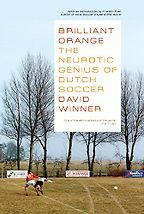
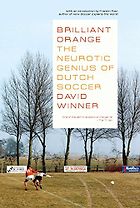
This is about Holland and Dutch football and what makes it special. I grew up in Holland, so I have a particular tie to this book. Actually I was in Amsterdam the winter that David Winner was there writing his book. We were both writing books and we’d occasionally meet for dinner. And I got to know David and I really liked him, but I thought ‘Poor old David, he’s going to write a book about Dutch football, and nobody’s going to read it.’ Also I grew up in Holland, and I thought, there’s nothing he can tell me about Dutch football, it’s all going to be old hat or he won’t get it right. But he gave the book to me in manuscript and I read it, and when I finished it, I just wanted to break out into applause. He did it beautifully. It’s completely original. David is a film buff so it has all these film references and it’s just very surprising. He interviews architects and rabbis about what makes Dutch football special. It’s not like other football books – he approaches football through architecture and space and landscape and painting, and it’s absurd, but it works.
And you come away from it with what insight into Dutch football? Or is it more about Dutch society?
It’s about Dutch society, it’s about Dutch painting. One of his ideas is that because Holland is a small country, the use of space is very important. There’s an obsession with space, and you see that in Dutch football, where the use of space is very important. So he draws those parallels. And he presents the Dutch team, in the middle of the 1970s, the great Dutch team, as a product of the individualistic seventies, in a very original and non-clichéd way. Also, when he interviews players, people come out of it as humans, not as footballers. He interviews this player who didn’t want to go to the World Cup. The player says, ‘I was having a difficult time with my family, I didn’t want to spend the summer at the World Cup. We wanted to go away and we went on a family holiday.’ And David asks, ‘Don’t you regret it? You missed playing in maybe the best football team in history.’ And the guy says, ‘No, this was what my family needed.’ So you have these wonderful little human moments. I think one challenge in writing about footballers, particularly now they’re so shielded, is to present them as real people, and David does that in a very touching way.
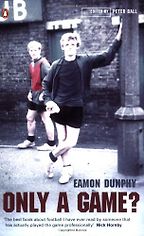
Let’s go on to Only A Game? which is a diary of a professional footballer.
This is a cult book among those of us who like reading about football. It came out in the 1970s when really no one was publishing books about football. Eamon Dunphy was a very run-of-the-mill professional footballer in London, playing for Millwall, of Irish origin. And he sat down with a journalist to write this book about what it’s really like to be a footballer: The daily life, the grind, the stress, the frustrations with your team-mates, with the manager, the worries about money. At some point Millwall say, ‘OK, we’ve had it with you, we’re going to sell you!’ and he comes home to his house, and even his house belongs to the club. And he thinks, ‘What am I going to do? I’m 28 years old, I don’t own my own house, I’ve got another couple of years left and then it’s all over.’
Five Books interviews are expensive to produce. If you're enjoying this interview, please support us by donating a small amount.
So he has these real anxieties, and he’s dropped from the first team, and he’s supposed to go along and watch, and he doesn’t. He just sits at home and watches Crossroads on the telly, because he thinks, ‘If I go and watch I’ll just be sitting there hoping they’ll lose and that’s just too miserable, I can’t do that.’ So it ends up being a very miserable season, but again all the characters in the book come to life. Dunphy, who was, like most footballers of his day, a very working-class lad, from a poor Irish family, became, off the back of it, a very successful journalist. He has written a couple of other big-selling football books; he also wrote a biography of U2. He was just a man with talent, and this book was a discovery of that talent. It’s a book that tells you what it really is like to be a professional footballer, and it’s not very pretty.
Is Millwall a big club?
No, it’s a small club in south London: They always were and they are now. Their home ground was in a street called Coldblow Lane, so it was really miserable, a very unglamorous existence. Dunphy had, for a short time, as a young footballer, been at Manchester United, where he knew fellow Irishman George Best. So he’d very briefly tasted the glamour of Manchester United, but he didn’t make it and ended up at very unglamorous Millwall, where he spent most of his career.
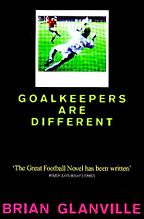
Your last book is Goalkeepers are Different, by Brian Glanville.
This is again a bit of a cult book. Brian Glanville is the legendary football journalist, he’s been doing it for, I think, 60 years – his age is never clear to me, but he must be in his late seventies now. He ghosted the autobiography of a famous pre-war footballer when he was 17 and has been in the business ever since. And he’s written wonderful histories – he’s a very, very fine writer and he also wrote some novels, partly about British Jewish families. But Goalkeepers are Different is a novel really for children/young people, about a guy who becomes a professional goalkeeper. Like Dunphy’s book it has some of the bitterness and frustrations and lack of glamour – and it’s just a wonderfully rendered novel.
As a teenager I must have read it five or eight times, and I’ve subsequently met other people who’ve had that experience too. It was a book about what you always dreamed of, of being a professional footballer, but it was rendered with grittiness and accuracy and it just has the pace of a really good novel. Glanville is a great writer and I sense that this book will outlive his nonfiction writings, as good as they are.
It captures both the glamour and the unglamorous side?
Yes, the jealousies inside the team, the conflict with the manager, but also the great moments – the novel, of course, ends with the keeper on the brink of winning an FA Cup Final. It’s a very realistic portrayal of the dream, and the dream isn’t entirely shattered – it has a very good balance between grittiness and happiness.
Are goalkeepers different?
That’s one of the football clichés, isn’t it? And the book is really a demolition of clichés, because it says actually this is what it’s really like. And the hero is a very ordinary young man, he doesn’t have flights of fancy, he’s not a remarkable person in any way. He’s a very difficult person to make the main character of a novel, because there’s nothing very exciting or interesting about him. And the novel succeeds partly because he’s a very convincing young professional footballer, he doesn’t have much experience of the world, he enters this universe he doesn’t know well… No, I think, based on this book, goalkeepers are not different. He’s a very ordinary person.
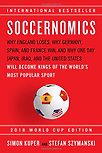
Lastly, I love the question posed in the title of your book. Could you tell me–why does England always lose?
In our book we crunch numbers, and we say that obviously one very important aspect of predicting whether a country will do well is population size. England always compares itself to Italy, to France and Germany and to Brazil. But Italy and France are somewhat larger, Germany is much larger, and Brazil is four times the size of England’s population. If you look at England coldly from afar, it’s half a mid-sized island. Why do we think England should win the World Cup – it’s ludicrous. In our book we reckon they should be about the 10th best team in the world, and that’s about what they usually are – in fact, England slightly outperforms. It’s just that the expectations are completely wrong, and that’s because we invented the game. But inventing the game doesn’t win you World Cups 150 years later…
And is that why Holland never wins either?
Holland’s got 16 million inhabitants – it would be astonishing if Holland won the World Cup. But Holland is a massively outperforming country. It’s a small population, but like England it’s wealthy, and wealth is a predictor of success (Brazil being the exception, a poor country that wins). Also, like England, Holland has been playing football a long time. That’s another predictor of success – how long has your national team been playing, how many games has your national team played? But there are quite a few countries that have been playing football a long time. So Holland has actually massively outperformed and it’s astonishing that it has ever got close to winning the World Cup and been in two finals.
The book is all about crunching numbers?
We hope it’s not as dry as that – but we do look at the data to come up with new truths about football, fascinating truths, I would say.
Spain does rather well out of the analysis, doesn’t it?
We show that Spain is not just the best team in the world right now (2o10), but possibly the best national football team ever, based on their results.
Five Books aims to keep its book recommendations and interviews up to date. If you are the interviewee and would like to update your choice of books (or even just what you say about them) please email us at editor@fivebooks.com