You have travelled all over the world as a writer, explorer and journalist. How would you describe the key aspects of modern American social history to someone who doesn’t live in America?
I’ve lived in the United States on and off since the 1960s. At the moment I am writing a book about America and in the preface I talk about my early affection for this country. When I first came over here, before I went up to university, I spent the best part of a year hitchhiking and coming to know the geography of America very well indeed. I am very much a walker, and in those days I was a climber as well, so I particularly came to know the Rockies, the Sierras and then the Great Plains as well. Now I live either in New York City or the Berkshires in Massachusetts.
So I came to know the topography of America pretty well. But I didn’t really stumble across its literature until 20 or so years ago. Then I became fascinated by all aspects of pioneering and the early settlers. This is known as the “closing of the frontier”. You have to remember that America was always a country which had an edge to it. On the inside edge was a fairly metropolitan, urban, sophisticated group of immigrants. The other side of the frontier confronted a really raw land peopled by Native Americans, which was a very contrasting situation to the one they knew.
That fascinated me, and all of the books that I have chosen tend to a greater or lesser degree to reflect the fascination I have with the nature of the frontier, which is a very American and non-European construct. On one side of the line – which is constantly moving westwards – is a sophisticated group of people, and on the other side an unsophisticated group. This is unlike anywhere else in the modern world. So if I were to explain to anyone what is the basis of American social history, I would answer the frontier.
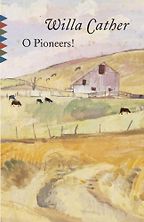
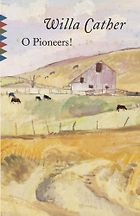
Your fascination with all aspects of pioneering makes your first choice particularly apt. O Pioneers! is a novel by Willa Cather, set in Nebraska.
Nebraska is the quintessential Great Plains state. If you drive across America, or go by train, you hurry through it as fast as you can and think it is no more than grass lands and corn fields. You think there is very little else except for one big city on the eastern side, Omaha – where, incidentally, America’s richest man, Warren Buffett, lives. Two great rivers dominate the state, the North Platte and the Missouri.
I have become fascinated with the internals, as it were, of Nebraska. I love the fact that the great migratory routes – the Oregon trail and the Mormon migrations – all passed through it. There is an enormous sandstone pinnacle in the far west of Nebraska called Chimney Rock, a landmark which you can see from 30 miles. It remains unchanged from the times it was a real landmark, over 100 years ago.
To me, Nebraska is a fantastically interesting crossroads, and a place where the east-west journeying of America is at its apex. You see the quintessence of pioneering in Nebraska. Willa Cather, who was born there but spent most of her writing life in New York City, felt a keen sense of nostalgia for the very hardscrabble life in the early pioneering days in Nebraska, and has written several books. I think she is one of the greatest of all American women writers.
It is difficult to choose a favourite book of hers, but if I had to choose it would be O Pioneers! It’s an extraordinary story of a Swedish family who stepped over the frontier that I was talking about into this raw, untouched and very harsh land. There was no habitation, no cities, roads or anything. You had to start from scratch. They would build sod houses, begin to grow things, raise animals and see whether they could survive through a hard winter. And then they met other people and there was a market, and then came children.
“I think she is one of the greatest of all American women writers.”
And slowly they become a community.
Yes. It is quite extraordinary to see the formation of an American community. You find out about the lives and loves that define that community, and ultimately the crime. There is a famous murder under a mulberry tree.
How did the lives of those early pioneers shape America’s social history?
Tremendously so. Of course, it answers to a degree the deep and sincerely felt godliness of Americans. God was all they had to trust, because all the elements of nature worked against them so all they could do was pray and hope for the best. Most of them ultimately survived, got through and succeeded. So a toughness, determination, ambition and underlying godliness very much marks the Midwestern life in America, even to this day.
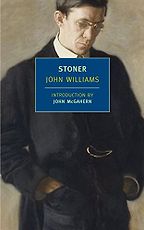
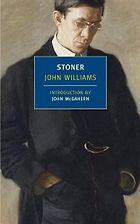
Next up is the classic novel Stoner, by John Williams, which explores the repercussions of trying to better yourself through education.
This book begins in a similar way to O Pioneers!, with a hardscrabble farm in the same part of the world. It was set at the end of the 19th century and has nothing to do with being stoned. A lot of people think, “This is a novel about drugs.” It is not at all! It is about a young man, William Stoner, who goes off to university at great financial cost and deprivation to his father, who is a pioneer farmer. The boy goes off to agricultural college and this is seen as a great triumph. But while he is there he encounters literature for the first time, specifically a Shakespearian sonnet, and is transformed by reading it. He decides he doesn’t want to study agriculture at all, and we see him become a professor of literature.
It is tempting to think that this is an academic novel with all its trials and tribulations, but it is not that either. It is a much more tender thing. It is a novel based essentially on disappointment, because Stoner has a rotten marriage and a terrible time academically. But he carries on and develops an intense affection for his now much more modest life. It is a story of intellectual determination and the ability of a man to find love simply in what he does. It is a book about love of learning.
I don’t want to give it all away, but he does find true love with a woman towards the end of his life, so in the end there is great blessing and happiness. To me, Stoner is almost the perfect novel. It is very little known but anyone who reads it is completely captivated by it. It is a wonderful, wonderful book.
His first marriage is a move upwards socially, but as you say he isn’t happy in it. People often think that there is more social mobility in the US than in the UK. As someone who has lived in both places, do you think that is the case?
I do, to be perfectly honest. There are novels which show some ossification of social stratification in America, and in cities like Boston it is rampant. But generally I would say that there is a lot more social mobility in this country than in Britain. It is one of the reasons why I find there is a much greater degree of opportunity for someone like me than back in my home country of the UK. I have become a citizen of the United States, and while I am in no way disdainful of Britain and enormously affectionate of it, I am pleased that I am an American.
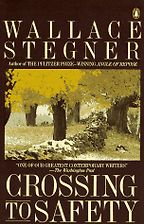
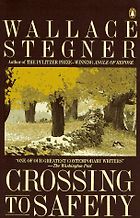
Your next choice, Crossing to Safety by Wallace Stegner, is about the friendships between two very different couples who met during the Great Depression.
In a way this is an expansion of the theme in Stoner, once again set in a university. It is a novel mainly about friendship and suffering. It is very sad, beginning with the death of one of the protagonists and how it ends is incredibly touching. Wallace Stegner is known as the great western novelist and is famous for books about Montana and the crossing of the west, most notably a novel called Angle of Repose which is an absolute classic. But in terms of human tenderness I find this particular book remarkable and unforgettable.
The couples are very different characters – one is a very subdued elder couple.
Yes, they are very different indeed. The differences between them are reflected particularly in the Vermont chapter, where all sorts of bizarre things happen during a walk in the woods. What I really love about this novel is the depth of friendship which crossed between these couples from very different classes, who are on the one hand academic failures and on the other academic successes.
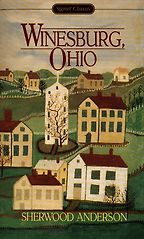
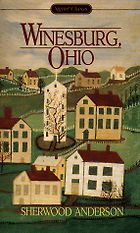
Winesburg, Ohio by Sherwood Anderson looks at the strange and secret lives of this make-believe small town.
Yes, there is no Winesburg, Ohio. Most people think it is based on Sherwood Anderson’s home town in Ohio, called Clyde. It is the most remarkable novel, written in 1919 so I think we are going to see some publicity when it celebrates its centenary. Once again, rather like Stoner, it dropped out of circulation for long periods. It was very modern and groundbreaking for its time, an entirely new form of writing.
He draws about 20 portraits of people who lived in this mythical town. Most of them are seen through the eyes of a local newspaper reporter, a chap called George Willard. He calls the people “grotesques”. That is his word in 1919, but as with many English words things change subtly over the years – a better word to describe them now would be “eccentrics”. These are eccentrics that look for their own truths from whatever they were doing in the town, but they became very odd in their quests for those truths.
All of the people in it are very peculiar and have strange stories. But taken as a whole, the portrait of this little town is unforgettable and wonderful and I commend it to anyone. You could see a novel like Main Street by Sinclair Lewis as being a great portrait of an American small town. But you see small towns in a much more impassioned way through the eyes of these grotesques, as reported by George Willard.
“These days there is the scourge of political correctness. Things like television and Walmart and the unifying forces of modern America reduce this eccentricity that was once a motif, particularly of these small towns.”
Do you think it echoes the sense of freedom that many people living in America feel enables them to be eccentrics and do their own thing?
Yes, although much more then than now. These days there is the scourge of political correctness. Things like television and Walmart and the unifying forces of modern America reduce this eccentricity that was once a motif, particularly of these small towns.
So you think life in America is more constrained and less free that it was earlier in the 20th century?
I think things are becoming more standard. I am writing a book at the moment which looks at the idea of the United States of America. I look at how the States were united and explore whether they are still united. As I mentioned, I really believe that things like huge stores and the homogenising influence of television and radio are reducing eccentricity to a mere trickle compared to what it was like a century ago.
What other ideas are you exploring for your book?
I look into the histories of those people who consciously decided to unite the different states. There is the Lewis and Clark expedition from 1804 to 1806, and I end with the people who built the interstate highway system in the 1950s and 60s. To give you one example from this great pantheon of once again rather “grotesque” people, I follow one remarkable geologist called Clarence King who did a survey of the west of America in the 1860s which took seven years.
King did not like white women, even though he was white. He decided that he would if possible marry a black woman, but that was frowned upon in those days. So he created an alter ego for himself called James Todd, claiming to be a Pullman porter but with fairly pale skin. And ostensibly as a black man, he married a black woman in Baltimore. So he lived two lives. One Clarence King, geologist and ultimately director of the first US Geological Survey, and another James Todd, a black porter married to a woman from Baltimore. He didn’t let on to either of the other lives until a year before his death!
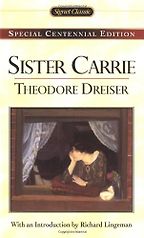
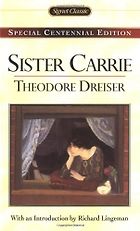
What a great story. Let’s finish with Sister Carrie, a novel by Theodore Dreiser which first came out in a censored version in 1900.
This is really the converse of most of the things I have been talking about here. Carrie is a very beautiful woman who came from Wisconsin. Some people thought this was a book about nuns, but it wasn’t. There is no nun-like behaviour in the book at all. Quite the reverse! Carrie goes to Chicago and falls in with a swell [a dandy]. He takes her on as his mistress, and her life is tremendously up and down. She has an affair with a man who is married, and is then taken to New York and lives in Lower Manhattan with a man who ultimately treats her badly.
But she is determined to succeed, and makes it as a well-known starlet in up-market theatrical performances, while her lover declines to beggary. She ultimately leaves him and gives him $20, – the same sum, ironically, that she was given on her first date with the swell in Chicago. So this is an urban story which is gritty and shows real life. As a consequence of that it was frowned upon hugely at the time it was published, and as you mentioned it was heavily censored. But now it is regarded as a classic of early American modernist literature.
Five Books aims to keep its book recommendations and interviews up to date. If you are the interviewee and would like to update your choice of books (or even just what you say about them) please email us at editor@fivebooks.com
Five Books interviews are expensive to produce. If you've enjoyed this interview, please support us by donating a small amount.