Nonfiction Books » History Books
The best books on The Enlightenment
recommended by Sophie Gee
The author of The Scandal of the Season – and Princeton University professor – gives an 18th century literature specialist's view of the Enlightenment.


The author of The Scandal of the Season – and Princeton University professor – gives an 18th century literature specialist's view of the Enlightenment.
The books that you’ve chosen look at the Enlightenment as a sort of slow-breaking social revolution – a revolution which is still breaking – starting with Isaac Newton’s Opticks, first published in 1704. You’ve also picked three extra books which you felt you had to recommend in addition to your chosen five.
Yes, I put those books in an order – not really an historical order, nor precisely thematic – more a way of describing how I’ve come to think of the Enlightenment. Some of the ways in which I think it’s interesting.
Newton’s Opticks seems a good place to start because it’s about light.
Exactly, and about seeing. The idea of light and vision seem to me to be behind the fundamental breakthroughs of the Enlightenment. They can be taken as the principles or the maxims of almost all moments in intellectual history where people see themselves undergoing a revolution or transformation.
“The classic symbol of the Enlightenment is simply light – truth emerging from darkness.”
The idea that you are seeing something familiar differently, even as capable of changing the world, seems to be the essence of all intellectual and social revolutions. So we’re taking the Enlightenment here as the single most important of all intellectual revolutions in the West and I picked Isaac Newton’s Opticks as my first text in order to flag the main themes of this revolution.
You also wanted to draw our attention particularly to a later addition to the Opticks known as the ‘Queries’.
Yes. Newton’s a genius whose most obvious contribution to science was to formulate the laws of motion and of gravity and to come up with breakthrough theories about light, colour, vision and so on. But in the Queries to the Opticks he treats these questions as philosophical problems as much as scientific problems. He sees his work not simply as changing the way that scientific inquiry is going to happen for the next 300 years, but also the way that people think about what it means to be human. So if we’re using optics as a key figure for how people think about revolution then Newton gives us another word: ‘Query’, the idea of questioning, investigating, of opening up problems to people at large.
Which is perhaps why you chose John Locke’s Essay Concerning Human Understanding as your next book? This is an earlier work, published in 1690.
Locke’s a very interesting figure in many of the same ways that Newton is. They’re both coming out of a century of revolution and dissent in England; a century in which the church and the state have been questioned in the most profound ways. A century in which absolutism has been seen as an insupportable political position, where the old regime government in Britain was no longer viable. The 17th century saw a dawning of parliamentary government, and a commitment at least to popular social participation in the life of the state. That’s the political backdrop against which both of these men are working.
“ So instead of a supreme, authoritative, monarchic figure being the presence that describes what power is like in the world, the authority of the individual takes over.”
Locke’s a political philosopher, Newton’s a natural philosopher or scientist. But really both of them were responding to this idea of popular participation, the will of the people, as a way to think about philosophy and science in radically different ways. Newton’s work on vision and light and sight and Locke’s ideas about the emotions and the mind establish the consciousness and perceptions of the individual at the centre of human life. It’s a secular view. So instead of a supreme, authoritative, monarchic figure being the presence that describes what power is like in the world, the authority of the individual takes over. Newton establishes the validity of human perception, Locke establishes the validity of individual consciousness. And these two things, the ability to see or think authoritatively really become the cornerstones of the Enlightenment, and from there of all modern thought. They establish the individual at the centre of collective life.
Towards the end of the 18th century a German clergyman, the Reverend Johann Friedrich Zollner, asked ‘what is the Enlightenment?’, provoking the third book on your list….
Yes, Answering the Question: What is Enlightenment? by Immanuel Kant. Kant is responding to a lot of same questions as Newton and Locke, but a century later. Each of those three thinkers have come up with the idea that human beings are going through and must go through a fundamental transformation, and the fundamental transformation that each thinker is committed to is from humans being controlled by a higher authority to human beings being capable of autonomous individual decision making and thought. We’ve already talked about what that means for Newton and Locke. Kant, I think, sees the Enlightenment as a way of thinking which liberates individuals from what he calls immaturity. He’s interested in mature decision making, independent social and political decision making springing from individual Enlightenment. And in order to encapsulate the essence of what he means by this he uses a phrase coined by Horace: ‘Sapere aude!’ – dare to know, dare to be wise!
It makes me think of the cardinal in Italy who refused to look through Galileo’s telescope. You chose optics for your first book, Locke’s treatise on human understanding or the formulation of ideas for your second, and Kant’s notion of intellectual daring for your third…
Absolutely. The looking through the telescope is a symbol for all this. But none of these thinkers were suggesting that the universe was fundamentally different or radically altered from the universe that people had thought they were living in. They weren’t heretics in that way. What they were saying was that if we look properly at things, if we examine things rigorously, we will see things that were previously invisible, a series of truths that were previously hidden. And this is why the classic symbol of the Enlightenment is simply light – truth emerging from darkness. But another symbol of it is the telescope or the microscope, instruments that revealed things that had been their all along but hitherto had been invisible. So the idea is of a world that might be infinitely dense, infinitely complicated, made infinitely visible actually by looking more and more carefully at familiar objects. And by looking carefully both making them strange and yet also more completely known.
Your fourth choice is an essay by Foucault’s What is Enlightenment?, which I assume is a response to Kant’s essay, which was published 3 centuries later.
I wanted to recommend a couple of Foucault books here. He’s going through a less fashionable phase now, but I think he’s one of the most exciting, innovative thinkers of the twentieth century. I also wanted to show that part of post-structuralist thinking in the twentieth century – i.e. what went on to become cutting-edge modern philosophy – was still deeply indebted to the Enlightenment.
Something amazing happened in the last years of the seventeenth century that somebody in the 1960s was still thinking through. And I suppose that the question Foucault asks is, how, after the catastrophes of the twentieth century—the Holocaust, the world wars, the economic depression—are we going to reground ourselves? How are we going to find an intellectual framework from which we can understand what we’ve done to ourselves and establish the foundations of an ethical life?
And what does Foucault have to add to Kant? How does he borrow from Kant and yet redefine the question in the context of the twentieth century?
There were cultural turns that Foucault was considering that had not yet become central issues in Kant’s time: the historic and philosophical meaning of insanity, of poverty, of certain kinds of deviant sexuality. So Foucault is daring to know, but what he wants to look at are the margins of cultural life, what the rejected parts of life look like. He’s inserting what had previously been unknowable narratives into our understanding of what it means to be human.
Here we get to your three extra recommendations before you discuss your final choice. This is a novel by Neal Stephenson, called Quicksilver, set in the time of Newton and Leibniz and framed by their struggle to develop calculus.
Lots of things are interesting about this book. Neal Stephenson has this unbelievably capacious and exciting mind that links things in entirely unexpected and convincing ways. This is a book about late seventeenth century and early eighteenth century Europe and also America, and is really the template for me of what an historical novel should be. It feels completely contemporary. The research is just unbelievably detailed and perceptive, yet is presented in a way which feels entirely familiar and vivid. It’s a great historical novel. It’s also not the easiest. It’s intellectually very dense.
Newton’s one of the main characters in the early part of the book and basically what Stephenson’s doing in the Baroque Cycle book trilogy in general I think is to draw together all the threads of the Enlightenment – the scientific Enlightenment, the philosophical Enlightenment, revolutions in finance and credit. At the same time the English colonial adventure is reaching its height and in particular the relationship between England and America is approaching its revolutionary crisis. He has a magisterial understanding of how all these different ways of understanding the world are coming together, resonating with each other, and yet at the same time how each requires a different form of expertise. So that in the Enlightenment the idea of the renaissance man, the well rounded man, the man accomplished in all branches of art and science, is replaced by admiration for the expert or specialist. This is what intellectual rigour comes to look like.
I suppose if you wanted to understand the Enlightenment, you might want to read a novel that simply makes you feel as though you were living there?
Yes, I think this novel makes you understand why people felt that they were standing at the beginning of a new age, the modern world… Why it felt like a series of changes were taking place that fundamentally altered what it meant to be human – altered what it meant in a good way. It was a profoundly optimistic period in many ways.
Stephenson’s book reminds one that the novel is a genre which thrives on multiplicity and plurality, and which, as you say, is championing the expert over the totalizing, all-round genius.
Leviathan and the Air Pump. Yes. A history of science book. It’s a brilliant title that perhaps doesn’t perhaps draw you into reading the book, but to me, this is perhaps the single best history of science book that’s ever been written. It’s a fantastic book, though again it’s gone a little out of fashion. But at the time it fundamentally changed the way that people saw the history of science.
Support Five Books
Five Books interviews are expensive to produce. If you're enjoying this interview, please support us by donating a small amount.
The claims that the authors are making in the book are essentially that the political philosophy of Hobbes and other contemporaries, including Locke, and the scientific breakthroughs of Boyle who did the first set of experiments using an air pump – that these two bodies of thought weren’t developing human understanding in parallel. They were part of a cultural shift that was interlinked and that was going to produce a new account of what it meant to be a human being. So in other words what this book really did was to show that changes taking place in apparently different areas of human understanding were actually linked to one another and that the Enlightenment, while dependent on immensely talented individuals and specialists, was a kind of collective commitment – a commitment which paradoxically transcended the individual.
Some of the optimism which informed the age of Enlightenment may have dwindled since. But we’re going to come back to Foucault at this point, a man who you’ve said is one of the most interesting thinkers of the twentieth century. And one of the things that perhaps makes Foucault a moving as well as an enlightening thinker is the way in which he is prepared to engage with the limits of experience, with the frustration of that early optimism….
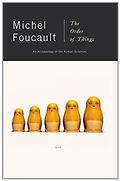
The Order of Things. Yes, it begins with a painting: Velasquez’s Las Meninas. Foucault does a reading of that painting to show that at any particular moment in culture, the way that something gets represented and the ways in which we analyze representation – what we choose to see, what is emphasized, what occluded – is governed by a world view peculiar to that age. What he does is to track changes in the way that knowledge and ideas get organized from the Renaissance onward. And for my purposes what’s really extraordinary about this book is Foucault’s description of the renaissance world as being a world of infinite connectedness, infinite analogy, where it seems that everything is analogous or equivalent to everything else. So that if you think about the world of a Shakespeare play you realize that the world of finance and of magic and of the professional classes and of the aristocracy – poets, madmen – all of these worlds are knowable and fundamentally the same.
But what happens with the Enlightenment is that suddenly it occurs to people that perhaps, rather than everything being comparable to everything else, rather than analogy being the system of understanding, that perhaps distinction and discrimination might be a better way of understanding the complete human experience. What’s particularly compelling about Foucault’s approach is that he recognizes that we are always struggling with the same problems: how to understand the world around us; how to connect different aspects of experience and give them meaning. This impulse to order is what we do when we think and Foucault recognizes the same impulse in every age; but by creating an anatomy of each distinct period since the renaissance he helps us to grasp the way in which people are looking and representing things differently even if they are asking very similar questions.
Before we get to your final official choice, and the only book about sex on your list, perhaps we should talk a little about Jurgen Habermas’ The Structural Transformation of the Public Sphere. Because all this has a profoundly political aspect, doesn’t it? I mean Jean Paul Sartre condemned Foucault’s book as ‘the last barricade of the bourgeoisie’ and you can see why he might. For Sartre, as a socialist, Foucault’s theory of organization was just another theory of appropriation…
That’s right, Habermas, like Sartre – and Foucault, and also Locke – is saying that when you describe something you’re also giving an account of your own political ideology. Locke happens to be writing about the operation of the consciousness in human understanding, but he’s really talking about the same kinds of ideas that he’s talking about in his treatises on government. Similarly, Habermas is talking about this emergence of what he calls the public sphere during the Enlightenment, but he’s also explicitly thinking about what the ideal state would look like. He comes up with the idea that in the eighteenth century the public space is transformed, becoming a potentially neutral, ambiguous, commonly held realm. A forum in which individuals are able to interact with one another without class or personal narrative getting in the way of being able to forge a collective life. The public sphere becomes a place in which collective life can take place untrammeled by the gory details of people’s private affairs.
During the Enlightenment, the icon of this would have been the European coffee house, where everyone could come together whether they were a member of the nobility or a working man or a servant or cleric or lawyer. Everyone could come into this collectively held space and become a citizen rather than a person whose individual circumstances determine their identity. It’s a deeply idealizing notion, and Habermas has been strongly criticized on this score by other political philosophers, but the idea is of a sphere which permits possibility and change, rather than the early modern idea of a public space where individuals were dominated and determined by the social, political and economic roles which had already been assigned them by the existing order. Public life becomes about openness, argument and change. The private individual becomes effaced in the interests of the collective world.
Habermas talks about the transition from a feudal society to an essentially bourgeois society, and then, in the twentieth century, to something else. He talks about a ‘mass social’ welfare society, which sees, in some ways, the individual once again determined by the state.
One of the problems of the post-Enlightenment world is that the irony of individual freedom, the irony of creating a state that is responsible for individuals, but also individuals that are responsible for the state, is the visible evidence of that freedom and responsibility: the catastrophes of totalitarianism, Stalin’s Russia, Hitler’s Germany, and also the infringements of social freedom that come with establishing things like the welfare state. So I think that part of the reason why modern thinkers tend to come back to the Enlightenment is that after the events of the first half of the twentieth century it starts to feel like a dangerously naïve position to take, to advocate for the kind of statehood that the Enlightenment seems to have produced.
The second half of the twentieth century represents a sort of backlash against the Enlightenment, a profound disenchantment with what it promised but did not deliver. Whereas now, in the twenty first century, in the context of climate change, globalization, a global economic melt down, I think that people are going back to the sort of claims that people like Newton, Locke, Kant and Descartes were making. How can we revisit these questions? Because these are still the questions. What does it mean to be an individual in a society? What is the role the individual plays? What is the role society plays?
And collectively these questions still mean, ‘What is Enlightenment?’
Yes, how can we emerge from immaturity? What does it mean to be capable of asserting reason? Of transforming the world we live in through the power of our own consciousness and imagination.
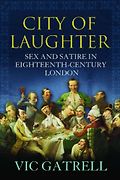
So finally to City of Laughter: Sex and Satire in Eighteenth Century London, which a reviewer describes like this: ‘Great toppling pyramids of bottoms and bosoms decorate this book, nipples stipple it, and on every page chamber pots and tankards overflow.’
I wanted to put a book in that showed that the Enlightenment wasn’t just about people having big ideas. It was also about people having a good time. And I suppose that one of the consequences of political and social optimism was collective pleasure, and that’s really what this book’s about. It’s about people being libidinous and bawdy and sexually free in a big city. Feeling for the first time that they were living in a modern world. What’s coming across in this book is that the Enlightenment is a period of excess, of luxury, of feeling as though people have more than enough to go round – piles of bottoms and breasts – a celebration of life and plenty. And an acknowledgement as well of the other side of that which is a plenitude of filth and lewdness and disenchantment and poverty and vice. In other words the overflow of the other side of life.
May 19, 2009
Five Books aims to keep its book recommendations and interviews up to date. If you are the interviewee and would like to update your choice of books (or even just what you say about them) please email us at editor@fivebooks.com

Sophie Gee
Sophie Gee is an English professor at Princeton University, and is currently the inaugural Vice-Chancellor’s Fellow at the University of Sydney. She is the author of acclaimed fiction and literary criticism, including The Scandal of the Season, Making Waste, and The Barbarous Feast. She is co-host of the Secret Life of Books podcast, which is dedicated to keeping the great books of the past alive and relevant.
Sophie Gee
Sophie Gee is an English professor at Princeton University, and is currently the inaugural Vice-Chancellor’s Fellow at the University of Sydney. She is the author of acclaimed fiction and literary criticism, including The Scandal of the Season, Making Waste, and The Barbarous Feast. She is co-host of the Secret Life of Books podcast, which is dedicated to keeping the great books of the past alive and relevant.
© Five Books 2025