When you took over his seat on the Supreme Court, Justice Harry Blackmun advised you, “When you have the chance, tell people what you do”. So I’m going to ask a very simple question, because I know the answer is quite complex. What do you do?
We work on difficult legal issues involving laws passed by Congress. We are most likely to hear those cases where lower courts have come to different conclusions about the same question of federal law. Our job, the nine of us, is basically to create a uniform rule of law by ironing out differences. A case in front of us might involve the meaning of a statute. It might involve a comma in the Internal Revenue Code, which different courts interpret differently. Or it might involve whether Guantanamo prisoners are entitled to seek habeas corpus. It could be a major question, it could be a minor question. If there’s a difference in the federal law interpretation, we’ll probably hear the case and try to iron it out. That’s what we do.
The books you’ve cited as intellectual influences are not standards of the law school curriculum. Why is it important for lawyers and judges to read widely?
Law requires both a head and a heart. You need a good head to read all those words [in law books] and figure out how they apply. But when you are representing human beings or deciding things that affect them, you need to understand, as best you can, the workings of human life.
Turning to the books, let’s begin with Democracy in America. Tell us about it and why it continues to resonate with you.
It’s a masterpiece of sociological and political analysis. In the 1830s, Tocqueville looked at the newly democratic America and described it in terms that, for the most part, are applicable today. For example, he spoke of the clamour that he heard when he reached the shores of America. Law in America rises from the bottom up, it isn’t decreed from the top down. When we have a new problem, we start with vigorous debate and discussion that can sound like clamour.
For instance, how will privacy and free expression interact in the Internet age? The village gossip would forget what was going on, but computers won’t. Norms about privacy and how privacy relates to free expression are changing. When we want change in an area like that, we start to discuss it – in schools, in associations, in newspapers, in magazine articles. Debate and discussion bubbles up. Some kind of rule is formed, perhaps through an administrative process. We may change it, there may be legislative hearings, our representatives might write a statute and if that isn’t working well, the new rule is tested through the courts to see whether it falls within the boundaries of the constitution.
Get the weekly Five Books newsletter
The constitution is a document that sets boundaries. Being a judge on a constitutional court is like living on a frontier. Is this statute inside or outside America’s boundaries? That’s what we’re deciding. Now, sometimes that’s difficult. Is abortion inside or outside our constitutional boundaries? Is prayer in schools? These are difficult questions. But in the vast area between the boundaries, democratically elected representatives make decisions, after all sorts of consultation with the people, after all sorts of clamour. Tocqueville encapsulates all that. His work still helps us understand America, 170 years after he wrote it.
How did Tocqueville influence your view of our constitutional system?
He talks about the importance of aggregating views, as we do in the United States, through voluntary associations. He talks about the importance of bringing the average person into the democratic process. Tocqueville, in his writing, shows us the many ways in which the average person can participate and must participate for the democratic process to work.
Tocqueville observed two persistent tendencies in American culture: abhorrence of elite institutions and reliance on our legal system to settle differences. It seems to me these two tendencies are in tension and place the Supreme Court in a rather tough spot.
I don’t have a fixed view on that point. Life is complicated. America is a country of 309 million people who think a lot of different things. There’s every race, there’s every religion, there’s every point of view. We have a common view that real differences should be decided under law. That is a miracle, all things considered. Considering the number of differences that are possible, it’s not surprising that law is complex. Now, I don’t think our system is perfect. I could list 10,000 reforms, but I won’t bore you. I’ll just say it’s important not to understate the need for law and for lawyers.
Let’s move forward to another classic work of literary nonfiction, The Education of Henry Adams. Please tell us about Adams and his quasi-autobiography.
It’s a marvellous book. Every American should read it and so should anyone who wants to understand America.
Henry Adams grew up in an aristocratic family. His grandfather was President. His great grandfather was President. He was a perfectly positioned observer of the political scene. His perspective and his longevity gave him a broad view. In his life, from 1838 until 1918, he saw radical change in America – a lot of it for the worse. He saw the country expand economically but he also saw the rise of a class of robber barons. He saw all kinds of corruption in Washington, where he was based. He saw the end of slavery and the reconstruction era, which brought segregation. As he reviews what he saw, he asks himself the question, “Can democracy survive?” His answer to that question was, “What other choice do we have? We have got to make our democracy work.”
As you say, Adams was both sceptical and optimistic about the constitutional system which his forefathers created. What makes you sceptical and what makes you optimistic about how American democracy will survive this century?
There is nothing that I can say about that, which you can’t learn better from turning on your television and listening to commentators. There is concern that politics is too polarised. There is concern that it’s difficult to think through questions, because the media reports comments made by people in public life in a bad light. There is concern that blogs and the Internet make it worse. I’m sure many criticisms have truth to them and many are exaggerated. But it is up to us to make our system work, whatever the challenges. I think Adams’s attitude is the right one.
Next, please tell us about JL Austin and How to Do Things with Words.
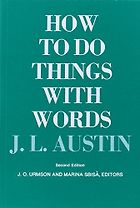
JL Austin was an ordinary language philosopher. When I studied in Oxford, I went to one of his classes and I read his books. How to Do Things with Words teaches us a lot about how ordinary language works. It is useful to me as a judge, because it helps me avoid the traps that linguistic imprecision can set. If I had to pick a single thing that I draw from Austin’s work it would be that context matters. It enables us to understand, when someone makes a statement, what that statement refers to and what that person meant. Austin set a famous exam question: you bet that all swans are white or black, but does this refer to possible swans on Mars? Not clear. The question is: what’s the context? What’s the scope of that bet?
“The constitution is a document that sets boundaries. Being a judge on a constitutional court is like living on a frontier”
When I see the word “any” in a statute, I immediately know it’s unlikely to mean “anything” in the universe. “Any” will have a limitation on it, depending on the context. When my wife says, “there isn’t any butter,” I understand that she’s talking about what is in our refrigerator, not worldwide. We look at context over and over, in life and in law.
What do you think Austin teaches about strict constructionism and its variations?
Austin suggests that there is good reason to look beyond text to context. Context is very important when you examine a statement or law. A statement made by Congress, under certain formal conditions, becomes a law. Context helps us interpret language, including the language of a statute. Purpose is often an important part of context. So Austin probably encourages me to put more weight on purpose.
Let’s move onto Camus and The Plague. Why do you cite this classic novel as intellectually formative?
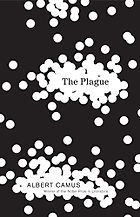
Because it really speaks to my generation. I grew up during World War II. Though I was a young child, I can still remember blackout shades coming down in San Francisco because people were worried about an invasion. My wife is English. We just saw a documentary about Churchill, and in it there were lots of English women carrying their babies into Tube [metro] stations during air raids. I thought maybe one of those babies is [my wife] Joanna. That was the world that we were born into. Camus, in The Plague, writes about that world. Although the story takes place in Algeria, he’s really writing about the Nazi occupation of France.
Most read this work on an allegorical level.
He talks about the plague. Well, the plague is that part of a human being which can be very evil. That germ, he says at the end, never dies, it simply goes into remission. It lurks. It lurks in the cupboards, it lurks in the hallways, it lurks in the filing cabinets. It lurks throughout the house, perhaps one day to reawaken and once again send forth its pestilence into what was once a happy city.
All over the world, people are trying to stop that plague because it’s still there, in the hearts of people. To keep the plague away, we build institutions including independent judiciaries to interpret constitutions that contain words, which are protective of human beings’ basic rights. That’s true in Europe, it’s true in the United States, and it’s more and more true throughout the world. I have a job that is one small part of the effort to build a barrier against another epidemic of evil like what we saw in World War II.
Your final choice is Remembrance of Things Past. Forgive me for not attempting the French. How do you think of Proust?
He has an enormous talent for building characters and bringing a world to life. In his descriptions of his own experiences you see the role of art in life. Art is not separate from life, it is an element of life. We all have the need and the capacity to impose form upon the flux around us. Now, we can impose a better form or we can impose a worse form. We aren’t all geniuses like Proust. Yet we can try to clarify our thoughts and remember the importance of form when we write. Proust shows us that activity helps give meaning to life and it’s helpful to keep in mind as a judge.
You cited Proust and Camus in the original French and you advise those interested in law to learn another language. Why is mastering another language so valuable in your view?
I have spent a lot of time with French. I try. It’s work sometimes. But worth it, for the same reason I recommend reading literature. We have only one life, each of us. Through literature and language we can begin to understand the lives of other people and get insight into how others see the world. By reading some French books as originally written, I think I gain a better view of a world that is seen by many people who speak French, which I would be cut off from otherwise because translation is different. So language, like literature, opens windows.
This quality of empathetic imagination that we’ve been talking about – why is it crucial for a Supreme Court Justice, in particular, to possess?
The job of being a judge entails spending every day alone in a room with books and a word processor. Yet the words that you write affect other people. Only the most difficult cases get to the Supreme Court, those cases where perfectly good judges come to different conclusions on the meaning of the same words. In those difficult cases, it is very important to imaginatively understand how other people live and how your decisions might affect them, so you can take that into account when you write.
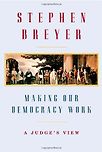
You are transparent about your jurisprudence in Making Our Democracy Work. Please characterise your approach.
Judges have the job of trying to work out what the words written down in a statute actually mean. We have six traditional ways of approaching this job. First, we read the words. Second, we look to the tradition. For instance, the phrase “habeas corpus” has a big legal tradition behind it. Third, we look to the history of the case. Fourth, we look to precedent – what has been said about this in previous cases? Fifth, we look to purposes – somebody wrote this statute, what did they have in mind and what were they trying to accomplish with these words? And sixth, we look to consequences. That is, if we interpret the statute this way are we furthering the statute’s purpose or are we hindering it. Everybody uses those six tools: Text, tradition, history, precedent, purpose and consequence.
Five Books interviews are expensive to produce. If you're enjoying this interview, please support us by donating a small amount.
Some judges tend to emphasise purposes and consequences. That’s what I do. I often cannot get the answer from the first four things, so I look to purpose – what did the authors of the bill mean? What were they trying to accomplish? Other judges feel that that’s too subjective. They try to find the answer in history, text, language and tradition – the first four. That explains differences among the judges. It’s a question of emphasis. I fear that just looking at text, history, tradition and precedent won’t answer the question. If that’s all you look to, too often you will produce a law that is too rigid to adapt to human circumstances, which are ever-changing. That’s why I look to purposes, but I certainly agree that the first four are relevant.
Strict constructionists focus on text, history, tradition and precedent?
They believe they can find answers in those four factors more often. When you’re interpreting a provision of our constitution, which was written in 1787, ratified in 1789 and the phrases are general, the strict constructionist tends to think he can find the answer by looking back to see what the founders would have thought. All of us, including me, agree that you have to look back to find out the primary value that underlies the provision of the constitution. For example, what was the constitution trying to protect when it protected freedom of speech? Speech is a form of expression. They were trying to protect expression. You have to find the value.
Get the weekly Five Books newsletter
Values don’t change, but circumstances do. The Internet is something that George Washington didn’t envision. George Washington can’t tell us how the First Amendment applies to the Internet. But history can tell us what the framers were trying to achieve when they wrote the First Amendment. Some people think they can answer specific questions today through history. I think you can’t get that much out of it and you must apply, as best you can, unchanging values like free expression to the ever-changing circumstances of modern life.
The Court is about to wrap up its term. What is on your summer reading list?
I’ve spent the last four summers writing Making Our Democracy Work. I put a lot of my heart and soul into trying to translate the experience I’m having into a form that is understandable for all readers. So this summer I have a lot of reading I want to catch up on, including some American biographies. Good ones recently came out on George Washington, for example. And I do like French literature, I’ll probably go back and read some Balzac. There are a whole lot of things. I have a large pile. I can’t remember what is in it, but I am looking forward to it.
Five Books aims to keep its book recommendations and interviews up to date. If you are the interviewee and would like to update your choice of books (or even just what you say about them) please email us at editor@fivebooks.com