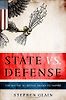
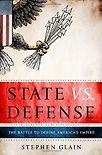
I was reading the Foreign Policy excerpt of your book, about the huge imbalance between the civil and the military arms of the US government. For example, the Pentagon has more lawyers than the State Department has diplomats.
It also has more band members than the State Department has diplomats. That’s become so clichéd I decided to use lawyers instead.
Also, while people are talking about cutting social security, the Pentagon exceeds its budget by $300bn.
Yes, and has repeatedly failed to account, every year, for hundreds of billions of dollars – sometimes even more than a trillion dollars in expenditures.
These are important points, but ones at which a lot of people just shrug their shoulders…
I was surprised, in the past, that when I sat down to drinks with friends and talked about this, it failed to resonate. Now I’m out hitting the talk shows and there does seem to be something of a response, but I think that’s largely symptomatic of the economic condition the country is now mired in.
I was wondering what made you feel outraged enough about the situation to write a book about it. Was it your experience as a reporter for The Wall Street Journal in Asia and the Middle East?
What compelled me to write about this process of foreign policy militarisation was seeing the enormous amount of military resources that the US has established overseas, sometimes, literally, in my backyard. For example, when I was in Korea, I had an apartment not far from the main army base in Itaewon in Seoul. Then I went to Japan, where the US also has an enormous presence. Before that I was in Hong Kong, and every now and then the ships would come in for liberty call. It was a slow process. My tenure overseas coincided with the collapse of the Soviet Union. Before that, I had accepted the Cold War orthodoxy, that these military commitments on the part of the US were necessary in order to contain the Soviet bear. After it imploded, it took me several years of reporting about arms sales to allies, about joint development programmes, of seeing these incredibly intrusive bases, for me to understand the paradox of maintaining these huge deployments in the absence of a clear threat. It gradually became clear to me that this was not only a craving for dominion, but dominion for its own sake.
Then, when I went to the Middle East, I encountered a somewhat different iteration of it. But it was obvious that to the average person anywhere in the world, if they were going to meet an American, it was increasingly likely that they would be wearing a military uniform. To Americans that’s not necessarily disturbing, because we’re blessed with an incredibly professional, highly educated, highly trained, highly motivated military, which we don’t see as a threat. But if you’re Korean or Japanese, or if you’re European, chances are you have a different perception of what a military bureaucracy is capable of doing. So I knew that we were sending a potentially negative signal in not just maintaining our Cold War military bureaucracies, but intensifying them worldwide. That’s really what informed my decision to proceed with this book.
I should also point out that I grew up near Camp Pendleton, which is the largest US marine base in the world, and most of my friends were the children of active duty marine officers. So I grew up with an enormous amount of respect for them and what they were doing. I never bought into this notion that there is something malign or pernicious about the military. It’s more about the way civilians in Washington are abusing the military and its people, like these kids now doing their third or fourth tours in Afghanistan and Iraq.
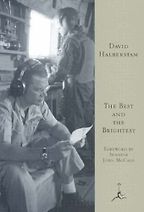
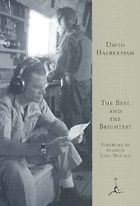
The first book you’ve chosen is David Halberstam’s The Best and the Brightest, which dates from 1972. The reviews describe it as “the epic true story of how America got involved in Vietnam” or “the Iliad of America’s doomed involvement in Vietnam”. It really does sound like one of those books that everyone should read.
I read this book when I was living in Asia, and it was my first memorable encounter with investigative journalism in the service of creating a historical narrative. It’s a book that is not only very compelling, and staggering in its scope and its conclusions, but the perfect example of a revisionist history. It was contrary to everything I thought I knew about the events that it accounted for, which was basically the Kennedy years and early Johnson administration and how they dealt with Vietnam. It also introduced me to the personalities who are not well known to most Americans, but who became, as a result of Halberstam’s telling, real heroes to me. These are the China experts who worked for the US State Department, who were in China in the 1940s and 1950s. They worked with both the communist Chinese and the nationalist Chinese and cabled back, very courageously, that the nationalists were corrupt and that though the communists were communist, they had a greater legitimacy in the eyes of the people and therefore we should work with them. For me, reading this in my late 20s/early 30s was quite a revelation, and it’s why I hold the book very close to my heart. Rereading it when researching my own book, State vs. Defense, was a real pleasure, because I was reading it with the benefit of 20 years of experience as a correspondent.
What light does it shed on US militarism, specifically?
It shows how a president, however reluctant to engage militarily or to militarise foreign policy, finds himself getting swept along by events or political imperatives that he can’t control. Kennedy did not want to escalate the US presence in Vietnam – he was very clear on that score. But he was concerned that if he did not make some kind of gesture – perhaps by sending slightly less than half what the generals were insisting he send – he would be portrayed as being soft on communism, and that that would compromise some of his other initiatives, like civil rights. It’s interesting how every time the US had a crisis on its hands, or a foreign policy challenge, the heads of state were reluctant to get involved, but gave way to political pressure, usually from the right. That pressure was either well intentioned and sincere or simply a political tactic to put the president on the defensive. Obviously this was not the case with the most recent President Bush’s rush to war, which was very much his own inspiration.
What about Obama? He’s also remained more involved in foreign wars than I would have expected from his comments on the campaign trail.
On the campaign trail he said Afghanistan was the good war. He may have believed that. He almost certainly understood that he would have a better chance to be elected if he established his credibility as someone who is prepared to intensify the conflict in Afghanistan. It’s another specimen of how this pressure works, just a more subtle one.
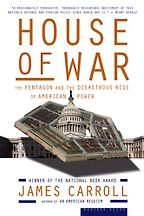
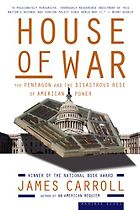
Let’s go on to House of War by James Carroll. This is about the Pentagon, but it’s a personal take: Carroll’s father was a general.
Yes, and this gives it an intimacy which other books of this genre don’t necessarily have. He does a great job of twinning his own experiences and memories with the towering personalities of the Cold War, like Curtis LeMay. LeMay figures very heavily in my book, because he is the ultimate militarist who was also in the military. In my book I am very careful to point out that most of the militarism that goes on in Washington is done by civilians, because we still have a civilian-led military. The book is very well written – it’s a very uninhibited account of what it was like for him growing up and, through his father, being part of the Pentagon bureaucracy. It’s very subversive. I read it before I was serious about writing the book that would ultimately become State vs. Defense, and I thought to myself, “Why should I write a book about foreign policy militarisation when Carroll has done such a great job of doing it?”
You say it’s subversive. Give me an example.
He’s talking about LeMay, and it has to do with the Gaither Report, which President Eisenhower commissioned, in part to protect his own right flank from anti-communist hawks in Congress. We’re talking about Eisenhower here, the hero of Normandy! So he commissioned an investigation into accusations that America had fallen behind in missile production. Carroll takes us into the room where some members of the committee are interviewing LeMay. They say, “Here’s your scenario. You just received an urgent message that Soviet bombers have flown past the distant early-warning line in Canada, and they’re about to launch an attack. How many bombers can you get off the ground before they come under attack themselves?”
And LeMay says, “None, because it is my policy to maintain my own intelligence sources. The minute I think the Soviets have scrambled I am going to retaliate pre-emptively.” Which of course would be a giant act of insubordination. It’s not the military that orders attacks, it’s the president of the US. I was struck by just how cavalier this individual was when it came to something so vital and what it said about the system, that it could produce someone who would act so rashly.
So in your book are you very anti-Donald Rumsfeld?
Yes, my book is quite harsh on Rumsfeld, because he was the architect of Iraq and he’s a perfect example of a militarist who was a civilian, when he was in the process of militarising US policy after 9/11.
And like LeMay, very cavalier?
Cavalier and contemptuous of the people around him. It was appalling the way he humiliated his own generals. He would wire-brush subordinates if their reports were not up to his liking. That’s one of the leitmotifs of my book. Every time that there is a president or a secretary of defence or a senior official who is driving the country towards war against a perceived threat, there is always someone in the bureaucracy – whether it’s a diplomat or a military attaché, or a spymaster – sitting in an embassy where the perceived threat is apparently emerging, saying, “No, this is not a major threat and we should not be getting involved in this.” That’s when you see the disconnect between how the world is and how Washington perceives it. Rumsfeld’s perception of the world was completely at odds with the way it was, and unfortunately that is a myopia that is way too common in this town [Washington DC]. It’s one of the reasons why the US keeps getting into conflicts and quagmires that it could have avoided had it just listened to its area experts. That’s a theme that resonates in The Best and the Brightest, and Legacy of Ashes, which is the next book on the list.
And in this regard, things didn’t improve much between Vietnam and the aftermath of September 11, 2001.
I was in Washington writing a book when 9/11 happened. I was personally stunned at the level of ignorance about the Middle East, the complete misinterpretation of what the attacks were all about, and the extent to which it was a wilful ignorance, spread largely by domestic politics. That just became a barrier to any kind of thoughtful inquiry as to what the attacks meant, and more importantly, how to respond to them.
When you say people completely misunderstood 9/11 what do you mean?
It’s still unfashionable to say this, but when George Bush addressed Congress he said the terrorists hate us not for what we do, but who we are, our democracy, our values, our way of life. But anybody who Googled Bin Laden would have seen that the first entry was his 1996 fatwa or declaration of war, against what he called the “Zionist crusader alliance”. That tells you right there that it’s not about American democracy, it’s about American policies. US support of Israel was one of those policies that so outraged Bin Laden. The other thing was the US residual force of troops in Saudi Arabia after Operation Desert Storm, which Bin Laden, like a lot of Muslims, regarded as an apostasy. And because it was the Saudi monarchy that abetted that deployment, that put the monarchy within his crosshairs as well. Ditto US support for secular dictators like Hosni Mubarak. You can argue about whether or not these policies are legitimate and in America’s interest. But to suggest that they somehow did not play a role in Bin Laden’s motivation was duplicitous. It created the environment where such a massive and misplaced military response to 9/11 could happen. A “War on Terror”: In retrospect, it sounds ridiculous. But it made something as reckless and disproportionate [as the American response to 9/11] possible and even fashionable. Because if they’re attacking our way of life, we have no choice but to resist.
So were you just horrified when they announced they were going into Iraq?
I’d spent a lot of time in Iraq, and I’d seen what the sanctions had done to these extraordinary people. I believed then, as I do now, that it was an absolutely inhumane thing to do, to punish 24 million Iraqis while enriching Saddam and the kleptocracy that had congealed around him. But when it became clear that the US was going to war in Iraq, it became obvious to me that it was not about the Iraqis. It was about remaking the Middle Eastern map in a way that would make Israel more comfortable. That was quite a revelation. I don’t think I’ll ever really recover from that.
Did your next journalistic assignment involve Iraq?
Once my book was completed I was hired by The Boston Globe. One of the things that I took on my own initiative was to cover how the White House was going to handle the post-conflict side of the Iraq war, the rebuilding. That’s when I got a pretty intimate look at how Rumsfeld was neglecting it, and how he was locking out the civilian side. He was obstructing NGOs from doing what they normally do in the run-up to a war, which is to try to pre-empt a refugee crisis and cholera outbreaks, and to make sure there is no deprivation. He pretty much kept the NGOs from doing their jobs. Also, I remember interviewing a former ambassador to Egypt, who informed me that he had just been tapped by Colin Powell to help assist in the shadow interim government, so it was going to be his job to oversee the foreign ministry. There were a couple of dozen of these people, all of whom had considerable Arab expertise. Within days it was announced that Rumsfeld had vetoed Powell’s team. It showed just how out of control this man was, but it was also just another example of Washington discrediting or neglecting the very people who know a lot about the parts of the world we profess to be a great national security concern.
This is partly a legacy of McCarthyism, I suppose. If you’re an expert on a country, then you can’t be trusted, because your allegiance might lie more with that country.
Yes, the idea of divided loyalties, or “gone local”. One thing I learned in researching my book is that you cannot exaggerate the damage that Joe McCarthy did to American statesmanship. Maybe if it hadn’t been him, it would have been something else. But his shadow still looms. Now it’s not communists, it’s Muslims.
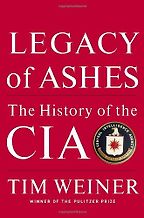
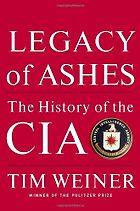
So on to Tim Weiner’s Legacy of Ashes, which is about the CIA. Let me read you a bit of the summary from the Publishers Weekly review: “Is the CIA a bulwark of freedom against dangerous foes or a malevolent conspiracy to spread imperialism?” This book concludes that “it’s a bit of both, but mainly a reservoir of incompetence and delusions”.
Yes. This book reads like the Keystone Kops. It’s amazing how often the CIA just blundered, going from one screw-up to the next, despite having some very intelligent people. But I once listened to Tim Weiner giving an interview and he said something very profound. He said every president since it was created under Truman has abused the CIA. Too often it’s used to prove a presumed fact, a fact that has been created for domestic political purposes, and completely queers the pitch from the outset. If you’re not encouraging conclusions that may differ from your own presumptions then you’re fated to commit the mistakes of so many American presidents and heads of state everywhere. Also, while the CIA got it wrong on the Bay of Pigs, they also got it right sometimes. A perfect example of that is the US plot under Eisenhower to overthrow Mohammad Mosaddegh, the Iranian prime minister. We’re still living with the legacy of that plot today. There was a station chief in Tehran who disputed John Foster Dulles’s notion that Mosaddegh was a Soviet stooge. He was not. He was neutral. There’s an example of the CIA calling it like it was. Ditto, Richard Nixon and Henry Kissinger’s war on Chilean president Allende. The CIA was saying, ‘No, this man is not a proxy of the Soviets. He’s popular, he’s legitimate, and we should not be seen as trying to undermine him.’
So is the book quite balanced?
I think it is. Tim Weiner covered the hell out of the CIA and the whole national security bureaucracy. It’s very well sourced. I have a friend who works for the CIA, and she said they were very good about providing him with as many documents as he requested, to the extent possible. They were just stunned at the scathing treatment he gave the CIA. But to his credit, he asked for the documents, he gave them a fair hearing, and then he rendered his verdict. I’m very sympathetic to his notion that the CIA is abused, just like the military is abused by civilians.
So on the weapons of mass destruction in Iraq: Did the CIA know there weren’t any?
From Weiner’s account, the CIA was not coming up with what Cheney wanted to hear. When the vice-president makes a special trip to Langley [CIA headquarters] to sit down with senior researchers and analysts and demands to know what they’ve got on WMD, that’s a perfect example of abusing the CIA. Even the most redoubtable agent can withstand only so much political pressure. So Cheney got what he wanted.
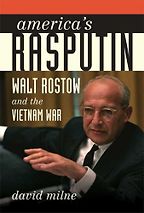
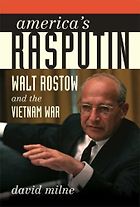
Let’s talk about your next choice, American Rasputin by David Milne.
This is a wonderful book. I came across it because I read a review and it became clear to me that Walter Rostow, the subject of the book, was a singular personality in the panoply of foreign policy militarisation. It’s a very good read. I believe it’s David Milne’s first book, and he just knocks it out of the park. He opens with this amazing anecdote about Robert McNamara. It was his last day in office as secretary of defence – he was going on to the World Bank, and he was already broken down emotionally because he realised that his legacy was going to be as dubious as it is. There was Walter Rostow, giving a briefing on how the US should intensify and accelerate the bombing runs in North Vietnam, and finally McNamara just stands up and says, “You’ve been telling us this for the last three years, and it hasn’t done a thing.” He uses all sorts of blue language and he finally collapses and begins to weep in the Oval Office, with the most powerful men in the world all assembled. It’s just a searing image, and he does a great job in crafting it and making it come to life.
But Rostow wasn’t a cynic, was he? He was an idealist who did a lot of damage, in the mould of Graham Greene’s The Quiet American.
Very much so. He ends up, indirectly, being responsible for the murders of hundreds of thousands of people. Milne does a great job of sketching out how an incredibly bright man can be such a dullard when it comes to the consequences of waging war without listening to people on the ground. For example, there’s one bit when he goes with General Westmoreland on a fact-finding tour to Vietnam. By the time they get to Honolulu, they had already decided to intensify the bombing. Before they got to Saigon, they had already rendered their verdict.
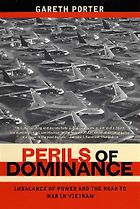
Your last book is The Perils of Dominance, a revisionist view of why the US went into Vietnam.
The author, Gareth Porter, makes some very interesting points, backed up by his source notes, that put things in a different perspective for me. For example, he points out how utterly weak the Soviet Union was, throughout much of the Cold War, relative to the US. And how defensive its posture was, relative to the US. How it lacked the technology and weaponry that could have allowed it to do the kinds of things that people like Curtis LeMay said the Soviets could do just by snapping their fingers. Again, he does a great job of showcasing the extent to which the Soviet threat was hyped. He also effectively debunks some of the other shibboleths of the Cold War, like the Sino-Soviet bloc. That’s a perfect example. At a time when Dulles is saying, “We’re locked in a mortal struggle with the Sino-Soviet bloc,” Porter shows that Mao and Stalin were hurling the most crude epithets at one another. If there was going to be a war at all, it wasn’t going to be between the US and the Sino-Soviet bloc, but between Russia and China.
You said at the beginning that you’re finding more resonance for your views. Are you optimistic about things becoming more balanced between civilian and military in future?
It’s hard to reverse a spending imbalance with a ratio of 12:1. For every $12 we spend on defence we spend $1 on diplomacy. There’s just no appetite in Congress to give the State Department the resources that they need, and, to be honest, the State Department is in need of an enormous amount of structural and institutional reform. I’ve had very thoughtful, worldly men in military uniform, say, “Look, we hear it loud and clear and we agree with you. We’re tired of having to shoulder the State Department’s burden, but they’re not up to it.” Which segues into another conversation, which is how do you fix the State Department in such a way that if you do give them more money, it won’t be wasted or allocated in an inefficient way.
What about the appetite in Congress for reducing spending on defence?
They’re cutting defence spending right now, but that’s because they don’t have the courage to go after our entitlement systems. Their hearts are not in it. They’re not doing it because they want to, they’re doing it because it’s the lesser of two evils. They’re talking about significant cuts, but they’re not talking about dismantling the American empire, because the vast majority of lawmakers would not acknowledge that we have an empire. There is something about these foreign deployments in Korea, Japan and Europe that is just so deeply entrenched. It’s not just American constituencies that have an interest in maintaining them, it’s also the host countries. They like having the US in their back pocket. They contribute to the economy, they’re the source of a huge black market. It would be politically difficult for them to kick the Americans out. They may take some serious whacks at the defence budget, but until they start talking seriously about dismantling these Cold War-era deployments, which are the foundation of the empire, I just don’t see any prospects for change.
If you were in power what would you do?
I would put our allies on notice that the days of unconditional US hegemony are numbered. We’re prepared to help you develop your own deterrent against whatever threats you face. I would tell NATO, you’re going to have to develop expeditionary capability without our help. We’ll help you, but in four years’ time we’re out the door. The other thing I would do is appoint our best Sinologists to figure out how we’re going to disentangle all of these claims and counterclaims to the strategic seaways of Asia, which have become such a touchstone for potential conflict between the US and China. Because I would hate to be the one to tell the mothers of America that their sons or daughters died defending Mischief Reef in the South China Sea from Chinese encroachment.
Given that America is so strong in soft power and winning hearts and minds – my Vietnamese history teacher at Harvard used to say that while America lost the war there, you could say it won the subsequent peace – that there would be more emphasis on non-military solutions to conflict.
You would think so. At a time when we’re facing a relentless challenger in the form of China, which, for now, is peaceful, you’d think we’d want to cultivate our diplomatic resources. You can’t win a war with China. It’s just madness to even consider it. But because the all-volunteer military in this country has been so successful, we’ve effectively segregated the military and the civilian realms. We don’t know what they do, we don’t know the sacrifices they’re making, but we appreciate that we don’t have to make similar sacrifices. So we give them all the money they need. They leave us alone, and we leave them alone. That’s a really pernicious legacy of this wildly successful professional military of ours.
Five Books aims to keep its book recommendations and interviews up to date. If you are the interviewee and would like to update your choice of books (or even just what you say about them) please email us at editor@fivebooks.com
Five Books interviews are expensive to produce. If you've enjoyed this interview, please support us by donating a small amount.