First of all, I know you had some trouble narrowing your book choices down to five – and you also said it was difficult to restrict yourself to English-language books. Can you tell us what made it so hard?
If you’d asked me about the French Revolution, another of my fields, I probably would have reacted in the same way. Choosing the “best” books on any subject always implies invidious omissions, because books are pertinent or engaging for different reasons at different moments, and I think it’s hard to say in universal, unqualified terms: “These are the five best books in my field.” It’s particularly difficult in the food field, because food is at the confluence of five, six, seven disciplines – and it’s almost impossible when you do food history not to be doing at the same time food anthropology, food economics, food sociology, et cetera. So there’s a sprawling literature, and different books are compelling for different reasons and on different occasions.
“I have not found any society where food in some form or other is not a mediating agency between the sacred and the profane.”
Personally, I felt extremely uneasy about making some kind of hierarchical order out of the literally hundreds and hundreds of books that I’ve read in the course of the last 40 years, in what was once an embryonic and completely inchoate field, and has now become rather a growth industry. It’s particularly complicated in the food field, because you get a really bizarre mixture of books. You get books that are serious, scholarly undertakings; you get the history of the chocolate éclair (or the crêpe Suzette or baked Alaska) by a well-meaning foodie who has no idea about how to do history; you have cookbooks; you have books about cookbooks; you have meta-analyses; you have ethnographic studies – you have an absolutely exuberant array of different approaches, and that makes it difficult to make some kind of hard-and-fast choice about what’s best. So, yes, I chafed under your constraints.
That’s understandable. Before we go on to talk about your first book, can you give us a brief history of the field of food history itself?
The field probably goes back about 40 years. That’s when people began seriously writing about food in academia. Certainly, people had been writing about food for a long time, but it was a field that was largely journalistic, and in journalism different criteria apply – there are different kinds of evidentiary rules, and different tests for truth claims, different kinds of logics come to bear. So there was an important and influential journalistic literature in the 19th century, but it wasn’t really until the 1970s that we began to see scholars moving into the field – and they moved into the field with some manifest inquietude, especially in history. It was more natural for people to do this in anthropology, because they were dealing with societies whose chief preoccupation, in many cases, was simply food (food was at once the ration of survival, the focus of sacrality and religion, the major object or item or instrument of exchange, and so on). Anthropologists in some sense didn’t face the kind of resistance that we faced in history.
I remember in history it was not seen as being serious, initially, to be writing about food. It was one thing to go and have dinner, and it was another to try to get tenure by writing about food. But gradually, as we began to make the case for this kind of work, and as we began to define the field in fairly broad terms, it became clear that it was a hybrid of economic, social, cultural, religious, and political history – that it spoke to the mainstream epistemological and methodological questions of doing history – and so, after the initial period of resistance and scepticism and even sometimes contempt on the part of certain people, by the mid-1980s it became clear to people that this was a real field.
It’s important to stress here that the history of food is not, and never has been, coterminous with the history of gastronomy. It’s a very easy error to make, and I think it’s a categorical and fundamental error. The history of food is not about spending $500 at a Ducasse restaurant, or going to the new three-star restaurant in Copenhagen with its imaginatively inventive terroir – that’s not what the history of food is about. Gastronomy is only a small part of the history of food. The wider field begins with the search for food and the growing of food, the cultivating of food. It begins with farming, with animal husbandry. It begins, indeed, with hunting and gathering. And it covers the production, transformation, and communication of food – how it’s distributed, how it traverses space through commerce, how it enters into the market nexus and then the various ways in which social stratification segments its utilisation.
It’s a story that’s rich, textured, and highly differentiated – one that has different trajectories in different societies, in different cultures, one that is characterised by different words in different languages, and one that raises questions of a tremendous diversity. I mean, food can be the body and the blood of Christ, food can be a way in which to create trust in a business meal, food can be part of an act of seduction, food can be an arm in warfare (cold or hot), food can be a form of social control, it can be a form of political legitimation. It just has so many different incarnations. It has always been, and still is, a great mistake to think about food history as being the Julia Child/James Beard/Joël Robuchon/Heston Blumenthal Fat Duck what-have-you story. It’s not that. It’s not just about fine dining.
Well, let’s get started by talking about your first book, Capitalism and Material Life by Fernand Braudel. I don’t think he would have seen his work in the context of the history of food necessarily – is that right?
No, he certainly did not see this as a history of food – and I don’t see this as being food history, in any narrow way. It is, however, one of the books that has most shaped my perspective on how to think about the history of food, and that’s why I chose it. In the 1950s and 60s, Braudel talked about “total history” – in ways that now seem both quaint and megalomaniacal. “Total history” meant trying to look across the long run (in French, the longue durée) at all the aspects of the human experience. Braudel began this study by talking about “capitalism and material life,” because for the 400-year eco-cycle that he was looking at, the driving force for much of material life was the development of capitalism, and material life was to a great extent about eating and clothing and shelter (in that order). He’s talking about the basics of what makes a society and an economy operate, he’s talking already in the 1960s, when he wrote this book, about what we today call globalisation, and he’s enormously interested in what I call the construction of the everyday order, or what we could call the banality of things – that is to say, the everyday life that people struggle to get by in.
What’s really interesting about all this is that Braudel is constantly talking about the way in which the fundamentals of material life really begin with food. For me, this is a very powerful story, because it’s a story about how societies are organised in ways that permit them to reproduce themselves; permit them to overcome horrors like the Black Death – in which a third of the European population is wiped out – and to overcome the famines that are structurally inscribed in the nature of things, and to develop systems of exchange through markets that acquire relative sophistication. These are the kinds of questions that historians (even historians of food) tend frequently not to think about, because they’re really the big, structural questions. But I like the respiration of the long run. I like looking at things across hundreds of years, because I think that often crucial factors don’t appear to us in the short term. Conversely, of course, the long-run view can also mask very interesting short-term questions. You need to have a kind of dialectic between the very long run – several centuries, or even more than that – and the very short run: a day, a year, a decade.
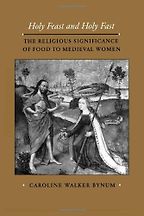
Your next book is a contrast to the Braudel, I think, in its scope – and probably also in terms of the way that it uses sources. This is Holy Feast and Holy Fast: The Religious Significance of Food to Medieval Women by Caroline Walker Bynum.
This is a wonderful book, and for very different reasons. Like the Braudel, it has a kind of long-run perspective – because the Middle Ages, from Bynum’s point of view, cover several centuries – but it’s much more focused thematically, and whereas Braudel is very little preoccupied with cultural issues and much more focused on material issues, Bynum is highly alert to the symbolic dimensions of the food question.
I situate food at the crossroads between the symbolic and the material. I always argue that good economic historians have to be good cultural historians, because to understand economics you have to constantly keep in mind the symbolic, psychological, and cultural aspects of things. In this book, Bynum asks several questions. She asks, first of all, why food was the dominant theme for much of the medieval world – and she points out that medieval Europe in particular suffered from structural penury, from chronic recurrent dearth and repeated famine. Clearly, the issue of food was really a matter of survival for a vast majority of the population. She also looks specifically at the way in which religion intersects with food, and her interest here focuses on Christianity, in which, as you know, Christ is in some sense metaphorically (and, for Catholics physically and actually) incarnated in food: It’s the bread and the wine which are the transsubstantiated body and the blood of Jesus. So she’s dealing here with this whole dimension of a specific kind of sacrality as mediated by food.
The third thing Bynum is concerned with is women – and she’s really one of the first, and most powerful, historians of women’s voice, women’s needs, women’s central place, and women’s specificity in the unfolding of history (particularly, again, in this European context). She uses the chronicles of holy lives, saintly texts, and a whole array of religious discourse to try to understand two things. One, how to read these kinds of texts when you’re a historian, and how to try to discern from these texts the relationship between norms that are projected by the church and the actual lived practices of the individuals. And two, how women leveraged food into an extraordinary form of power, in a world in which they were otherwise more or less powerless. The book is fascinating because of the intelligence and the perspicacity of Bynum, and the empathy she feels with the women she writes about.
These women we’re talking about are fasting women, they’re women who have certain of the characteristics that, many, many years later, we associate with anorexia – such a terrible problem in our own contemporary world. In this story, there are just endless numbers of women – many of them future saints – who identify what Bynum calls “inedia” (not eating) with a state of holiness in which one can survive simply through fusion with the body of Christ. It’s an eroticised attachment. It’s not overtly sexual, but it certainly touches on sexuality. It involves women who want to nourish Christ with their bodies, but who also want to nourish themselves on the lacerated, broken body of Christ on the cross – it’s what Bynum calls “imitatio Christi”, the imitation of Christ. It’s a very complex, beautifully argued, wonderfully written book that is obviously beyond my means to summarise in a few words – but I think I’ve given you a little bit of the flavour of it.
While we’re on the topic of religion, I can’t help wondering, do you think there is any one religion in which food plays a larger role than it does in all the others? Or, since food is so central and necessary to life, does it just show up everywhere?
I have not found any society where food in some form or other is not a mediating agency between the sacred and the profane. And that goes from the simplest societies, what we used to call primitive, tribal societies – societies that live in relative isolation and have only been in “contact” for relatively recent periods of time, where pigs or yams or other kinds of food can either play a role directly as embodying spirits and transcendental beings or indirectly as figuring symbolically the sacred or serving as a vector of communication with various divinities. I think this is virtually universal, and it begins with issues of fecundity and fertility. (How can you ensure that you have food? Well, you need to beckon the intervention of God.) It’s true in Greek and Roman and Egyptian mythology, and you can go through all of the great societal origin myths. You can go back to Homer, who talks about civilised people as being “eaters of bread”, while people who don’t eat bread are the “uncivilised”.
In today’s religions, obviously, we’ve seen a modernisation – I would say a kind of eclipse of the centrality of food. The host that’s used in Roman Catholic churches is almost unrecognisable as being a form of bread, even if that’s what it’s supposed to be. Since I write a great deal about bread myself, and am an ardent defender of artisanal bread production (particularly in France), I often joke by saying I wish that the Roman Catholic Church had followed the Greek Orthodox Church, which (and this was one of the reasons for the Great Schism) denied the continuities between the Jewish Passover and the Last Supper – and so even today, in communions, uses a fermented bread, the sort of wheat loaf that you can get in any really good bakery. The Roman Catholics, on the other hand, argued that the Last Supper was a Passover meal, and therefore that the bread was unfermented and thus akin to matzo. Because of this, the host as it’s offered today in Catholic churches is a bread that’s manufactured mechanically and industrially of wheat but without any fermentation – and it’s obviously much less attractive, much less interesting to incorporate into one’s body, than a real piece of bread.
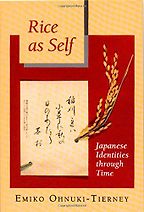
Let’s move on to Emiko Ohnuki-Tierney’s Rice as Self.
I chose this book not only for its intrinsic worth, but also for another reason – because I didn’t want to make my list perfectly ethnocentric by focusing only on the places that I have studied and that I know best, which are Western and European.
Nothing is more intimately linked to Japanese self-representation than rice, and this book represents a remarkable effort to make sense of the way in which Japanese notions of identity have been linked by their representation of rice across periods of time. Now it’s no secret that after the Second World War Americans tried to “democratise” Japan in part by using food – by getting the Japanese to eat Western foods. There was massive exporting of wheat products in an effort to promote the eating of bread, and massive exporting of chicken as well. This was all part of Public Law 480, a law passed by the American Congress in the mid- or late 1950s. It was instituted in part simply to create outlets for American surplus agricultural production – but it also had a kind of ideological edge to it.
In fact, this is in some ways linked to the next book on the list, Nelson Algren’s America Eats. Algren was part of a group of writers whose work was later called upon by the anthropologist Margaret Mead, who was drafted, as it were, by the American government to help run a committee on food habits, which counselled both the American military and the State Department on ways in which they could use food to further American national interests in the aftermath of the wars. General MacArthur tried to get the Japanese to eat “Western”, because the thought was that by getting them to eat Western foods, the US could wean the Japanese from imperial adoration, from ancestor worship, and from other practices that seemed to be inimical to the development of democracy.
Get the weekly Five Books newsletter
That’s an interesting story in itself, but what Ohnuki-Tierney does in Rice as Self is talk about an older and a more persistent Japan. She’s an anthropologist who’s tried to historicise in part her point of view, and she shows the way in which rice had acquired, early on in the long Japanese trajectory, a role that was not purely reducible to calories or to carbohydrates or that sort of thing, but one that had a sacral aspect to it. Rice participated in the construction of the community, in exchange relations that helped the family to be linked to a larger clan or to a lineage. It spoke to the way in which the Japanese saw themselves as being apart from other people. Even today, in certain regions – and, until quite recently, globally – the Japanese resisted importing rice from outside. There was tremendous pressure from Californian producers for many years. I believe they’ve had access to Japanese markets for a certain time now, but for a long time the Japanese felt that rice that was not grown in Japanese soil, nurtured by Japanese water and cultivated and harvested by Japanese hands, somehow didn’t carry that quality of “Japaneseness” that spoke to their collective sense of self.
Even though this book is, strictly speaking, “anthropology”, I view this field in very eclectic and (if you will) omnivorous terms. For me, this speaks as much to historical questions as Caroline Bynum’s book, or Fernand Braudel’s. It does it with a very different methodology, of course, and that was also something I wanted to do with my list – I wanted to embody the field with works that were of a very different character, to underline the inherently trans-disciplinary nature of a subject like the history and culture of food.
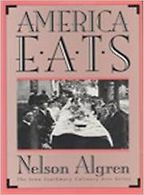
Your next choice is Nelson Algren’s America Eats. Why did you choose this one?
This book came about on account of the New Deal’s public works administration. Nelson Algren is best known for a very different sort of writing: The Man with the Golden Arm, and other novels of that kind. Algren was an interesting character. He was under FBI surveillance for a time, and he was involved in all sorts of interesting things. For instance, he was the lover of Simone de Beauvoir, whom he desperately wanted to marry, and he wrote a number of extremely interesting books. Never Come Morning, for example, is a Chicago book that is still very powerful – and of course The Man with the Golden Arm won the National Book Award.
In the early part of his life, Algren ran this operation that had been sponsored by the American government, the purpose of which was to try to find out about how Americans ate. This is fascinating, because we don’t have a good inventory of regional cuisine in America the way the French now do, for example – indeed, we have tended, until the recent upsurge of foodie-ism in the last 20 years, to be extremely cavalier about food. We’ve regarded it as being a form of fuel, and we haven’t seen it as being either fundamentally about pleasure or fundamentally about culture, as something that needs to be decrypted, decoded, made sense of, and so on. We’ve seen it basically as simply energy and calories.
Algren coordinated an effort in which a lot of very good writers (and some lesser talents) went around to various places – the Ozarks, New Mexico, parts of California, the Dakotas – and tried to understand what was specific about what we might call today the ecosystems, the terroirs, the locavore practices that were common in those particular areas in the 1930s and the early 1940s. From where did people get food, what did they eat every day, what were the festive foods, what were the foods that were part of segmented markets that were only accessible to people of certain means, as opposed to the foods that were accessible to ordinary people? Algren himself did one of these studies.
It’s a small book, maybe 70-80 pages (I haven’t seen it in quite a while) and he focused on Illinois in particular – it was really a remarkable piece of amateur anthropology and sociology. It was not governed by specific methodologies or a reflexive way of trying to attack the subject but, in Algren’s case, it was wonderfully evocative and powerfully written – really reportage or journalism of the highest order. There were many, many studies like this. A great deal of them have never been published, but they are presumably still in the national archives, and I think they ought to be published in their entirety. In fact, I think they ought to be redone today. We ought to assign a person to look at the same issues that Nelson Algren looked at, for example, and that many of the people of Margaret Mead’s generation looked at. It would be interesting to go back today and see the extent to which practices that were codified in the 1930s still survive, or have completely disappeared or are making a comeback as the result of culinary nostalgia or wistfulness – or as a result of a search by certain chefs for culinary roots, in the Alice Waters sense of doing a local archaeology of things.
What’s good about Nelson Algren is that he has class consciousness, so he’s aware of the fact that everyone is not equal before one’s plate – that there are people who are eating well and people who are eating not well, people who are eating steak and people who are eating macaroni. Algren understands food as being the sort of totalistic kind of factor that I see it as, and that’s one of the reasons why I put Algren on the list. I also put him on the list because he’s a novelist and famous for lots of things – and I probably also have him on here because I envy his having slept with Simone de Beauvoir. But that’s another issue.
You say it would be good to have another project like this going on now. I know there’s an enthusiastic, journalistic “road food” movement going on in the States at the moment. What’s the history of the amateur food travelogue? How long have these been around?
Oh, that goes back a long way – and we can assimilate it to a couple of different trends. On the one hand, we can find precursors in travel literature that goes back as far as the 16th century, when we see travellers all over the European world visiting both Europe and, a little bit later, savage America. These people report on what they see and write a good bit about food, because food is part of what they see most in looking at the cultures and societies that they’re visiting. So that all is one stream that feeds into this. Another is the cookbook stream. The writing of cookbooks was, I think, early on less a narrowly technical matter of the transmission of recipes than a more broadly cultural act of commenting upon the way in which people lived through the expression of different meal choices and selection of foods. I think that’s a trend that also goes back a long way in the European experience.
The more recent writings draw on those two strains, as well as on a journalistic strain or current that goes back into the 19th century, and that is a kind of hybrid between travelogue and amateur sociological anthologising. Some of it’s really quite nice, and I think for the historian what’s interesting is that, of course, it becomes a primary source. We don’t use it because it’s ‘“true”, we use it because it’s revealing of the way in which certain people are seeing their own world.
I think just as a matter of national heritage it would be a damn shame if we didn’t really chronicle all these traditions, in every country. I’m an American – I spend most of my time in France, but I’m an American – and I’m the son of immigrant parents. I have vivid memories of seeing my grandmother buying fresh carp, watching them swim around in the bathtub, and then beating them to death in order to make gefilte fish. I’d like to know about the history of grits. I’d like to know more about soul food. We’ve had some books written on soul food recently – each has certain strengths, but none is sufficiently probing. I’d like to see more done on the way in which black and white culinary practices in the South both nurtured each other and resisted each other. I’d like to know about Indian cuisine and its vestiges and its resurgence. I was always fascinated with the story of corn-eating Mexicans who were terrorised and brutalised and slaughtered by conquering Spaniards, who tried to force them to eat wheat – and the tension between white wheat bread and corn tortillas still is part of the story of the cultural landscape of Mexico, and was sort of the main theme for much of the 20th century experience of so-called modernisation.
If we don’t start creating a cultural inventory, all this is going to be outside the realm of what’s recoverable, which is why I like the idea of taking the Nelson Algren/Margaret Mead methods and using them as a kind of device to go back and take stock of things. We need to ask, how would Nelson Algren approach modern “foodways”? I think that approach would produce fascinating material.
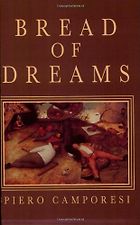
The fifth book you’ve chosen is Pietro Camporesi’s Bread of Dreams. Why have you chosen this one?
Well, so far I have a Frenchman, an American, a Japanese woman, a fiction writer – and now Pietro Camporesi, who is from Bologna, an Italian communist, a literary person who was not an historian but who was trained in literary criticism and the history of literature. Camporesi identified deeply with ordinary people, with people who were oppressed, with people who were subordinated and dominated and mutilated. The history he writes here is not wholly a convincing history. In short, it extrapolates from literary sources to lived life, which is really hard to do – you can’t take Moby Dick as a template for the way in which people lived at a certain time in 19th century America, for instance. But what’s marvellous about this book is its élan, its exultation and exaltation, its plea in favour of ordinary people, and its condemnation of the manipulation of ordinary people.
One of the major themes in the book is that ordinary people who have such a hard time surviving in the 16th, 17th and 18th centuries are in fact poisoned in some ways by a system that forces them, for their survival, to eat inedible foods – foods which often produce, as a kind of ancillary effect, hallucinatory outcomes, trance-like states of stupor and numbness. Camporesi uses this notion of the “bread of dreams” to show that the bread that peasants ate, in particular, was often composed of this mixture of the edible and the inedible that caused people to simply become a little bit crazy. It’s in the collective dementia of people that he sees a powerful metaphor for the tyranny under which they lived.
So the “bread of dreams” is not a bread of happy dreams, it’s more a bread of nightmares. It’s the bread of suffering, it’s the bread of betrayal. It’s not the bread of paternalism, it’s not the bread of nourishing princes, it’s not the bread of political legitimacy. The “bread of dreams” of Camporesi is a bread that’s meant to dull people into submission, to drug them into a kind of passivity. It’s not quite a plot or a conspiracy, but there’s that sort of inflection in Camporesi’s narrative. He has very powerful literary sources, which I think are not particularly useful for understanding the actual social history of Italians, in particular in the early modern period – but, nonetheless, it’s a book that, despite these methodological issues, is extremely evocative and offers us another way in which to try to understand food.
Anyone who picks this book up will have a hard time putting it down. It’s extremely compelling. It’s well written, the translation is reasonably fluid, and I think it just gives you a very different take on what food means. In a European context, bread is the body of Christ, bread is the promise of salvation. It is, or it’s supposed to be, the staff of life – but in this instance it’s in fact the vector of illness, death, misery, melancholy and madness.
Five Books aims to keep its book recommendations and interviews up to date. If you are the interviewee and would like to update your choice of books (or even just what you say about them) please email us at editor@fivebooks.com
Five Books interviews are expensive to produce. If you've enjoyed this interview, please support us by donating a small amount.