Nonfiction Books » Environmental Books
The best books on Man and Nature
recommended by TC Boyle
The novelist and nature lover T C Boyle tells us about delicious dodos, angry tigers, snakes on planes and why Viagra saves rhinos.


The novelist and nature lover T C Boyle tells us about delicious dodos, angry tigers, snakes on planes and why Viagra saves rhinos.
What is the background to your interest in nature?
I’m interested in man’s attempt to manage nature. I’m afraid that because we are part of nature ourselves, things don’t often come out the way we would expect. Why am I interested? Well, because I’m a nature boy myself. Where did you grow up? In the city?
I did, yes. In London.
Ah, a lovely city. Well, I grew up in the suburbs of New York City and in my time there, there was a lot of deep forest, particularly around the development in which I lived. Being a hyperactive child, I spent a lot of time outdoors. My mother dealt with hyperactivity not with psychiatrists and drugs but with our back door. I was out with the other kids playing ball all the time and wandering through the woods, and I’ve always had a love of the outdoors. I spend several months a year in the Squaw National Forest in the Southern Sierras in California, which is very wild, where we have things that were exterminated in your country a thousand years ago, or maybe never lived there. We have the mountain lion, bears, eagles and all sorts of things. I am just thrilled that there is a place where I can go and experience wild nature.
Tell me about your first book.
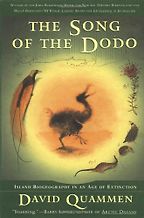
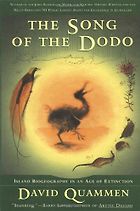
The Song of the Dodo by David Quammen. I read the book when it came out more than 10 years ago. It is superb. David is a very scholarly but brilliant journalist who can tell scientific stories with the kind of panache you’d expect from a novelist. The Song of the Dodo is now a classic. It’s about island biogeography, about Darwin and Alfred Russell Wallace and how their theories are demonstrated in closed ecosystems. That is, Darwin’s famous study of the finches of the Galapagos – how in a closed ecosystem, like an island, any animals arriving or introduced will have unforeseen consequences on that ecosystem. For instance, on the island I’ve written about in When The Killing’s Done, Santa Cruz island, we have a scrub blue jay there, related to our blue jay here [in the American mainland], only because of the principles of island geography it is one third larger and much bluer. It’s a different subspecies because it’s in a different environment, and it grew larger because it had less competitors. By the same token we have the island fox, which is the size of a house cat. It became a dwarf variety for the same reasons. It didn’t have enough resources to grow bigger.
Quammen’s book talks about this kind of thing on islands around the world. One of the stories he tells is of the Komodo dragon on Komodo island. This is a monitor lizard that has grown to gigantic proportions. It’s so wonderful how nature works outside of our agency. It’s theorised that it originally fed on the dwarf elephant. Of course, those things are long extinct, so what is it eating now? Deer. Deer introduced by humankind. It’s a very fascinating book and it tells you all about Darwin’s and Alfred Lord Russell’s theories about evolution, especially as applied to island biogeography.
Does he actually talk about the dodo?
Yes, he tells the entire story of the dodo quite beautifully.
Tell me something about the dodo. The only thing I know about it is that it’s extinct.
Well, you know all about it from your reading of Alice in Wonderland. The dodo was related to the pigeon. Flight is very expensive, to be able to fly costs a lot of calories. Birds fly to escape enemies. On the island of Mauritius the dodo did not have any enemies, so it grew much larger and lost the ability to fly. It was utterly defenceless when people first came to the island and it was quickly decimated. Can you imagine? Sailing ships came by looking for food, having eaten dried fish and salt pork for months, and here is this huge, fat, delicious pigeon standing there looking at them. There is also a term for island animals – naïve. That is, they are naïve of predation so they are rather tame. This is true of the foxes on Santa Cruz island to this day. No-one has hunted them, no-one has disturbed them, they have no natural enemies, nothing eats them so they are almost tame.
So, people ate all the dodos?
They ate the dodos, but people also introduced pigs and dogs, and the pigs and dogs took care of what people didn’t. The pigs in particular ate the eggs.
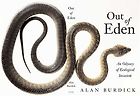
Tell me about Out of Eden.
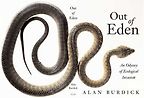
This is a delightful book by Alan Burdick. It has the subtitle “An Odyssey of Ecological Invasion”. Burdick is talking about invasive species throughout the world. My favourite is the story of the brown tree snake. The brown tree snake has invaded Guam. The theory is that it got there in the undercarriage of a light aircraft during World War II. These snakes came from Indonesia where they live in a balance with the rest of the creatures because they evolved there, and so have natural enemies and natural controls. In Guam there was no such thing and they are everywhere on this island. They are impossible to remove, they have decimated the bird population, they are eating other invasive species like cane toads and rats, and they’re eating each other. There is no end to them! The great fear is that they will get to other islands like Hawaii. Every plane leaving Guam is closely inspected because this snake has a propensity for crawling into tight little places and secreting itself. Twice they have been discovered in airplanes coming into Hawaii. They were exterminated because otherwise a disaster of unknown proportions could have occurred.
In the last chapter, Burdick talks about two species of bacteria that live nowhere on this planet except in the absolutely sterile jet propulsion labs in Pasadena, California. We have created these through natural selection. They used to be able to super-heat these things to get rid of bacteria but now, because of the delicate computers and so on, they have to use a strong bleach in order to kill bacteria. As we know from our hospitals, that never kills off everything, just the ones that are weakest. So, living in the labs now are these invasive species, known nowhere else in the world.
Does this matter? That we are introducing species to other environments, killing off some, strengthening others?
Well, when you consider that our only purpose in life is to procreate and die then nothing matters whatsoever. Everything is irrelevant. The conservatives took this line. I don’t know if you recall, but America was controlled by a group of evangelical thugs for eight years.They took the line, in opposition to any environmental reforms, that anything is natural – plastics, DDT, atomic bombs – because an animal created it. I think this is rather specious reasoning. If the earth goes on for another three-and-a-half billion years, I can’t quite figure out how old I’m going to be then, but the conditions that gave rise to our species are rapidly being eroded and there is going to be some kind of catastrophic collapse for our species. I don’t think it’s going to be in the too distant future. We see global warming and the catastrophes it’s causing, as well as the fight for resources that’s going on now throughout the world – tribalism and all this crazy shit that we’re descending into. It all looks pretty bleak.
But back to introducing species and letting some die off, presumably the evolutionary process is like that anyway without our intervention?
That’s correct, of course, and our intervention is natural. We are animals. But when the world was a smaller place and we didn’t have jet planes and this promiscuous interplay between people around the world, things would have evolved in isolation and creatures wouldn’t have seen one another. It probably doesn’t really matter that the polar bear will be extinct in 50 years. The polar bear was a breakaway from the grizzly bear, and now they are meeting once again because the polar ice cap is disappearing and the polar bears are forced to come on land to forage. Maybe they could even still mate, who knows? We’ll have hybrid species. Unfortunately, we are eliminating so many species unique to their ecosystem that we will have a much more degraded world in which rats and pigeons will be throughout the world, while songbirds will be gone. To somebody in 100 years’ time, maybe that won’t matter because they won’t know any different. For our grandchildren, tigers and lions will be like dinosaurs – gone. But if you value nature then you might try to do something about it. If you don’t, you’re right, it’s all part of the natural process and we can’t control it.
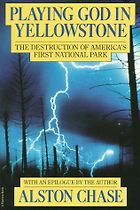
Playing God in Yellowstone.
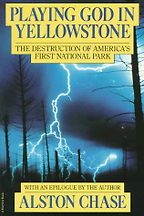
I used this book both for A Friend of the Earth and for my current book, When the Killing’s Done. This is a book about the biggest national park in the US. We Americans think the streets may be degraded but at least we have Yellowstone, at least there’s a wild place. Here is the most managed ecosystem in America, maybe in the world, and it’s been a dismal failure for a simple reason – we removed the predators because tourists like to see pretty animals like elk and deer and moose. Their numbers were fewer when predators were at large, so the predators were killed off. The results were catastrophic. It first appeared among the beavers. There were suddenly fewer beavers, so the streams were not dammed up. Why fewer beavers? Because there were no wolves, who normally eat the deer and elk, so the deer and elk ate all the river banks down to nothing, and the whole ecosystem began to collapse. Recently wolves have been reintroduced to great effect.
What conclusions does Alston Chase come to?
He comes to the conclusion that we destroyed an ecosystem that we were trying to manage and protect, with the best of intentions. He is an advocate for trying to manage ecosystems not by killing predators, but by introducing them.
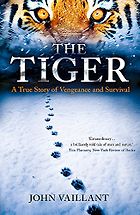
Your next book is The Tiger, by John Vaillant.
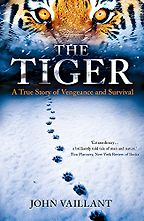
It’s about Siberian tigers, the largest predator on earth. They can weigh 600lbs. Their numbers are greatly reduced, they are living in a reserve near the Chinese border. This book talks about how the very impoverished people living in these woods are negatively impacting on these tigers, quite specifically by shooting them. They sell them to the Chinese across the border who pay a huge amount of money to use them in folk remedies. Apparently the invention of Viagra has helped preserve the rhinoceros. Viagra works and powdered rhinoceros horn does not, so there’s less need for it. Boiled tigers’ bones and whiskers and whatnot in the folk remedies really don’t do anything for anybody. We are eliminating this magnificent animal that will soon be extinct. For one impoverished hunter, one tiger could get him a Toyota pick-up truck. He shoots a tiger. But this tiger has been shot several times, so this time the tiger objects, and all that was left of the hunter was two chewed up boots with the stumps of two feet in them. Sometimes nature strikes back, and in this book you really do root for the animal.
Do you think they have an unfair advantage because they’re beautiful? I have a friend who absolutely hates pandas, because they’re cute and everybody puts money into preserving them. She is desperately trying to get money to preserve a special kind of frog that’s quite ugly, and nobody cares.
I’m a frog lover myself, but they’ll be extinct any day now so she can save her breath. I understand there are these apex species people donate for, whereas smaller things like the frog are ignored by the public. How can we prefer one to the other? My children had a pet rat that was very well-treated, and yet we were exterminating their cousins in the walls. And what about eating animals? There are terrible pig factories where pigs are kept in the dark attached to a machine, and can’t even turn around. They never see light. It’s like some horrible science-fiction movie.
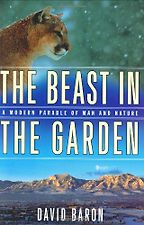
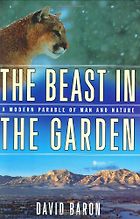
The Beast in the Garden.
This is a book about a series of mountain lion attacks in Boulder, Colorado. The way it fits in with what I’m talking about here and invasive species is that, of course, man is an invasive species. People have moved farther and farther out from the city centre to the hills and suburbs, which was traditionally territory for mountain lions. Meanwhile, these people love wildlife, so they began to put out food for various other animals including deer. The deer began to crowd their gardens, and this brought the mountain lions back to hunt the deer. However, there was other prey available – dogs. A young lion cub will eat what its mother catches to give it. In the wild they live almost exclusively on deer, but in the suburbs dogs were available and easy to catch, and I presume so absolutely delicious that some lions grew up eating nothing but dogs. There may be a small step from dog to human, so a mother in the woods there was pursued by two mountain lions. She fought them off by climbing a tree but, of course, they climbed up after her. She kicked them but they raked her legs with their claws. They waited at the bottom of the tree for four hours until a deer appeared and they vanished. A week later, a high school boy was running in the woods and was killed by one of these lions. His body was found and they thought a serial killer had killed him, because in his chest cavity an almost perfect circle was removed, as if a surgeon had done it. They were looking, horrified, at this corpse when they heard a growl from the nearby bushes. Grrrrr.
So, do you want to come here and walk in the woods with me?
Yes. Sounds exciting.
It is pretty exciting. Cynical and depressed about it as I may be, I still just love to be a creature alone in nature and feel this thing bigger than all of us. I am thrilled that there are these creatures here in the west of the America. I don’t want to be killed or attacked, but the only animals that have attacked me recently, both savagely and unprovoked, were tics.
I hate tics.
Be careful. What can I say?
June 10, 2011
Five Books aims to keep its book recommendations and interviews up to date. If you are the interviewee and would like to update your choice of books (or even just what you say about them) please email us at editor@fivebooks.com
Support Five Books
Five Books interviews are expensive to produce. If you've enjoyed this interview, please support us by donating a small amount.

TC Boyle
Tom Coraghessan Boyle is an American novelist and nature enthusiast. He is author of 12 novels and more than 100 short stories.
TC Boyle
Tom Coraghessan Boyle is an American novelist and nature enthusiast. He is author of 12 novels and more than 100 short stories.
© Five Books 2025