Professor Tim Birkhead is one of the pioneers of spermatology. He explains how promiscuous females can be selective about sperm, even after multiple inseminations
You have an interesting area of expertise. How did you end up in this field?
I’ve always been interested in reproduction and birds. And I’ve managed to combine my two passions into one career. I’ve researched bird reproduction for 30 years, with a particular emphasis on sperm. There’s a lot of interest in this area, partly because of a change in biological thinking in the 1960s.
Your first choice is a paper by Gustaf Retzius called Die Spermien der Vogel, published in his book Biologische Untersuchungen
.
Retzius is one of my heroes: a well-trained polymath from a dynasty of scientists. He had a fortunate break in his thirties – he married the daughter of a newspaper magnate. She was so rich that he never had to work again.
That was lucky.
He bought the best microscope on the market and published his results in the way he wanted to. He spent his career doing fundamental zoological anatomy using the microscope. This book is one of a series. He was a very skilled draftsman and did beautiful drawings.
What period was this and where did Retzius come from?
This was in the late 1800s. He was Swedish, and was nominated 12 times for a Nobel Prize. He never quite made it.
What is this particular paper about?
When he was about 60, Retzius became interested in the microscopy of sperm. He started buying specimens – including a chimpanzee pickled in brandy – and dissected them. He was amazed at the tremendous diversity of sperm in different animals. For those of us working in the field today, Retzius was the first spermatologist and the first person to make an encyclopedic directory of animal sperm. He didn’t do much interpretation. He just described in tremendous detail, and with great accuracy, what he saw.
As a layperson, I can’t imagine how sperm could be particularly diverse. Can you give me an example?
Many of us have a basic image of sperm in our heads: a tadpole with an elongated tail.
My image is of Woody Allen in a tadpole suit.
Some insects produce sperm that look like discs, with no tails at all. The bird sperm I study have augur-shaped heads and helix-shaped tails. Fruit flies, just two or three millimetres long, have sperm that stretch up to ten centimetres because they are in rolls like balls of thread. That’s phenomenal.
Let’s move on to the ecology book by Krebs and Davies.
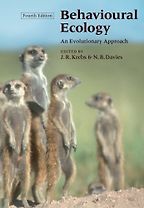
Behavioural Ecology is the first textbook in a field that emerged in the late 1960s and 1970s. It focuses on the fact that natural selection doesn’t operate in groups or species, but in individuals. This refinement of Darwin’s idea caused a revolution in biology. With its four subsequent editions, it had a massive effect on the way people viewed the natural world.
It’s a collection of essays from the key players in the field. One of them, Geoff Parker, was a pioneer in ‘sperm competition’. When females mate with more than one male, Geoff noticed that the sperm would compete to fertilise the eggs. He wrote a groundbreaking paper in 1970 and he provides a chapter on the subject in this book. For a few years people thought the concept only applied to insects – Geoff’s speciality. In the mid-1970s I realised it could relate to birds. In the following decade, there was an incredible realisation that female promiscuity was largely ubiquitous in the animal kingdom. Darwin had said exactly the opposite – that most females were strictly monogamous. Geoff’s chapter summarises what we knew until this point.
So you are saying that the competition for the female carries on after ejaculation.
Exactly. Darwin assumed that the competition stopped once a partner was acquired. Geoff’s idea was that sexual selection continues after insemination, with males competing for fertilisation and not simply for a partner. Females are particularly promiscuous in the breeding season.
That topic continues with Bob Smith’s Sperm Competition.
Parker was invited to a US symposium organised by Bob Smith. Bob brought together everyone in the field and got them to write essays on key topics. This is a set of reviews on promiscuity and sperm competition across the animal kingdom. It was the first broad overview and recognition that sperm competition and promiscuity were ubiquitous. Smith’s own chapter on human sperm competition was exciting, stimulating and controversial.
Why?
Until that point, we were rather reserved about these things. The implicit assumption was that female humans were monogamous, even though males were not. There’s a section on testes size in primates. It turns out that the relative size of testes in any animal group strongly correlates with the degree of promiscuity in that species. Therefore, gorillas have tiny testes for their body size, whereas chimpanzees have enormous ones. In gorilla societies, you have huge silverback males who can afford to produce relatively few sperm because they don’t need to compete. By contrast, male and female chimpanzees copulate with everyone in the troupe, every day. The males need huge quantities of sperm to do that.
How exhausting.
Exhausting, but exhilarating. What Bob Smith did was to fit humans into the data for primates. Humans are at the lower end of the scale. We’re not as exciting as chimpanzees but not as dull as gorillas.
William Eberhard looks at things from a different perspective in Female Control.
A criticism of early pioneers like Geoff Parker and me was that we were sexist because we only studied males. Male traits are much easier to study than female ones. It’s hardly surprising we researched the easy bits first.
Why are females more difficult to study?
If you look at pre-copulation displays, males are much more brazen. They show off their attributes. Females are more subtle in the way they make their choices. You can’t tell what’s going on in a peahen’s head when she’s surrounded by peacocks. But you can see the males strutting and fanning.
The expression ‘female promiscuity’ makes it sound like a choice. But the ornithologist Jonathan Elphick describes female ducks as being essentially gang-raped, and sometimes drowned, in the mating process. In most species, it’s a matter of choice. Female Control deals with situations in which it might not be.
In the mid-1980s, the biologist Randy Thornhill suggested that females might be able to discriminate between sperm from different males after insemination. He called it ‘cryptic female choice’, to distinguish it from pre-copulatory female choice. There was no real evidence at the time that females chose between males, let alone sperm. But the evidence for sperm competition soon became better established. Eberhard provides an encyclopedia of possibilities for female control. He argues that anatomy reveals different ways in which females might control what males do. For example, a female might simply stop a male inseminating her or reject sperm altogether.
How could you possibly reject sperm after the event?
We studied chickens and that’s exactly what happens. Females want to be inseminated by the dominant cockerel. If a subordinate one manages to inseminate a female then she immediately ejects the sperm in a kind of muscular twitch. Our chicken study was one of the first demonstrations of cryptic female choice.
What about us?
Human reproduction is much more difficult to study because you can’t do the kind of experiments that you do with chickens. So we have no real evidence. There are, however, hints. There is a huge level of spontaneous abortion in humans, almost undetected by women. One explanation is that eggs have been fertilised by the ‘wrong’ sperm. In other words, an embryo might not develop properly so the body developed a technique for aborting it and starting again.
Any possibility that is a conscious thing?
No. When behavioural ecologists describe what is going on they often use expressions that imply consciousness. But there is no question of that at all.
So it’s just a question of embryo viability.
Yes. We know that female birds can recognise certain types of sperm, probably by proteins on the sperm surface. There might be an immunological reaction that stops these sperm in their tracks. Some sperm may be more compatible with the female and encouraged through the reproductive tract. Bill’s book made people sit up and address this.
It doesn’t sound like a great system.
No biological system is perfect. I suspect there might be sperm and embryo selection going on in humans. It’s always hard to use humans as a yardstick for anything because we’re protected by medicine. Cultural factors also come into play. The reason I’ve worked on non-humans is that those effects do not confound you. But the situations where you are most likely to detect sperm selection are those alluded to earlier, where females are forcibly mated. That’s precisely the kind of situation where the female doesn’t have a free choice. She needs a mechanism for determining who fertilises her eggs.
You final choice is Leigh Simmons book on sperm competition in insects.
Since Geoff Parker’s work on dung flies, the study of sperm competition in insects has gone from strength to strength. Leigh Simmons was one of Geoff’s students and wrote this book in 2001. The title is the same as Geoff’s 1970 paper on the subject. Though still very active in the field, Geoff hasn’t written his own book. This is a tribute to him for getting things started.
What about what you don’t know? What are people working on? What are you working on?
The $64,000 question is why females are promiscuous. It’s easy to see why a male might be promiscuous from an evolutionary point of view: he might father more offspring. There is quite good evidence for this in birds. If a male stays with his partner and prevents her from mating with anyone else, he might produce, say, four offspring. If he was promiscuous, he might produce one or two extra offspring in other birds’ nests –but only if he’s not himself cuckolded. We use molecular techniques to look at parentage and the fertilisation success he has at home and elsewhere. In the species we looked at, males definitely increased their success by being promiscuous.
It’s very difficult to see what females get out of being promiscuous. They are not going to have more offspring by mating with more males. If there is a cryptic female choice going on, in which females choose between sperm, the assumption has been that if they choose the right sperm they’ll have better offspring. So far, there isn’t much evidence for that. We are still left with this mystery as to why females are promiscuous.
What do you think?
I think the majority of birds have some level of extra-pair paternity. Few are monogamous, though mute swans are. But look at sparrows, blue tits, robins and blackbirds: ten per cent of their chicks will be fathered by someone other than the male of the pair. A lot of those might be accidents. A female out foraging may bump into another male and think: ‘Let’s get it over with.’ But there are other birds, like the reed bunting, where extra-pair paternity levels are as high as 75 per cent. They can’t just be accidents. The most common view is that they are getting better-quality offspring.
How could you find that out?
You find nests and do molecular parent analysis on the chicks. You need chicks from the pair and extra-pair chicks raised together. If the female has made a strategic decision who to have the extra-pair chicks with, you would expect those chicks to do better.
In terms of being bigger?
And growing faster, and being better at fighting off parasites and diseases. Some studies show that; others do not. A similar idea is that by having offspring fathered by several different males you increase the genetic diversity.
Another explanation, for which there is very little support, is that a female must ensure it has some offspring in case its partner is infertile. In birds, there is almost no evidence of infertility in the wild. In humans, there’s a lot to suggest that females not getting pregnant in the pair will go off and have an extra-pair copulation. To ensure pregnancy, women will take the problem into their own hands.
February 2, 2011
Five Books aims to keep its book recommendations and interviews up to date. If you are the interviewee and would like to update your choice of books (or even just what you say about them) please email us at editor@fivebooks.com
Five Books interviews are expensive to produce. If you've enjoyed this interview, please support us by donating a small amount.
Tim Birkhead
Timothy Robert Birkhead is Professor of behaviour and evolution at the University of Sheffield, where he has been since 1976. His books include Bird Sense (2012), Ten Thousand Birds: Ornithology since Darwin (2014), and The Most Perfect Thing: the Inside (and Outside) of a Birds Egg (2016). His forthcoming book is The Wonderful Mr Willughby: the first True Ornithologist (2018), a biography of the pioneering seventeenth-century ornithologist.
Timothy Robert Birkhead is Professor of behaviour and evolution at the University of Sheffield, where he has been since 1976. His books include Bird Sense (2012), Ten Thousand Birds: Ornithology since Darwin (2014), and The Most Perfect Thing: the Inside (and Outside) of a Birds Egg (2016). His forthcoming book is The Wonderful Mr Willughby: the first True Ornithologist (2018), a biography of the pioneering seventeenth-century ornithologist.