Paleoanthropologist Tim White tells us about his work investigating the origins of homo sapiens and explains what a 4.4 million-year-old skeleton he found in Africa tells us about our common past.
Human Osteology by Tim D White, Michael T Black and Pieter A Folkens & Tim White
I started to work there in the 1970s and I have been working in different African countries ever since, from South Africa all the way up East Africa and then on into Jordan, largely in the Great Rift Valley that runs right through the eastern side of Africa. And for the last 30 years we have concentrated our efforts in Ethiopia, in a particular part known as the Afar Triangle. This is where the famous “Lucy” skeleton was found in the 1970s. Then in the 1990s our team was successful in finding a fossil skeleton over a million years older than Lucy that has taken us into uncharted territory in a temporal sense.
And this is the oldest skeleton ever found.
That is right; she is called “Ardi”. And finding that came in little bits at a time. We started with an Ethiopian student who was here at Berkeley named Yohannes Haile-Selassie (no relation to the emperor). He was a trained osteologist and he first recognised a piece of the palm. And as we started to collect other bones from the surface right in that area we began to appreciate that some of these bones were still embedded in the ancient sediment. And so over the next three years we excavated the skeleton piece by piece and put it back together again.
It was a very large study because we tried to understand that entire world that Ardipithecus inhabited, in addition to Ardipithecus herself, as represented by the skeleton. And since this period was completely unknown in Africa we were in uncharted territory.
It must have been very exciting trying to put together this 3-D picture.
Exactly – it was of an ecology that has now disappeared because this area is a very remote, lowland desert today.
Why do you think it is so important to find out about prehistoric men and women? How can it help us?
Well, simply to contextualise our place in nature. This is something that is of universal interest. Every culture studied by anthropologists has its own mythology of how people came about. These range from Australian aboriginal accounts to people in the Arctic, to people in the Middle East. The differences among these different myths are very great, of course, because they are all just myth. If we really want to find out where we came from, there is only one way that we can do that, and that is through the science of palaeontology. And so that is why we go out and try to get the evidence and pull that evidence together to understand what truly happened in our history and prehistory.
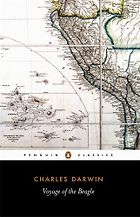
Let’s look at some of your book choices, which are linked to that. Your first book is Charles Darwin’s Voyage of the Beagle, which is the diary he kept of his extraordinary voyage.
In this book Darwin is writing as a much younger man than we meet later as a result of his great scientific achievements. But this was really the beginning of those achievements, as he was on this small wooden boat circumnavigating the planet and experiencing all the different cultures and all the different scientific data that were really new in those days. In South America he saw animals that science was only beginning to learn about.
This was on the Galapagos Islands.
Yes – there he recognised this great variety of clearly related forms, and, in the years that followed, he worked out how these species had arisen. His Voyage of the Beagle outlines that, and it is a great history book. It is also a great adventure book as well, as he witnesses volcanoes and earthquakes and different cultures and describes all of this in that mid-1800s terminology. Darwin is a great writer and an excellent observer so it is a good place to start understanding where we came from, and how we came to that understanding.
Is this what sparked off his interest in being a naturalist?
Yes, indeed. His father thought that it would be good for him to get into medicine and so forth. Actually, Darwin’s grandfather, Erasmus Darwin, was a prominent British physician. In fact, he was an evolutionist, so evolutionary thinking was already in the family. And it was also very widespread in Darwin’s day. The problem was explaining it, and that is the problem that Darwin solved. His solution to that problem really began during this voyage of the Beagle, when he was exposed to the tremendous variety in the tree of life. He was beginning to grapple with this question of how do we explain this tremendous diversity in life itself, and what is our part in all of that?
Your next choice is a natural progression. This is Charles Darwin’s more controversial book, On the Origin of Species.
This is a classic in science. It is the explanation for how we got here. In other words why evolution occurs. And it is an interesting title because it is On the Origin of Species. Many people mistakenly think it is “The Origin of the Species”. But, in fact, Darwin says virtually nothing about human evolution until the very end of this book. And even then he only says, “Much light will be thrown on the origin of man and his history.” That is it – then he drops the topic, saving it for a later book.
But, of course, the scientific public and the general public immediately got the implications in 1859. What he had done was to provide an explanation for how evolution occurred, and this was natural selection. This was Darwin’s great insight and what that did was to provide the explanation of how and why all of life was linked together. It wasn’t until 1871 that Darwin published his book on human evolution. But even in 1871 there still was virtually no fossil evidence for human evolution. That’s where we now differ so much from the state of affairs in the 1870s. Now we have a tremendous amount of paleontological data about how we evolved.
For you personally, how have these two books helped with your work?
They provide an historical context and, importantly, these books provide a foundation for thinking about the past. We see this because they integrate disciplines that in those days weren’t all even called the disciplines we call them today. We have the geological sciences. Darwin drew heavily upon the geologists of the day to understand time. We have the biological sciences. Darwin was himself a great naturalist who tried to understand how organisms work. And we have the social sciences and the anthropological science. Darwin saw all these cultures that (in those days in the early to mid-1800s) had not yet been as altered or changed as they are now. We have here the integration of the earth sciences, the biological sciences and the social sciences that is crucial to understanding where we come from.
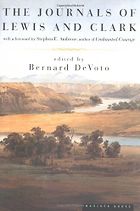
Next up are some journals from another even earlier expedition. These are The Journals of Lewis and Clark, which are all about a 19th century trek across the vast American West, where they were exploring and mapping the land, which had just been bought from the French.
It was a fantastic insight of Thomas Jefferson to create what he called the Corps of Discovery. These men went on this amazing voyage into the unknown, effectively from 1804 to 1806. Meriwether Lewis and William Clark, the two partners on this expedition, had basically no idea what they were going to find as they set off to the west of the Mississippi River. Everything in those days between the plains and the Pacific Coast was effectively unknown.
It turns out that Jefferson was actually a palaeontologist. He didn’t call himself that. He was Mr President and so forth, but he had a lot of interest in these gigantic elephant bones that were being found in places like Kentucky. Clearly there weren’t any living elephants left in Kentucky and Massachusetts, but they didn’t know whether or not they might find these creatures alive as they went into the Rocky Mountains.
So here we have this expedition that sets off into the complete unknown and we have this journal of the people that they meet. They encountered 72 American Indian tribes. They find and describe 200 plants and animals that are entirely new to science. They are setting off into a geography and a biology and an anthropology that was then just completely unknown. This is an analogy to what we are doing when we explore deep time, not in a geographic sense, where we are expanding our geographic knowledge. As we set off into the unknown past as palaeontologists, we want to find out what the world of the past was like. So, like Lewis and Clark, we are explorers with very little data. And like those past explorers, we have developed special tools to investigate the past.
What kind of tools do you have for that?
We have tools from the geological sciences that allow us to tell time. For example, where we work in Ethiopia is now a remote desert. When we look across the modern Awash River from sediment outcrops where we are finding these fossils, we see a great big volcanic mountain about 2,000 metres high. Three million years ago that volcano was not there. So you can’t go in thinking, “Well, Lucy must have seen that volcano.” We can find her bones and we can use volcanic horizons that accumulated through the eruption of other volcanoes to tell time, so we can calibrate what we find. Today we know that Lucy is 3.2 million years and Ardi is 4.4 million years old, so we are starting to build this sequence. What we wanted to do at the 4.4-million-year horizon was to get additional information on that lost world of the past.
Even getting the information about what Ardi was like was completely fascinating because it turned out to be so unexpected. People had expected that we would find more and more chimpanzee-like things as we went back. But what we found is a creature that is not particularly chimpanzee-like. It is not entirely human-like either. It is unique. We would never have been able to find it unless we took this expedition into the past. Even if you look at something like its hand, it is fascinatingly complex. The palm is quite short like ours, and yet the fingers are very very long – like those of chimpanzees. When we look at the foot, the toe can grasp like all other primates. And yet the outside was built as a lever so that Ardi could walk on two legs. When we look at her head we find a braincase that is about the size of a chimpanzee’s but the face isn’t nearly so projecting. Her canines are short and blunt, and even the males in her species had very short canines.
Support Five Books
Five Books interviews are expensive to produce. If you're enjoying this interview, please support us by donating a small amount.
Here is a creature that is new to science, which had never been seen before we found these bones. But what we wanted to do is say, “We have this creature which we can understand because we have the bones, but to really understand its biology, its ecology, its context, we wanted to take a broader look. Fortunately the horizon that we found her in takes us back to a very distant world of 4.4 million years ago, and we have animal remains, plant remains. We have the snails, we have the leaves, we have fossil wood, fossil pollen, we have fossil fish and fossil small mammals like mice and bats. We even have creatures that don’t exist any more. There is a gigantic bear that used to live in Africa. We have its remains, so we are able to accurately reconstruct the world of Ardi as it was then. We have built this knowledge and it becomes important because it shows us that she inhabited a place that was a woodland environment and that bipedality had already been established there. We used to think that this first came about as a result of opening up the savannas in Africa and that we are a savanna-adapted mammal – a kind of a chimp that became adapted to grasslands. And now the Ardi discoveries throw those ideas right out of the window.
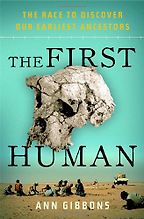
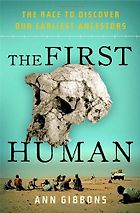
This leads on nicely to Ann Gibbons’s book, The First Human, which is all about the fieldwork that you and your team carried out in Africa.
Yes, there is an interesting story to that. Ann is the correspondent for Science magazine who covers this field, so she is extremely knowledgeable and very much up to date. She has been to all of these sites and she approached me many years ago, a few years before this book got published. She said, “I am going to do this book. I want to go to the field, I want to get the story of Ardipithecus,” and I said, “Well, we haven’t published the science, and the reason we haven’t published it is because we are not finished doing it – we are still engaged in fieldwork – so can you wait?” And she couldn’t because this was a topic that was hot.
And she probably had a publisher hounding her to get it out.
Exactly, and in those days this was the first time anyone had ever had a look beyond Lucy into this four-million-year stretch. We were exploring the unknown, so people were very anxious to get the information. And we were very anxious to get the information right and sometimes science goes more slowly than you would hope. It took a long time to put this skeleton back together again and preserve the bones and contextualise and understand this ancient discovery.
So what do you make of her book?
She forged ahead and she covered not only our work but the work of many other people. So this gives the reader the most up-to-date knowledge of how modern paleoanthropology is done. And it gives you a sense of the personalities involved and the breadth of science and so forth. The problem is that a few years after it was published we came out with the rest of our results, so it became somewhat out of date. But she does know that, and we are looking forward to a second edition.
But it was worth it at the time because there was such an appetite for it.
Absolutely, and there still is. It turns out that just about everyone is interested in this particular subject.
In Ann’s book you are described as meticulous and mercurial – is that fair?
My colleagues describe me as too meticulous and too mercurial! But I think passionate is a better word to describe me. I love this work.
It must be strange for you to read about yourself in a book.
I don’t like the genre of tell-all politics of paleoanthropology books, and there are a great number of those. I think Ann did a good job of steering clear of those as much as she could and instead she really got into the science. My Ethiopian colleague Dr Berhane Asfaw is currently working on a book that will tell the stories of our team’s discoveries from a more personal point of view as an Ethiopian scientist. We prefer to leave all the politics to the side and do the science, which is more interesting.
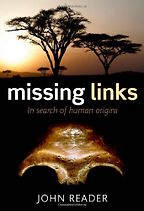
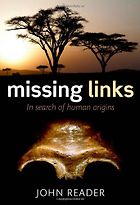
Your final book, Missing Links: In Search of Human Origins by John Reader, is another book about the search for the ancestors of our species.
This is a book that I assign to my upper division classes here at Berkeley. It is the best available book on the history of paleoanthropology. It looks at how these finds have been made ever since Darwin. I met John Reader many years ago at a place called Laetoli in Tanzania where Mary Leakey and I were excavating these footprints that were about 3.7 million years old. John was, and still is, a fantastic photographer and a great observer, and he has a sequence of different chapters in his book about the various fieldworks that have gone on. For many years I have been using the book and watching it go out of date because this is a very quickly moving field. So I was really happy when a new edition of Missing Links just came out. This is the second edition, which has a chapter on Ardipithecus at the end of the book that brings the reader right up to date. It is a very nice complement to the previous Gibbons book which shows more how the modern science is done. John presents the history of this field.
Get the weekly Five Books newsletter
In summary, by putting those five books together you have explorers from the early 1800s all the way up to the present. And you can understand the sweep of the science, the history of the science, and all of the different elements that now comprise the investigation of our origins.
October 17, 2011
Five Books aims to keep its book recommendations and interviews up to date. If you are the interviewee and would like to update your choice of books (or even just what you say about them) please email us at editor@fivebooks.com
Tim White is an American paleoanthropologist and Professor of Integrative Biology at the University of California, Berkeley. He is most famous for his work on early hominids in Africa, particularly the skeleton nicknamed “Ardi”, the oldest hominid skeleton ever found
Tim White is an American paleoanthropologist and Professor of Integrative Biology at the University of California, Berkeley. He is most famous for his work on early hominids in Africa, particularly the skeleton nicknamed “Ardi”, the oldest hominid skeleton ever found