What should journalism aspire to be?
I like HL Mencken’s dictum – it’s the duty of a newspaper to comfort the afflicted and afflict the comfortable. I suppose I’ve done more of the latter than the former in my career, but still. Another dictum I like is the one Kenneth Tynan pinned up above his writing desk: “Rouse tempers, goad and lacerate, raise whirlwinds.” I’ve tried to do that, too.
How has the media changed since its early beginnings?
It’s gradually become more respectable, which is a bad thing. Luckily, the Internet is making it less respectable again. To paraphrase Ben Hecht, journalists should occupy a rung on the status ladder somewhere between whores and bartenders.
What is journalism at its worst?
Panjandrums like Tom Baldwin – an apologist for Gordon Brown while on The Times and now Ed Miliband’s press secretary – who instead of speaking truth to power simply suck up to the powerful. I remember seeing a photograph on the Vanity Fair contributor page of a member of staff with his arm around Tom Cruise, grinning from ear to ear – the same journalist who had interviewed Cruise in that issue. I thought, “That interview won’t be worth reading.”
Talking of bad practice, you’ve been particularly excoriating towards disgraced reporter Johann Hari. I enjoyed your fisking of his too-little too-late apology. What precisely was it that Hari did which was inexcusable?
Hari’s crime wasn’t to lift quotes from other people’s interviews and insert them into his own without attribution. That’s borderline acceptable. Rather, his crime was to do that and deliberately give the impression that the people in question had said those things to him. In addition, creating a fake identity on Wikipedia and using it to trash people on his political enemies list was pretty low. If Hari had been a News of the World journalist, those things wouldn’t have mattered that much. But because he’s a holier-than-though, butter-wouldn’t-melt-in-my-mouth, world-class prig, they do.
Is British journalism particularly nasty? What is your take on the phone hacking scandal and red-top tabloids in general?
I’m a fan of red tops and regret the closure of The News of the World. In the furore following The Guardian’s story that the deletion of Milly Dowler’s phone messages had given false hope to her parents, all the important stories The News of the World had broken over the years got overlooked. Let’s not forget, it broke the cricket match-fixing story, the Jeffrey Archer story and many others. It didn’t just deal in celebrity tittle-tattle, it also exposed corruption and many powerful people will be sleeping more easily now that the Screws has closed.
How did you rate Christopher Hitchens?
I liked Hitchens personally, admired his courage and thought he was right about Islamofascism and the Iraq war, but found most of his journalistic output unreadable. He had this verbose, hyperarticulate, mannered style that I just couldn’t stomach. I didn’t usually get beyond the first paragraph. I prefer reading his brother, Peter.
Tell us why you chose Scoop as your first book.
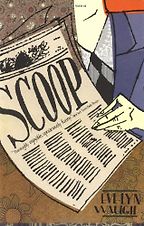
Others have tried to write comic novels about journalism – Towards the End of the Morning by Michael Frayn, for instance – but Scoop has yet to be bettered and I doubt it ever will be. I re-read it recently and was struck by how unchanged Fleet Street is, 80 years after it was written. One of my best friends is a foreign correspondent and he’s reported on several shooting wars from the saloon bar of the InterContinental Hotel. In my mind’s eye, I can picture Evelyn Waugh giving evidence to the Leveson Inquiry.
“To paraphrase Ben Hecht, journalists should occupy a rung on the status ladder somewhere between whores and bartenders.”
It’s clearly intended to be a vituperative satire, but it’s hard not to detect some affection for the loathesome hacks that appear in its pages, partly because they’re so accurately drawn. Could someone capable of describing them so perfectly not harbour any warm feelings towards them? Let’s not forget that Waugh himself was one of them for a considerable period of time, and never turned his back on the Streets of Shame.
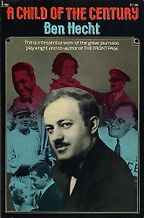
How did you discover Ben Hecht’s book Child of the Century?
I discovered Ben Hecht through His Girl Friday, one of the few great Hollywood films of the 1930s and 40s that he didn’t write. It was based on The Front Page, a play that Hecht co-authored with Charles MacArthur when they were both Chicago newspapermen. The Front Page is a vicious satire of drink-sodden hacks and the papers they worked for, but it’s also a tribute to them. Walter Burns, the central character, keeps company with crooks and ne’er-do-wells, and employs every black art in the book to get stories, but he also brings down a cabal of corrupt politicians. In that respect, he’s a model of what all good tabloid editors should aspire to be – and indeed many are.
Needless to say, Hecht and MacArthur’s colleagues, many of whom were the models for the characters in the play, absolutely loved it. Jed Harris, the play’s original producer, wrote an account of the reception the play got on its opening night:
“It was one of the marvels of The Front Page that although all the characters were actual people, nobody ever thought of suing us for invasion of privacy. Indeed, they all turned up for the opening night in Chicago and simply wallowed in delight. When the curtain fell at the end of the first act, the roar that rose from the audience sounded like the bellowing of a herd of wild animals panicked by a fire in a zoo. Above this din one great monster of a voice could be heard yelling: ‘MAKE IT MORE PERSONAL.’”
A Child of the Century is Hecht’s autobiography and it spans his career, not just as a journalist, playwright and screenwriter but as a literary novelist as well. In an essay written in the 1960s, the film critic Pauline Kael said that Hecht wrote almost half the entertaining movies ever produced in Hollywood and she’s not far off. His credits include Gunga Din, The Prisoner of Zenda, Stagecoach, Gone With the Wind, Spellbound, Strangers on a Train and Cleopatra. I love Ben Hecht and for many years aspired to have a career like his. One of the reasons I was so disappointed by New York journalism when I lived there in the mid-to-late nineties is because I didn’t meet anyone like him.
Moving onto Radical Chic and Tom Wolfe, who tried to invent a new form of journalism in the sixties and seventies.
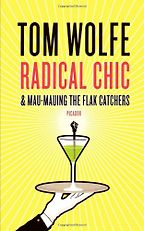
I’ve been a Tom Wolfe fan ever since my mother bought me The Electric Kool–Aid Acid Test when I was a teenager. I like nearly all of his work, particularly The Bonfire of the Vanities, but my all-time favourite is Radical Chic. It originally appeared as an essay in New York magazine, but was later published in book form alongside another essay, “Mau-Mauing the Flak Catchers”. It’s an account of a party given by Leonard and Felicia Bernstein for the Black Panthers in 1970 in their Park Avenue duplex, and while it’s ostensibly just a brilliant piece of satire there’s a conservative critique of New York’s liberal elite bubbling away beneath the surface.
Wolfe is one of the greatest journalists of the second half of the 20th century – possibly the greatest – and in Radical Chic we find him at the very top of his game. He notices absolutely everything and takes you right into the scene he’s describing. But he’s not just a reporter without parallel. He also has a novelist’s ability to enter into the heads of those present, recording their thoughts as if he can see into their minds. This style of writing – combining reportage and social realism with a novelist’s imagination – became known as “New Journalism”. Wolfe edited a very good anthology of that name that includes pieces by all of the genre’s most celebrated practitioners, including Gay Talese. But Wolfe was its leading light, and Radical Chic its most shining example.
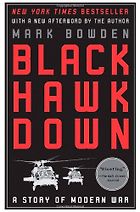
Next, tell us about Black Hawk Down.
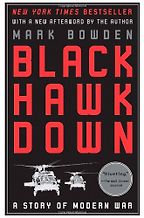
As a journalist who rarely leaves my desk, I don’t get an opportunity to do much reportage – but I get a vicarious thrill from reading it. Some of my favourite journalism books are examples of sustained reporting about a single subject – The Studio by John Gregory Dunne, for instance, and American Ground by William Langewiesche – but I don’t think I’ve enjoyed a book of reportage more than Black Hawk Down.
What’s so great about it is that it describes a humiliating military defeat [the 1993 battle of Mogadishu in Somalia], and yet the American soldiers featured in its pages emerge as stone-cold heroes. It’s a familiar story – the lion-hearted fighting men let down by faulty equipment and incompetent generals. The Ridley Scott movie really doesn’t do it justice.
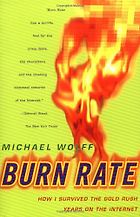
Your fifth and last book is Burn Rate.
Of all the journalists I met in New York when I was working at Vanity Fair, the one who came closest to living up to my ideal – fearless, funny, provocative, profound – was Michael Wolff. When I met him in 1998 he was writing a weekly media column for New York magazine and it was so good, such a must-read, that he was the toast of the city. I introduced myself via email after reading Burn Rate and he was kind enough to invite me to lunch. We didn’t hit it off right away, but a few years later, after I had been sacked by Vanity Fair and he was now writing a media column for the magazine, we became good friends.
Burn Rate is Wolff’s hilarious, self-deprecating account of his unhappy career as a dot com entrepreneur. For a while it looked as though he might hit the big time and cash out with billions of dollars – which was definitely his aim – but he missed it by a whisker and his business ended up going down the tubes. The book is terrifically informative – he has an extraordinary depth of knowledge about the space where technology, business and media intersect – but what makes it so compelling is the comic juxtaposition of his conviction that he’s always the smartest person in the room, no matter what, and his inability to hit the big time. The book might as well be subtitled “If I’m so smart, how come I’m not rich?” and while that sounds like it could be whiny and bitter, it’s actually very funny.
Wolff and I fell out after he insulted my wife at a dinner party in 2008 and we haven’t spoken since. He’s a prickly, irascible character with a Sicilian capacity for feuding, but if you’re on the right side of him he’s wonderfully entertaining company.
Finally, tell us a little about the West London Free School, which you co-founded.
I wrote an article for The Observer in August 2009 saying I wanted to set up a “comprehensive grammar” in west London, and it snowballed from there. Getting involved in a campaign and using my platform in the national media to promote a cause has been a new departure for me, but a good one. I have a serious side that, before I started campaigning for free schools, didn’t come out much in my journalism. I spent three years at various universities after leaving Oxford, pursuing a career as an academic, but I left all that by the wayside when my journalism career took off. It’s been good to pick it back up again.
One of the biggest differences it’s made to my professional life is that I find myself writing much longer pieces, often targeted at quite specialised audiences. For instance, I’ve just written a 3,000 word essay about Sweden’s public service reforms. That’s quite a departure from writing about gatecrashing the Vanity Fair Oscar party.
Get the weekly Five Books newsletter
Another departure that’s flowed from my involvement with free schools is that I’ve become more overtly political. I’ve always been a libertarian Tory, but before 2009 I didn’t write much about politics. Now I write – or, rather, blog – about little else, taking up the cudgels on behalf of the coalition, particularly Michael Gove. Does that make me a Tom Baldwin figure? I don’t think so, because my regard for Michael is based on a shared belief in classical liberal education rather than obeisance to power – but I suppose Baldwin might make the same defence.
I occupy a slightly odd position as a journalist in that I’m not simply a commentator, I’m also a minor protagonist in the political drama I’m writing about. There’s nothing new about being a campaigning journalist, but it’s unusual for someone waging a campaign to cross over into the political arena – and when they do, they often stop being a journalist. I haven’t stopped. I guess you’d describe me as a journalist and activist rather than a journalist and campaigner, which is a subtle difference. But I’m sure journalist/activists will become more common. It’s something that goes hand in hand with blogging. It’s a combination of roles that seems to be more and more popular with young journalists just entering the profession.
Five Books aims to keep its book recommendations and interviews up to date. If you are the interviewee and would like to update your choice of books (or even just what you say about them) please email us at editor@fivebooks.com
Five Books interviews are expensive to produce. If you've enjoyed this interview, please support us by donating a small amount.