Victor Shih's selection highlights rising inequality, economic irregularity and political heavy-handedness at the heart of modern China. As its economy blazes on, uncertain times may be looming
It’s good that you’re covering this topic. Wherever we are in the world, we all now need to understand the Chinese economy.
Yes, and especially some of its more sceptical aspects. Exports from China are still huge. It grew faster than almost any country in the world in 2009 and 2010. A recent calculation suggests its GDP has surpassed the United States on a purchasing power parity basis. But there are weaknesses in the Chinese economy that the educated reader needs to know about.
What do people get most wrong when they think of the Chinese economy?
The biggest misperception about China is that it’s a dynamic market economy – it isn’t. It’s a fast-growing, state-dominated economy with some dynamic, private-market aspects. If you look at investment, a main driver of growth, much of it is going to state-owned enterprises (SOEs) or shareholding companies dominated by state entities. Or it’s going directly to government investments carried out at a central or local level. The misperception has abated recently following Richard McGregor’s book on the Chinese Communist Party. People are realising that the party is still behind much of what happens in China.
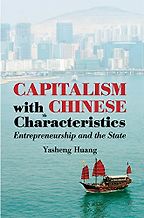
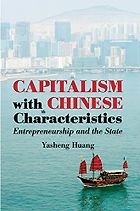
Your first choice is Yasheng Huang’s Capitalism with Chinese Characteristics. I believe this book successfully demolishes the idea that China is developing a new economic model called ‘market authoritarianism’.
I think Yasheng goes a little too far with some of his claims. But the broad outline is correct. There was a period of healthy organic growth in the 80s, driven by the de facto private sector. Many township and village enterprises were collectives or owned by the local government. But in reality they were private enterprises. This changed in the mid-90s, especially with the adoption of the ‘grasping the large and letting the small go’ policy that circumvented the special interests in the state sector. When Deng Xiaoping was alive, his executive vice premier, Zhu Rongji, wanted to bankrupt or merge many of the smaller state-owned enterprises into larger ones. It was a political tactic to further reform. And it worked.
The problem was that it created these giant, state-owned enterprises. Recent statistics reveal the state sector made a profit of 2 trillion renminbi last year, of which the 122 largest SOEs made 1.35 trillion. They have combined assets of over 10 trillion dollars and have become an enormously resourceful and powerful interest group. Their CEOs have numerous ties with top political leaders and sit on the party’s central committee. Most bank loans, issued bonds and stock-listing proceeds in the system go to these conglomerates. There’s still a private sector but it has been squeezed tremendously, especially in the last two years.
Yasheng does a great job of explaining the genealogy of this process. He shows us the evidence on a national basis and in terms of Shanghai. People think of Shanghai as this dynamic, market-oriented city that symbolises the future of China. But Yasheng points out – and I know this because I’ve done fieldwork in the city – that the largest enterprises in Shanghai are state-owned. From energy, steel and car manufacturing to taxi firms and newspaper stands, the state dominates.
Does this bode badly for the Chinese economy or can the state get away with it?
Yasheng says it’s a bad thing because the state doesn’t allocate capital efficiently. It’s not their money, after all. That’s what you see in China: a lot of wasted money. Travellers are impressed with the infrastructure – stadiums, airports, opera houses – but it’s not used very much. The Bird’s Nest – the Olympic stadium in Beijing – cost hundreds of millions of dollars but I don’t think anyone uses it. There are many other examples like that across China. But I do think Yasheng’s book is possibly a little harsh.
In what way?
The reason for such a concentration of financial resources is that the leadership became increasingly concerned about the possibility of a major economic shock. The policy stemmed from insecurity, especially after the death of Deng in 1997, which coincided with the Asian financial crisis. They wanted to ensure there was a large foreign-exchange reserve and plenty of centrally-controlled resources. They tried to suppress the amount of explicit government debt. Instead of using budgetary allocation to finance local infrastructure, the central government instructed local governments to form companies and borrow money from the banks, thus hiding the deficits. They got the results they wanted: relative financial stability and fast growth, fuelled by high investment rates and low government deficits. Since 1997, we’ve had a decade and a half of stability and growth. That’s quite something.
Still, I agree with Yasheng that this situation will become increasingly untenable in the future. There has been so much waste, a lot of it financed by debt in the financial system instead of government debt. This means that either these wasteful projects will have to generate cash flow to pay back the banks or the banks will become insolvent. The Chinese government is grappling with this major issue.
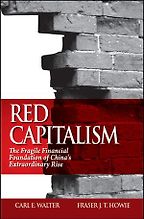
Since we’re discussing the problems facing China’s banks, shall we talk about Carl Walter and Fraser Howie’s Red Capitalism? You mentioned you think this is going to be a bestseller.
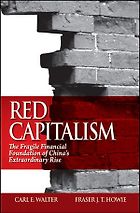
To the extent that a book on finance can be a bestseller, yes, I really hope so! People need to pay attention to it because it’s a very important book. Carl has been in Beijing since the financial sector opened to foreign activity in the early 90s. He’s seen the evolution of the entire process and has an insider’s view.
Most investment bankers like to talk things up, but that’s not something we can accuse Carl of doing.
By the late 90s, China’s banks were technically insolvent because the non-performing loans ratio was 40 to 50 per cent. Carl’s still a big fan of Zhu Rongji, the former prime minister. One of Zhu’s greatest achievements was to ‘solve’ the problems in the banking sector by setting up asset-management companies and recapitalising the banks. Today, of course, the banks are still lending very recklessly despite a lot of reform – the formation of credit and risk-management committees, for example. The banks continue to require bailouts and recapitalisation from the Chinese government, which props them up so that they can sell these bank shares to the public in Hong Kong or Shanghai. Carl sees this process as a kind of Ponzi scheme.
And you disagree?
Zhu was very inventive in trying to recapitalise the banks while still maintaining state ownership over them. That was the goal and continues to be the goal of policymakers in China: prop up the banks and make sure non-performing loans don’t appear on the books. We don’t actually know the amount of non-performing loans that exist on the ledgers of China’s banks. Whenever a loan becomes problematic, especially when the borrower is a major SOE, it’s restructured – i.e. rolled over or extended.
So despite all the high-profile stock market listings in Hong Kong, it’s the same old story – these banks are in very bad shape.
Yes. Carl and I were hopeful in 2005 and 2006, the period just after these banks were listed. We thought things might turn around. But 2009 was a watershed year: the central government essentially ordered the banks to lend to local governments to finance infrastructure projects and beat the world recession. The order from Zhongnanhai, the complex where China’s top leaders are based, was that cost was of no consequence and that we needed to maintain growth of at least eight per cent. The banks duly lent the highest amount in Chinese history. There was over 30 per cent growth in credit expansion in a year. All the cautionary procedures the banks put in place were useless. Now, of course, the government has to deal with these loans, many of which are becoming problematic.
Do you agree with Carl’s analysis that none of these big Chinese listings were privatisations in any sense –
they were just state monopolies or duopolies selling off a few shares?
It’s a way to rope in money from investors. Share issuance didn’t really change anything. The party is still in every large, state-owned corporation. And most shares are still owned by government entities. Most of the large SOEs just obey Zhongnanhai’s orders. They don’t really care about profits and they can get cheap, low-interest loans from the banks.
Still, one good outcome of listing the minority shares of SOEs and state-owned financial institutions is that there’s much more transparency now. Even if some balance sheets are manipulated, the fact that these quoted companies need to issue annual reports and quarterly summaries leads to a lot more information on how the companies are run. A careful observer can look at the figures and see when something untoward is happening. And that’s what people like me are doing now. You can view the publicly available information and spot some disturbing trends. You can then bring evidence to the table when you’re arguing against people who are very bullish about China.
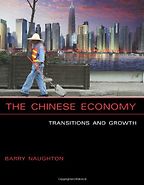
Let’s move on to Barry Naughton’s The Chinese Economy.
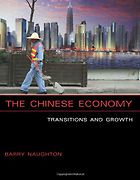
Barry’s book is a great overview of the Chinese economy and its evolution since the late 70s. Barry is a keen, seasoned and knowledgeable observer and covers a range of topics. These include the general economic growth, the agricultural and industrial economies and the reform of the SOEs.
So if you haven’t read anything about the Chinese economy until now, is this the place to start?
If you want a good primer, this is the book to read. Barry and I disagree on some issues. But in terms of the facts, the broad outline of what happened and how aspects of the economy evolved, I don’t think anyone else provides such comprehensive coverage.
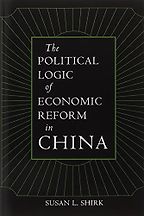
What about Susan Shirk’s The Political Logic of Economic Reform in China? This came out in 1993 but I gather it’s still relevant.
It remains a classic work on contemporary political economy. It’s amazing to me that, almost two decades after the book’s publication, you still have policymakers with naive notions that the Chinese leadership is unified and wants what’s best for China. That’s certainly not true in the United States so why should it be true in China?
Susan Shirk’s pioneering book focuses on the role of interest-group politics in economic decision-making. Even though Deng wanted to implement reforms, he couldn’t accomplish them by command due to powerful interest-group resistance. He had to circumvent these interests by forming alliances with the coastal provinces, where the relative size of the state sector was smaller. The book really brings to life the political dynamic at the very highest level that allowed Deng to carry out these reforms.
One thing lacking in Yasheng’s book is a political explanation as to why there was so much private entrepreneurialism in the 80s followed by a high concentration of state assets in the 90s and beyond. You can infer what happened by reading Shirk’s book. To pass reforms, Deng had to make deals. The largest central SOEs were told: ‘If you forego the planned economy and control over your smaller subsidiaries, we will give you financial resources so you still have a soft-budget constraint.’ These trade-offs in the late 80s and early 90s continue to cast a long shadow over China’s economic evolution today. It’s a very important book.
Lastly, you’ve chosen a report prepared for Credit Suisse.
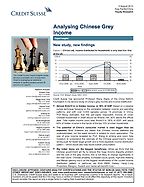
Analysing Chinese Grey Income was written by Wang Xiaolu, a senior scholar in the China Reform Foundation. The latter was originally set up by the government but probably now relies on private funding, like the money Credit Suisse would have paid for this report. This is Wang’s second income study and it finds something incredibly interesting. One of the puzzles in China is that consumption as a share of GDP is low and getting lower. But there’s a segment of consumption that’s doing incredibly well: luxury. When was the last time you went to Beijing or Shanghai?
2005.
If you go today, you’ll see many more Porsches, Mercedes and BMWs than you saw six years ago. Maseratis are the latest fad. The streets of Beijing increasingly look like Moscow. And if you speak to luxury brands like Louis Vuitton or Prada, they may tell you that China is their fastest-growing market in terms of revenue. Clearly, there’s a huge amount of spending at the top end.
But look at the official information and it’s not there. The top decile of household-income data appears to be growing at around the same pace as the lowest twenty per cent of households. There’s a creeping increase in inequality but it’s very slow and not much higher than, say, five years ago. So how do you explain the explosion of high-end cars and Louis Vuitton handbags? Wang concludes that the official data is completely wrong. Which, of course, everyone knew, even without the evidence.
How did he get this evidence?
He did something very novel and somewhat questionable from a statistical perspective. Usually you do random samples in surveys. But when you’re trying to work out how much money rich people have made, you’re going to miss most of them because they represent a small minority of the population. Even the ones you sample are probably going to refuse an interview or give you false information, to hide their income from the tax authorities.
So Wang hired a large number of researchers and asked them to go out and talk to as many of their own friends and family members as possible. Many of the researchers were students from Beijing or Qinghua universities and from reasonably wealthy families. They gathered information about income and consumption from some of the wealthiest households in China. Based on this information, Wang calculated that the official data missed 10 trillion renminbi of income in 2009. Moreover, that over 60 per cent of this ‘grey income’ went to the top ten per cent of households.
This makes a lot of sense. Clearly, the official figures are completely off. Inequality in China is rising rapidly and most of the gains are going to the top ten per cent of households. That’s something everyone knows in their gut. And it explains the explosion of private jets, property speculators and luxury yachts.
What does it all mean?
Politically, it’s not great. And not just in terms of the short-term legitimacy of the government, which is a big issue. There has also been a lot of politico-economic research done recently, notably by MIT economist Daron Acemoglu, showing that high levels of inequality are bad for the political development of a country. If there’s a small class of super-wealthy people, they are not going to want to democratise because it threatens their wealth – maybe they’ll be taxed more. So they’ll spend resources to protect the dictatorship. And even if there’s democratisation one day, inequality may lead to corruption and an undermining of the democratic process.
In addition, if a wealthy elite dominates public policy, it won’t care about the welfare of the bottom 90 per cent of the population. Obviously, some inequality is good for economic growth because you need to give benefits to smart and creative people. But there’s also evidence that, above a certain threshold, it actually becomes a bad thing for economic growth. That’s also something China will have to worry about in the future.
Five Books aims to keep its book recommendations and interviews up to date. If you are the interviewee and would like to update your choice of books (or even just what you say about them) please email us at editor@fivebooks.com
Five Books interviews are expensive to produce. If you've enjoyed this interview, please support us by donating a small amount.
Victor Shih
Victor Shih is a political economist at Northwestern University. He has written articles on Chinese political and economical life for The China Quarterly, Comparative Political Studies, The Asian Wall Street Journal and many other titles. He advises the private sector on the banking industry in China. His current research concerns elite political dynamics in China and Chinese fiscal policies.
Victor Shih is a political economist at Northwestern University. He has written articles on Chinese political and economical life for The China Quarterly, Comparative Political Studies, The Asian Wall Street Journal and many other titles. He advises the private sector on the banking industry in China. His current research concerns elite political dynamics in China and Chinese fiscal policies.