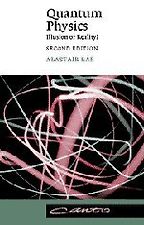
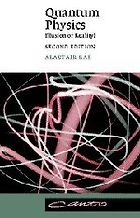
Your first book is Quantum Physics: Illusion or Reality? by Alastair Rae.
This is a completely popular book about quantum physics: there is not a single equation in there, I think. What he does is to go through all the major ways in which we try to understand quantum physics, all the major interpretations. It’s extremely good in that he writes in a very objective way and it’s very difficult to tell which one he supports. It’s very passionately argued as well, and it’s a beautiful exposition, very philosophical. I think it’s the best, probably my favourite, popular account of all the things we argue about on the fundamental side of quantum physics.
There are all kinds of strange views on what quantum physics actually is.
Right. There are connections with religion, then there are extremes saying it’s all in the mind: basically that nothing becomes real until we measure it and look at it and consciously record it. On the other side there is a point of view that it’s as real as anything else, out there independently of us and so on. He talks about these two extreme views and what quantum physics tells us about this very old question: whether the world is ideal or real.
Does he resolve it?
He really leaves it open because, to be completely honest about these issues, I don’t think we have something that’s universally accepted as the view: each has lots of positive points but also something that makes it a not completely plausible view to hold. That’s a really nice book.
Your second book?
The Ghost in the Atom. This was actually a sequence of radio interviews recorded by Paul Davies, who’s probably the best populariser of physics we have.
He’s the Search for Extra-Terrestrial Intelligence guy?
Right. He’s written a book about that as well. I think in the 70s/80s he conducted a set of radio interviews with about 10 of the leading physicists of the time. And the spirit is similar to the previous book in that it’s all to do with how we understand the unusual phenomena in quantum physics. The book is written as a dialogue – Davies asks a question and then the interviewee answers – and I would say this format is a much more exciting read than typical prose where someone exposes something. It also goes into personal issues, which you usually don’t get in these books, in that he asks each person about how they got engaged, when did they first learn about quantum mechanics, how did they learn it? It’s really fantastic, an amazing read.
To whom does he speak?
People like John Bell, who came up with Bell’s Inequality, which was one way of quantifying the weirdness in quantum mechanics; then David Bond who has one of those interpretations that tries to retain, I would say, some kind of reality in quantum mechanics, arguing that the world is still as real as it was in a Newtonian kind of framework. Davies chose a person to represent each of these points of view, and it’s really interesting how the interview is conducted and then where it leads – how different people end up in completely different parts of quantum physics, and what they find exciting, and so on.
Does it lead you to believe that maybe people go into quantum physics to prove an idea that they’ve already had?
That’s an interesting point. It’s difficult to tell what comes prior to what, right? In a way we do have these inner feelings, all of us, as to what we think the world should be like. And we usually carry this prejudice with us into our research as well, so it’s not clear whether you come with a prejudice and then you’re trying to use this theory to confirm what you already thought the world was like prior to that. In this kind of interview it’s easy to expose these kinds of things: you can see that people started with some ideas and then maybe changed them or didn’t change them as they did research.
All these unifying theories that quantum mechanics proves, seem to have already been posited in literature or religion or whatever.
Yes, I don’t think there is anything really distinctly novel that was brought there philosophically by quantum mechanics. The key tenet I would say is this randomness that is at the core of our interaction with the world: there is an element that you can never make more deterministic. And, of course, randomness as a way of looking at the world existed for a long time. If you go back to the ancient Greeks I think you will see a spectrum of all of these world views already present there.
Your next book?
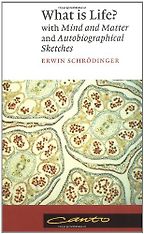
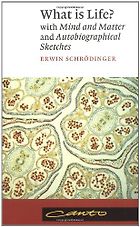
In physics we always study simple, inanimate objects, so physicists find it very difficult to understand, for example, weather patterns, or financial markets. Anything that’s more complicated, it seems that we don’t have the same grasp that we have with atoms or things like that, so I think that’s exactly where I would like to go to with the next three books. Firstly, What is Life? by Erwin Schroedinger. He was one of the founding fathers of quantum mechanics in the 1920s and then in the 1940s he began to think about biology. At that time the big problem was how biological information is encoded. This is just before Watson and Crick found the structure of DNA and explained the whole thing. About ten years before though, Shroedinger asked this question: can I take this very simplistic way we have of thinking in physics, namely that we like to reduce everything to a very simple mathematical formula (which seems to work actually pretty well) and take that over to biology and start to understand some more complicated processes within a cell, or maybe even light propagation, in terms of physics? The interesting thing there is that he concludes somewhere that classical Newtonian mechanics is probably not sufficient to understand biological things, and we might have to use the full quantum mechanics to understand that. And he comes so close to getting the right mechanism for propagating biological information that he almost managed to scoop Watson and Crick.
He got as far as the idea of a building block?
Yes. He just didn’t know enough biology to identify the DNA: he thought it was another form, another crystal-like form, but he was very close to it. Just by using basic physical principles he figured out what kind of medium you need to do this in a stable way. The book is written at a completely popular level, and apparently it was highly influential in the subsequent decades. Lots of people who read it and were studying physics immediately switched to biology. It acted as a big stimulus for people to go into more complicated subjects. The subsequent research was crucial – all the x-ray crystallography applied to DNA – he didn’t have that information at the time.
Next book?
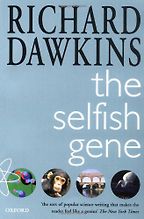
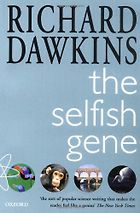
This is really extremely famous and I think rightly so – The Selfish Gene, Richard Dawkins: I love that book. When you look at theories in physics, they are really phrased very precisely with mathematical formulae, and if you are trying to make a prediction of a physical system you can do this extremely well with very high precision. So, for example, if you want to know where Mars will be in 10,000 years’ time, then our laws of physics are so accurate that actually you can really do that to an extremely good precision. However, when you look at more complicated things like biology and you want to say: well, can I look at a species and say what’s going to happen in terms of evolution in 10,000 years, then of course it’s very difficult, and I don’t think anyone has a clue how to make this more mathematical. But the first time I saw how far you can go, and I was really surprised, was with The Selfish Gene. Because the theory of evolution seems to a physicist much less rigorous than any theory that we have in physics – it just doesn’t have the power to predict things in the same way. You’ve got these two basic principles – the random mutation of the genetic material, and then the subsequent deliberate selection by the environment of whether the resulting individual survives or doesn’t survive these genetic modifications. Dawkins’s book was the first time that someone tried to make the theory very mathematical, and explain it fully, and tried to make predictions based on it.
He’s saying, how far can I go down in terms of simplicity, and try to explain everything in the biological world just in terms of very simple units – in this case, of course, this would be genes. Dawkins’s approach, just the way he writes, is extremely nice and I think he’s the best popular science writer. No one else really compares. It made me think that you could ultimately apply physics to biology and really reduce it even more, because you know once you reduce biological behaviour to genetics, then of course you now are working with genetics and molecules, and that’s the subject of chemistry, which itself is based on quantum physics. So, in a way, you’ve got this beautiful pyramid of explanations: starting from quantum physics, then explaining basic chemical laws based on quantum physics and then from chemistry you try to explain genetics and then more complicated living organisms. Somehow the whole fits this nice scientific logic.
Your last book?
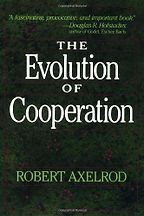
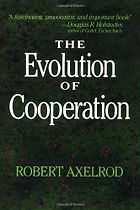
We can explain living systems scientifically very well, but what about human beings? What about the mind? I don’t think we have any ideas in science really how to attack this problem. Because, even defining what the mind or consciousness is, this is still completely open, and in science we have to have a good definition. So now we are not talking about biology any more; we are really talking about sociology. Can we explain interactions between human beings, between societies, with a similar logic to what we used to explain biology for example? The book that made a huge difference there and generated a whole field in sociology and economics is called The Evolution of Cooperation by Robert Axelrod. It’s also a popular book with no equations, but basically the point he is making is that you can use exactly the same mathematics we use in physics and in biology to start to attack more complicated things like this cooperation issue. If you link it back to The Selfish Gene, which claims that underlying human behaviour is this selfishness of genes in some sense, then, of course, any cooperative behaviour becomes a mystery. Why do we ever actually cooperate with each other? Why do we have this built in? And why do societies or tribes cooperate with other tribes and other societies? Axelrod really tries to explain this in this book, which generated this whole field of taking the game theory of mathematics and trying to apply it to the social context to understand conflict and cooperation and so on.
What does he discover?
I think that even if you have an underlying selfish tendency, then cooperation can evolve simply because you’re forced to interact with someone else over and over again. If you interact with someone just once, then there is no incentive to cooperate. But if you know that you’ll be interacting with a person over and over again, where you can check and verify what the other person is doing, and, crucially, if you don’t know how long this interaction will last, then somehow mathematics would suggest that it’s better for you to switch to cooperation rather than to continue to be selfish. He goes through lots of computer simulations and also experiments with people and some animal species to show that cooperation can evolve. So in a way it’s a very optimistic book in that sense: even though we know the first instinct is to protect your own interest, somehow it seems that evolution would really favour cooperation.
Doesn’t that depend on the context? At Goldman Sachs you can interact every day and still act selfishly.
Right. The point is that we’re really at the very beginning of trying to apply the same logic to complex systems, and maybe ultimately it’s impossible to fully grasp and explain and predict them. But somehow books like this made me feel a bit more encouraged that this might be possible.
This interview was first published in 2010.
Five Books aims to keep its book recommendations and interviews up to date. If you are the interviewee and would like to update your choice of books (or even just what you say about them) please email us at editor@fivebooks.com
Five Books interviews are expensive to produce. If you've enjoyed this interview, please support us by donating a small amount.