What is the difference between fairness and equality? In contemporary capitalist societies, some inequality is inevitable and desirable. But the rewards for the few at the top have soared while the rest have been squeezed. Is this fair? We need a new social contract, says the author and columnist
I’ll begin with what might be accused of being a rhetorical question. Are we living in fair and equal societies in Britain and in the West?
We’re living in unequal societies, but what makes the inequality noxious, and very inflammable socially, is that we’re also living in very unfair societies. That’s to say – and this is true of the less developed as well as the developed world – societies in which it is widely felt that many rewards and fortunes have not been accrued in a proportional relationship to effort, enterprise, hard work and the contribution to the societies of which these men and women are part.
“We’re living in unequal societies, but what makes the inequality noxious, and very inflammable socially, is that we’re also living in very unfair societies.”
People’s rewards have often come about because they have got lucky, rigged a market or manipulated things, like a mafia gangster or oligarch, sometimes illegitimately, to get themselves into the position in which they are in. It is this interrelationship between inequality and unfairness – which are two discrete analytic categories – that I think is the hallmark of our times. And it raises big questions about the legitimacy of contemporary capitalism.
What precisely is your critique of the capitalism we’re living in now?
The apologists for today’s capitalism have a series of theories which at a high level of abstraction are about markets always working optimally. What sits behind those theories is a belief system that the way markets work, and the way life works, revolves very much around the principles of Darwinian natural selection. That capitalism is about survival of the fittest, and hunter-gatherers pursuing their own interests individualistically.
My critique is that this doesn’t describe the world of hunter-gatherers, doesn’t describe how Darwin conceived of natural selection, and more importantly doesn’t describe how actually a contemporary capitalism works and how it has an ongoing legitimacy. My argument is that capitalism delivers its best when it respects some very deeply held human views about the way reward and punishment should be distributed. It should be proportional, and it should have a profound relationship to effort and contribution – what David Miller, one of the authors of the books I have chosen, calls due desert.
Tell me about his book.
David Miller is a moral philosopher. I read Principles of Social Justice when researching my newest book, ThemandUs. It was very influential in helping me to harden views about inequality and fairness that I’ve held for many years. There are traces of this thinking in [my books] TheStateWe’reIn and TheWritingontheWall but I hadn’t crystallised it until I read Miller.
Essentially what he argues is that if you are to operationalise social justice – so that people actually put their hands into their pockets, and financially or in another way help their fellow man or woman – then the only way to turn abstract notions into actually making that happen is if the value system that underpins it is felt to correspond to deeply held human instincts. Although Miller is sympathetic to John Rawls and his theory of justice – that the test of a just society is whether you would be indifferent to which family you are born into, because the opportunity to exploit all your talents would be equal wherever you were – he feels that doesn’t really cut it, because people do feel that there should be a proportional relationship between effort and reward, or due desert.
He also explores the role of luck in society. He acknowledges that some people are prettier, physically stronger or more intellectually adept at some things than others. The skills that one has are just there, and people are then better or worse able to exploit those skills. So there will always be an element of income inequality in any society. The question is whether it is felt to be deserved.
You’ve been looking at this kind of issue yourself in the High Pay Commission, at the behest of the British government.
Yes, I used precisely these ideas in that commission which I was asked to lead by the government. I was asked to investigate the question of high pay in the public sector, think through some principles for addressing it, and see if those principles could be used more broadly in the private sector. I used Miller’s ideas of desert – the Treasury officials I was working with must have thought, what is Will Hutton going on about? – and notions of good and bad luck.
People feel strongly about circumstantial luck that you have done nothing to earn. An unearned bonus is felt to be very illegitimate, and equally if you are very ill or hurt yourself badly that’s considered brute bad luck that we should do something about.
So I used these principles of fairness to address high pay. I said there is a strong sense among the British that high pay for some public servants – teachers, headmasters, police chief constables – is fair do’s if they’re doing a great job. Where things go pear-shaped is where the public feel that their tax pounds are being spent by someone who’s gamed the system and is being overpaid for the job that they do.
And how about the private sector? I gather CEOs in the FTSE 100 are paid 81 times the average worker salary.
More than that, actually. It’s over 140 times median pay. Pay in the private sector has just gone sky high.
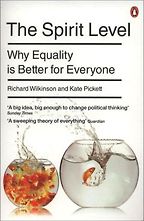
Let’s continue to explore these questions with The Spirit Level by Richard Wilkinson and Kate Pickett, subtitled “Why Greater Equality Makes Societies Stronger”.
What I liked especially about The Spirit Level is the way it builds a case that inequality is phenomenally dysfunctional. Different states in the US, with different levels of equality, have different levels of teenage pregnancy or homicide. It all comes back to inequality, and the book shows that high levels of inequality are completely dysfunctional.
I wanted to position this book in a family of five books because what was absent, I felt, from Wilkinson and Pickett’s work – which is hugely impressive in the data they’ve marshalled and the correlations they’ve assembled, despite criticisms from some quarters – is that it needed to nest itself in the work of David Miller and Amartya Sen. Inequality is driving these dysfunctional behaviours, but it raises the question of why, and what’s the remedy? There I felt that the book was less well thought through.
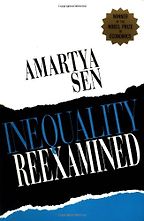
One of the reasons why I think inequality has these toxic outcomes that they describe is its interrelationship with felt fairness. I would have liked to see them push on, and cross-reference their numbers with societies which have displayed a better relationship between desert and outcome than others. I would also have liked to see the book open up to the debate that Amartya Sen, another author I’ve identified here, puts on the table.
Which is?
That you can’t just be flat-earth about this. You can’t just say if the Gini coefficient – a measure of inequality – is moving very rapidly and you want to get it back to a tolerable level, then all you need to do is tax the rich and give the proceeds to the poor. Simple acts of redistribution like that are a necessary but insufficient condition, because you’ve also got to equip the poor to get themselves out of their position.
So it’s not just about poverty relief, and that is where Sen is so efficient. He puts on the table a much more tolerable statement than simply, ‘Everyone should be equal.’ No one believes that, because I can’t be equal to a brilliant musician or mathematician, or someone who can run the 100 metres in close to nine seconds. Those apologists are out there, but once you think about the whole basket of things that everyone needs you quickly get yourself into a fix.
What works much better is to say that everybody has the right to live a life of value, and it is the job of all of us to create the institutions and processes that permit people to develop their capabilities wherever they are on the rungs of intellectual or physical capability. To have the opportunity, given what they’ve got, to develop themselves to be the best they can be.
Sen also puts a lot of emphasis on concepts of freedom.
But you can’t have freedom, Amartya says, if you can’t read and write. Of course this very much comes out of his experience of India, where elections are manipulated because so many of the peasants who vote can’t even read the ballot paper. What kind of a democracy is that? You have to be able to weigh what competing candidates are saying, and you must be able to bring your case to a court of law if there’s been an injustice. You must have these capabilities in order to operationalise freedom.
The freedom just of having liberty to do whatever you like is a utopian notion. There are always internal constraints on what you can do, as John Stuart Mill has argued. One has to have the capability to make the most of any opportunities that freedom might provide. Freedom alone is an empty promise.
So Inequality Reexamined continues the argument that we must systematically readdress societal inequalities?
Yes, that is very much the thesis of the book. And it leads onto the next one.
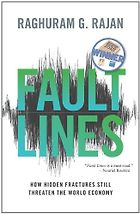
Fault Lines.
Raghuram Rajan is a mainstream orthodox economist and former chief economist at the IMF. He wrote this book in the aftermath of the financial crisis. It’s obvious that the corner that the American financial system got itself into was that easy credit – and the property bubble that resulted – was a way of deluding people in the States, particularly the squeezed middle, that they were more affluent than they were. It disguised the impact of the enormous inequalities that were emerging.
This extraordinary financial system that the connivances of successive American administrations and Congresses developed, which overtly compensated for the weakness of the American social safety net and the emergence of this inequality, made people happier to live with a raw social deal.
So inequality drove the crisis?
Inequality helped drive the crisis, that is his thesis. One of the reasons, he argues, why the middle got so squeezed in the States was that in a period of globalisation the US completely under-invested in developing the capabilities of what Americans call the middle class – what I guess we [British] would call the upper working class or lower middle class, the great mass of people whose income is around the median.
Skills development and education levels in the States have actually regressed, partly because American neoconservatives and Republicans have argued that it’s socialist to offer education – that it should be an individual responsibility and tax levels should be as low as possible. So America has regressed. Its regression led to people wanting to chase the American dream through borrowing, and that led to rising house prices. Then the whole thing shuddered to a halt in 2008.
So Rajan does see American inequality, and what caused it, as one of the generators of the financial crisis across the capitalist West. And I think that’s an important argument. It’s been picked up by the IMF and others, and has begun to make concerns about how contemporary capitalism is operating much more legitimate than they would otherwise have been. Fault Lines is a very important book.
Are we still rumbling along that financial San Andreas fault? We haven’t learnt anything from the crisis?
Oh yes. In Them and Us I set out my agenda for change. I think that if you’re going to have a competitive free market capitalism that has wild ups and downs in economic cycles – and once every 50 or 100 years ends in a calamity like the one we’re living through – then you have to aggressively use monetary and fiscal policy to sort things out. That means the state acting. We’re not there in any way in 2012. We have to think about how the capitalist enterprise is owned, and whether people are taking their stewardship and engagement obligations sufficiently seriously enough, or just taking their money and running.
We’ve also got to think seriously about how one supports innovation, because it is innovation that drives wealth. That means everything from schools and universities to networks in the business community. There has to be a 21st century social contract – around the principles of due desert but drawing on Sen’s point that we are investing in people’s capabilities – that permits people to manage the extremities of this new capitalism. And that debate is just beginning.
Support Five Books
Five Books interviews are expensive to produce. If you're enjoying this interview, please support us by donating a small amount.
There are people who have done very well out of the last 20 years who believe that it was because of their genius, and not just because that was the way the whole system was set up. They have no intention of putting any money in the pot because they feel that they deserve their money, and that those who aren’t as privileged as them in some sense deserve it. And that in turn leads to the last of the books.
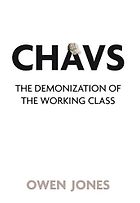
Chavs. We should explain this term, which is half-joking, half-insulting British slang for working class youths.
Yes, it’s a British acronym. No one quite knows what the acronym stands for. There are various hypotheses: Council House And Vile is one. They tend to wear baseball caps in reverse order so the cap faces over their neck, and ultra baggy trousers, and eat fast food excessively.
Do you agree with Owen Jones that we are demonising them?
Absolutely. I’m not claiming any great knowledge – Owen Jones wrote a whole book about it – but the demonisation of the working class was a centre point of my own chapter on British society. The sneering and contemptuous way in which chavs are referred to – going to “chav bops” or dressing as a chav to go to some charity ball – is slightly less acute now than it was five years ago, when prosperity was high and people thought they were all doing well. Now people feel newly precarious that they might actually find themselves with similar incomes to chavs.
But if you demonise them then you’re saying that it is their due desert to be in that place. That somehow they deserve their circumstance, and that we who are better off have no obligation to offer leadership for them to be better, or to design systems in which they can develop their capabilities. We’re saying, in a sense, that we are the deserving rich and they are the deserving poor. Owen Jones very successfully describes the ways in which that takes place, gets fiercely angry about it and says that working class people have been demonised right throughout British history.
David Lammy, in his Five Books interview, was telling me that you can’t really call them working class because so many of them don’t have work. Isn’t it the case that the cuts do hit the poorest hardest?
I know David quite well, and I know why he says that. But actually there are 30 million working class people of working age in Britain, and only a lamentable three or four million of them have no work because they’re unemployed, incapable of working or have somehow opted out of the labour market. There’s another great swathe – as many as 10 million – who make less than £15,000 [$23,000] a year. They are in work but it’s the kind of work that doesn’t attract benefits, holidays, employment rights and pensions, and is very precarious.
So our working class – which in the 19th century used to be alienated in mills and factories – in the 21st century is exploited in much subtler forms, by working in a nice place but without control over the shifts, or by being asked to work standing up in a fast food chain.
While top execs get fat pay cheques and summer bonuses.
Exactly. There are enormous salaries and remunerations at the top. People understand that those who run huge organisations deserve to be paid more than they are, because it’s a big responsible job and when you get it wrong many people’s livelihoods will go down with your own.
But the question they ask is that if in the 1980s someone at the top of a big British company was being paid 30 or 40 times the middle in that organisation, what has happened to make that 150 times today? What are CEOs doing that’s different? Are the decisions tougher and the responsibilities greater? Obviously they’re not. Nor is the country noticeably richer, or to the extent that the country is richer it’s not solely due to the efforts of the top 1%.
Get the weekly Five Books newsletter
And it’s not even the top 1%, incidentally. My only disagreement with the Occupy movement is that it’s not the top 1%, it’s the top 0.01% really who are making these extravagant gains.
You write in your book that British values are in flux. What is the moral core that is systematically missing in our Western capitalist societies?
Proportionality. Responsibility. A sense of obligation to others. An acknowledgement that relationships are reciprocal and trust has to be earned. If you want your workers, customers and those around you to trust you then it’s theirs to give and not yours to demand, and if you want it you have to earn it. You earn it through acknowledging those reciprocities and obligations, and recognising that no man is an island. You’re interviewing me in Hertford College [Oxford] where I’m Principal. John Donne was a student here and that’s his line: “No man is an island”. It’s an appropriate thing to say in this room.
“If you want your workers, customers and those around you to trust you then it’s theirs to give and not yours to demand.”
So those are the values. And given all that, reward has to be proportional to its due desert. I think the British know that, but also know that in 2012 all those values are more observed in the breach. Consequently they feel that their society is in flux and they lash out against authority, like the looters in the summer riots did. They lash out against foreigners. They’re eurosceptic. Scotland could leave the UK and England could leave the European Union. These are not easy times.
Five Books aims to keep its book recommendations and interviews up to date. If you are the interviewee and would like to update your choice of books (or even just what you say about them) please email us at editor@fivebooks.com
Will Hutton is a British political economist, academic administrator, and journalist. He is currently Principal of Hertford College, University of Oxford, and Chair of the Big Innovation Centre, He is the author of several books, including TheStateWe’reIn and most recently ThemandUs. In 2010 he was invited by the British government to lead a commission into high pay in the public sector.
Will Hutton is a British political economist, academic administrator, and journalist. He is currently Principal of Hertford College, University of Oxford, and Chair of the Big Innovation Centre, He is the author of several books, including TheStateWe’reIn and most recently ThemandUs. In 2010 he was invited by the British government to lead a commission into high pay in the public sector.