Great books can introduce kids to economics at a young age, says Rutgers University economics professor Yana van der Meulen Rodgers. Here she picks some lovely story books for 5-10 year olds and explains the key economic concepts they illustrate.
It’s great that you’ve chosen picture books because, judging from the recent crisis, I think we all need a bit of help with basic economic concepts.
That’s true and that’s part of the idea behind this project I’m involved with – to teach children while they’re young about economic concepts and to get them to be familiar at an early age with the economic world around them. Also, not to be scared of economics – many of us, as adults, don’t like that word. But, if kids grow up very familiar with some of these economics ideas in a comfortable context, what better thing is there?
What age range are these books for?
Kindergarten to fourth grade, ages approximately five to ten. After that, kids start to read textbooks and chapter books; they don’t need pictures so much any more.
You have a PhD in economics from Harvard – you could have done anything. What inspired you to set up EconKids?
I’m an international economist and I do research about women in the labour market. But, having three young children myself, I’m always reading to children. About ten years ago, I came across a bibliography at the public library of children’s books with economics content. And I thought, what a cool concept! So I ended up taking out all these books and getting to know the woman who put the list together, who was a reading specialist. We ended up doing some research articles together about teaching economics to children.
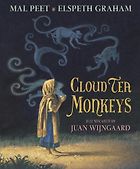
So the first book you’ve chosen is Cloud Tea Monkeys, by Mal Peet and Elspeth Graham. Tell me why it’s on your list.
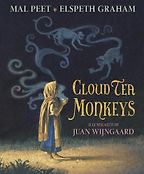
My own specialty is women globally and I do a lot of work on women in poor countries. This book focuses on a woman who is very poor. She is in a South Asian country and she picks tea leaves for a living. Her daughter is either too young to go to school or they cannot afford to send her to school, so the daughter often comes along to the plantation. But one day the mother gets very sick and she can no longer pick tea. The daughter is worried that there is no money to pay for the doctor, she really despairs, and ultimately ends up dragging this enormous tea basket to the plantation to try and do the work herself. The overseer is really an angry, mean boss, and he just laughs at her.
“You can get a picture book by a high-profile person, teaching traditional financial topics for a young child to understand”
And then the fantasy kicks in. The young girl goes and cries in the woods next to the tea plantation and some monkeys end up filling the tea basket, with the best tea in the world, Cloud Tea. The emperor of this country loves the tea and after that, every year, the mother and her daughter get a bag of coins from the emperor for this magical tea. It’s a lovely story. It shows some of the very real poverty that we see in developing countries, but there’s a touch of magic in it, that it’s all going to be OK. So this book really touched my heart. I’ve read it to a number of classes and by the end the children are clapping – they love the story.
The tea plantation is in a beautiful place in the mountains – the illustrations are really nice.
They are beautiful illustrations. That’s the nice thing with these picture books. I’m often looking at the text, the economics in the narrative, but the pictures really help to make or break a book.
If I were reading this book to my kids, what would I be teaching them about, income inequality?
Yes. There are several lessons, and income inequality is definitely one of them. But also, here in the US, often kids don’t like school. A lesson is to teach our kids how fortunate they are to be in school, because in some countries children are so poor they cannot go to school – the family cannot afford the fees, or the children actually have to work to support the family.
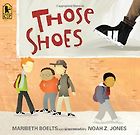
Your next book is Those Shoes, about a little boy who can’t afford the trendy shoes all his classmates have.
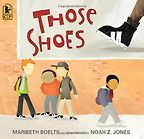
In this book the main concept is want versus need, and in the American school system, in many state standards, that’s one of the first economic concepts that young children, five-year-olds, are mandated to have to learn. Teachers have to teach some simple economic concepts, beginning with wants and needs. So this book is just right on.
“I think it’s crucial for our children be aware of how fortunate they are, and to start thinking about how they can give back.”
The boy really wants these shoes that everyone else has, but he is very poor. He’s being raised by his grandmother and she knows he needs new boots, he does not need these fancy sneakers. But he wants them so badly! And they visit different shops and finally he sees those shoes at a thrift store, but they’re too small. He doesn’t care, he still asks his grandmother to buy them, which she does. But they hurt his feet whenever he wears them and they cause blisters, so ultimately he stops wearing them. By the end of the story he is giving the shoes away to another boy in the class who is also from a poor background. It’s a hard decision for him to give the shoes away, but he does. It’s such a nice story.
Very understandable why the boy wants what everyone else in the class has, and also so easy, as a parent, if you’re not poor, to always say yes.
It is. It’s hard to teach budget constraints when perhaps our families are not as constrained as some others. It’s very easy to give in when our children say, ‘But everyone else has one.’ We don’t want our children to stick out like a sore thumb; we want to help them fit in.
And yet there’s definitely an anti-materialistic streak in your book choices… Do you think that income inequality is something we really need to set out and teach at an early age, that otherwise it might pass children by?
Yes, and that’s why a lot of these books in my top five have this international and poverty focus: that’s my own leaning. I think it’s crucial for our children be aware of how fortunate they are, and to start thinking about how they can give back. It’s important for them to see the world with more open eyes and be less materialistic – rather than getting caught up in ‘I’ve got to have this’, ‘I really want that’.
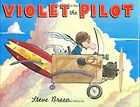
Next is Violet The Pilot. How excellent to include this because, as parents, we are constantly faced with the problem of gender stereotyping. So Violet is a mechanical genius who could repair almost any appliance by age two.
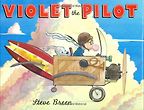
Exactly. The economics here is a little more sophisticated. The general themes are women in science, which economists write about as well, and women breaking into non-traditional occupations. But there’s another concept that is embedded in some of these content standards and that’s innovation and invention: how innovation helps to improve our standard of living.
Violet the Pilot is also just a very nice book, isn’t it?
Yes, the illustrations are just incredible – the detail and the warmth and the humour embedded in them. So this book is about a young girl who is an inventor and an innovator, who designs these contraptions, and that’s the economics part of the book, even though it’s not really that clear in the story. Violet invents different airplanes and helicopters, and she is on her way to an air show where she wants to show off her inventions when she notices that there is a boy-scout troop stranded in the river. So she misses the air show, and instead she rescues this troop. She comes home all disheartened because she missed her air show, but at the end of the book she is celebrated because she is a hero who rescued these people who needed help.
Why do little girls get obsessed with being princesses rather than pilots? I don’t think I’ve encouraged my daughters in that direction, and yet…
It’s hard to escape the power of the media. You may not have Barbie dolls and princess stuff in your house, but whenever the children exit your door they are going to see that at their friends’ houses, they see commercials, it’s just everywhere. And I think sometimes it’s even harder when it’s the other way around. We were at a house this weekend where there was a little two-year-old boy who likes the princess stuff. He wanted to dress up in a princess gown and a tiara, and he was so happy. And the parents let him, thankfully, but I could tell they were a little embarrassed. We all laughed, but the gender roles… why is to so uncomfortable for these parents to see their little boy enjoying wearing a tiara and a princess dress?
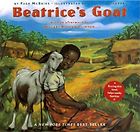
Your next book is Beatrice’s Goat, which is based on a true story, I think.
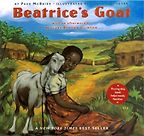
Yes, it’s actually based on a non-profit organisation called Heifer International. People donate money and the Heifer project donates livestock animals to people in poor countries, who then use the animals to become self-sufficient. For example, goats and cows – they can sell the milk, or they can sell the wool or make the wool into arts and crafts, or they can use the cattle to plough their fields. The organisation even has a catalogue – you can use it to choose a goat, and have the goat go to a country, and you learn about the family who gets the goat.
Sign up here for our newsletter featuring the best children’s
and young adult books, as recommended by authors, teachers, librarians and,
of course, kids.
So, in the case of this book, it’s about a girl named Beatrice who lives in an African country – I think it might be Kenya or Uganda. She has some younger siblings and they’re very poor, and she doesn’t go to school. She has to work to help take care of her siblings and she does some farm work also. But her dream is to go to school. So then they get this donation of a goat, and Beatrice is able to sell the goat’s milk and she gives the money to her mother and it turns out her mother has been saving for Beatrice to go to school as well. So the goat’s milk allows them to buy Beatrice’s uniform and her books. Then, at the end of the story, she’s able to go to school and she is just so happy. The words, the sheer happiness that this girl can finally go to school, it really brings tears to one’s eyes. It’s such a good book.
In terms of the economic concepts, I interviewed Robert Shiller the other day and he was talking about saving and how absolutely crucial it is. If you save, you’ll get rich.
Exactly, and also in this case the richness is coming from investing in oneself. When you get an education you’re investing in your human capital, to use the economics jargon, so Beatrice and her mother are investing in Beatrice as human capital when they send her to school, which is a very good use of one’s savings. Another good thing about this book is that I believe some of the proceeds for every book sold go back to the Heifer Project.
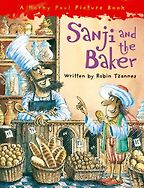
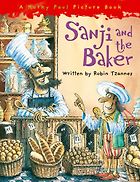
Your last book is Sanji and the Baker.
This is illustrated by Korky Paul, who is quite well-known. I love Korky Paul, he’s my absolute favourite illustrator and I stumbled upon this book early on, before I even started the EconKids project. I was reading the book to my kids and I was struck by the illustrations but then as I read it I thought, ‘Wow this is all economics!’ It’s about a little boy in a fictional Middle Eastern country who lives above a bakery. He cannot afford to buy anything from the bakery, but he loves to smell the smells and he even designs a contraption to help him smell everything better. The baker is this grouchy old man who gets really annoyed and demands the boy meet him in court – he wants the judge to order the boy to pay for the smells. So the judge orders the boy to bring five coins the following day. The next day the baker and the boy come back to the judge, and the judge clinks each coin loudly into a metal bowl. He asks the baker, ‘Did you hear that?’ and the baker says ‘Yes!’ And the judge says, ‘Did you like the sound of that money?’ And the baker says, ‘Yes!’ And then the judge says, ‘Well, consider yourself compensated!’ And he gives the coins back to Sanji.
That story is about what in economics we call an externality: when something that somebody produces has either a benefit or a cost for other people that is not included in the price. So in this case it’s the smell of the baked goods – other people can enjoy the smell, but they don’t have to pay for it. That’s a positive externality. A negative externality is pollution: when firms produce goods but they pollute the environment and nobody pays for it. It’s a very sophisticated concept, and yet here it is, in this picture book for young children.
Do you go around schools telling people about these books? How do people use the EconKids resource?
Mostly by coming to the website, and there’s also the papers that I co-authored with Shelby Hawthorne, who started the list. But I also volunteer: in schools, in classes where my children are. There’s also an international organisation called Junior Achievement – they do a lot of work teaching economic and financial literacy, and I’ve done some volunteering work with them as well.
By the way, there is a children’s book that was a book of the month about a year ago, that I do also want to mention. It is more classic economics and it’s called Isabel’s Carwash. The author is Sheila Bair, who has been chairman of the United States FDIC for the last couple of years. So she’s one of the most important financial regulators in the world and she has written a couple of children’s books about saving, investing, and interest rates. Isabel’s Carwash is about a girl who wants to raise money, but she needs a loan, so she borrows from her friend. She promises them the loan back, plus some interest and she starts her own business which is a carwash. There’s risk involved – so it’s all the classic things – risk, interest, lending, investing. It’s a good book.
It’s a picture book?
Yes, and I use that as an example that you can get a picture book by a high-profile person, teaching traditional financial topics for a young child to understand.
Five Books aims to keep its book recommendations and interviews up to date. If you are the interviewee and would like to update your choice of books (or even just what you say about them) please email us at editor@fivebooks.com
Five Books interviews are expensive to produce. If you've enjoyed this interview, please support us by donating a small amount.
Yana van der Meulen Rodgers
Yana van der Meulen Rodgers is a Professor of Women's and Gender Studies at Rutgers University. She holds a PhD from Harvard in economics and has co-authored two research papers on the teaching of economics to young children.
Yana van der Meulen Rodgers is a Professor of Women's and Gender Studies at Rutgers University. She holds a PhD from Harvard in economics and has co-authored two research papers on the teaching of economics to young children.