Rachel Ruysch, "one of the greatest still-life painters in the history of art", was more famous during her lifetime than Rembrandt or Vermeer. Born in 1664, she lived to 86. Her father was a renowned embalmer and she too had the knack of turning "a perishable commodity into a stable one" — in her case, flowers and fruit, immortalised at the zenith of their beauty in her abundant compositions in oils (2,500 words)
When learning Japanese, divide and conquer. Either learn to write the kanji first, or learn how to speak, but don't do both at the same time. This separation can later result in "character amnesia", though. "There is even a term for it, wahpro baka (ワープロ馬鹿), meaning 'word-processor idiot,' from the idea that spending too much time typing into Microsoft Word atrophies handwriting skills" (1,900 words)
Want more? The full Browser recommends five outstanding articles, a video and a podcast daily, for less than $1 a week.
Robert Foyle Hunwick | China Books Review | 7th August 2025
Review of a book about sex work in China. The author provides an introduction to "the Chinese underworld of surly madams, hard-bitten hookers, predatory policemen and truculent johns" who orbit this illicit trade. Socialism is "not compatible with commodification of the body" and sex work has always been banned in the People's Republic. Other than to serve high-ranking party officials, of course (2,000 words)
The highest point in the Pacific island nation of Tuvalu stands at 4.5 metres. By the year 2100, predictions show that 90 per cent of it will be underwater. The heat might make it uninhabitable before then. Although it is one of the least-visited countries in the world, tourists are already arriving to see the place before it disappears. The 11,000 residents of Tuvalu have to decide if, and when, to leave (5,900 words)
Want more? The full Browser recommends five outstanding articles, a video and a podcast daily, for less than $1 a week.
The rationalist community was drawn together by Eliezer Yudkowsky’s The Sequences, a set of essays about thinking more rationally. Ironically, the same community has played host to groups with very strange beliefs, including claims of interacting with demons. The Zizians, a loose group of vegan anarchist transhumanists, have been linked to six violent deaths. Why? Analysed here by an insider (5,400 words)
Harvey Lederman | Shtetl-Optimised | 4th August 2025
On the dread of a life without work, as more of it is automated. “If mechanised minds consume all the empty space on the intellectual map, lives dedicated to discovery won’t be lives that humans can lead. The post-instrumental world could be a much better place. But its coming means the death of my culture. We may be the last to enjoy this spell, before all exploration is done by fully automated sleds” (5,100 words)
Want more? The full Browser recommends five outstanding articles, a video and a podcast daily, for less than $1 a week.
Do you love the Browser? We're looking for new testimonials for our website — if you'd like to participate, please share with us here. If chosen you’ll get some exclusive Browser merchandise as a thank you (and your name in lights on the Browser homepage!)
The full Browser recommends five articles, a video and a podcast. Today, enjoy our audio and video picks.
Podcast: Whispering Pines | Charlie's Place. Beginning of a five-part series about Charlie Fitzgerald, a Black businessman who operated a popular integrated nightclub in the Jim Crow South during the 1940s (32m 43s)
Rehearsal footage and reflections from prima ballerina Gillian Murphy as she prepares for her retirement performance in Swan Lake after a career spanning 29 years.
Not-at-all boring essay about the nature and utility of boredom, which is "the substrate without which peace is impossible". Eliminate it at your peril. "We think we’re escaping boredom by filling every silence, every pause, every flicker of inconvenience. But it’s the other way around. What we’re escaping is everything else — depth, clarity, attention, the work of tolerating discomfort" (8,500 words)
Lengthy and heavily footnoted review of the evidence for the miraculous life and career of Joan of Arc. She was an "artillerist, fraudbuster, confirmed saint, and Extremely Documented Person". There is no other saint with such a paper trail. This makes Joan fascinating: even this agnostic writer has to admit that "she’s such unusually good evidence for miracles". Could we see her like again? (24,000 words)
Want more? The full Browser recommends five outstanding articles, a video and a podcast daily, for less than $1 a week.
Thoughts arising from a visit to the Totteridge Yew, London's oldest tree. It can be found in a churchyard in Barnet, at the northern end of the Northern Line. It is somewhere between 1,000 and 2,000 years old. "It is a ridiculous sort of tree, its character faintly lunatic, all those branches pointing out in different directions under a shaggy coat, a kind of manginess to its self-presentation" (2,600 words)
Talia Lavin | The Sword And The Sandwich | 1st August 2025
Post-burglary debrief. During a break-in that did not disturb any of the four people or the dog asleep in the writer's apartment, the malefactor unmounted and made off with ten huge swords that had been fixed to the wall. None were especially valuable and much pricier electronics were left undisturbed. The police "manfully refrained from laughing" because "I am the victim of an extremely silly crime" (1,800 words)
Want more? The full Browser recommends five outstanding articles, a video and a podcast daily, for less than $1 a week.
Musings on laughter, oft-equated with happiness when it should be seen as a form of release found in any visceral experience — sex, grief, horror. The Auschwitz prisoners who found humour there proved that it can be found in any place. When her hair was shaved, one prisoner laughed and explained that it was her first time getting a free hairdo. To laugh amidst suffering is a great spiritual accomplishment (1,800 words)
Adam Ozimek | Economic Innovation Group | 1st August 2025
The protectionist case for the US auto industry to be insulated from foreign competition rests on a few myths, debunked here. The auto industry has not been decimated by globalisation, it is alive and well. 10.3 million vehicles are made annually, with the value of cars at all-time highs. Detroit’s decline was caused not by trade but by local unions’ militancy and factories moving to other parts of the US (6,600 words)
Want more? The full Browser recommends five outstanding articles, a video and a podcast daily, for less than $1 a week.
Despite its apparent strangeness to speakers of Indo-European languages, there are many similar words in Finnish. Hamppu, haukka, kakku, leipä and valas resemble hemp, hawk, cake, loaf and whale respectively. The English same and the Finnish sama are essentially the same. That most Finnish of words, sauna, may have derived from a Proto-Germanic word that has given English stack (2,200 words)
It has been 100 years since the Paris Expo which gave Art Deco its name. The French, keen to reassert their role as arbiters of taste, wanted to disallow Le Corbusier’s pavilion for being too “austere” and “stark”. Le Corbusier, for his part, was dismissive of Art Deco: “decorative art is the final twitch of the old manual mode. Our pavilion will contain only standard things created by industry and mass-produced” (1,400 words)
Want more? The full Browser recommends five outstanding articles, a video and a podcast daily, for less than $1 a week.
Five Books features in-depth author interviews recommending five books on a theme. You can read more interviews on the site, or sign up for the newsletter.
From the death of Stalin and the career of Putin's chef to shaministic rituals on the Indonesian island of Siberut, Five Books editor Sophie Roell gives an overview of some of the excellent new nonfiction books that have appeared since April. Read more
If you have recently discovered the work of Kristin Hannah following her recent hit The Women, a story of female fighters in the Vietnam War, then you may be excited to learn that she has an extensive back-catalogue of more than twenty books to catch up on. Here they are, in order. Read more
Want more to read? The full Browser sends five outstanding articles, a video and a podcast daily, to keep you fascinated for longer.
The Appalachian Trail runs 2,000 miles from Georgia to Maine. Hiking the length of it — a five or six month adventure — changes the mind and the body. Not always for the better. “Naturally, most hiking injuries center around the feet. Blisters bubble up. Toenails blacken and fall off. Joints swell. During the course of my hike, my feet grew a half shoe size. The easiest way to spot a thru-hiker is to catch them barefoot. Without boots, the super-hiker is reduced to a limping old crone” (3,040 words)
A conversation with Osama bin Laden’s mother, Alia Ghanem, who lives in Jeddah with her second husband and two sons; they remain one of Saudi Arabia’s richest families thanks to Saudi Binladin, their “dynastic construction empire”. Ghanem says Osama was “brainwashed” at university by radicals who wanted his money, and that at least some of his wives and children have been allowed back from Abbottabad: “I speak to his harem most weeks. They live nearby” (3,300 words)
Question Of The Week
August rolls around, and it's time to round up our reading for the July edition of the Browser Book Club. What did you read last month, and what did you make of it?
We shared Jack Maden’s Should Parenting Require a License?, in which he considers philosopher Hugh LaFollette’s idea that we should introduce a license for raising (not creating) children, “to screen out people who’d make very bad, abusive parents”. Were Browser readers persuaded?
(i) Yes, I would support some form of parental licensing 53% (ii) No, I object to any form of parental licensing 47 %
For a while it seemed we might be reporting the first draw in QOTW history, but the ayes just about won out with the final votes. The nays, however, are more numerous in the mailbag — and they are fervent nays. A rich crop of arguments this week, considering prejudicial enforcement, failures of existing licenses, failures of existing care systems — and the possible need to license philosophers, too.
Astonishing vocal acrobatics. Watch in awe. Intimately shot, too; there’s a lot to be enjoyed in the performers’ delight, and the twitches of Bartoli’s hand as she guides herself through the treacherous passages.
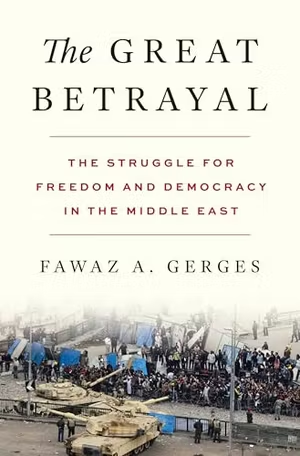
“The Great Betrayal: The Struggle for Freedom and Democracy in the Middle East is by Fawaz Gerges, a professor at LSE, and represents more than a decade of work “trying to answer a recurring question posed by my students: Why has the Middle East reached this seeming low point after a century of state- and nation-building?” The book covers the region from the end of the Ottoman Empire to the Arab Spring and highlights the interaction of foreign intervention and domestic authoritarianism as the root cause of the problems.”
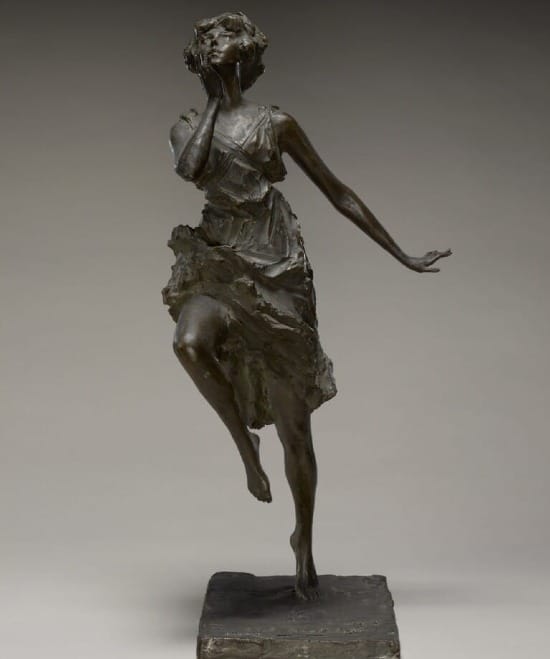
Wonderfully vivid sculpture in bronze. The sitter was Russian dancer and pianist Countess Thamara Swirskaya. Troubetzkoy, born in Italy with an American mother and a Russian prince for his father, was internationally renowned: he also created the St Petersburg Equestrian Statue of Tsar Alexander III, and the monument to General Harrison Grey Otis in MacArthur Park, Los Angeles.
These statements pertain to one major geographical landmark: the first letters of the missing words spell out its name. Can you piece together the name and fill in the blanks?
(i) It begins in the ______ (ii) The largest city alongside it is ______ (iii) It ends where it meets the ______ (iv) It is spanned by ______ bridges (v) Its name is popularly attributed to the female resistance encountered by the expedition of Francisco de ______ (vi) It crosses ______ countries
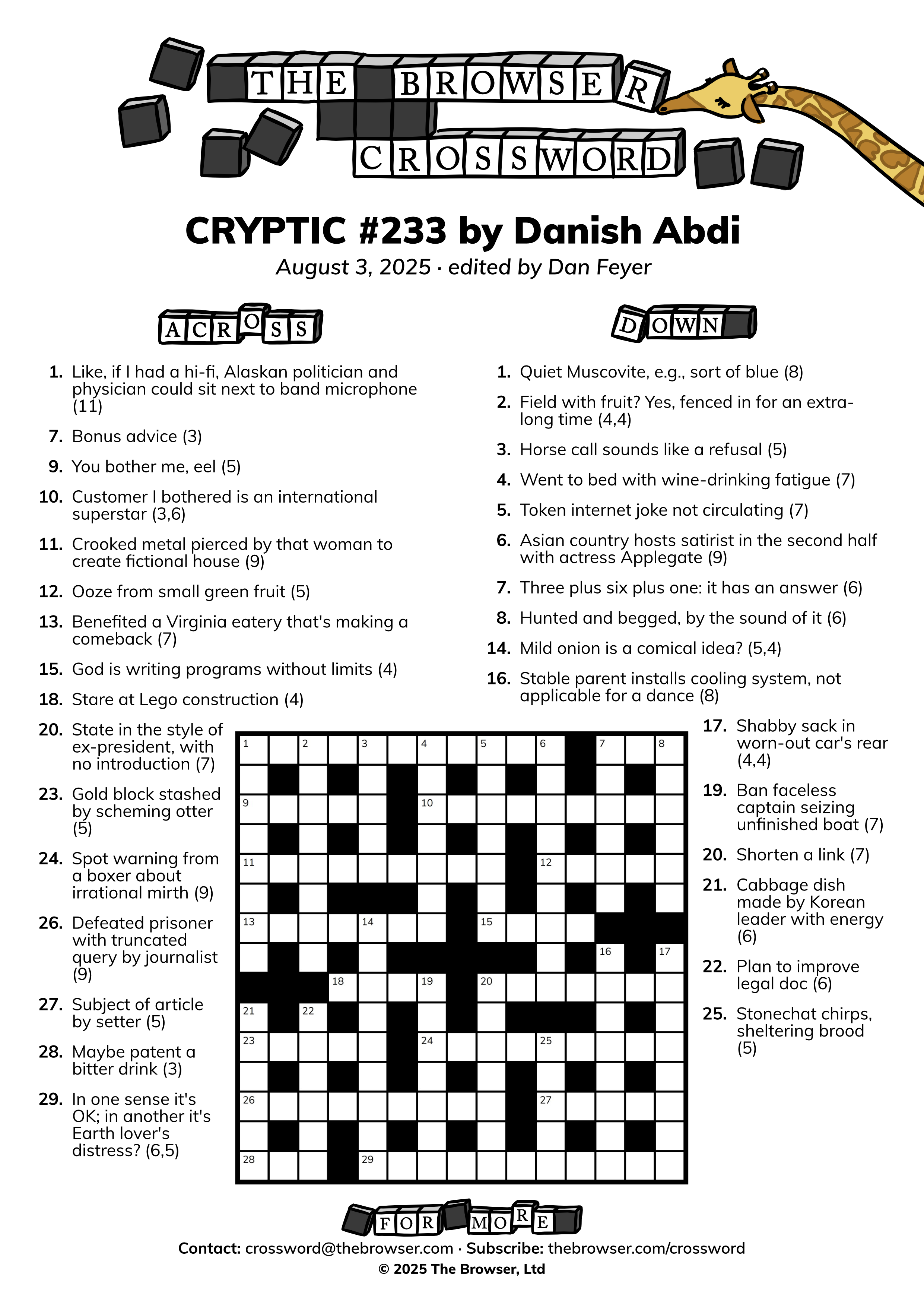
Another debut cryptic this week! Setter Danish Abdi is a freelance game designer and musician in Bangalore, India, filling up what's left of his time with poetry, triathlons, open water swimming, rock climbing, and calisthenics –Dan Feyer
Quiz Answers
The landmark is the River Amazon
(i) It begins in the ANDES (ii) The largest city alongside it is MANAUS (iii) It ends where it meets the ATLANTIC (iv) It is spanned by ZERO bridges (v) Its name is popularly attributed to the female resistance encountered by the expedition of Francisco de ORELLANA* (vi) It crosses NINE countries
*This idea has been present since 1609 but is by no means firmly established. An alternative theory comes from the native term 'amassona', or 'boat destroyer'. An interesting etymological detour.
Shortcode Glossary: U = Ungated, free. M = Metered paywall. B = Metered paywall can be bypassed using private/incognito browsing. Full details of our shortcodes here.
This post is only for paying subscribers of The Browser, but please do forward it to any friends who deserve a treat today, especially if you think they might be interested in becoming Browser subscribers in the future.
Caroline Crampton, Editor-In-Chief; Robert Cottrell, Founding Editor; Jodi Ettenberg, Editor-At-Large; Dan Feyer, Crossword Editor; Uri Bram, CEO & Publisher; Sylvia Bishop, Assistant Publisher; Al Breach, Founding Director
Elsewhere on The Browser, and of possible interest to Browser subscribers: Letters To The Editor, where you will find constructive comment from fellow-subscribers; The Reader, our commonplace book of clippings and quotations; Notes, our occasional blog. You can always Give The Browser, surely the finest possible gift for discerning friends and family.
Erik Hoel | Intrinsic Perspective | 31st July 2025
Children can start learning to read at an early age, between two and four. There is plenty of historical evidence from the 18C that this was common, since specific reading primers were published for this age group. Yet it is increasingly the norm in the US that reading isn't taught until kids are seven or eight, because of 60-year-old "neuromyths" about what early reading does to the brain (3,500 words)
Before they founded Studio Ghibli in the 1980s, the animator-director partnership of Hayao Miyazaki and Isao Takahata were working continual overtime making films and TV series as employees of other companies. Hits included Heidi, Girl of the Alps and Anne of Green Gables, both from the mid-1970s. This retrospective is illustrated with plenty of wonderful sketches and frame outlines (2,900 words)
Want more? The full Browser recommends five outstanding articles, a video and a podcast daily, for less than $1 a week.