Free • 1 min read

Prison Money Diaries

Beth Schwarzapfel | Marshall Project | 4th August 2022

American prisoners explain what they earn and spend behind bars. It varies a lot from prison to prison, but the average hourly wage for prison work is just 52 cents. Or you can find ways to "live off the land", which is to say, live by your wits: "We’re not supposed to be gambling, or bartering canteen items. But as long as nobody is getting stabbed over unpaid debts, they’ll turn a blind eye" (5,090 words)


Explicit Content

Suzannah Lipscomb | History Today | 4th August 2022

A guide to cursing in Shakespearean England. Words relating to what we might now call bodily functions were scarcely considered rude at all. Words relating to sex were considered naughty rather than obscene. Anything invoking God counted as stronger stuff. The worst insults were those against character and reputation. Shouting "knave", "thief", "harlot" or "cuckold" was asking for a fight (760 words)


Never name another "knave"!
Wise advice on Tudor vice.
If embarrassment you'd save,
Let us advise you more than twice.
Every day, get our five fave
Good writings, in your inbox. Nice.
Free • 1 min read

On Water Matters

Grant Wyeth | The Interpreter | 1st August 2022

The best way to get to know a place is "to travel through it by the most inconvenient means". Around the Baltic Sea, that means taking a ferry instead of a flight. This ship has bars, slot machines, "a piano man is belting out soft pop classics" and a terrible magician. Safe passage has only been possible since the end of the Cold War; Russia's invasion of Ukraine now makes it uncertain (915 words)


What If Letterforms Had More Serifs?

Angela Riechers | Eye On Design | 3rd August 2022

Discussion of a new font that blends letterform and decoration. The designer started from the premise that "there are not enough serifs in our typefaces", a question that the writer observes is like asking "why can’t people have an extra set of arms at waist level?". Serifs exist to guide the eye from letter to letter, but here they adorn all vertices, giving the impression of rapid motion (1,086 words)


Why can't people have an extra set of arms at waist level, though?
Honestly, we don't have an answer. But we do have lots of other fascinating facts for you to make up for it. Join us for five outstanding articles daily, plus a video and a podcast.
Free • 1 min read

Unleash The Mississippi

Boyce Upholt | Hakai | 12th July 2022

The Mississippi — a massive river that drains "32 US states and two Canadian provinces, from Alberta to New York to New Mexico" — has for centuries been restricted to suit commercial interests. Now, its ecologically vital delta is facing unprecedented land loss and the proposed solution is artificially to free the stream's course, which could have its own negative consequences (5,628 words)


Our Technology Sickness

Micah Goodman | Sources | 30th May 2022

Thoughts on technology addiction from a scholar of Judaism. "Our lives are being transformed by three grand bargains. The intellectual bargain: we have more knowledge but less capacity to concentrate and focus. The social bargain: we are much more available but much less attentive. And most importantly, the emotional bargain: we are much more connected, but much less empathetic" (4,218 words)


You're only getting two of our article recommendations each day. We'd love to send you five article recommendations, a podcast and a video tonight:
Free • 1 min read

Rev Richard Coles And Richard Dawkins

Sam Wollaston | Guardian | 31st July 2022

Discussion between two people destined to disagree: Dawkins, atheist scientist, and Coles, Church of England vicar. They cover the gospels, HIV, music, Darwin, and much more. What emerges is a conflict between feelings and facts, but there is still the possibility of accord. As Dawkins says: "You’re the kind of vicar who is much harder to argue with because that’s a reasonable point" (1,254 words)


Dialling The Moon

Peter Hitchens | The Lamp | 14th July 2022

Memoir of a life spent worrying about the telephone. Saddest of all is this anecdote, about helping a stranger check if his handset is functioning. "I was not sure afterwards whether this increased or lessened his misery, but the encounter made me think less of myself and has done ever since. Had I condemned others in my life to wait by telephones that did not ring?" (1,693 words)


If you don't like the telephone
But do not like to be alone
A remedy that never fails,
Of course, is electronic mails.
But what if those who correspond
With you, are - frankly - though we're fond
Of them, of course - quite boring? Friend!
Your days of snoring we shall end
By sending you five bits of writing
Scintillating and exciting
Plus one vid and one podcast!
Sign up swiftly! Sign up fast!
Free • 1 min read

Playing Carnegie Hall

Jay Nordlinger | New Criterion Dispatch | 28th July 2022

Ask any musician: The acoustics in Carnegie Hall in New York are superb, whether the auditorium is sold out or empty. "The hall is reverb-y, but not soupy. It is clear and crisp, but not dry". Which raises some practical questions. Are the acoustics in Carnegie Hall so good by accident or by design? In either case, why do other designers of other concert halls not simply copy this examplar? (800 words)


More Life

Hannah Black | Jewish Currents | 1st July 2022

Thought-provoking discussion of Couples Therapy, Showtime's reality-television series which follows the work of New York psychoanalyst Orna Guralnik. "Orna, like a priestly intermediary between action and interiority, offers the promise of absolution. When her patients arrive at their innermost parts, it seems as though she’s been waiting there for them all along, like a chthonic god" (3,300 words)


Playing life is tricky, sometimes. Score an easy win: sign up to The Browser and get a daily dose of outstanding reading - over a year you'll net 1400 great articles, 300 videos and 260 podcasts. Nice.
Free • 1 min read

On Sundays, Browser readers receive a special edition with puzzles, poems, books, charts, music and more - plus selections from our decade-plus archive of the finest writing on the internet. Here's a taste of this week's edition.

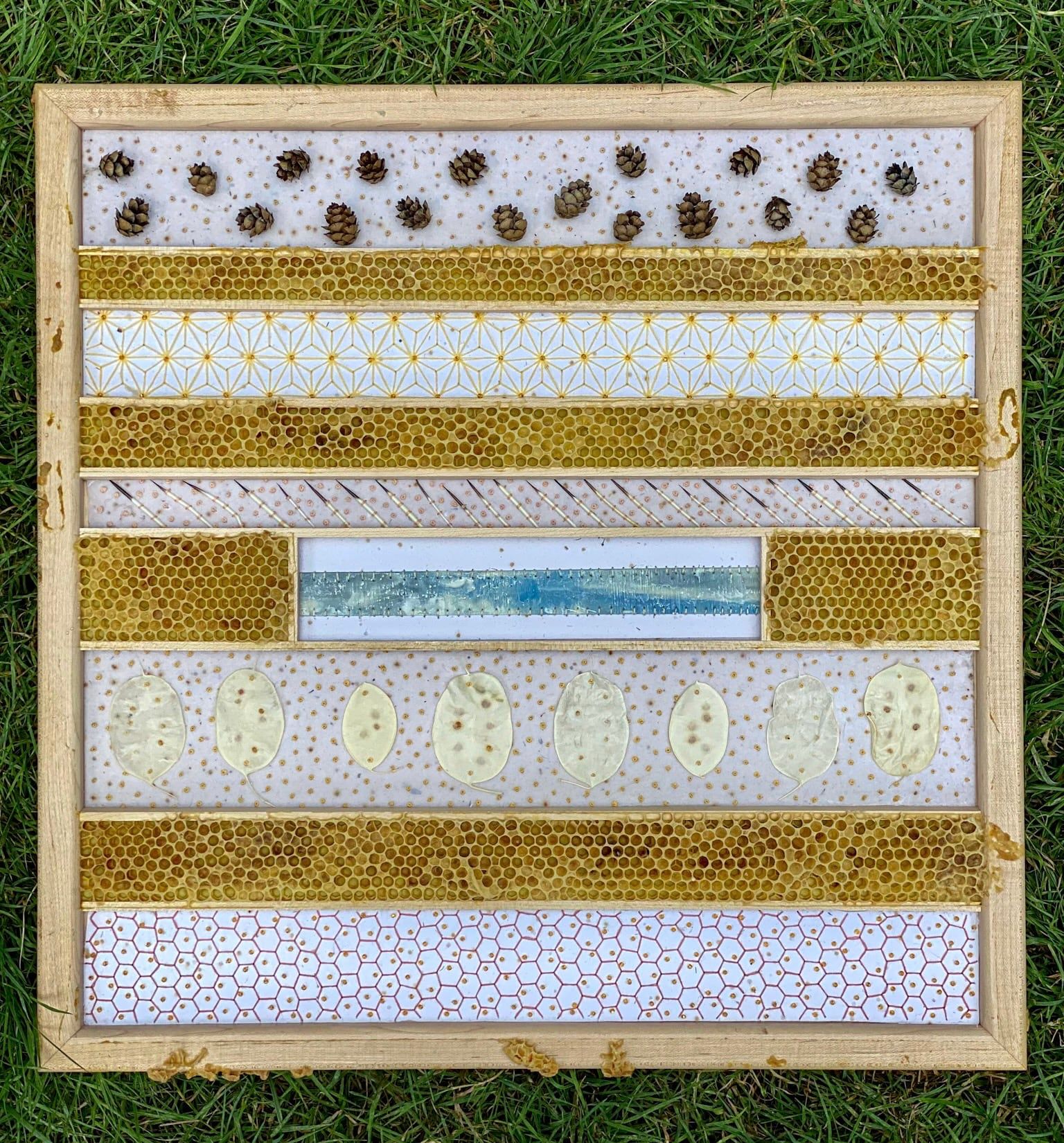
Image Of The Week

Honeybee Collaboration

“Honeybee Collaboration, Lunaria Leaves,” beeswax, Hemlock cones, porcupine quills, Lunaria leaves, photography, oil stick, embroidery floss and glass beads on seeded paper with honeycomb, in custom maple frame, 17.5 x 17.5 inches

Seasons and the natural rhythms of honeybees determine much of Ava Roth’s practice, which hinges on collaborating with the bees. The Ontario-based artist stitches elaborate embroideries with beads and intricate thread-based motifs that, once her contribution is complete, she turns over to her insect counterparts, who embed her work in golden, hexagonal honeycomb — Colossal


Poem Of The Week

Dream In Which My Body Is A Snow Storm
A.D. Lauren-Abunassar | Poetry Foundation  2020

and doesn’t make anyone cold. If I fell I would fall
in state-shaped flakes. One for every place my body
lingered. One for every little bit of light I stole
and kept. No cars startless. No tangled up roadways. Neck
becoming mountain of drift; foot becoming fierce kicking
eddies. Heat would not melt me. Hands would not help
me undo. Blanketing softly. Whimsy not pretend.
Dream in which my body is a snowstorm and the storm says
a purpose in falling.

continue reading at Poetry Foundation


The Browser Sunday edition is a smorgasbord of delights. If you enjoyed this taster, subscribe for puzzles, crosswords, art, charts, articles and more each Sunday - plus five articles daily, in your inbox:

Free • 1 min read

Why So Many Bikes End Up Underwater

Jody Rosen | Guardian | 28th July 2022

Some bicycles end up in canals by accident. Cyclists get lost at night, or in fog, and steer off towpaths. Drunk cyclists fall from bridges. Throwing a bicycle into a canal is "a specialised sport, which offers its own peculiar satisfactions". But one way or another, especially in Paris and Amsterdam, where canals have to be periodically dredged for drowned bikes, a whole lot of bikes end up in canals (3,800 words)


The Dystopia Of San Paulo

Nicola Abé | Der Spiegel  25th July 2022

Portrait of São Paulo in Brazil, home to 22 million people, the largest metropolis in the southern hemisphere, the wealthiest city in South America, and one of the most unequal cities in the world. The rich travel by private helicopter while the city council puts boulders under bridges to displace rough sleepers. "Society here has failed miserably in making a dignified life possible for everyone" (4,400 words)


Don't let the bicycle of your day and up in the canal of banality.
Steer it somewhere more interesting, with five outstanding articles, a video and a podcast, every day. 
Free • 1 min read

Is Everything Getting Old?

Byrne Hobart | The Diff | 25th July 2022

The US Senate is the oldest ever; the speaker of the House is 82; the President is a 77-year-old who beat out a 74-year-old. And it isn't only politics that seems age-blocked. In the 14 years between 2005 and 2019 the average age of a Fortune 500 CEO rose by 14 years; similar story in scientific research. Are older people staying fitter and smarter for longer — or just getting better at hanging on? (1,800 words)


James Lovelock at 100

Gaia Vince | New Scientist | 24th July 2019

Obituaries abound today for Lovelock, who has died at 103, but this interview with New Scientist (and how Lovelock must have smiled at his interviewer's name) captures much of Lovelock's delightful character in his own words. His opening remark, while serving iced coffee: "A chunk of ice cools the coffee 80 times more effectively than the equivalent volume of water at 0 degrees" (1,900 words)


A chunk of Browser cools the brain 80 times more effectively than the equivalent volume of un-curated reading.
Probably. Doubt our science? Do your own experiment... and get five outstanding articles, a video and a podcast, every day.
Free • 1 min read

Roxanne Khamsi | Nature | 22nd June 2022

Notes towards a scientific explanation of why smells can trigger distant memories and the emotions associated with them. It may go back to the womb. One theory holds that the chemical signatures of the amniotic fluid surrounding an unborn baby may be echoed in the mother's body-scent — which is why the newborn baby will instinctively favour its mother's smell over any other smell (2,600 words)


Forer Statements

Scott Alexander | Astral Codex Ten | 26th July 2022

Explaining the Forer Effect, a technique used by astrologers, psychics and interrogators to win a person's trust by making assertions about the person's character which appear to be deeply insightful but which could, in fact, apply to almost anyone. For example: "You have a great need for other people to like and admire you"; "Security is one of your major goals in life" (1,400 words)


Some guesses:

Security is one of your major goals in life. (True of almost anyone.)

Delighted curiosity is one of your major goals in life. (True of almost any Browser reader.)

Have we won your trust yet? Then join us: five outstanding articles, a video and a podcast daily - for the delightfully curious.
Free • 1 min read

Hispaniola's Great Divergence

Craig Palsson | Fitzwilliam | 24th July 2022

Why is Haiti the poorest country in the Western hemisphere? Comparison with Haiti's neighbour, the Dominican Republic, suggests that the causes go back to the closing of the Haitian economy to foreigners after independence in 1804, and soil exhaustion on small family farms created by land redistribution. These encouraged political instability, which deterred tourism and investment (3,020 words)


The Giraffe, A Supposedly Composite Creature

Victor Mair | Language Log | 24th July 2022

The English word "giraffe" comes from the Arabic zarāfah, meaning "fast walker", which derives in turn from the ancient Persian zurnāpā, a portmanteau of "flute" and "leg". Until the late 16th century the giraffe was known in England as the "camelopard", echoing its ancient Greek name, kamēlopárdalis, and the middle-Persian equivalent, šotorgâvpalang, or “camel-ox-leopard” (2,066 words)


Browser Bites explores a new idea each day, in under a minute. Join Uri Bram, Sebastian Park (@SebPark), and guests as they blitz through an idea in less time than it takes to brush your teeth.
Browser Bites
Browser Bites explores a new idea each day, in under a minute. Join Uri Bram (Publisher of The Browser), Sebastian Park (@SebPark), and guests as they blitz through an idea in less time than it takes to brush your teeth.

We might be biased, but we think the greatest giraffe of all is The Browser's own Cecily Giraffe. Not content with browsing leaves, she digests writing from all over the web to bring you the five best articles, a video and a podcast, every day. Not bad for a camel-ox-leopard.

Join 150,000+ curious readers who grow with us every day

No spam. No nonsense. Unsubscribe anytime.

Great! Check your inbox and click the link to confirm your subscription
Please enter a valid email address!
You've successfully subscribed to The Browser
Welcome back! You've successfully signed in
Could not sign in! Login link expired. Click here to retry
Cookies must be enabled in your browser to sign in
search