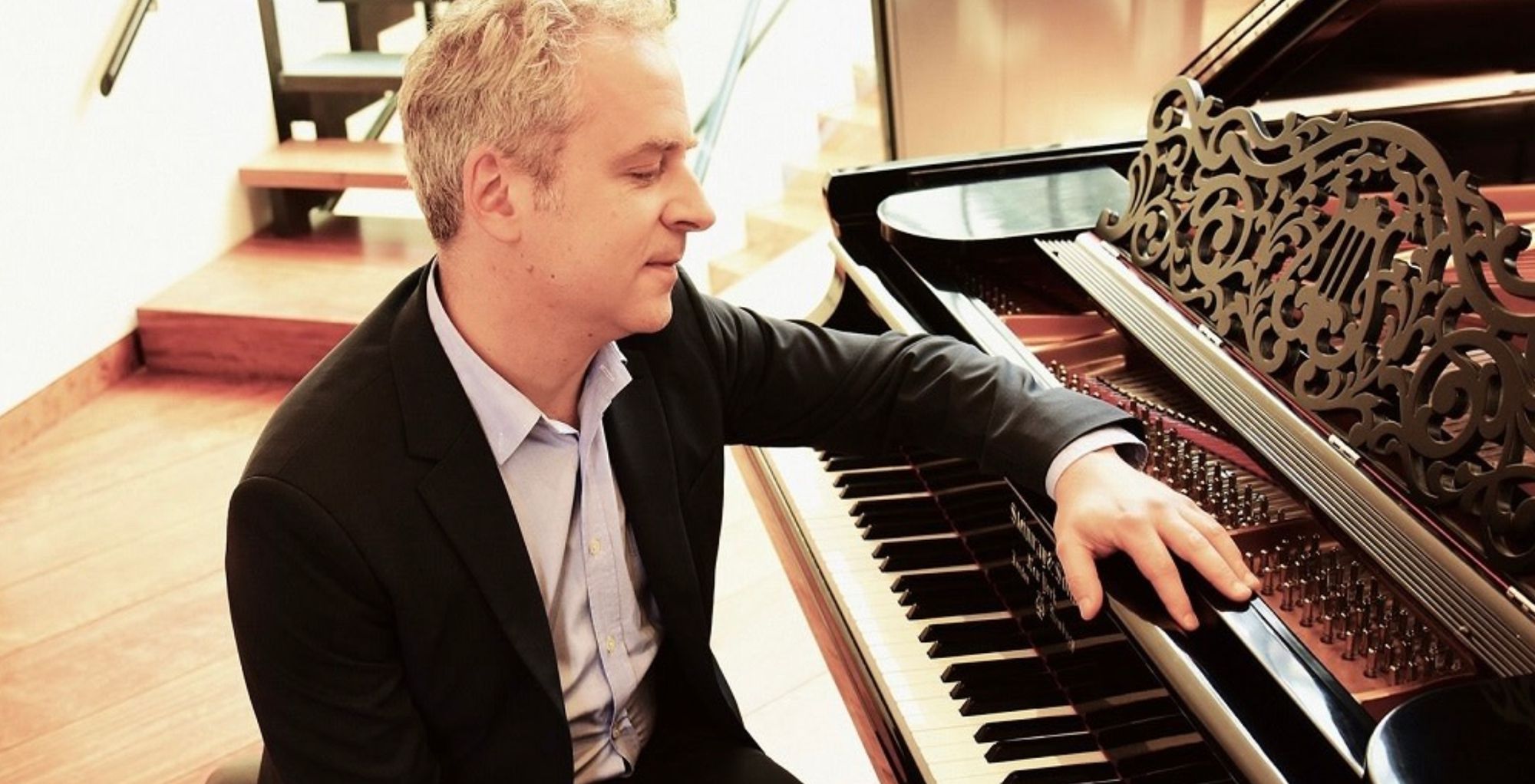
I have been making a start on Every Good Boy Does Fine, a memoir by the pianist Jeremy Denk, encouraged by my colleague Caroline Crampton's review in The Guardian. I find myself thrilled by the pages given over to discussions of music, if a touch less thrilled by those given over to events in Denk's fairly conventional American childhood. Above all, I am impressed that a leading concert pianist could write a generally excellent book. How many novelists have ever excelled in any field beyond the written word?
There seems to be something about pianists which makes them good writers. When I try to think of musicians whose writing I admire I think first of Alfred Brendel, whose essays and lectures have been collected as Music, Sense And Nonsense; the late Charles Rosen, author of Piano Notes: The Hidden World Of The Pianist (and, like Brendel, a regular contributor to the New York Review Of Books under Robert Silvers's editorship); Susan Tomes, author of The Piano: A History In 100 Pieces; Stephen Hough, author of Rough Ideas; and, of course, Andras Schiff, whose conversations, memories and writings are collected in that most beautiful and melancholy of memoirs, Music Comes Out Of Silence.
It cannot be mere manual dexterity, the easy transition from one keyboard to another, that makes pianists such good writers (oddly enough, pianists do not score particularly well on clinical dexterity tests). Perhaps it has something to do with the declarative nature of the piano. A piano dominates a room or a stage whether it is being played or not. When it does speak, it commands attention. It will not go quietly into any backpack. I wonder if the piano, like the writing of books, exerts a natural attraction on those who feel they have something to say.
It may also be that my sample is not representative and that there are equally excellent books by oboeists, timpanists and double-bass players (among percussionists, Evelyn Glennie is a captivating speaker). And I am certainly open to the argument that composers as a class may be at least as gifted as pianists when they turn their hands to writing. I think here of Ned Rorem, John Cage and Nico Muhly in recent years. Since Mozart's Letters I doubt there has been a composer worth listening to who has not also produced something worth reading.
Among working musicians, and composers in particular, I wish Nico Muhly would write more. I enjoy his candour and energy. I still treasure his advice from 2015 about learning to appreciate a piece of contemporary music when hearing it for the first time:
Some music starts with a tiny germ and then it’s rub, rub, rub, rub, rub into a larger structure. I feel like Thomas Adès’ music is like that. Each piece has a kind of central nugget of information with this molecular tension that almost starts to spiral out of control. There’s other music like John Luther Adams where it’s an atmosphere and the drama of it is, you get the sense that if you weren’t there it would still happen. It’s like some gigantic natural thing that’s just hanging out like a big mountain.
Isn't there something marvellous in those few lines? They suggest at least a glimpse of how music may inhabit the mind of a composer. In How I Write Music, an essay for the London Review Of Books published in 2019, Muhly goes deeper into his technique:
I see each commission as a challenge: write a piece of music which lasts between fifteen and twenty minutes, for an orchestra comprising the following 65 instruments, and we’d like it by this date. These are known restrictions, the sort of predetermined constraints architects and painters work with too: you know the site on which the building will be built, or the size of the wall on which the canvas will be hung. The primary task, I feel, is to create a piece of art that is better than the same amount of silence; I would prefer to sit silently thinking for ten minutes than to listen to certain pieces of music, and therefore feel that it is my duty as a composer to occupy the time of the listener and the musicians with something challenging, engaging and emotionally alluring. I don’t want to play them a movie with a clear exposition, obvious climax and poignant conclusion, nor do I want to drop them blind into a bat cave of aggressively perplexing musical jabs. I try to create an environment that suggests motion but that doesn’t insist on certain things being felt at certain times.
As in any walk of life — politics, banking, journalism, what have you — there are things that only insiders know for sure. When Nico Muhly writes about composing music, he can do so with a practitioner's authority. The assurance radiates from the page. By contrast, novelists who elect to write about musicians can only guess at their subjects' inner lives.
There are novels about composers which range from the good to the great — think of Dr Faustus by Thomas Mann, The Noise Of Time by Julian Barnes, Amsterdam by Ian McEwan. But none of these writers — not even Mann, despite all the work that he put into the musicology of his novel, tutored by Theodor Adorno — gives a persuasive picture of where the art lies in musical composition, a sense of where music comes from, how it feels in the mind, why it takes the form that it does. If Barnes had decided to write a Noise Of Time with Anna Akhmatova as its central character in place of Dmitri Shostakovich, I dare say the substance of the story could have been much the same.
Early in his writing life Aldous Huxley was music critic for the Westminster Gazette. He later became a close friend to Stravinsky, and maintained a lifelong passion for music which often crossed over into his novels. But he never doubted the gulf between the mind of a writer and the mind of a composer:
"I am as utterly in the dark about the workings of a mind like Beethoven’s as a dog is in the dark about the workings of my mind. No mental experience of my own avails me to form the slightest idea of what it must be like to have a mind that cogitates in terms of such things as the opening. of the C-sharp minor quartet and the slow movement of the Ninth Symphony.
This circumspection helped to make Huxley's columns for the Gazette in the 1920s some of the most engaging music criticism ever written. Huxley would go to a concert and write about his impressions of the performance just as any member of the audience might have done. He rarely had anything analytical to say about the music being performed, merely noting whether or not it was well suited to the performer, on the grounds that a particular interest in the music would be much better satisfied by attentive listening to a gramophone record: "The best [the critic] can do is to indicate in the most general terms the nature of the musical beauty-truth under consideration and refer curious truth-seekers to the original."
Huxley has a worthy successor in our own time whose writing gives me cause for delight almost every week: I have in mind Jay Nordlinger, at the New Criterion, who spends his evenings at Carnegie Hall and the Lincoln Center and whose reports are as rich in description as they are sparing in analysis. I love Nordlinger's writing for its informality and good humour, its learning so lightly worn. Here is Nordlinger describing a new concerto by Philip Glass performed by the New York Philharmonic in 2017:
If this concerto were written by someone other than Glass, I would call it “Glassian,” and I suppose one can call it that still. It is instantly recognizable, having the Glassian sheen, and the Glassian vibe. It is gay, jazzy, bony, and repetitive. There is downward chromaticism in Glass’s piece. The music is pleasant — and after about five minutes, you think, or I thought, “Will this be it? How long will it go on?” Eventually, the music quiets — it is no longer peppy. It is slow and watery. There is a raindrop effect. Then the music gets peppy again, with that Glassian cross between menacing and daring. In due course, some jungle timpani come along. Then there is something like a barcarolle, rocking, sighing — until the music starts to wail. I did not dislike this piece. I think I would have liked less of it.
If we want to move up one level of abstraction, from the criticism of performance to the criticism of music itself, then the most indispensable and unavoidable of living critics is, as everyone knows, Alex Ross, at the New Yorker and on his blog. Ross is intelligent, adventurous, dedicated and massively knowledgeable, but I have to confess that he rarely delights me in the way that Nordlinger does. He approaches music, I would say, less as an art-form and more as a field of human activity. He is an historian of musical ideas. His subject-matter is what musicians are doing, not what goes on in their minds when they are doing it.
Ross aside, I cannot think of a consistently recommendable music critic in mainstream media, at least since Anthony Tommasini's retirement as chief critic of the New York Times. But no matter, music is rich in specialist publications. For news about music and musicians, I go first to Slipped Disc, the busy, chatty site run since 2007 by Norman Lebrecht. For short reviews of newly released classical recordings, I find Gramophone consistent and reliable.
For occasional long features about the composing and performing of music I look hopefully from time to time at the Berlin-based Van Magazine (the "Van" comes from Beethoven); at Music & Literature, though the balance here tends to be much more towards literature; at BBC Music Magazine; and at Ted Gioia's Honest Broker.
From these last four sources, here are some representative articles, each with merit:
From Van, an interview with Alex Ross about Wagner, and a critique of Wagner's Bayreuth opera house by Volker Hagedorn.
From Music & Literature, an interview with the pianist Stephen Hough
From BBC Music Magazine, an investigation into the importance of eye-contact among orchestral musicians and with conductors
From Honest Broker, whose centre of gravity favours jazz and the American Songbook, a profile of Toots Thielemans.
Philosophers also tend to write well about classical music. One might attribute the coincidence to a philosophical taste for abstraction, save that I do not detect any similar pattern of musicality among mathematicians, whose discipline is at least as abstract; besides which, philosophers show a pronounced weakness for music in that most physical of forms, opera.
Isaiah Berlin was a director of the Royal Opera House, and wrote notable essays on Khovanshchina and on Verdi. Bernard Williams's anthology of essays, On Opera, was published posthumously in 2006. The introduction to On Opera was written by the Cambridge philosopher Michael Tanner, who is even now the opera critic of The Spectator. Roger Scruton was so taken by opera that he wrote one himself, Violet, in addition to publishing and lecturing extensively on music in general and on Wagner in particular. Brian Magee was another Wagnerian; as is Philip Kitcher, and as, indeed, is Michael Tanner. Wagner has been the philosophers' composer par excellence ever since Nietzsche pronounced himself first a devotee, and then a fierce detractor, of his German contemporary.
Perhaps the taste for opera among philosophers is better understood as a reaction against the abstractions in which philosophy must otherwise deal. As Williams's essays demonstrate well, opera can raise all sorts of questions about life and art while still providing a spectacle to be enjoyed. In opera the "meaning" of the the music is communicated by means of the libretto and the singers — quite unlike the "meaning" of a symphony or a string quartet, of which we can say only that such music works upon us in some mysterious way, largely bypassing our logical and literal modes of thought.
Huxley was fascinated by this peculiar property of instrumental music to transcend conscious thought. One happy consequence, as he saw it, was that people “of limited ability" could enjoy great music, whereas only people of "outstanding intellectual power and exceptional insight" could respond fully to other forms of great art. A less happy consequence foreseen by Huxley was that tunes could stick in one's mind for years on end, and any words attached to such tunes likewise, giving music great propaganda potential: “The words will tend automatically to repeat themselves every time the melody is heard or spontaneously remembered".
This last point of Huxley's seems to me to be a powerful argument for avoiding bad music and taking care only ever to listen to wonderful music — music that you would be willing to have haunt you for decades to come. As a gesture in that direction let me leave you with Regula Muhlemann and Patricia Nolz singing the Flower Duet from Lakme, by Léo Delibes.
— Robert Cottrell